Tortoises have a reputation for being slow, quiet pets that don’t need much entertainment. Give them food, water, warmth, and somewhere to sleep, and they’re good to go—right?
Not quite.
Tortoises may move at their own pace, but they’re active animals that naturally spend time walking, exploring, digging, grazing, investigating objects, and searching for food. A bare enclosure gives them very few opportunities to perform those behaviors.
That’s where enrichment comes in.
Good tortoise enrichment isn’t about buying colorful toys or trying to entertain your tortoise like a dog. It’s about creating a varied environment that encourages natural behaviors while allowing the animal to make choices.
The best enrichment can be surprisingly simple. A pile of leaves, a new hiding place, scattered food, uneven terrain, or a safe patch of soil to dig in may provide more meaningful stimulation than an expensive pet-store toy.
Here are some of the best enrichment ideas for keeping a tortoise active and engaged.
What Is Tortoise Enrichment?
Enrichment means providing opportunities for an animal to interact with its environment and perform natural behaviors.
For tortoises, those behaviors can include:
- Walking
- Exploring
- Foraging
- Grazing
- Digging
- Burrowing
- Climbing over low obstacles
- Investigating unfamiliar objects
- Choosing between different hiding areas
- Moving between warmer and cooler locations
Enrichment should be voluntary.
Your tortoise should be able to investigate something new or completely ignore it.
The goal isn’t to keep the animal busy every second of the day. It’s to provide an environment where there’s actually something to do when the tortoise chooses to be active.
Start With the Tortoise’s Enclosure
Before adding special activities, look at the enclosure itself.
A thoughtfully designed habitat provides enrichment every day without requiring you to constantly introduce new toys.
The enclosure should provide opportunities for the tortoise to:
- Walk
- Hide
- Dig
- Explore
- Thermoregulate
- Find food
- Investigate different surfaces
This requires usable space.
A small enclosure may technically fit the animal, but it can severely limit opportunities for natural movement and environmental complexity.
1. Create Different Types of Terrain
A completely flat enclosure isn’t particularly interesting.
Tortoises naturally encounter uneven surfaces, vegetation, soil, rocks, and other environmental features.
You can recreate some of that complexity by adding safe variations in terrain.
Depending on the species and enclosure, this might include:
- Soil
- Flat stones
- Grass
- Leaf litter
- Gentle slopes
- Mounds of substrate
- Pieces of cork
- Different safe ground textures
Transitions between surfaces give your tortoise more to investigate as it moves through the habitat.
Avoid slippery flooring and anything with sharp edges.
2. Give Your Tortoise Room to Walk
Walking is one of the simplest forms of tortoise enrichment.
These animals may be slow, but many species naturally travel considerable distances while searching for food, shelter, and suitable temperatures.
An appropriately sized enclosure gives your tortoise opportunities to move throughout the day.
Rather than placing everything next to each other, spread resources around when practical.
For example, food, water, hides, and basking areas can occupy different parts of the habitat.
The tortoise then has a reason to move between locations.
3. Scatter Food Around the Enclosure
Putting every meal into the same bowl is convenient.
Occasionally making your tortoise search for food can be much more interesting.
Instead of placing all suitable foods in one location, scatter small portions around safe areas of the enclosure.
Your tortoise can walk around and find them.
This encourages:
- Movement
- Exploration
- Foraging
- Use of different enclosure areas
Make sure you can remove uneaten fresh food before it spoils.
If your tortoise has health problems, difficulty moving, or special nutritional needs, easy access to food should take priority over enrichment.
4. Hide Food in Safe Places
You can make foraging slightly more challenging by placing food behind or around enclosure features.
For example, tuck suitable greens:
- Beside a hide
- Near a plant
- Behind a piece of cork
- Around a rock
- In several different feeding areas
Don’t make the food genuinely difficult to reach.
You’re encouraging the tortoise to investigate, not creating a puzzle it can’t solve.
Start simple and watch how the animal responds.
5. Grow Edible Plants
Live edible plants can provide both environmental enrichment and foraging opportunities.
Depending on the tortoise species and your climate, you may be able to grow appropriate grasses, weeds, flowers, or other safe plants.
Your tortoise can then graze naturally.
This can create a much more interesting feeding experience than receiving every meal on a plate.
However, plant identification matters.
Never assume a plant is safe because it grows naturally in your yard.
Only provide plants you’ve positively identified as safe for your particular tortoise species, and avoid anything treated with:
- Pesticides
- Herbicides
- Fertilizers
- Other potentially harmful chemicals
6. Provide Digging Opportunities
Many tortoises dig.
Depending on the species, digging may be associated with shelter, thermoregulation, nesting, or simply normal exploratory behavior.
A suitable substrate allows your tortoise to interact with its environment rather than constantly walking across a hard surface.
Provide enough depth for species-appropriate digging when possible.
The exact substrate and depth will depend on the type of tortoise you’re keeping.
7. Add a Digging Area
If the entire enclosure can’t support deep substrate, consider creating a designated digging area.
A section filled with suitable substrate can allow the tortoise to push, scrape, and dig.
You can make the area more interesting by adding:
- Leaf litter
- Safe soil
- Cork
- Small amounts of appropriate vegetation
Avoid substrate containing fertilizers, pesticides, sharp debris, or other contaminants.
Remember that different tortoise species come from very different habitats.
A substrate suitable for one species isn’t automatically appropriate for another.
8. Provide Multiple Hiding Places
A hide isn’t only a sleeping area.
Having several shelters gives a tortoise choices about where it wants to rest.
Try providing hiding areas in different environmental zones.
For example:
- A warmer hide
- A cooler hide
- A shaded retreat
- A more humid microenvironment when appropriate
Naturalistic shelters can include stable structures made from cork, wood, rocks, or appropriately designed reptile hides.
Make sure heavy objects can’t collapse onto a digging tortoise.
9. Use Visual Barriers
If a tortoise can see from one end of the enclosure to the other without anything breaking up the space, the habitat can feel very open.
Visual barriers make the environment more complex.
You can use:
- Plants
- Cork bark
- Logs
- Rocks
- Low walls
- Safe decorative structures
The tortoise then needs to walk around objects to see what’s on the other side.
This can encourage exploration without requiring complicated equipment.
10. Create Safe Low-Level Obstacles
Tortoises aren’t famous climbers, but many are surprisingly determined to climb over things.
Low, stable obstacles can provide physical enrichment.
You might create:
- Gentle slopes
- Small substrate mounds
- Wide rocks
- Low logs
- Gradual ramps
Keep everything low enough that a fall isn’t dangerous.
Avoid steep structures that could cause the tortoise to flip onto its back.
Any obstacle should be wide, stable, and easy to navigate.
11. Make Gentle Hills
A small change in elevation can turn a flat enclosure into a more interesting landscape.
Substrate can be shaped into gentle hills and depressions.
Your tortoise gets additional exercise walking up and down while exploring.
Make slopes gradual.
The goal isn’t to create a mountain-climbing challenge.
Also monitor the landscape over time. Tortoises are strong animals and may flatten your carefully designed terrain surprisingly quickly.
That’s fine.
Moving the substrate is enrichment too.
12. Add Tunnels
Large, appropriately sized tunnels can give a tortoise another structure to explore.
A tunnel should be:
- Wide enough for the animal
- Stable
- Well ventilated
- Easy to enter and exit
- Free of sharp edges
Avoid narrow tubes where the tortoise could become stuck.
Half logs, cork structures, and purpose-built reptile tunnels may work depending on the size and species.
13. Introduce New Objects Occasionally
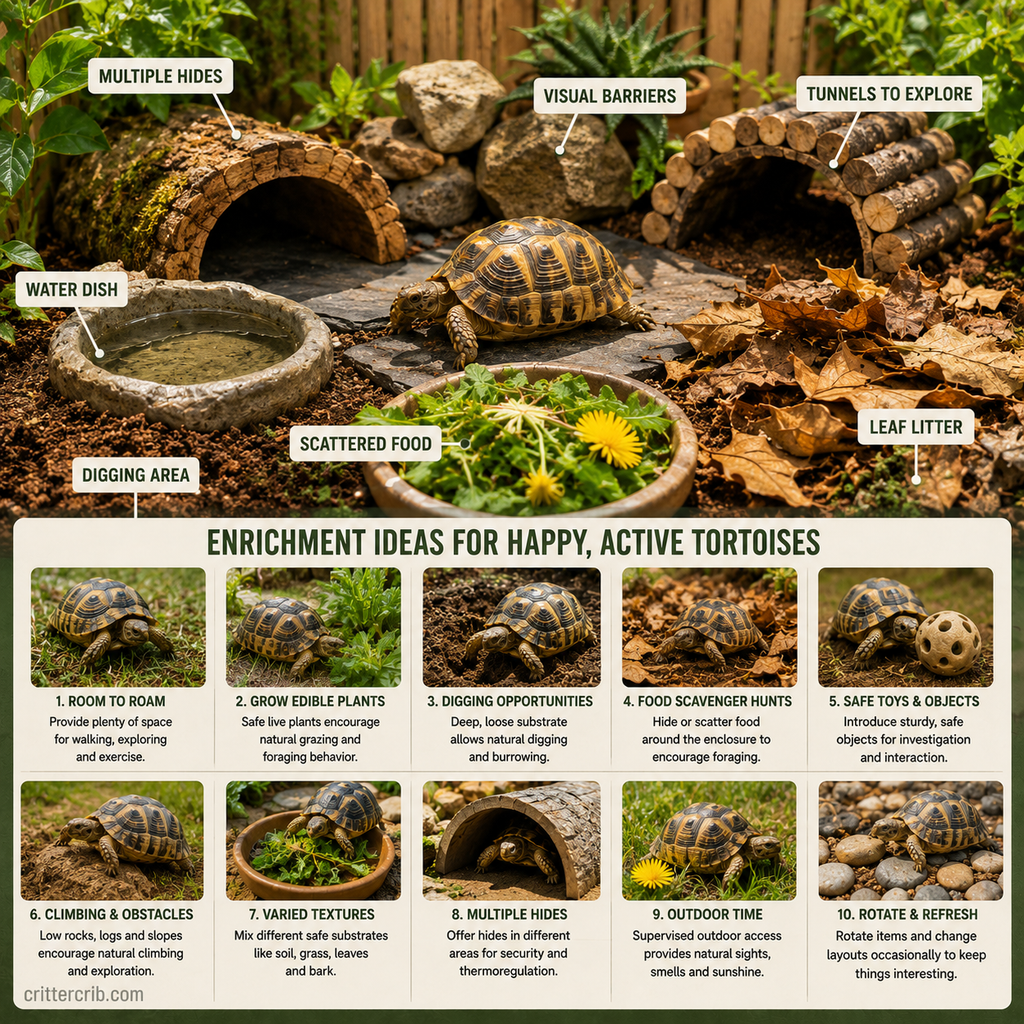
Tortoises can investigate unfamiliar objects placed in their environment.
You don’t need to completely rearrange the enclosure.
Instead, occasionally introduce one safe item.
For example:
- A new piece of cork
- A different rock
- A small pile of leaves
- A new hide
- A safe plant
- A low obstacle
Watch what happens.
Your tortoise might approach immediately, spend considerable time investigating, or completely ignore it.
All are acceptable responses.
14. Rotate Enrichment Items
You don’t need dozens of objects in the enclosure at once.
Keep a few safe items and rotate them occasionally.
Something that has been absent for several weeks may become interesting again when it returns.
This also prevents the habitat from becoming overcrowded.
Keep important resources consistent even when rotating enrichment.
The tortoise should always have reliable access to essential shelter, appropriate temperatures, water, and other husbandry necessities.
15. Try a Tortoise-Safe Foraging Ball
Some tortoises will interact with a large, sturdy object that releases food as it moves.
If you use a foraging device, make sure it can’t be:
- Swallowed
- Broken into small pieces
- Trapped around the tortoise
- Easily overturned onto the animal
Food openings should be large enough that the tortoise can access the food without getting its head or limbs stuck.
Simple is usually better.
You can often create equally effective enrichment by scattering food around the enclosure.
16. Use a Large Ball for Investigation
Some tortoises will push or investigate a lightweight ball.
This doesn’t mean every tortoise wants to play soccer.
The object simply provides something unfamiliar to inspect or move.
Choose a ball that’s much too large to swallow and doesn’t have holes where the tortoise’s head, legs, or claws could become trapped.
Supervise initial interactions.
Remove the object if your tortoise becomes stressed or repeatedly attempts to bite pieces from it.
17. Provide Leaf Piles
A pile of safe, clean leaves can provide surprisingly good enrichment.
Your tortoise may:
- Walk through it
- Push it around
- Hide beneath it
- Investigate scents
- Dig into it
Use leaves from plants known to be safe and from areas free of pesticides or other chemical treatments.
Avoid moldy or decomposing material.
Leaf litter can also contribute to a more naturalistic environment for appropriate species.
18. Rearrange Small Parts of the Habitat
A tortoise may quickly notice when something familiar has moved.
Occasionally repositioning a nonessential object can encourage exploration.
You might:
- Move a rock
- Change the position of cork
- Relocate a tunnel
- Add a small mound
- Move a visual barrier
Don’t completely redesign the enclosure every few days.
Constant disruption may create stress rather than useful enrichment.
Small, occasional changes are enough.
19. Offer Different Safe Food Textures
Feeding enrichment can also involve texture.
Depending on the species and appropriate diet, tortoises may encounter foods with different textures, shapes, and levels of toughness.
Instead of chopping everything into tiny identical pieces, some appropriate foods can be presented in ways that encourage natural biting and tearing.
Dietary variety should still be based on nutritional needs.
Enrichment isn’t an excuse to feed unhealthy treats.
20. Hang Appropriate Greens
For some tortoises, securing suitable greens slightly above normal ground level can create a different feeding challenge.
Keep them easily reachable.
The tortoise shouldn’t need to stand dangerously upright or strain to access food.
The idea is simply to encourage a little extra movement and interaction during feeding.
Make sure whatever holds the food is safe and can’t be swallowed.
21. Create a Grazing Area
For species that naturally consume grasses and other vegetation, a safe grazing area can provide excellent enrichment.
Rather than simply being handed food, the tortoise can walk, choose plants, and graze.
A grazing area can be particularly effective in a secure outdoor habitat.
Every plant needs to be safe for consumption.
Avoid lawns or gardens treated with chemicals.
22. Provide Safe Outdoor Time
When climate, weather, and species requirements allow, secure outdoor time can provide tremendous environmental variety.
Natural sunlight, soil, vegetation, smells, and changing surroundings create stimulation that’s difficult to fully reproduce indoors.
Outdoor access must be carefully controlled.
A safe outdoor tortoise area should protect against:
- Escape
- Predators
- Toxic plants
- Pesticides
- Excessive heat
- Cold temperatures
- Deep water
- Falling objects
- Theft or accidental disturbance
Never leave a tortoise loose in an unsecured yard simply because it moves slowly.
They can disappear much faster than people expect.
23. Let Your Tortoise Explore a Secure Area
Supervised exploration can provide additional exercise and environmental stimulation.
This should happen in a controlled, tortoise-proof area.
Remove hazards such as:
- Electrical cords
- Stairs
- Small objects
- Toxic plants
- Other pets
- Chemicals
- Gaps behind furniture
Indoor floors can also be colder than the tortoise’s normal environment, so temperature should be considered.
In many cases, a large, well-designed enclosure is safer and more useful than unrestricted roaming around a house.
24. Encourage Natural Behaviors Instead of Tricks
Tortoises can learn routines and may associate people or locations with food.
But enrichment doesn’t need to involve teaching elaborate tricks.
Focus on behaviors tortoises naturally perform:
- Walking
- Grazing
- Digging
- Exploring
- Foraging
- Hiding
- Navigating obstacles
These activities are more relevant to the animal than trying to make it behave like a dog or cat.
25. Give Your Tortoise Choices
One of the simplest forms of enrichment is choice.
Instead of providing only one acceptable location for every activity, create alternatives.
Your tortoise might choose between:
- Sun and shade
- Warm and cool areas
- Several hides
- Open and covered spaces
- Different substrates
- Different foraging locations
- Flat and uneven terrain
Giving an animal control over where it spends its time makes the enclosure more functional.
How Often Should You Provide Tortoise Enrichment?
You don’t need to create a brand-new activity every day.
Ideally, much of the enrichment comes from the permanent habitat.
A well-designed enclosure already provides:
- Space to walk
- Digging opportunities
- Multiple shelters
- Different temperatures
- Varied terrain
- Visual barriers
- Places to explore
Additional enrichment can be introduced periodically.
Food-based activities might occur several times per week as part of normal feeding, while enclosure objects might only be rotated occasionally.
Watch your tortoise rather than following a rigid enrichment calendar.
How Can You Tell if a Tortoise Is Interested?
Tortoises don’t express excitement in the same ways mammals do.
You may notice interest through behaviors such as:
- Approaching a new object
- Smelling it
- Looking closely at it
- Walking around it
- Pushing it
- Climbing over it
- Digging nearby
- Searching for scattered food
- Returning to investigate later
Some tortoises are naturally more exploratory than others.
Don’t assume an activity failed simply because your tortoise didn’t immediately react.
Signs Enrichment May Be Causing Stress
Enrichment should improve the environment, not make it chaotic.
Watch for persistent behaviors such as:
- Frantic pacing
- Repeated escape attempts
- Constant hiding
- Refusing food
- Avoiding a large section of the enclosure
- Repeatedly flipping over
- Defensive behavior
A new object may cause temporary caution.
Persistent distress is different.
Remove or modify the enrichment if it appears to be creating a problem.
Tortoise Enrichment Ideas to Avoid
Not every creative idea is a good one.
Safety should always come first.
Mirrors
Mirrors aren’t necessary enrichment.
A tortoise may interpret its reflection as another animal, potentially creating stress or repeated territorial behavior.
Interaction With Other Pets
Don’t use dogs, cats, or other household pets as entertainment for your tortoise.
Even friendly pets can injure a reptile accidentally.
Direct interactions aren’t worth the risk.
Tall Climbing Structures
Some tortoises will attempt to climb almost anything.
That doesn’t mean they should.
Avoid steep or tall structures where the animal could fall or flip onto its back.
Small Objects
Avoid anything small enough to swallow.
Tortoises may investigate unfamiliar objects with their mouths.
Objects With Holes
Be careful with toys, balls, and other objects containing openings.
A tortoise could potentially trap its head or limbs.
Unidentified Plants
Never add a plant simply because it looks natural.
Confirm that it is safe for the particular tortoise species and hasn’t been treated with harmful chemicals.
Can Tortoises Get Bored?
It’s difficult to measure boredom in a tortoise in exactly the same way we might recognize it in a person, dog, or other social mammal.
It’s better to avoid assuming a reptile experiences emotions exactly as humans do.
What we do know is that tortoises naturally interact with complex environments.
They move, search for food, investigate objects, dig, hide, and respond to changing environmental conditions.
A habitat that allows those behaviors is likely to provide a better quality of life than a bare enclosure with nothing to explore.
Do Tortoises Need Toys?
Tortoises don’t need traditional toys in the way many dogs or parrots do.
They benefit more from functional environmental enrichment.
Instead of asking, “What toy should I buy my tortoise?” think about providing:
- Something to explore
- Somewhere to dig
- Food to find
- Safe terrain to navigate
- Several places to hide
- Different environmental zones
- Objects to investigate
A pile of safe leaves may provide more useful enrichment than a brightly colored plastic toy.
Does Enrichment Replace a Proper Enclosure?
No.
Enrichment should never be used to compensate for inadequate husbandry.
A tortoise still needs species-appropriate:
- Enclosure space
- Temperatures
- Basking conditions
- UVB lighting
- Humidity
- Substrate
- Diet
- Hydration
- Shelter
- Veterinary care
Adding a ball to an enclosure doesn’t fix incorrect temperatures.
A foraging activity doesn’t compensate for a poor diet.
Get the fundamentals right first.
Then build enrichment on top of them.
Remember That Tortoise Species Have Different Needs
“Tortoise” covers many species from dramatically different environments.
A Russian tortoise, sulcata, Hermann’s tortoise, red-footed tortoise, and leopard tortoise don’t have identical husbandry requirements.
Enrichment should reflect the animal’s:
- Species
- Adult size
- Natural habitat
- Diet
- Humidity requirements
- Temperature requirements
- Digging behavior
- Activity level
A deep digging area that works beautifully for one species may not be appropriate in exactly the same form for another.
Always start with species-specific husbandry.
Frequently Asked Questions About Tortoise Enrichment
What Is the Best Enrichment for a Tortoise?
Some of the best enrichment comes from a spacious, varied habitat that encourages walking, digging, exploring, grazing, and foraging.
Food scattering, safe plants, multiple hides, uneven terrain, and occasional new objects can provide additional stimulation.
Do Tortoises Like to Explore?
Many tortoises actively investigate their environment.
Individual personalities vary, but providing enough space and environmental complexity gives them the opportunity to explore when they choose.
Do Tortoises Like Balls?
Some tortoises may investigate or push large, lightweight balls.
Others may completely ignore them.
If you provide one, make sure it’s too large to swallow and doesn’t have holes or pieces that could trap or injure the tortoise.
Can Tortoises Play With Toys?
Tortoises may interact with objects, but traditional “play” isn’t necessarily the best way to think about reptile enrichment.
Focus on activities that encourage natural behaviors such as foraging, walking, digging, and exploring.
Can I Rearrange My Tortoise’s Enclosure?
Occasional small changes can encourage exploration.
Avoid constantly rearranging the entire habitat or moving essential resources unnecessarily.
Can I Hide Food for My Tortoise?
Yes.
Placing appropriate foods in several easy-to-find locations can encourage natural foraging and movement.
Don’t make food difficult to access for young, elderly, sick, or mobility-impaired tortoises.
Is Outdoor Time Good Enrichment?
Secure outdoor access can provide excellent enrichment when temperatures, weather, and species requirements are appropriate.
The area must be escape-proof and protected from predators, toxic plants, chemicals, and other hazards.
Final Thoughts
The best tortoise enrichment ideas aren’t necessarily complicated.
Start by looking at the habitat from the tortoise’s perspective.
Is there somewhere to walk? Somewhere to dig? Several places to hide? Different surfaces to cross? Food to search for? Safe obstacles to navigate? A choice between different environmental conditions?
If the answer is yes, you’re already providing meaningful enrichment.
From there, simple activities such as scattering food, growing safe edible plants, creating leaf piles, introducing new objects, rotating enclosure furniture, and providing secure outdoor exploration can add variety.
Don’t feel obligated to keep your tortoise constantly entertained.
Enrichment isn’t about filling every minute with activity. It’s about giving the animal opportunities to behave like a tortoise.
Sometimes it will investigate the new object you carefully selected.
Sometimes it will climb over it.
Sometimes it will bulldoze it into the corner five minutes after you put it down.
And sometimes it will completely ignore your brilliant enrichment idea and go eat a leaf.
That’s fine.
Give your tortoise safe choices, enough space, a varied environment, and opportunities to explore at its own pace. That’s what meaningful enrichment is really about.