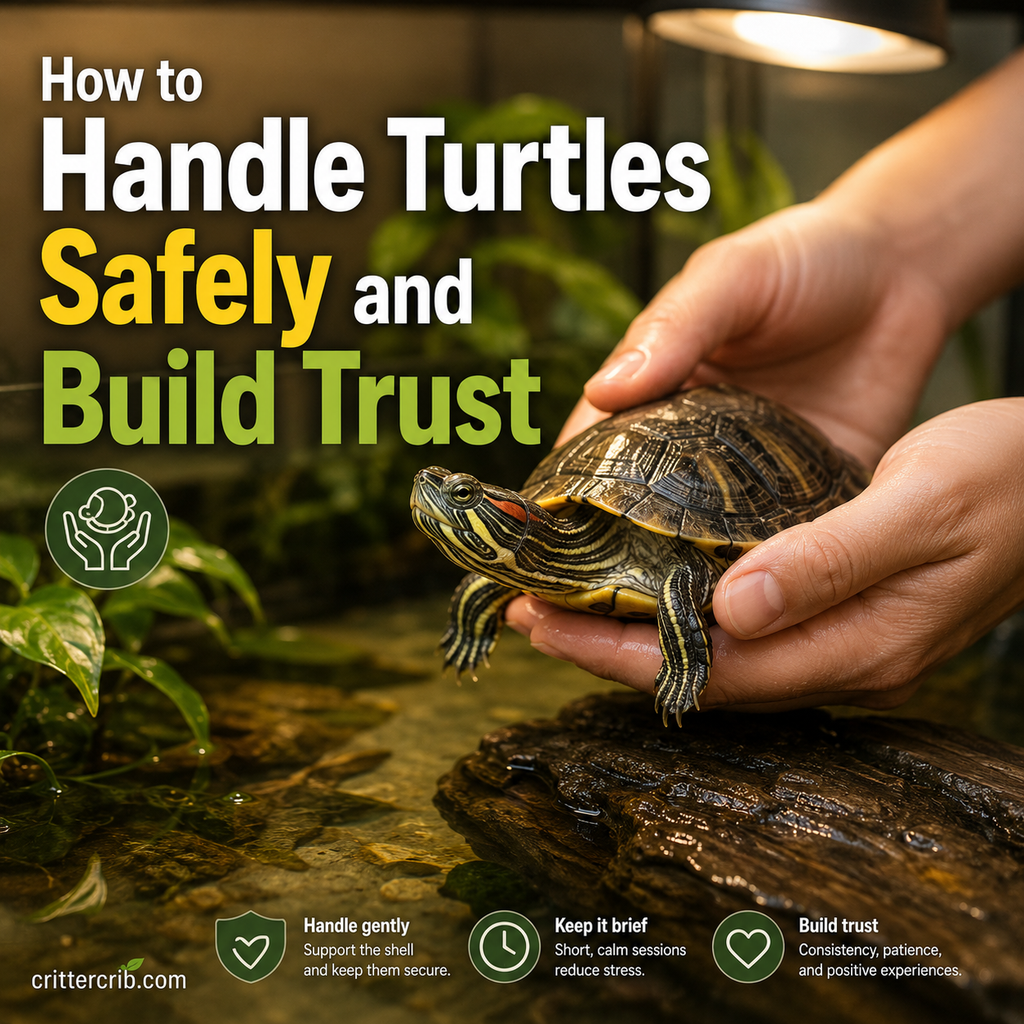
Turtles aren’t typically pets that want to be picked up and cuddled. Even a turtle that’s completely comfortable around its owner may prefer keeping all four feet on a solid surface.
That doesn’t mean you can’t build trust with one.
Over time, many pet turtles learn that their keeper isn’t a threat. They may approach when you enter the room, remain relaxed during routine care, take food comfortably in your presence, and tolerate necessary handling without immediately retreating into their shell.
The key is understanding handling from the turtle’s perspective. Rather than trying to make your turtle enjoy being held, focus on making interactions predictable, gentle, and as stress-free as possible.
Here’s how to do it safely.
Do Turtles Like Being Handled?
Most turtles don’t need physical affection from people.
Handling is generally something they tolerate rather than seek out. Some individuals become very accustomed to their owners, while others remain cautious throughout their lives.
Personality also matters.
One turtle might confidently approach the front of its enclosure whenever you appear. Another may immediately retreat into the water or pull into its shell.
Neither behavior necessarily means you’re doing something wrong.
A better goal than trying to make your turtle “like” handling is helping it become comfortable with your presence.
A turtle that trusts its environment and routine may:
- Remain visible when you approach
- Eat normally while you’re nearby
- Approach you at feeding time
- Explore while you’re present
- Show less defensive behavior during necessary handling
- Return to normal activity relatively quickly afterward
Those are more useful signs of trust than whether the turtle enjoys being picked up.
When Should You Handle a Turtle?
Handling should generally have a purpose.
There are several perfectly good reasons to pick up a turtle, including:
- Moving it while cleaning the enclosure
- Performing a basic health check
- Weighing it
- Transporting it
- Moving it to a safe temporary container
- Veterinary care
- Inspecting the shell, skin, eyes, or limbs
Occasional gentle interaction may also help a turtle become accustomed to necessary handling.
What you want to avoid is repeatedly picking it up simply because you want to hold it.
For many turtles, less handling is better.
Give a New Turtle Time to Settle In
Bringing a turtle home is a major environmental change.
Everything is unfamiliar: the enclosure, lighting, smells, water conditions, sounds, people, and feeding routine.
Immediately beginning frequent handling can add another source of stress.
Give a new turtle time to become familiar with its habitat.
During the initial adjustment period, focus on:
- Proper temperature
- Appropriate UVB lighting
- Clean water
- Suitable basking conditions
- Correct humidity for terrestrial species
- Secure hiding places
- Appropriate food
- A predictable day-night cycle
Wait until the turtle is eating and behaving more normally before introducing unnecessary handling.
There’s no exact number of days that works for every turtle. Watch the animal rather than the calendar.
How to Build Trust With a Turtle
Trust with a turtle usually develops through routine rather than physical contact.
You don’t need to constantly touch your turtle to form a positive relationship.
Spend Time Near the Enclosure
Allow your turtle to become accustomed to seeing you.
Move normally around the enclosure without constantly reaching inside.
Over time, your presence becomes part of the turtle’s regular environment instead of something unusual.
Create a Predictable Routine
Turtles can become familiar with repeated patterns.
Try to perform routine activities such as:
- Turning lights on and off
- Feeding
- Water changes
- Spot cleaning
- General enclosure maintenance
on a reasonably consistent schedule.
You don’t need to follow the exact same minute every day. The goal is simply to make interactions relatively predictable.
Move Slowly
Sudden movements can startle turtles.
When reaching into an enclosure, move calmly and deliberately.
Avoid rapidly reaching toward the turtle’s head or grabbing it without warning.
Let the Turtle Approach You
Some turtles become surprisingly interested in their keepers.
An aquatic turtle may swim toward you when you approach the tank. A terrestrial turtle may walk toward the front of its habitat.
Let these interactions happen naturally.
You don’t need to turn every approach into a handling session.
Sometimes simply allowing the turtle to investigate you without being picked up can help build confidence.
Can You Use Food to Build Trust With a Turtle?
Food can create positive associations, but use it carefully.
Many turtles quickly learn to associate people with feeding. That’s why a turtle that normally ignores you may suddenly become very interested when you walk toward the enclosure.
You can use normal feeding routines to help your turtle become comfortable with your presence.
However, avoid overfeeding simply to encourage interaction.
You also don’t need to hand-feed your turtle.
Hand-feeding can teach some turtles to associate fingers with food, which isn’t particularly helpful if you want to avoid accidental bites.
Using feeding tongs when appropriate or placing food into the enclosure is usually safer.
How to Pick Up a Turtle Safely
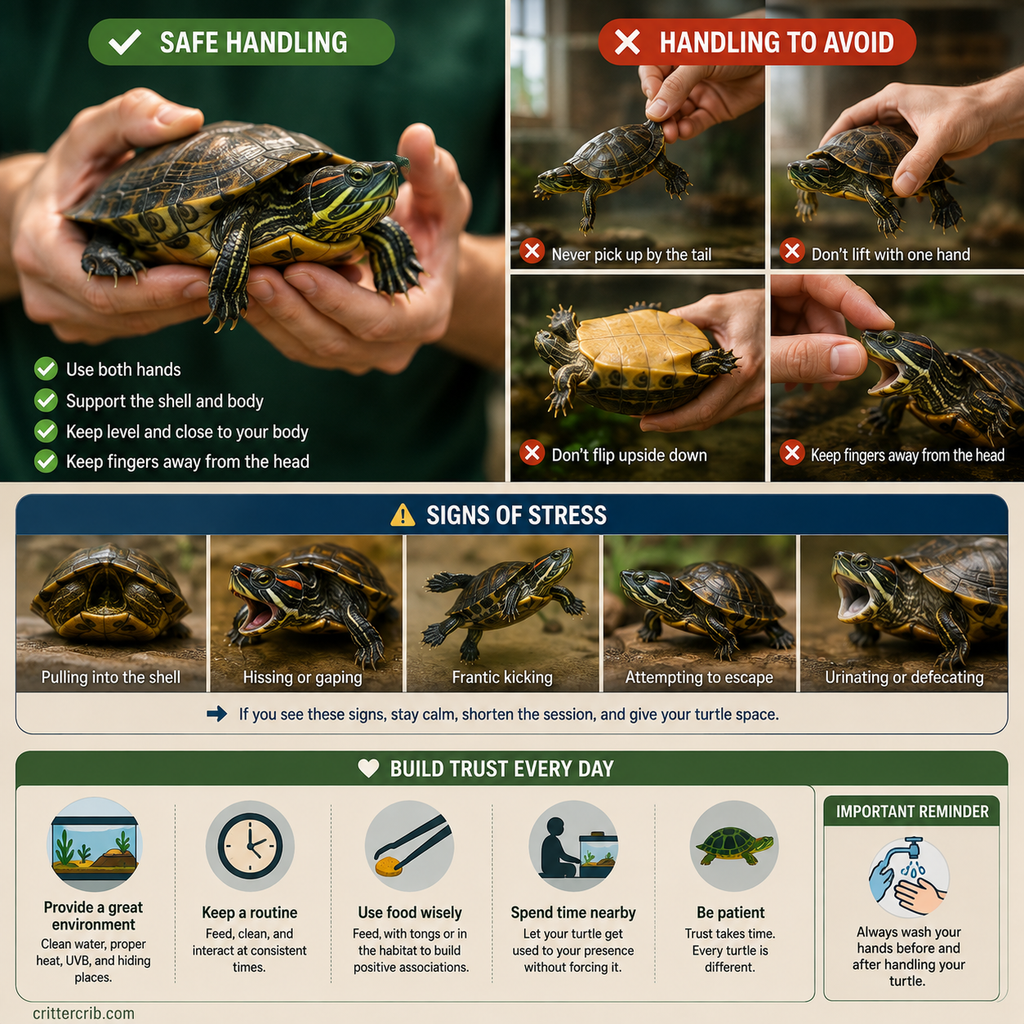
When handling is necessary, technique matters.
The goal is to support the turtle securely without squeezing it or restricting its breathing.
Step 1: Prepare Before Picking Up the Turtle
Know where you’re moving the turtle before you pick it up.
If you’re cleaning the enclosure, prepare the temporary container first.
If you’re weighing it, have the scale ready.
This keeps the handling session short.
Step 2: Approach Calmly
Move your hands slowly toward the turtle.
Whenever possible, avoid suddenly grabbing it from directly above.
Step 3: Use Both Hands
For most medium-sized turtles, use two hands.
Hold the shell securely along the sides, around the middle or rear portion of the shell where appropriate.
Keep your fingers away from the turtle’s mouth.
Step 4: Support the Turtle
Don’t let the turtle dangle unnecessarily.
Keep it relatively level and support its body securely.
A turtle may kick, scratch, or suddenly push against your hands when frightened.
Be prepared without squeezing.
Step 5: Keep the Turtle Close to a Safe Surface
Don’t carry a turtle high above the floor.
A turtle that suddenly struggles can be surprisingly difficult to hold.
Handling close to the ground or another safe surface reduces the risk of injury if something unexpected happens.
Never Pick Up a Turtle by Its Tail
A turtle should never be lifted by its tail.
The tail is connected to delicate structures, and pulling or lifting by it can cause serious injury.
Don’t pick a turtle up by:
- Its tail
- One leg
- Its head or neck
- The edge of the shell with one hand when the animal isn’t adequately supported
Support the shell and body instead.
Don’t Flip a Turtle Upside Down Unnecessarily
Being placed on its back can be stressful for a turtle.
While brief positioning may sometimes be necessary for a health examination or veterinary care, don’t flip a turtle upside down for entertainment or casual inspection.
Return it to a normal upright position as quickly as reasonably possible.
How to Handle Aquatic Turtles
Aquatic turtles can be particularly slippery.
Species such as sliders, painted turtles, and map turtles may kick strongly when removed from the water.
Before picking one up:
- Dry your hands if necessary for a secure grip
- Have a safe destination ready
- Keep fingers away from the head
- Use both hands
- Expect sudden kicking
Don’t hold an aquatic turtle directly over its aquarium.
If it slips, it could strike rocks, decorations, the enclosure rim, or other hard objects.
Instead, move it carefully and deliberately.
Don’t Keep Aquatic Turtles Out of Water Unnecessarily
Aquatic turtles naturally spend substantial amounts of time in water.
Although healthy animals routinely leave the water to bask, that doesn’t mean they should spend extended periods being carried around the house.
Keep handling sessions brief and purposeful.
Handling Terrestrial and Semi-Terrestrial Turtles
Box turtles and other more terrestrial species can still become stressed by excessive handling, even though they don’t present the same slippery-handling challenge as aquatic turtles.
Support the shell with both hands.
Allow the turtle to remain in a natural horizontal position and keep handling relatively brief.
Never assume a terrestrial turtle is safe simply because it moves slowly.
A determined turtle can push surprisingly hard against your hands.
How Long Should You Handle a Turtle?
There’s usually no reason for a routine handling session to last very long.
For necessary handling, aim to complete the task efficiently and return the turtle to its habitat.
If you’re gradually acclimating a turtle to handling, start with very short sessions—perhaps just a few minutes.
Pay attention to the turtle’s response.
If it becomes increasingly defensive or attempts to escape continuously, end the session.
Long handling sessions don’t automatically build more trust.
In fact, they can have the opposite effect.
How Often Should You Handle Your Turtle?
There isn’t a required handling schedule.
Unlike social mammals, turtles don’t need daily physical interaction with their owners.
For many pet turtles, handling only when necessary is perfectly appropriate.
If your turtle tolerates brief handling well, occasional sessions may help keep it accustomed to being picked up for health checks or enclosure maintenance.
The turtle’s behavior should guide you.
Signs a Turtle Is Stressed During Handling
Turtles don’t always show stress in obvious ways.
Possible signs include:
- Pulling tightly into the shell
- Frantic kicking
- Repeated attempts to escape
- Hissing
- Opening the mouth defensively
- Biting or attempting to bite
- Urinating or defecating when picked up
- Remaining withdrawn after being returned to the enclosure
A turtle pulling into its shell briefly when lifted isn’t unusual.
Persistent defensive behavior, however, suggests the animal isn’t comfortable with what’s happening.
Don’t try to “push through” the stress.
Shorten the interaction and give the turtle space.
Why Do Turtles Hiss When Picked Up?
A hissing sound can surprise new turtle owners.
In many cases, the sound isn’t an aggressive vocalization.
When a turtle rapidly retracts its head and limbs into its shell, air can be forced out of the lungs, creating a hiss-like sound.
The behavior still tells you something useful: the turtle is withdrawing defensively.
Give it time to relax.
Do Pet Turtles Bite?
Yes, turtles can bite.
The likelihood and severity depend on:
- Species
- Individual temperament
- Size
- Previous handling
- Whether the turtle feels threatened
- Whether your fingers smell like food
Some species have much stronger bites than others.
Never assume a familiar turtle can’t bite.
Avoid Putting Fingers Near the Mouth
Don’t tease a turtle with your fingers or intentionally encourage it to snap.
If you’re handling a species with a long, flexible neck, learn its reach before picking it up.
Some turtles can reach considerably farther around their shell than beginners expect.
What Should You Do if a Turtle Bites?
Don’t panic and violently pull away.
Sudden movement can potentially injure both you and the turtle.
Once you’re free, wash the bite thoroughly with soap and running water.
Seek medical attention for deep, severe, contaminated, or otherwise concerning bites.
More importantly, think about why the bite happened.
Was the turtle frightened?
Did your fingers smell like food?
Were you holding it too close to the head?
Was it already displaying defensive behavior?
Identifying the cause can help prevent another bite.
Never Handle Wild Turtles Like Pets
Finding a turtle outside doesn’t mean it needs to be picked up.
Wild turtles generally should be left alone unless they’re in immediate danger or assistance is genuinely necessary.
Don’t take a healthy wild turtle home simply because you think it would make an interesting pet.
Removing turtles from the wild may also be illegal depending on the species and location.
What if a Turtle Is Crossing the Road?
If it’s safe for you to assist, move the turtle in the direction it was already traveling.
Don’t relocate it to a completely different area because you think the new location looks safer.
Turtles often have established home ranges and may attempt to return.
For large or potentially dangerous species, don’t handle the animal unless you know how to do so safely. Contact local wildlife professionals when appropriate.
Wash Your Hands After Handling a Turtle
This is an essential part of turtle ownership.
Turtles can carry Salmonella and other germs even when they look completely healthy.
Always wash your hands thoroughly with soap and water after:
- Handling your turtle
- Touching enclosure water
- Cleaning the habitat
- Handling substrate
- Touching waste
- Cleaning filters or decorations
- Handling food dishes
Don’t eat or touch your face while handling a turtle or cleaning its enclosure.
Also avoid cleaning turtle equipment in areas where food is prepared.
Turtles and Young Children
Turtles aren’t ideal hands-on pets for very young children.
In addition to the risk of accidentally dropping or squeezing the turtle, reptiles can carry germs that may cause illness in people.
If an older child handles a turtle, an adult should supervise.
Teach children to:
- Use both hands.
- Support the turtle securely.
- Keep fingers away from the mouth.
- Never squeeze the shell.
- Never grab the tail.
- Keep the turtle close to the ground.
- Wash hands thoroughly afterward.
Children shouldn’t kiss turtles or hold them near their faces.
Can Turtles Recognize Their Owners?
Turtles can learn routines and associations.
Many pet turtles clearly respond when their keeper approaches, particularly around feeding time.
They may become familiar with:
- Your presence
- Movement around the enclosure
- Feeding routines
- Environmental cues
- Repeated interactions
Whether that should be described as “recognizing their owner” in the same social sense as a dog is another question.
It’s safer to say turtles can become familiar with people and routines and learn that certain interactions aren’t threatening.
That familiarity is an important part of what owners often experience as trust.
How Long Does It Take for a Turtle to Trust You?
There’s no fixed timeline.
Some turtles become noticeably more confident within weeks. Others may take months, and naturally cautious individuals may always prefer limited interaction.
Several factors can affect the process:
- Species
- Age
- Individual temperament
- Previous experiences
- Enclosure quality
- Handling frequency
- Handling technique
- Overall health
Focus on gradual progress.
A turtle that used to immediately hide when you entered the room but now remains visible has made progress.
A turtle that once struggled frantically during a health check but now remains relatively calm has made progress too.
Trust doesn’t have to mean climbing into your hand.
Common Turtle Handling Mistakes
Most handling problems are avoidable.
Try not to:
- Handle a new turtle excessively
- Pick up the turtle every time it approaches you
- Grab suddenly from above
- Lift a turtle by its tail
- Hold it by a limb
- Carry it high above the floor
- Flip it upside down unnecessarily
- Squeeze the shell
- Put fingers near the mouth
- Keep aquatic turtles out of their habitat for long periods
- Ignore defensive behavior
- Allow unsupervised children to handle it
- Handle a turtle around dogs or cats
- Skip handwashing afterward
Safe turtle handling is mostly about restraint on the owner’s part.
Just because you can pick up your turtle doesn’t mean you always should.
Frequently Asked Questions About Handling Turtles
Can I handle my turtle every day?
You can physically handle many pet turtles regularly, but daily handling usually isn’t necessary and may cause unnecessary stress.
Observe your turtle daily, but reserve physical handling for necessary care and occasional brief interaction when the animal tolerates it well.
Do turtles like being petted?
Some turtles may tolerate gentle touching, but petting shouldn’t be assumed to provide the same enjoyment it does for many mammals.
Watch your turtle’s behavior.
If it repeatedly withdraws, moves away, or becomes defensive, stop.
Where do turtles like to be touched?
There isn’t one spot that every turtle enjoys having touched.
Some individuals tolerate gentle contact with the shell or certain areas of the body, while others prefer not to be touched at all.
Avoid touching the face, pulling on limbs, or tapping repeatedly on the shell.
Why does my turtle swim toward me?
Food is often a major reason.
Aquatic turtles can quickly learn that a person approaching the enclosure predicts feeding.
Your turtle may also simply be responding to movement or investigating what’s happening.
It’s a positive sign that the animal isn’t immediately hiding from you, but it shouldn’t automatically be interpreted as affection.
Why does my turtle hide when it sees me?
Your turtle may still view your presence as potentially threatening.
Give it time.
Avoid repeatedly reaching into the enclosure, provide plenty of secure hiding areas, and maintain a predictable routine.
Should I hand-feed my turtle to build trust?
Hand-feeding isn’t necessary.
Using feeding tongs when appropriate or placing food into the habitat allows your turtle to associate your presence with feeding without teaching it that fingers are potential food.
Can turtles feel their shells?
Yes.
A turtle’s shell is living tissue connected to its skeletal and nervous systems. It isn’t an empty piece of armor.
Don’t tap, scratch, drill, paint, or otherwise treat the shell as though the turtle can’t feel what happens to it.
Why does my turtle pee when I pick it up?
Some turtles urinate or defecate when frightened or stressed by handling.
If this repeatedly occurs when your turtle is picked up, reduce unnecessary handling and reconsider your approach.
Building Trust Means Respecting Your Turtle
Building trust with a turtle doesn’t mean turning it into a cuddly pet.
It means creating an environment where the animal feels secure and making your interactions predictable enough that your presence doesn’t constantly trigger fear.
Start with good husbandry. Give your turtle appropriate temperatures, UVB lighting, clean water or suitable humidity, secure hiding places, a proper diet, and enough space to behave naturally.
Then be patient.
Move slowly, handle only when appropriate, support the turtle properly, and pay attention when it tells you it has had enough.
Some turtles become remarkably comfortable around their keepers. Others remain more reserved.
Either is fine.
The goal isn’t to force your turtle to behave like a different kind of pet. It’s to understand the animal you have and build trust in a way that makes sense for a turtle.