
Setting up a corn snake habitat isn’t especially complicated, but getting the basics right makes a huge difference. Your snake needs more than a tank, some bedding, and a water bowl. A good enclosure should provide the right temperatures, secure hiding places, room to explore, and an environment where your corn snake can behave naturally.
Corn snakes are active, curious animals and surprisingly capable climbers. They’re also talented escape artists. A habitat that looks perfectly adequate at first glance can quickly become a problem if the lid isn’t secure, the temperature is wrong, or there aren’t enough places to hide.
Whether you’re preparing for your first corn snake or upgrading an existing enclosure, this guide walks through everything you need to create a safe and comfortable home.
What Does a Corn Snake Need in Its Habitat?
A good corn snake setup should provide several basic necessities:
- A secure, appropriately sized enclosure
- A warm and cool temperature gradient
- Properly controlled heating
- Suitable humidity
- Safe substrate
- At least two secure hides
- Fresh drinking water
- Climbing and exploration opportunities
- Appropriate lighting
- Good ventilation
- A reliable cleaning routine
You don’t need to recreate an elaborate forest ecosystem to keep a corn snake successfully.
What matters most is giving your snake choices.
It should be able to warm up, cool down, hide, drink, climb, burrow, and explore without being exposed to unsafe conditions.
Choosing the Right Corn Snake Enclosure
Your enclosure is the foundation of the entire habitat.
Glass terrariums, PVC reptile enclosures, and other purpose-built reptile habitats can all work when properly configured.
Whatever style you choose, it needs to provide adequate ventilation while maintaining the temperatures and humidity your snake requires.
Most importantly, it must be escape-proof.
Corn Snake Enclosure Size
Corn snakes need enough room to fully stretch out and explore.
Juveniles can initially live in smaller enclosures, but adults benefit from considerably more space. Rather than repeatedly purchasing slightly larger habitats as your snake grows, you may choose to start with a larger enclosure as long as it contains plenty of secure hiding places and cover.
For an average adult corn snake, an enclosure around 4 feet long by 2 feet deep by 2 feet high is a useful target.
Larger enclosures can work very well when they’re properly furnished.
The important thing is to avoid putting a small snake into a huge, completely exposed enclosure. It’s usually the lack of cover—not simply the amount of space—that makes an environment feel insecure.
Don’t Forget Vertical Space
Corn snakes are primarily terrestrial, but they’re capable climbers and often take advantage of branches, ledges, and elevated areas.
An enclosure with usable height allows you to create a more interesting environment without sacrificing floor space.
Just make sure climbing structures are stable.
A heavy branch that shifts or falls could injure your snake.
Corn Snakes Are Excellent Escape Artists
If there is one thing corn snakes are exceptionally good at besides finding food, it’s finding tiny gaps in their enclosures.
Never underestimate them.
Check:
- Screen lids
- Sliding doors
- Cable openings
- Ventilation holes
- Corners
- Door tracks
- Locks and latches
- Gaps around heating or lighting equipment
A snake can fit through openings that look surprisingly small.
Screen-top enclosures should use secure clips or locking mechanisms rather than simply relying on the weight of the lid.
Sliding or front-opening enclosures should also have appropriate locks when necessary.
Do an escape check before bringing your snake home.
Creating the Proper Temperature Gradient
Corn snakes are ectothermic, meaning they rely on their environment to regulate body temperature.
The enclosure therefore shouldn’t be one temperature from end to end.
Instead, create a warmer side and a cooler side.
A practical target is approximately:
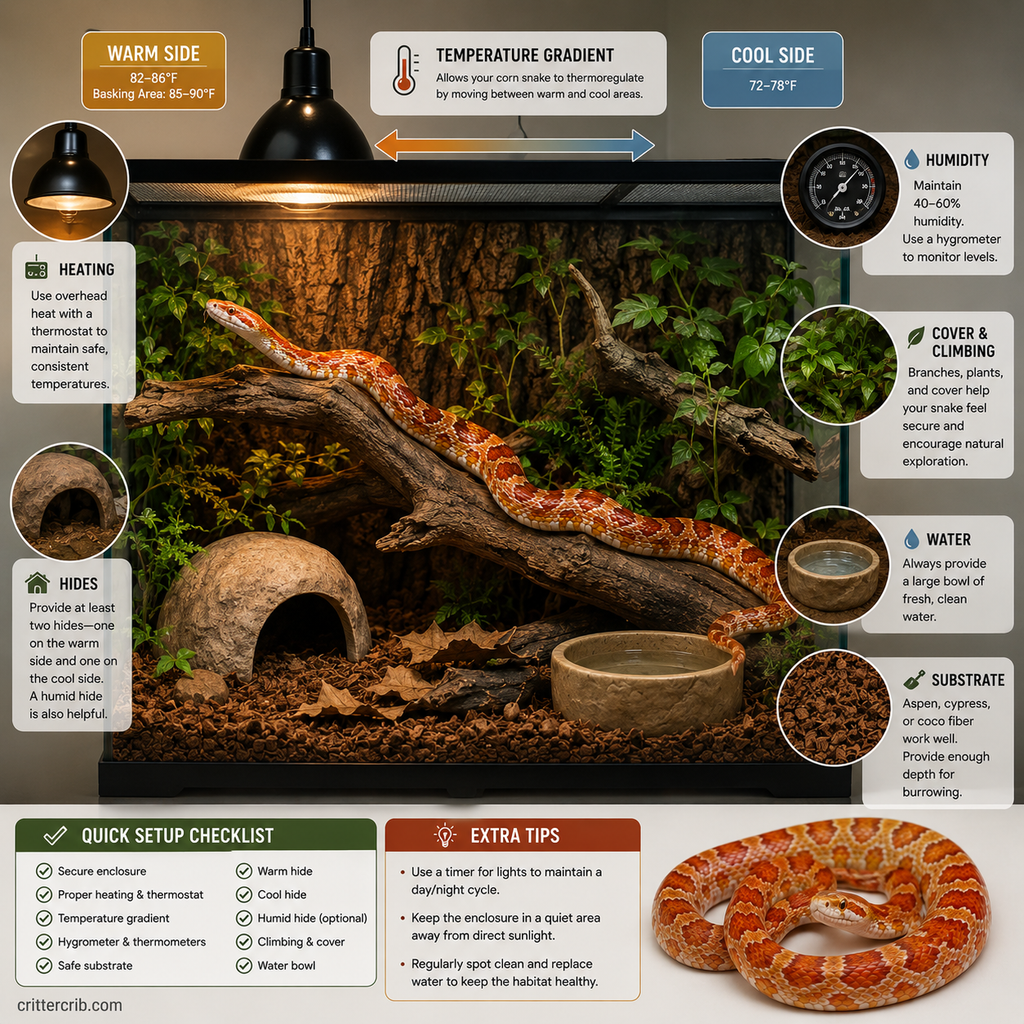
- Warm side: 82–86°F
- Cool side: 72–78°F
- Warm basking area: roughly 85–90°F
Small variations are normal, and temperatures can change somewhat throughout the day.
The important part is providing a usable gradient so the snake can move to the temperature it needs.
How to Measure Temperature
Don’t rely on how warm the enclosure feels to your hand.
Use reliable digital thermometers.
Ideally, monitor both the warm and cool portions of the habitat. An infrared temperature gun can also be useful for checking surface temperatures, although it doesn’t replace monitoring ambient conditions.
Place temperature probes where they provide meaningful readings rather than wherever they’re easiest to hide.
Choosing a Heat Source for a Corn Snake
Several heating methods can work depending on the enclosure.
Common options include:
- Halogen heat lamps
- Deep heat projectors
- Ceramic heat emitters
- Heat mats in appropriate setups
- Radiant heat panels in compatible enclosures
Overhead heating can create a natural warm area while allowing the snake to move farther from the heat source when it wants to cool down.
The best choice depends partly on your enclosure type and room conditions.
Regardless of which heat source you choose, temperature control is essential.
Always Control Heat Sources Properly
Reptile heating equipment can become dangerously hot if left uncontrolled.
Use an appropriate thermostat or other temperature-control equipment suitable for the heat source you’re operating.
Position probes correctly and verify temperatures independently with thermometers.
A thermostat shouldn’t be treated as a substitute for checking temperatures yourself.
Heating equipment should also be installed so the snake can’t come into direct contact with dangerously hot surfaces.
Do Corn Snakes Need a Heat Lamp at Night?
Corn snakes don’t need bright light throughout the night.
Maintaining a normal day-and-night cycle is important.
If nighttime temperatures in your home remain within a safe range, supplemental nighttime heat may not be necessary.
If additional heat is required, use a heating method that doesn’t produce visible light rather than red, blue, or other colored nighttime bulbs.
Your snake should experience darkness at night.
Lighting for Corn Snakes
Corn snakes benefit from a predictable light-dark cycle.
In many setups, daytime lighting can be provided by enclosure lighting or ambient room light, assuming the room has a consistent schedule.
Aim for a regular day-night rhythm rather than leaving lights on constantly.
Timers make this easy.
Do Corn Snakes Need UVB?
Corn snakes can survive without dedicated UVB lighting when their other husbandry needs are properly met, but appropriately provided low-level UVB may offer benefits and opportunities for more natural behavior.
If you choose to provide UVB, use reptile-appropriate equipment and follow the manufacturer’s recommendations for:
- Distance
- Fixture placement
- Mesh obstruction
- Replacement schedule
- Appropriate UVB strength
The snake should always have shaded areas and hides where it can move away from the light.
More UVB isn’t automatically better.
Corn Snake Humidity Requirements
Corn snakes generally do well at moderate humidity levels.
For many enclosures, roughly 40–60% relative humidity is a reasonable general range, although conditions naturally fluctuate and may need adjustment based on the snake, enclosure, and shedding.
Measure humidity with a digital hygrometer.
Don’t rely on guessing based on how dry or damp the substrate looks.
Humidity During Shedding
You may notice your corn snake becoming duller before a shed. Its eyes can also become cloudy or bluish.
Providing access to a humid hide during this period can be helpful.
A humid hide can contain slightly damp sphagnum moss or another suitable moisture-retaining material.
The goal is to create a humid microclimate—not make the entire enclosure soaking wet.
Signs Humidity May Be Too Low
Possible indications include:
- Incomplete sheds
- Retained pieces of skin
- Repeated shedding difficulties
If your snake consistently has poor sheds, review humidity, hydration, and overall husbandry.
What If Humidity Is Too High?
Persistently damp conditions can also create problems.
Constantly wet substrate combined with poor ventilation may encourage mold and bacterial growth and contribute to unhealthy enclosure conditions.
If humidity remains excessively high:
- Improve ventilation
- Check for spilled water
- Reduce unnecessary misting
- Replace waterlogged substrate
- Evaluate whether the substrate is holding too much moisture
The enclosure shouldn’t feel swampy.
Choosing the Best Substrate for Corn Snakes
Substrate covers the enclosure floor and can influence humidity, cleanliness, and your snake’s ability to burrow.
Several options can work well.
Aspen Bedding
Aspen is popular because it’s relatively inexpensive and allows corn snakes to burrow easily.
It should generally be kept dry.
If aspen becomes wet, replace the affected area because damp aspen can mold.
Cypress Mulch
Cypress mulch retains more moisture than aspen and can be useful in environments where maintaining humidity is difficult.
Check it regularly for excessive moisture or mold.
Coconut-Based Substrates
Coconut fiber and coconut husk products can also work.
They retain moisture well, so pay attention to humidity and avoid keeping them constantly saturated.
Paper-Based Substrate
Paper towels or unprinted paper can be useful for:
- Quarantine
- Temporary housing
- Monitoring waste
- Certain medical situations
They’re easy to replace but don’t offer much opportunity for natural burrowing.
Substrates to Avoid
Avoid substrates that present unnecessary risks.
These can include:
- Cedar
- Aromatic wood products
- Sharp materials
- Extremely dusty bedding
- Substrates treated with chemicals or fragrances
- Materials likely to cause injury if swallowed
When choosing bedding, consider safety before appearance.
How Deep Should Corn Snake Substrate Be?
Providing several inches of substrate allows a corn snake to dig and burrow.
Around 2–4 inches works well in many setups, although deeper substrate can provide additional opportunities for natural behavior.
You’ll sometimes discover your snake completely buried underneath it.
That’s usually nothing to worry about.
Burrowing is normal corn snake behavior.
Corn Snakes Need Secure Hides
Hides are essential.
At minimum, provide:
- A hide on the warm side
- A hide on the cool side
This lets your snake regulate its temperature without sacrificing security.
A third humid hide can also be useful, particularly during shedding.
What Makes a Good Snake Hide?
Corn snakes often prefer hides that feel relatively snug.
A hide that’s enormous compared with the snake may not provide the same sense of security.
Good hides should:
- Be stable
- Have smooth edges
- Be easy to clean
- Provide adequate coverage
- Allow the snake to comfortably curl inside
Commercial reptile hides work well, but appropriately designed cork bark and other safe materials can also provide cover.
Add Clutter and Cover
One of the most common mistakes in corn snake habitats is leaving the enclosure too empty.
Imagine being a small snake crossing a completely open area with nowhere to hide.
Adding visual cover helps your corn snake move around the habitat while remaining relatively concealed.
Consider adding:
- Artificial plants
- Reptile-safe live plants
- Cork bark
- Branches
- Logs
- Leaf litter
- Additional hiding areas
- Safe tunnels
You don’t need to fill every square inch.
Create pathways that allow your snake to move between different areas without always being completely exposed.
Provide Climbing Opportunities
Corn snakes can be enthusiastic climbers.
Branches and elevated platforms add usable space and environmental enrichment.
Make sure everything is securely anchored.
Test branches before introducing your snake.
If you can easily knock something over with your hand, your snake may eventually move it too.
Avoid positioning heavy decorations where they could collapse onto an animal burrowing underneath.
Choosing a Water Bowl
Your corn snake should always have access to clean, fresh water.
Choose a bowl that is:
- Heavy enough to resist tipping
- Easy to clean
- Large enough for convenient drinking
- Made from a safe, nonporous material
Some corn snakes may occasionally soak.
If your snake suddenly begins spending excessive amounts of time in its water bowl, however, investigate possible reasons such as overheating, mites, shedding, or inappropriate humidity.
Replace the water regularly and immediately if it becomes contaminated with substrate or waste.
Where Should the Water Bowl Go?
Water bowl placement can influence enclosure humidity.
Placing the bowl closer to the warm side may increase evaporation and humidity, while placing it toward the cooler side may reduce that effect.
You can use placement as one small tool for fine-tuning the environment.
Just make sure the snake can easily access it.
Enrichment for Corn Snakes
Enrichment doesn’t have to mean complicated toys.
For snakes, enrichment is largely about creating opportunities to explore and interact with a varied environment.
Useful options include:
- Climbing branches
- Cork tubes
- Multiple textures
- Deep substrate for burrowing
- Leaf litter
- Elevated resting areas
- Additional hides
- Plants and visual barriers
You can occasionally make small changes to the enclosure, but avoid completely redesigning your snake’s environment every few days.
Familiarity and security matter too.
Where to Place a Corn Snake Enclosure
Where you put the enclosure in your home can affect both temperature and stress.
Choose a location away from:
- Direct sunlight
- Heating vents
- Air-conditioning vents
- Drafty windows
- Loud speakers
- Constant foot traffic
- Areas accessible to unsupervised pets
Direct sunlight is particularly important to avoid.
Sunlight shining through glass can heat an enclosure surprisingly quickly, potentially creating dangerous temperatures.
A relatively quiet area with predictable conditions is usually best.
Setting Up a Corn Snake Habitat Step by Step
If you’re starting from scratch, setting everything up in the right order makes the process easier.
Step 1: Position the Empty Enclosure
Choose the permanent location before adding heavy substrate and decorations.
Make sure the surface underneath can safely support the enclosure’s weight.
Step 2: Install Heating and Lighting
Install your chosen heat source, thermostat, lighting, and any UVB equipment.
Follow manufacturer instructions carefully.
Step 3: Add Temperature and Humidity Monitoring
Place thermometers on the warm and cool sides and install a digital hygrometer.
Make sure probes are positioned correctly.
Step 4: Add Substrate
Spread an appropriate layer across the enclosure.
If you’re using a burrow-friendly substrate, provide enough depth for the snake to dig.
Step 5: Add Hides
Place at least one hide on each side of the temperature gradient.
Add a humid hide if desired.
Step 6: Add Branches and Cover
Create climbing opportunities and visual barriers while leaving enough room for the snake to move freely.
Secure heavy objects.
Step 7: Add the Water Bowl
Fill it with fresh water and place it where it’s easily accessible.
Step 8: Test Everything Before Adding the Snake
This step is easy to skip, but it’s one of the most useful.
Run the complete enclosure for at least a day or two before your corn snake moves in.
Monitor:
- Warm-side temperature
- Cool-side temperature
- Basking surface temperature
- Nighttime temperature
- Humidity
- Thermostat operation
- Lighting schedule
Make adjustments while the enclosure is empty.
It’s much easier than troubleshooting temperatures after your new snake has already arrived.
Cleaning a Corn Snake Habitat
A clean enclosure helps reduce odors and keeps waste from accumulating.
Spot Cleaning
Remove feces, urates, shed skin, and heavily soiled substrate whenever you notice them.
Clean contaminated surfaces as needed.
Water Bowl Cleaning
Rinse and refill the water bowl regularly.
If your snake defecates in the water, clean and disinfect the bowl before refilling it.
Deeper Cleaning
Periodically perform a more thorough enclosure cleaning.
How often this is necessary depends on factors such as:
- Enclosure size
- Substrate type
- Snake size
- Ventilation
- Spot-cleaning habits
During deeper cleaning, replace dirty substrate and clean enclosure surfaces and furnishings with reptile-safe products.
Always rinse appropriately and allow surfaces to dry before returning your snake.
Common Corn Snake Habitat Setup Mistakes
Even experienced keepers occasionally need to adjust an enclosure.
Watch for these common mistakes:
- Using an enclosure that isn’t escape-proof
- Providing only one hide
- Leaving too much open space
- Guessing temperatures instead of measuring them
- Using uncontrolled heating equipment
- Keeping the substrate constantly wet
- Providing no climbing opportunities
- Using unstable heavy decorations
- Leaving lights on all night
- Placing the enclosure in direct sunlight
- Ignoring nighttime temperatures
- Using inappropriate or aromatic substrate
- Allowing the water bowl to remain dirty
- Assuming a snake doesn’t need enrichment
Many husbandry problems are easier to prevent than correct.
Corn Snake Habitat Setup Checklist
Before bringing your snake home, make sure you have:
- Secure enclosure
- Reliable locking mechanism
- Appropriate heat source
- Thermostat or suitable heat controller
- Warm-side thermometer
- Cool-side thermometer
- Digital hygrometer
- Suitable substrate
- Warm hide
- Cool hide
- Humid hide if desired
- Water bowl
- Branches or climbing structures
- Plants or other visual cover
- Appropriate lighting
- Timer for lighting
- Cleaning supplies
Don’t forget feeding equipment and a plan for obtaining appropriately sized prey.
Having everything ready before your snake arrives makes the transition considerably easier.
Frequently Asked Questions About Corn Snake Habitats
What size enclosure does an adult corn snake need?
An enclosure around 4 feet long by 2 feet deep by 2 feet high is a useful target for many adult corn snakes. More space can be beneficial when the enclosure includes appropriate hides, cover, and enrichment.
Do corn snakes need a heat lamp?
Corn snakes require an appropriate temperature gradient, but there are several ways to provide heat. Overhead heat sources are commonly used because they can create an effective warm area. Whatever heating method you choose should be properly controlled and monitored.
Do corn snakes need a heat mat?
A heat mat isn’t mandatory. Other heating methods can provide appropriate temperatures, and the best choice depends on the enclosure design and environmental conditions.
Do corn snakes need UVB?
Corn snakes can be maintained without dedicated UVB when their other husbandry requirements are properly met. However, appropriately provided low-level UVB may offer benefits. If you use it, provide shaded areas and follow equipment-specific recommendations.
How many hides does a corn snake need?
Provide at least two secure hides: one on the warmer side and another on the cooler side. This allows the snake to thermoregulate without having to choose between temperature and security.
A humid hide can provide an additional option.
Should I mist my corn snake enclosure?
Routine misting isn’t automatically necessary.
Monitor humidity with a hygrometer and make adjustments based on actual conditions. Depending on your climate and enclosure, humidity may already be appropriate without regular misting.
Can corn snakes climb?
Yes.
Corn snakes are capable climbers and may readily use branches, ledges, and other elevated structures. Providing safe climbing opportunities can make better use of the enclosure and encourage natural exploration.
Can a corn snake live in a bioactive enclosure?
Yes, corn snakes can be kept in properly designed bioactive setups.
However, bioactive doesn’t mean maintenance-free. You’ll still need to monitor temperature, humidity, animal health, substrate conditions, water quality, and the overall cleanliness of the enclosure.
Beginners may find it easier to learn basic corn snake husbandry with a conventional setup before attempting a more complex bioactive habitat.
Creating a Habitat Your Corn Snake Can Actually Use
The best corn snake habitat isn’t necessarily the most expensive or elaborate.
It’s the one that consistently gives your snake what it needs.
Start with a secure enclosure and reliable environmental controls. Create a proper temperature gradient, maintain suitable humidity, and provide multiple snug hiding places.
Then make the space interesting.
Add substrate your snake can burrow into, sturdy branches for climbing, plants and cork for cover, and enough variation that your corn snake has choices about where it spends its time.
Finally, observe your snake.
If it uses its hides, explores different parts of the enclosure, climbs, burrows, eats normally, sheds well, and maintains a healthy body condition, those behaviors can help you evaluate whether your setup is working.
A corn snake habitat doesn’t have to perfectly recreate the wild. It simply needs to provide a safe, stable environment where your snake can comfortably behave like a corn snake.