Ball pythons aren’t exactly known for wearing their emotions on their sleeves. They don’t wag their tails when you walk into the room, and they aren’t going to come running when they’re excited to see you.
That can leave new owners wondering: How do I know if my ball python is actually happy?
With snakes, “happy” is probably better understood as comfortable, secure, and free from unnecessary stress. A ball python that feels safe in its environment will generally show predictable behaviors, maintain a healthy body condition, and comfortably move between resting, exploring, feeding, and other normal activities.
Once you know what to look for, your snake’s behavior can tell you quite a bit.
What Does a Happy Ball Python Look Like?
There isn’t one behavior that proves a ball python is happy. Instead, look at the overall pattern.
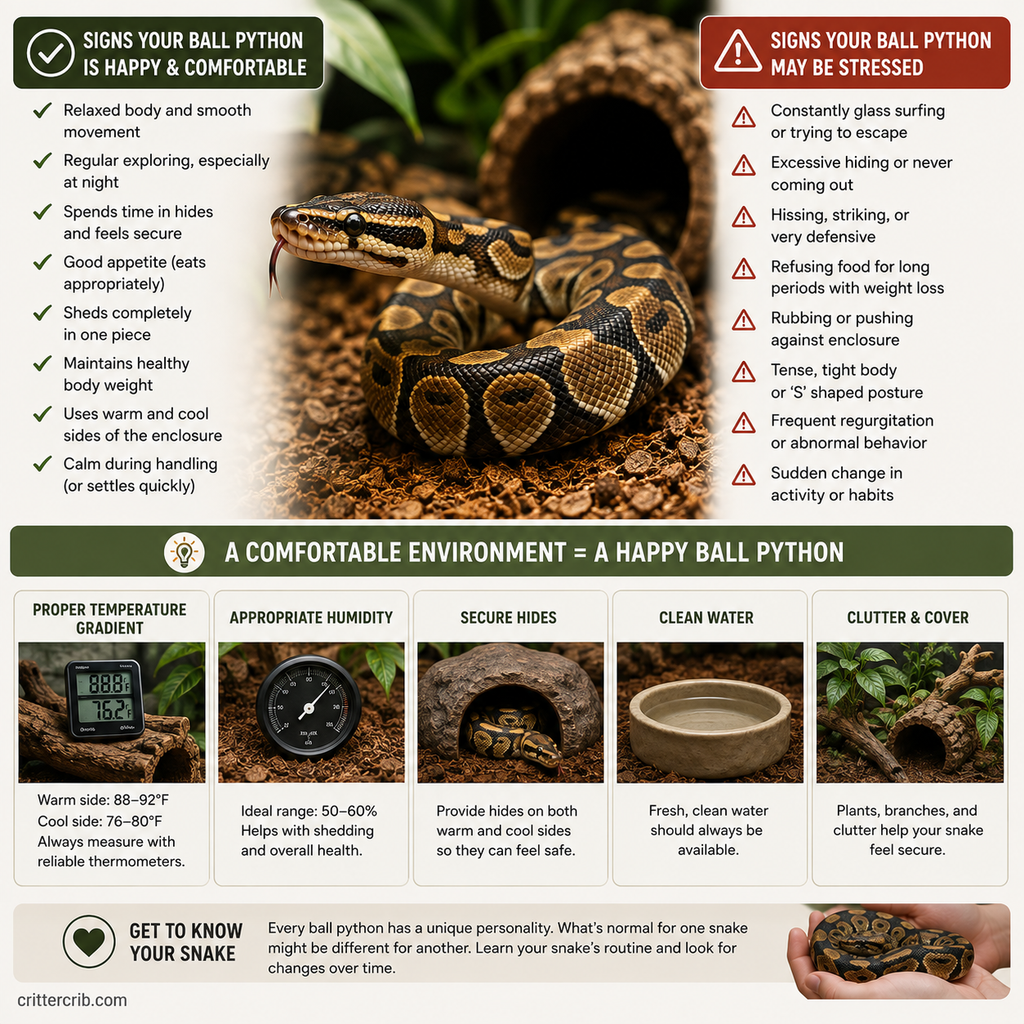
A comfortable ball python will typically:
- Spend plenty of time resting in hides
- Explore periodically, particularly during the evening or at night
- Move smoothly and deliberately
- Use different areas of its enclosure
- Maintain a healthy body condition
- Shed normally
- Show normal tongue-flicking while investigating its surroundings
- Settle after handling rather than remaining persistently agitated
- Eat with reasonable consistency, allowing for normal fasting periods
Some of these behaviors can vary considerably between individual snakes.
One ball python might explore regularly after dark, while another spends most of its time hidden. Both could be perfectly comfortable.
That’s why learning what’s normal for your particular snake is so useful.
A Comfortable Ball Python Usually Spends Time Hiding
Seeing your snake disappear into a hide for most of the day can initially seem concerning.
For a ball python, it’s usually exactly what you’d expect.
Ball pythons are naturally secretive animals. A properly designed enclosure should provide secure hiding places where the snake can rest without feeling exposed.
Your snake should ideally have access to suitable hides on both the warmer and cooler sides of the enclosure. This allows it to regulate its body temperature without having to choose between feeling secure and maintaining an appropriate temperature.
A good hide should be relatively snug.
If it’s so large and open that the snake feels exposed, it may not provide the same sense of security.
Is Hiding All Day Normal?
Usually, yes.
Ball pythons are commonly more active during evening and nighttime hours. A snake that remains tucked inside a hide while you’re awake may become considerably more active after the room gets dark.
If you’re curious, quietly checking the enclosure later in the evening may reveal a completely different side of your snake’s behavior.
Constant hiding becomes more concerning when it appears alongside other problems such as:
- Significant weight loss
- Abnormal breathing
- Unusual posture
- Poor body condition
- Difficulty moving
- Persistent refusal to eat combined with weight loss
- Other obvious signs of illness
Hiding by itself isn’t evidence that your ball python is unhappy.
Calm, Deliberate Movement Is a Good Sign
Watch how your ball python moves when it comes out to explore.
A comfortable snake generally moves slowly and deliberately. You’ll often see regular tongue flicks as it investigates surfaces and scents around the enclosure.
The body should appear relatively relaxed rather than rigid.
During calm exploration, your snake may:
- Move around enclosure furnishings
- Investigate branches or other objects
- Move between warm and cool areas
- Pause frequently
- Flick its tongue
- Climb occasionally
- Return to a hide when finished
This kind of purposeful exploration is very different from frantic attempts to escape.
Understanding Ball Python Tongue Flicking
Tongue flicking is one of the easiest behaviors to notice.
Snakes use their tongues to collect chemical information from their environment. Those particles are then analyzed using the vomeronasal, or Jacobson’s, organ.
In simple terms, your ball python is gathering information about what’s around it.
Regular tongue flicking while exploring is normal.
You may notice increased tongue flicking when:
- You open the enclosure
- The snake encounters something unfamiliar
- Food is nearby
- You’re handling the snake
- It begins exploring a new object
Tongue flicking shouldn’t automatically be interpreted as happiness, but relaxed investigation is generally part of normal snake behavior.
Healthy Ball Pythons Don’t Need to Be Constantly Active
Owners sometimes assume that an active reptile must be a happy reptile.
That’s not necessarily true.
Ball pythons naturally spend substantial amounts of time resting. A snake that constantly circles its enclosure, pushes against the glass, or appears unable to settle may actually be experiencing a problem.
Normal activity usually comes and goes.
Your snake might spend hours hidden and then explore for a while before returning to its resting place.
That’s much more typical than constant movement.
Your Ball Python Should Use Its Enclosure Normally
A properly designed enclosure gives your snake choices.
It should be able to move between warmer and cooler areas while remaining secure.
Over time, you may notice patterns.
Perhaps your ball python spends the afternoon in its warm hide and moves toward the cooler side later. Maybe it emerges shortly after the lights go out. Some snakes also climb or investigate particular enclosure furnishings regularly.
Using multiple areas of the enclosure is generally encouraging.
However, repeatedly avoiding one entire area may be worth investigating.
For example, if your snake refuses to use the warm side, check whether the temperature is too high. If it constantly remains near the heat source, make sure the rest of the enclosure isn’t too cold.
Behavior can sometimes alert you to husbandry problems before they become more serious.
Proper Temperature Helps Your Ball Python Feel Secure
Ball pythons rely on external heat sources to regulate their body temperature.
That makes an appropriate thermal gradient essential.
Rather than heating the entire enclosure to one uniform temperature, provide warmer and cooler areas so your snake can choose what it needs.
Temperatures should always be measured with reliable equipment rather than estimated by touching the enclosure.
If temperatures are inappropriate, you may notice changes in:
- Activity
- Digestion
- Feeding
- Hide selection
- General behavior
Any heat source that could become dangerously hot should be controlled appropriately, such as with a thermostat designed for the equipment being used.
Never rely on guesswork when managing enclosure heat.
Appropriate Humidity Matters Too
Humidity plays an important role in keeping ball pythons comfortable and supporting healthy shedding.
Conditions that are consistently too dry may contribute to incomplete sheds and dehydration. On the other hand, a persistently wet, poorly ventilated enclosure can create its own problems.
Instead of focusing only on the humidity reading, pay attention to the entire environment.
Look at:
- Humidity levels
- Substrate moisture
- Ventilation
- Shed quality
- Access to fresh water
- Whether condensation is constantly forming
- Whether surfaces remain excessively wet
The goal is an appropriately humid environment without turning the enclosure into a stagnant, waterlogged space.
A Good Shed Can Be an Encouraging Sign
Healthy shedding is another useful piece of the puzzle.
Before shedding, your ball python’s colors may become dull and its eyes can develop a cloudy or bluish appearance. During this period, snakes often become more secretive and may refuse food.
This is normal.
After shedding, inspect your snake and the shed skin when possible.
Pay particular attention to areas around the:
- Eyes
- Tail tip
- Head
- Body
Occasional shedding difficulties can happen, but repeated incomplete sheds may indicate that humidity, hydration, or another aspect of husbandry needs attention.
Eating Normally Can Be a Positive Sign
A ball python that regularly accepts appropriately sized meals is generally showing an important normal behavior.
However, feeding is one area where owners can easily become unnecessarily worried.
Ball pythons have a reputation for occasionally refusing food.
A healthy snake may temporarily stop eating because of:
- Seasonal changes
- Shedding
- Reproductive behavior
- Stress
- Recent relocation
- Changes in its environment
That’s why one refused meal doesn’t automatically mean something is wrong.
Monitor the larger picture.
A snake that skips meals while maintaining its weight and behaving normally is very different from a snake that stops eating and steadily loses weight.
Keeping a simple feeding and weight record can help you identify meaningful changes.
Healthy Body Condition Matters More Than Constant Eating
A snake that eats every time food appears isn’t necessarily healthier or happier.
Overfeeding ball pythons can lead to obesity.
Rather than trying to maximize feeding frequency, aim for an appropriate body condition and feeding schedule based on your snake’s age, size, and condition.
Regular weighing can be helpful because gradual changes aren’t always obvious by looking at your snake every day.
Unexpected or substantial weight loss deserves attention, particularly when accompanied by appetite or behavioral changes.
How a Comfortable Ball Python Behaves During Handling
A ball python that is accustomed to gentle handling may gradually begin exploring your hands and arms instead of immediately curling into a defensive position.
During a calm handling session, you might notice:
- Slow movement
- Regular tongue flicking
- A relatively relaxed body
- Gentle exploration
- Gripping for support without squeezing defensively
- Gradually moving from one hand to another
Support the snake’s body rather than allowing it to dangle.
Don’t tightly restrain it unless necessary.
Your hands should function primarily as surfaces for the snake to move across.
What Does It Mean When a Ball Python Curls Into a Ball?
This behavior is where the species gets its common name.
When frightened or threatened, a ball python may curl tightly around itself with its head protected inside its coils.
Occasionally assuming this posture isn’t unusual.
If your snake immediately balls up every time you approach or handle it, however, it may not feel comfortable with the interaction yet.
Don’t force the snake to uncurl.
Allow it to relax naturally and consider shortening handling sessions while it becomes accustomed to you.
Signs Your Ball Python May Be Stressed
Stress doesn’t always look dramatic.
Sometimes the first clue is simply a change from the snake’s normal behavior.
Possible signs of stress can include:
- Repeatedly trying to escape
- Persistent glass surfing
- Constantly pushing against the enclosure
- Frequent defensive posturing
- Repeated striking
- Remaining tightly balled during handling
- Excessive hiding combined with other behavioral changes
- Unusual restlessness
- Repeated food refusal associated with other stress signals
- Rubbing the nose against enclosure surfaces
One isolated behavior doesn’t necessarily indicate a serious problem.
Context matters.
A snake exploring the perimeter of a new enclosure isn’t the same as one rubbing its face against the glass night after night.
Look for persistent patterns.
Common Reasons Ball Pythons Become Stressed
If your snake suddenly seems uncomfortable, examine its environment before assuming something is wrong with its personality.
Common sources of stress can include:
- Incorrect temperatures
- Inappropriate humidity
- Lack of secure hides
- An enclosure that feels too exposed
- Excessive handling
- Frequent changes to the enclosure
- Loud or constant disturbances
- Other pets approaching the enclosure
- Poor enclosure hygiene
- Inadequate access to water
- Being handled immediately after feeding
- Illness or injury
A new ball python may also need time to adjust after arriving home.
Repeatedly removing a nervous new snake from its enclosure can make acclimation more difficult.
How to Help Your Ball Python Feel More Comfortable
Creating a comfortable ball python isn’t about constantly interacting with it.
In many cases, the best thing you can do is provide a stable environment and allow the snake to behave naturally.
1. Provide Secure Hides
Give your ball python snug hiding places on both the warm and cool sides of the enclosure.
Additional cover, such as artificial plants, branches, cork, or other safe furnishings, can help reduce large exposed areas.
2. Maintain an Appropriate Temperature Gradient
Your snake should be able to move between warmer and cooler areas.
Use reliable thermometers and properly controlled heating equipment.
3. Monitor Humidity
Use a reliable hygrometer and adjust enclosure conditions when necessary.
Don’t wait until a poor shed occurs to start paying attention to humidity.
4. Provide Fresh Water
Keep clean drinking water available at all times.
Choose a sturdy bowl that won’t easily tip over.
5. Keep a Predictable Routine
Ball pythons don’t need entertainment schedules, but stability helps.
Avoid constantly rearranging the enclosure or unnecessarily disturbing your snake’s hiding places.
6. Handle Gently
Allow a new snake time to settle before beginning frequent handling.
Once handling begins, keep early sessions relatively short and calm.
7. Give Your Snake Privacy
Your ball python doesn’t need attention every time you see it.
Allow it to hide, rest, digest, and shed without unnecessary interruptions.
Signs of a Comfortable Ball Python vs. a Stressed Ball Python
It can help to compare general patterns.
Comfortable Ball Python
A comfortable snake may:
- Rest securely in its hides
- Explore periodically
- Move slowly and deliberately
- Show regular tongue flicking
- Maintain healthy body condition
- Shed normally
- Use different areas of its enclosure
- Settle after gentle handling
- Display predictable behavior
Potentially Stressed Ball Python
A stressed snake may:
- Constantly attempt to escape
- Push or rub against enclosure walls repeatedly
- Remain unusually defensive
- Ball tightly whenever approached
- Become persistently restless
- Refuse food alongside other concerning changes
- Avoid particular areas because conditions are unsuitable
- Show significant changes from its usual behavior
Again, these aren’t absolute rules.
Your snake’s normal baseline matters.
Don’t Judge Your Ball Python by Human Emotions
One of the hardest adjustments for new reptile owners is learning not to interpret every behavior through the lens of a dog or cat.
Your ball python probably isn’t lonely because it’s hiding.
It isn’t necessarily bored because it spends hours resting.
And a snake that doesn’t seem interested in interacting with you isn’t rejecting you.
Ball pythons experience and respond to their environment differently from highly social mammals.
A better question than “Does my snake love me?” is:
“Does my snake feel secure enough to behave normally?”
That gives you something meaningful to observe.
When Behavior Could Indicate a Health Problem
Changes in behavior aren’t always caused by stress.
Illness can also make a snake unusually inactive, restless, defensive, or reluctant to eat.
Contact a reptile-experienced veterinarian if you notice concerning symptoms such as:
- Wheezing or clicking while breathing
- Mucus or bubbles around the nose or mouth
- Open-mouth breathing
- Significant unexplained weight loss
- Swelling
- Wounds or unusual skin changes
- Difficulty moving
- Persistent abnormal posture
- Severe lethargy
- Repeated regurgitation
- Suspected parasites
- Persistent shedding problems
- Other sudden or significant changes from normal behavior
You don’t need to wait until a snake appears severely ill before seeking veterinary advice.
Frequently Asked Questions About Happy Ball Pythons
How do I know if my ball python likes me?
It’s difficult to know whether a ball python experiences attachment in the same way people typically mean when they say a pet “likes” someone. What you can observe is whether your snake becomes familiar with routine handling and remains relatively calm around you.
A snake that comfortably explores while being handled rather than immediately becoming defensive may have learned that your presence isn’t a threat.
Why does my ball python stare at me?
Your ball python may simply be observing its surroundings.
Snakes gather environmental information through several senses, including vision, smell, and chemical cues collected through tongue flicking.
Staring shouldn’t automatically be interpreted as affection, aggression, or hunger.
Is it good if my ball python explores at night?
Periodic nighttime exploration is generally normal behavior for ball pythons.
If the snake moves calmly around the enclosure and later settles again, this usually isn’t concerning.
Constant frantic activity, however, may warrant checking enclosure conditions.
Why is my ball python always hiding?
Hiding is a normal part of ball python behavior.
A snake that uses its hides frequently isn’t necessarily unhappy. Secure hiding places are an important part of making a ball python feel comfortable.
Be more concerned about sudden behavioral changes or hiding accompanied by other symptoms.
Does my ball python need attention every day?
No.
Ball pythons don’t require daily social interaction with humans. Regular observation is important so you can monitor their health and enclosure conditions, but your snake doesn’t need to be handled every day.
Can ball pythons recognize their owners?
Ball pythons can become familiar with repeated smells, routines, and experiences, but it’s best not to compare this directly with human recognition or the social bonds formed by dogs and other highly social animals.
A snake can become accustomed to your presence and handling without necessarily viewing you as a social companion.
Does a ball python need enrichment?
Providing an enclosure with appropriate opportunities to explore and express natural behaviors can be beneficial.
Depending on the enclosure, this might include:
- Branches
- Cork bark
- Artificial or reptile-safe plants
- Multiple hiding opportunities
- Different textures
- Safe climbing structures
- Areas with varying levels of cover
Enrichment shouldn’t come at the expense of basic husbandry. Proper temperatures, humidity, security, water, cleanliness, and adequate space remain the priorities.
Learn What’s Normal for Your Ball Python
There’s no single pose, movement, or behavior that tells you your ball python is happy.
Instead, look at the whole animal.
A comfortable ball python generally feels secure enough to hide when it wants to, explore when it wants to, regulate its temperature, eat appropriately, shed normally, and move through its environment without constantly behaving as though it needs to escape.
Most importantly, learn your individual snake’s routine.
When you know what’s normal, changes become much easier to notice.
Your ball python doesn’t need to act excited when you walk into the room. If it’s healthy, secure, and calmly going about its very snake-like life, that’s a much better indication that you’re providing the environment it needs.