

Crested geckos can become surprisingly comfortable around their keepers, but that doesn’t mean they naturally enjoy being picked up. To a small gecko, a hand reaching into the enclosure can initially look more like a threat than an invitation.
The good news is that most crested geckos can learn to tolerate—and sometimes seem quite comfortable with—gentle handling. The key is patience. Instead of trying to force interaction, you want your gecko to gradually learn that your presence and hands are nothing to worry about.
Whether you recently brought home your first crested gecko or you’re trying to gain the trust of a particularly nervous one, the following approach can make handling safer and less stressful for both of you.
Do Crested Geckos Like Being Handled?
Crested geckos are generally considered one of the more handleable pet geckos, but it’s important to keep expectations realistic.
They aren’t domesticated animals in the same way dogs or cats are. A crested gecko may become accustomed to being handled without necessarily seeking out physical affection.
Individual personalities also vary considerably.
Some crested geckos calmly walk onto their keeper’s hand. Others are energetic and constantly try to jump. A particularly shy gecko may prefer very limited handling even after becoming familiar with its owner.
The goal should therefore be to build tolerance and trust rather than trying to make your gecko enjoy being held.
Signs that a crested gecko is becoming comfortable around you can include:
- Remaining relatively calm when you approach the enclosure
- Watching you without immediately hiding
- Eating while you’re nearby
- Walking onto your hand voluntarily
- Exploring your hands and arms without frantic attempts to escape
- Returning to normal behavior soon after a handling session
Trust usually develops gradually rather than after one or two successful interactions.
How Long Should You Wait Before Handling a New Crested Gecko?
When you first bring a crested gecko home, give it time to settle into its enclosure before beginning regular handling.
Moving to a new environment introduces unfamiliar smells, sounds, temperatures, hiding places, and people. Immediately adding frequent handling can create unnecessary stress.
A common approach is to allow roughly one to two weeks for acclimation before beginning regular handling, although the individual gecko’s behavior matters more than following an exact schedule.
During this period, focus on basic husbandry.
Make sure your gecko is:
- Exploring the enclosure
- Finding its hiding areas
- Eating consistently
- Defecating normally
- Maintaining appropriate body condition
- Experiencing proper temperature and humidity
A gecko that hasn’t begun eating reliably should usually be allowed additional time to settle before frequent handling.
How to Build Trust With a Crested Gecko
Trust begins before you ever pick your gecko up.
One of the easiest mistakes new owners make is trying to speed up the process. Repeatedly grabbing a nervous gecko usually doesn’t teach it that handling is safe. It may instead teach the animal that your hand predicts an unwanted chase.
A slower approach tends to work better.
Spend Time Near the Enclosure
Start simply by being around your gecko.
Sit near the enclosure in the evening when crested geckos are naturally becoming active. Perform normal maintenance without constantly attempting to touch the animal.
Over time, your movements become part of its normal environment.
You can also speak quietly while performing routine care. Your gecko won’t understand your words, of course, but predictable sounds and movements can help make your presence less startling.
Move Slowly Around Your Gecko
Sudden movement can trigger an escape response.
When opening the enclosure, avoid quickly reaching directly toward the gecko. Move deliberately and give it time to see your hand.
Approaching from the side or slightly below is often less intimidating than reaching straight down from above.
In nature, danger frequently comes from above. While every gecko reacts differently, avoiding large overhead movements can make early interactions easier.
Let Your Hand Become Familiar
Before trying to pick up your gecko, occasionally place your hand inside the enclosure without touching it.
Keep your hand still for a short period.
The goal isn’t necessarily for the gecko to climb onto you immediately. You’re simply allowing it to investigate your hand on its own terms.
If it approaches, resist the temptation to suddenly grab it.
Let curiosity do the work.
Encourage Voluntary Interaction
Once your gecko seems comfortable with your hand nearby, position your hand in front of it as a possible climbing surface.
Some geckos will eventually step onto a hand without much encouragement.
You can gently place a finger or hand in front of the gecko’s front feet. If it walks forward, allow it to climb onto you rather than closing your fingers around its body.
Voluntary handling can be especially helpful with timid geckos because they retain more control over the interaction.
How to Pick Up a Crested Gecko Safely
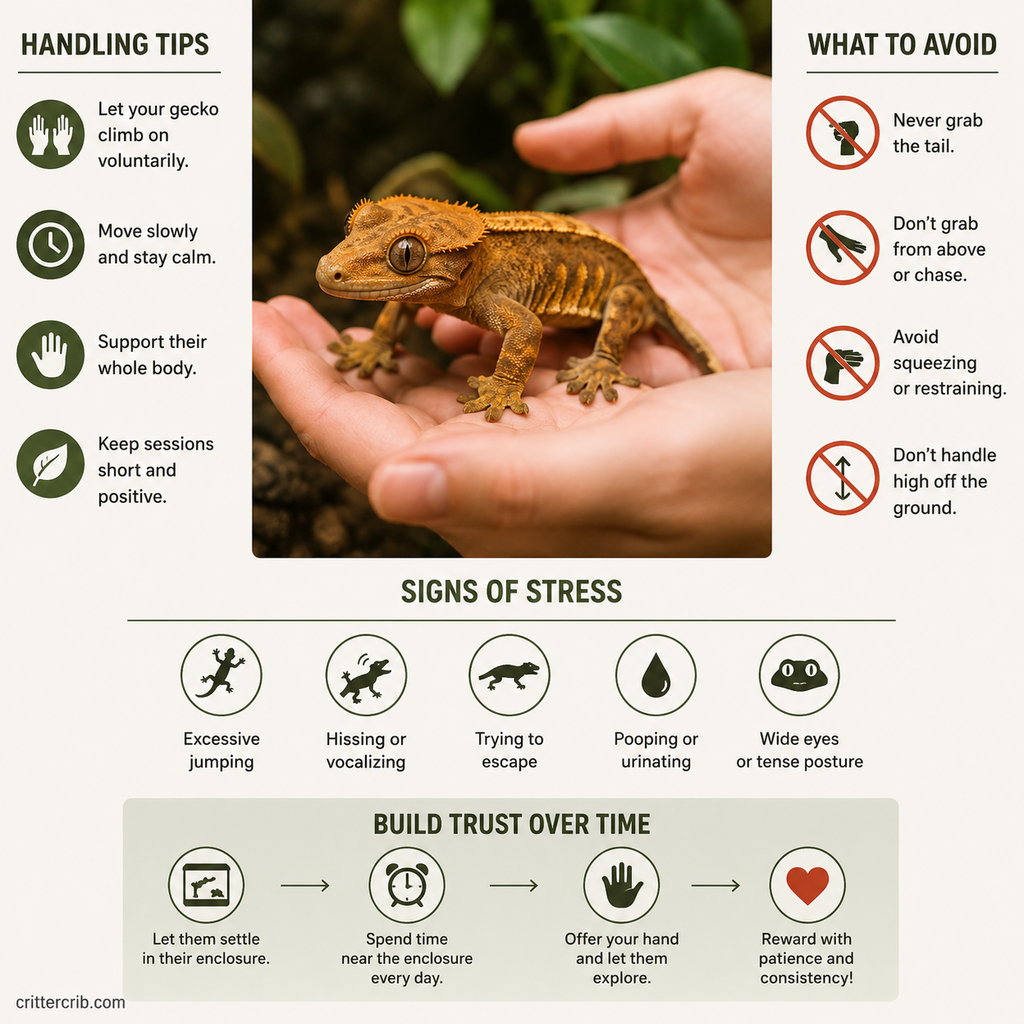
Once your gecko is ready for handling, technique matters.
Crested geckos are lightweight animals with delicate bodies. They should be supported rather than squeezed or restrained tightly.
Step 1: Wash and Dry Your Hands
Wash your hands before handling your gecko, especially if you’ve recently handled food, cleaning products, another reptile, or anything that could leave residue on your skin.
Rinse thoroughly and dry your hands.
Your hands should also be free of lotions, perfumes, sanitizers, or other products that could transfer to the animal.
Step 2: Approach Slowly
Open the enclosure carefully and allow your gecko to see your hand.
Avoid chasing it around branches and foliage.
If the gecko immediately runs away or hides, it may simply not be a good time for handling.
Step 3: Scoop Instead of Grab
Place your hand gently beneath or in front of the gecko.
Encourage it to step forward onto your hand.
If necessary, you can use your other hand to gently guide the gecko from behind, but avoid pinching or gripping its body.
Think of your hands as platforms rather than restraints.
Step 4: Support the Gecko
Once your crested gecko is on your hand, keep your fingers relaxed.
Allow it to stand naturally.
Don’t wrap your fingers tightly around its abdomen or chest. Restricting movement can cause stress and may injure such a small animal.
Step 5: Keep Your Hands Close Together
Crested geckos are excellent jumpers.
During handling, keep one hand in front of the other so your gecko always has another surface available.
As it walks onto one hand, move the other hand ahead of it.
This creates a gentle hand-to-hand walking motion sometimes described as “hand walking.”
It also gives an active gecko somewhere safe to go instead of attempting a long jump.
Be Prepared for Crested Gecko Jumping
One of the first things new owners discover is just how suddenly a crested gecko can launch itself.
A gecko may sit quietly for several seconds and then leap without warning.
This is normal behavior.
Never assume your gecko will remain on your hand simply because it appears calm.
When you’re still learning its behavior, handle it:
- While sitting on the floor
- Over a bed or another broad, soft surface
- Away from stairs
- Away from open doors and windows
- Away from other pets
- Away from small spaces where it could disappear
Keeping handling sessions low to the ground significantly reduces the distance your gecko could fall.
Don’t attempt to catch a jumping gecko by grabbing at its tail.
Never Grab a Crested Gecko by the Tail
This is one of the most important handling rules for crested geckos.
Crested geckos can drop their tails as a defensive response when frightened or stressed. This natural process is known as autotomy.
Unlike some other gecko species, a crested gecko’s tail does not grow back after being dropped.
A tailless crested gecko can still live a normal life, and many healthy adults have no tails at all. However, tail loss is still something responsible handling should try to prevent.
Never:
- Pick up a crested gecko by its tail
- Pull on the tail
- Pin the tail against a surface
- Use the tail to stop an escaping gecko
- Allow children to hold the tail
Support the gecko’s body instead.
How Long Should You Handle a Crested Gecko?
Early handling sessions should be short.
Around five minutes can be plenty for a gecko that is just beginning to become accustomed to human contact.
If the animal remains relaxed, sessions can gradually become longer. Many keepers eventually handle comfortable adults for around 10 to 15 minutes at a time.
Long sessions aren’t necessary for building trust.
Regular, calm interactions are usually more useful than occasionally keeping your gecko out of its enclosure for a long period.
Pay attention to behavior rather than watching the clock alone.
If your gecko becomes increasingly restless or stressed, return it to the enclosure.
How Often Should You Handle Your Crested Gecko?
You don’t need to handle a crested gecko every day.
A few short handling sessions per week may be enough to keep a comfortable gecko accustomed to interaction.
Young or nervous animals may need a slower introduction.
Instead of focusing on a strict schedule, watch how your gecko responds. If each session seems to make the animal increasingly defensive, reduce the frequency and allow more time between interactions.
There are also times when handling should be minimized or avoided altogether.
When You Should Avoid Handling a Crested Gecko
Even a normally calm gecko may need periods when it is left alone.
During Shedding
Crested geckos periodically shed their skin and often eat the shed afterward.
During this process they may become less active, more secretive, or less interested in interaction.
Unless handling is necessary, giving them privacy during shedding is usually best.
Immediately After Eating
Avoid unnecessary handling immediately after your gecko has eaten a substantial meal.
Give it time to settle and digest.
When the Gecko Is Sick or Injured
If your crested gecko is experiencing a health problem, handling should generally be limited to what is necessary for care.
Excessive handling can add stress when the animal is already vulnerable.
If you notice significant lethargy, abnormal movement, unexplained weight loss, injuries, breathing difficulties, or other concerning symptoms, contact a veterinarian experienced with reptiles.
During the Initial Acclimation Period
As mentioned earlier, newly acquired geckos benefit from time to adjust before regular handling begins.
When the Gecko Is Extremely Stressed
Sometimes your gecko simply isn’t interested.
If it repeatedly runs, hides, vocalizes defensively, bites, or frantically attempts to escape, stop the session and try again another day.
Signs a Crested Gecko Is Stressed During Handling
Learning your gecko’s body language makes handling much easier.
Possible signs that a crested gecko is uncomfortable include:
- Frantic jumping
- Rapid escape attempts
- Repeatedly trying to hide
- Defensive vocalizations
- Biting
- Sudden urination or defecation
- Heavy or unusually rapid breathing
- Persistent attempts to flee your hands
Not every jump means your gecko is terrified. Crested geckos naturally jump while exploring.
Look at the overall pattern.
A gecko calmly walking and occasionally jumping between your hands is behaving very differently from one repeatedly launching itself away in an obvious attempt to escape.
What to Do If Your Crested Gecko Bites
Crested gecko bites aren’t generally a major danger to people, but they can be surprising.
A frightened gecko may bite if it feels cornered or restrained.
If your gecko bites, don’t panic or yank your hand away. Sudden movement could injure the gecko.
Stay calm and allow it to release.
Afterward, wash the affected area thoroughly with soap and water.
More importantly, consider why the bite occurred.
Were you chasing the gecko around the enclosure? Did you grab it from above? Was it already showing defensive behavior?
Adjusting your handling approach can often prevent another bite.
Handling Baby Crested Geckos
Juvenile crested geckos require extra caution because they are tiny, fast, and often much more jumpy than adults.
A baby can disappear behind furniture surprisingly quickly.
Handle juveniles in a controlled environment and stay very close to the ground.
Keep your hands near each other and avoid restraining the gecko unless absolutely necessary.
If a young gecko is extremely nervous, focus on building familiarity through routine enclosure care before attempting frequent handling.
There is no benefit to rushing.
Can Children Handle Crested Geckos?
Children can interact with crested geckos, but handling should always be supervised by a responsible adult.
The biggest concern isn’t usually the gecko hurting the child. It’s the child accidentally squeezing, dropping, or grabbing the gecko.
Before allowing a child to hold one, explain a few simple rules:
- Sit on the floor while holding the gecko.
- Keep both hands open.
- Never squeeze the gecko.
- Never grab its tail.
- Let it walk between your hands.
- Don’t chase it if it wants to hide.
- Wash hands after handling.
Very young children may be better off observing the gecko rather than holding it.
Wash Your Hands After Handling
Good hygiene is an important part of reptile ownership.
Reptiles can carry Salmonella and other germs even when they appear perfectly healthy. Wash your hands thoroughly with soap and water after handling your crested gecko, its food, enclosure accessories, substrate, or waste.
Avoid touching your face or eating while handling your gecko.
Young children, older adults, pregnant people, and individuals with weakened immune systems should be particularly careful about reptile-associated hygiene.
Common Crested Gecko Handling Mistakes
Most handling problems come from moving too quickly or trying to control the gecko too much.
Avoid these common mistakes:
- Grabbing the gecko from above
- Chasing it around the enclosure
- Holding it tightly
- Pulling or grabbing the tail
- Handling it high above the floor
- Forcing long handling sessions
- Ignoring obvious signs of stress
- Handling immediately after bringing it home
- Allowing unsupervised young children to hold it
- Handling around dogs, cats, or other pets
- Leaving doors or windows open nearby
- Handling with lotion, chemicals, or food residue on your hands
The safest handling often involves doing less rather than more.
Give the gecko somewhere to stand, let it move naturally, and intervene only when necessary.
How Long Does It Take for a Crested Gecko to Trust You?
There isn’t a universal timeline.
Some crested geckos become comfortable stepping onto a person’s hand within a few weeks. Others may take months to become consistently calm.
Personality, age, previous experiences, enclosure conditions, and handling technique can all affect the process.
Rather than measuring progress by how long you can hold your gecko, look for smaller improvements.
Maybe your gecko used to hide whenever you entered the room but now remains visible.
Perhaps it previously ran whenever you opened the enclosure but now watches your hand calmly.
Eventually, it might begin stepping onto your hand instead of retreating.
Those small changes are meaningful signs of increasing comfort.
Frequently Asked Questions About Handling Crested Geckos
Can you handle a crested gecko every day?
A healthy crested gecko that is comfortable with handling may tolerate regular interaction, but daily handling isn’t necessary. Short, positive sessions a few times per week can be enough for many geckos. Always adjust handling based on the individual animal’s behavior.
Why does my crested gecko run away from me?
Running away usually means your gecko feels uncertain or threatened. This is especially common with new or young geckos. Slow down your movements, reduce forced handling, and give the animal more opportunities to become accustomed to your presence.
Why does my crested gecko jump off my hand?
Jumping is a normal part of crested gecko movement. Their toe pads and powerful hind legs make them excellent climbers and jumpers. Keep your hands close together and handle the gecko near a safe surface so unexpected jumps don’t result in dangerous falls.
Should I hand-feed my crested gecko to build trust?
Occasional supervised interaction around food may help a gecko associate your presence with something non-threatening, but routine hand-feeding isn’t necessary for building trust. Your gecko should remain capable of finding and eating its normal diet independently.
Can a crested gecko recognize its owner?
Crested geckos can become accustomed to familiar routines, smells, movements, and interactions, but their perception of people shouldn’t be compared directly with the social recognition seen in animals such as dogs. What owners often describe as “recognition” may be a combination of familiarity and learned associations.
What if my crested gecko never likes being handled?
That’s okay. Crested geckos have individual temperaments, and some remain more cautious than others.
Handling isn’t a requirement for a gecko to have a good quality of life.
If your gecko consistently finds handling stressful, limit interaction to necessary enclosure maintenance, health checks, weighing, and veterinary care. Responsible reptile keeping means respecting the animal’s behavior rather than forcing it to become a hands-on pet.
Building Trust Takes Patience
Learning how to handle a crested gecko safely is less about mastering a particular grip and more about understanding the animal in front of you.
Move slowly. Support the body rather than restraining it. Keep handling sessions short at first, stay close to the ground, and never grab the tail.
Most importantly, allow trust to develop gradually.
A gecko that learns your hands aren’t something to fear will generally be much easier to handle than one that is repeatedly chased or grabbed. Some individuals make progress quickly, while others need considerably more time.
Work at your gecko’s pace, pay attention to its behavior, and make each interaction as calm and predictable as possible. That’s the foundation of safe handling—and the best way to build lasting trust.