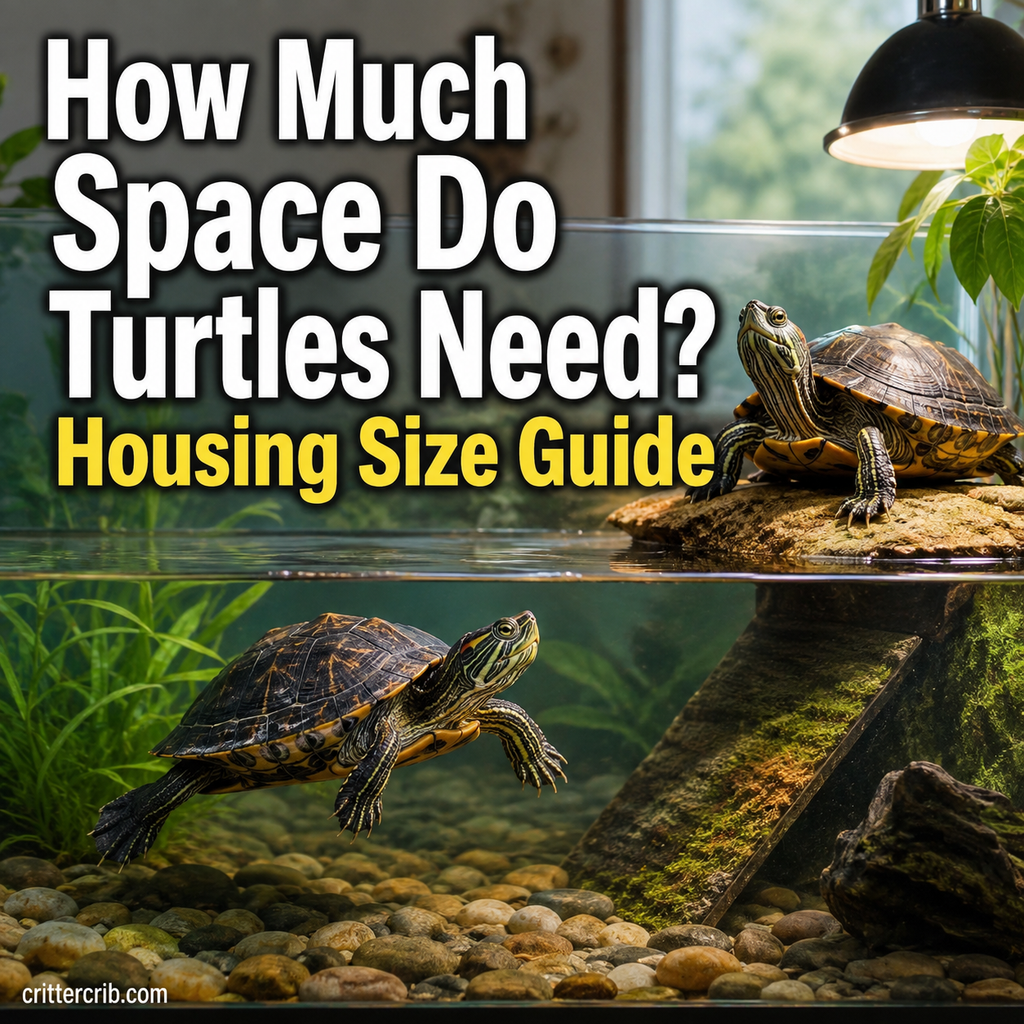
Turtles may look small when you first bring them home, but their housing needs can be surprisingly large. A young turtle that fits comfortably in your hand can grow into an adult that needs a sizable aquarium, stock tank, pond, or other purpose-built enclosure.
Giving a turtle enough space isn’t just about making its habitat look nice. The size of the enclosure affects swimming, exercise, water quality, temperature control, basking opportunities, and how easily you can maintain a healthy environment.
So, how much space does a turtle actually need?
The answer depends on the species, adult size, and whether you’re caring for an aquatic, semi-aquatic, or terrestrial turtle. For many commonly kept aquatic turtles, a useful starting guideline is around 10 gallons of water capacity per inch of shell length, although individual species may need more space.
This guide explains how to estimate the right enclosure size and how to create a habitat that will continue working as your turtle grows.
Why Turtles Need More Space Than You Might Expect
Turtles aren’t particularly fast-moving pets, which can make it seem as though they don’t need much room. In reality, many species are active explorers.
Aquatic turtles may spend hours swimming, diving, searching for food, investigating objects, and moving between warmer and cooler areas of their habitat.
A properly sized enclosure makes it easier to provide:
- Enough swimming room
- A dry basking area
- Appropriate water depth
- Temperature gradients
- UVB lighting
- Hiding and resting areas
- Strong filtration
- Cleaner, more stable water conditions
Space becomes especially important as a turtle reaches adulthood.
A small aquarium that works temporarily for a hatchling may become inadequate surprisingly quickly.
The 10-Gallons-Per-Inch Turtle Tank Rule
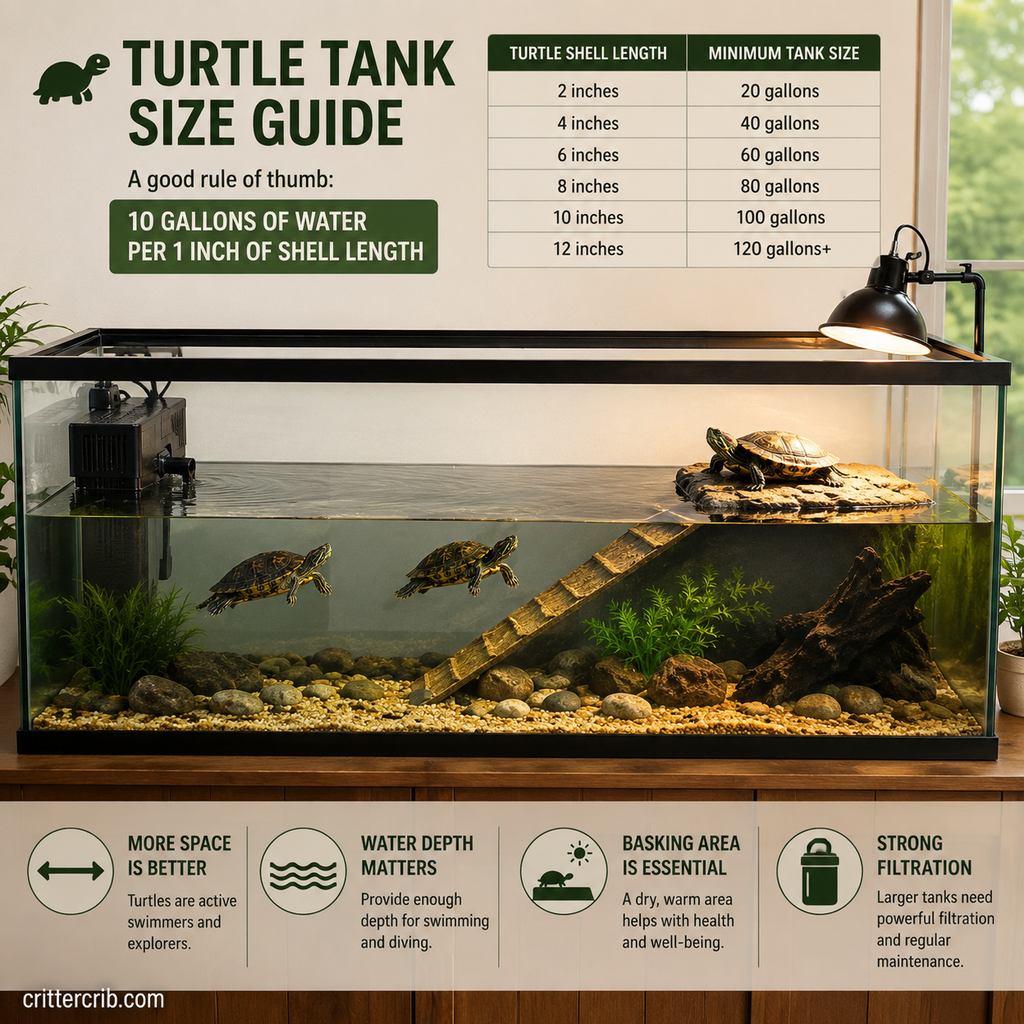
One commonly used guideline for aquatic turtles is to provide approximately 10 gallons of enclosure capacity for every inch of shell length.
Measure the turtle’s shell from front to back in a straight line rather than following the curve of the shell.
Using this guideline:
- 2-inch turtle: about 20 gallons
- 4-inch turtle: about 40 gallons
- 6-inch turtle: about 60 gallons
- 8-inch turtle: about 80 gallons
- 10-inch turtle: about 100 gallons
- 12-inch turtle: about 120 gallons
Think of this as a starting point rather than an absolute rule.
Species, activity level, body shape, water depth requirements, and enclosure layout all matter. Larger accommodations are generally preferable when they can be provided safely.
It’s also important to distinguish between the advertised capacity of an aquarium and the amount of usable water inside it. A 75-gallon aquarium may contain considerably less than 75 gallons if the water level is lowered or large decorations take up substantial space.
Plan for Your Turtle’s Adult Size
One of the easiest mistakes to make is choosing an enclosure based only on the turtle’s current size.
Hatchlings can be tiny.
Adults may not be.
For example, several popular aquatic turtles can eventually reach shell lengths of roughly 8 inches or more, with some individuals and species becoming considerably larger.
Before buying an enclosure, research the expected adult size of the exact species you plan to keep.
Whenever practical, buying an enclosure appropriate for the turtle’s expected adult size can save money and hassle. Instead of purchasing several progressively larger aquariums, you may be able to establish a spacious habitat from the beginning.
Just make sure a small turtle can safely reach the surface and basking area in a larger setup.
How Much Space Do Red-Eared Sliders Need?
Red-eared sliders are a perfect example of why planning for adulthood matters.
Young sliders are commonly sold when they’re very small, but adults require substantial housing. Females generally grow larger than males and can sometimes reach around 10–12 inches in shell length.
Following the 10-gallons-per-inch guideline, a large adult slider could therefore require an enclosure in the neighborhood of 100–120 gallons.
More room can be beneficial.
The enclosure also needs to accommodate:
- Deep swimming water
- A secure basking platform
- UVB lighting
- A basking heat source
- Powerful filtration
- Areas for resting and exploring
This is why a small starter aquarium should never be considered permanent housing for a red-eared slider.
How Much Space Do Painted Turtles Need?
Painted turtles are another popular aquatic species.
Adult size varies depending on the subspecies and sex, but many painted turtles reach somewhere around 4–10 inches in shell length.
A smaller adult may be manageable in a moderately sized aquarium, while a large female will require considerably more space.
Because painted turtles are active swimmers, prioritize usable horizontal swimming room rather than simply choosing a tall aquarium with limited floor dimensions.
A longer enclosure gives the turtle more room to move naturally.
How Much Space Do Map Turtles Need?
Map turtles vary considerably in size depending on species and sex.
In some species, males remain relatively small while females grow much larger. That means two turtles of the same species can have very different adult housing requirements.
Researching the specific type of map turtle is especially important.
They are generally active aquatic turtles and benefit from:
- Plenty of swimming space
- Good water depth
- Secure basking areas
- Excellent filtration
- Branches or structures for resting and climbing
Again, size the habitat around the expected adult rather than the juvenile you currently have.
Tank Dimensions Matter, Not Just Gallons
Two aquariums can hold approximately the same amount of water while offering very different living spaces.
For turtles, horizontal space is particularly valuable.
A long, wide aquarium usually provides more useful swimming and exploring room than a narrow, unusually tall aquarium of similar capacity.
When comparing habitats, consider:
- Overall length
- Front-to-back width
- Water depth
- Basking platform size
- Open swimming area
Don’t focus exclusively on the gallon number printed on the aquarium.
Your goal is to create usable space.
How Deep Should Turtle Water Be?
Aquatic turtles need enough water to swim naturally rather than simply crawl along the bottom.
The ideal depth varies by species, age, and swimming ability.
Healthy adult sliders, painted turtles, and many other commonly kept aquatic turtles are generally capable swimmers and can use relatively deep water. Deeper setups also provide more total swimming volume.
However, the habitat should include easy ways for the turtle to rest near the surface.
These might include:
- Driftwood
- Submerged platforms
- Sturdy rocks
- Turtle-safe ledges
- Basking ramps
Hatchlings and turtles with health or mobility problems may require more cautious setups.
Always research the natural behavior of your particular species rather than assuming every turtle has identical swimming abilities.
Don’t Forget the Basking Area
Water isn’t the only space your turtle needs.
Most commonly kept aquatic turtles require access to a completely dry basking area where they can leave the water, warm themselves, and receive appropriate UVB exposure.
The platform should be large enough for the turtle to climb onto it and comfortably dry its entire body.
A good basking area should be:
- Easy to access
- Stable
- Completely dry on top
- Large enough for the whole turtle
- Positioned correctly beneath heat and UVB lighting
- Designed so the turtle can’t become trapped
As your turtle grows, the basking platform needs to grow too.
A platform designed for a 2-inch hatchling may become unusable for an 8-inch adult.
Above-Tank Basking Areas Can Create More Swimming Space
Large turtles can take up a surprising amount of aquarium space, and traditional floating basking docks may occupy valuable swimming room.
An above-tank basking area can be a useful alternative.
These setups place the basking platform above the aquarium with a ramp allowing the turtle to climb out of the water.
This arrangement can allow you to use more of the aquarium for swimming while still providing a substantial dry area.
Any elevated basking setup must be secure. Turtles can climb much better than many owners expect, so the enclosure should prevent falls and escapes.
Bigger Turtle Habitats Can Be Easier to Maintain
It may seem like a larger aquarium would automatically mean more work.
In some ways, the opposite can be true.
Turtles produce a significant amount of waste. In a small amount of water, waste can accumulate quickly and water quality can deteriorate faster.
Larger water volumes generally provide more dilution and can make conditions more stable when paired with appropriate filtration and maintenance.
That doesn’t mean a large aquarium cleans itself.
You’ll still need regular:
- Partial water changes
- Filter maintenance
- Waste removal
- Water-quality monitoring
- Cleaning of basking and habitat surfaces
But adequate water volume gives you a better foundation for maintaining good conditions.
Turtle Filtration Needs Increase With Tank Size
A large habitat needs an appropriately sized filtration system.
Turtle filtration can be more demanding than filtration for a lightly stocked fish aquarium because turtles are messy eaters and produce substantial waste.
Many turtle keepers use powerful canister filters for larger aquatic setups.
When selecting a filter, don’t look at aquarium size alone. Consider:
- Actual water volume
- Turtle size
- Number of turtles
- Amount of waste produced
- Filter media capacity
- Manufacturer recommendations
Good filtration doesn’t replace water changes, but it can make maintaining a large turtle habitat much more manageable.
How Much Space Do Two Turtles Need?
Keeping two turtles isn’t as simple as doubling the food and adding another basking spot.
Additional turtles require significantly more room and create more waste.
They may also become territorial or aggressive.
Competition can develop over:
- Food
- Basking areas
- Warm spots
- Hiding places
- Swimming territory
Even turtles that have lived together peacefully for years can develop conflicts as they mature.
If multiple turtles are housed together, the habitat should be substantially larger than one designed for a single turtle, and you should be prepared to separate them permanently if aggression develops.
Never depend on the assumption that two turtles need companionship. Many turtles do perfectly well without another turtle sharing their enclosure.
Signs a Turtle Enclosure May Be Too Small
There isn’t one behavior that definitively proves an enclosure is undersized, but several factors can suggest that the habitat needs improvement.
Look at the overall setup if your turtle:
- Has very little room to swim
- Can barely turn around comfortably
- Constantly rearranges or collides with enclosure objects
- Has a basking area that is too small
- Cannot easily move between different areas
- Lives in water that becomes dirty extremely quickly
Repeated attempts to climb the walls can occur for several reasons, including inadequate space, incorrect temperatures, unsuitable habitat conditions, reproductive behavior, or simply exploration.
Instead of assuming one behavior has one cause, evaluate the entire environment.
Are Plastic Tubs and Stock Tanks Good for Turtles?
Glass aquariums aren’t the only option.
Large, sturdy plastic tubs and stock tanks can provide excellent turtle habitats when they’re made from suitable materials and set up correctly.
Their advantages can include:
- Large usable footprint
- Lower cost per gallon
- Easier access
- More room for large turtles
- Flexible basking arrangements
Stock tanks can be particularly practical for adult aquatic turtles that have outgrown conventional aquariums.
The trade-off is appearance. They may not provide the same front-facing view as a glass aquarium.
For the turtle, however, usable space matters more than whether the enclosure resembles a traditional aquarium.
Can Aquatic Turtles Live in Outdoor Ponds?
For suitable species and climates, a properly designed outdoor pond can provide an enormous amount of swimming and exploration space.
But putting a turtle outside requires much more planning than filling a backyard pond with water.
Outdoor turtle habitats need protection from:
- Predators
- Escapes
- Extreme heat
- Cold temperatures
- Unsafe plants
- Contaminated water
- Other animals
The enclosure must also provide appropriate basking opportunities, shade, water depth, and secure boundaries.
Seasonal temperature changes are particularly important. Whether a turtle can safely remain outdoors year-round depends heavily on the species and local climate.
What About Box Turtles?
Box turtles need a very different habitat from aquatic turtles.
They are primarily terrestrial, so the 10-gallons-per-inch aquatic guideline isn’t appropriate.
For box turtles, floor space is much more important than aquarium volume.
A spacious terrestrial enclosure allows room for:
- Walking and exploring
- Burrowing
- Hiding
- Feeding
- Basking
- Thermoregulation
- Accessing different humidity zones
Outdoor pens can work extremely well for appropriate box turtle species in suitable climates, provided they are secure from predators and escapes.
Indoor habitats should prioritize a large footprint rather than a tall glass aquarium.
Common Turtle Housing Mistakes
Choosing an enclosure is easier when you know what problems to avoid.
Buying a Tiny Starter Tank
Small kits can look appropriate when a turtle is a hatchling, but many are quickly outgrown.
Research adult size before purchasing the enclosure.
Filling the Tank With Too Many Decorations
Rocks, artificial plants, hides, and driftwood can make an enclosure interesting, but too many objects reduce swimming room.
Provide enrichment without creating an obstacle course.
Using a Basking Platform That’s Too Small
The entire turtle should be able to leave the water and dry off comfortably.
Replace or upgrade platforms as the turtle grows.
Underestimating Filtration
A large tank with inadequate filtration can still develop poor water quality.
Choose filtration appropriate for the turtle’s waste production and actual water volume.
Housing Multiple Turtles in a Small Space
Crowding increases competition and makes maintaining water quality more difficult.
More turtles require more resources and substantially more space.
Planning Around the Turtle’s Current Size
A hatchling’s housing needs can change dramatically over the next several years.
Whenever possible, plan ahead.
How to Choose the Right Turtle Enclosure
Before purchasing a habitat, work through these steps.
- Identify the exact turtle species.
- Research its typical adult size, including differences between males and females.
- Determine whether it is aquatic, semi-aquatic, or primarily terrestrial.
- Estimate the enclosure size needed at adulthood.
- Make sure there is enough usable horizontal space.
- Plan the basking area before adding decorations.
- Choose appropriate heating and UVB lighting.
- Select filtration suitable for the expected water volume and waste load.
- Leave room for the turtle to swim and explore.
- Consider whether you have enough physical space in your home for the adult enclosure.
That final point is easy to overlook.
A 100-gallon-plus turtle habitat is a substantial piece of equipment. Once filled with water, substrate, decorations, and equipment, it can also be extremely heavy.
Make sure the location and support structure are appropriate for the completed setup.
Should You Buy a Bigger Tank Than Your Turtle Currently Needs?
Often, yes.
If you already know that a juvenile turtle will eventually require a large enclosure, purchasing a larger habitat early can reduce the number of upgrades you’ll need later.
There are still practical considerations.
A very young turtle should be able to:
- Reach the surface easily
- Find the basking platform
- Access resting areas
- Locate food
- Move safely around equipment
You can modify the layout while the turtle is small and gradually adjust it as the animal grows.
How Often Should You Reevaluate Your Turtle’s Habitat?
Check your turtle’s enclosure periodically rather than waiting until it obviously looks crowded.
Measure shell length as the turtle grows and evaluate whether the habitat still provides adequate swimming, basking, resting, and exploration space.
Also inspect:
- Basking platform size
- Water depth
- Filter performance
- UVB positioning
- Heating equipment
- Ramps and resting areas
- Escape risks
Turtle housing isn’t something you necessarily set up once and leave unchanged for decades.
The habitat should evolve with the animal.
Frequently Asked Questions About Turtle Housing Size
Is a 20-gallon tank big enough for a turtle?
It may work temporarily for a very small aquatic turtle, depending on the species, but a 20-gallon aquarium is too small as permanent housing for many commonly kept adult turtles.
Always plan around adult size.
Is a 40-gallon tank enough for an adult turtle?
It depends on the species and individual turtle.
A small species or individual may have different requirements from an adult red-eared slider or another large aquatic turtle. Using the approximate 10-gallons-per-inch guideline can help you estimate a starting point for many aquatic species.
Can a turtle tank be too big?
Healthy aquatic turtles generally benefit from generous swimming space, provided the habitat is designed appropriately.
A small or young turtle should still have easy access to the surface, resting places, food, and its basking area.
Do turtles prefer long or tall tanks?
For many aquatic turtles, a long enclosure with generous horizontal swimming room is more useful than a narrow, extremely tall aquarium.
Water depth still matters, but overall usable swimming space should be considered when choosing the tank.
Do turtles need space outside the water?
Most commonly kept aquatic turtles need a dry basking area where they can completely leave the water.
Terrestrial species such as box turtles require primarily land-based habitats instead.
Can turtles live together in the same tank?
Sometimes, but keeping multiple turtles together introduces risks including aggression, competition, injury, and increased waste.
A larger enclosure doesn’t guarantee compatibility. Owners keeping multiple turtles should have a plan for separate housing if necessary.
Final Thoughts: Give Your Turtle Room to Grow
The tiny turtle you bring home may eventually need far more space than you expect.
For many aquatic turtles, roughly 10 gallons of capacity per inch of shell length is a useful starting guideline, but species-specific needs should always come first. Tank dimensions, swimming depth, basking space, filtration, and adult size are just as important as the number of gallons.
The best approach is to research your turtle’s expected adult size before buying its permanent habitat.
A roomy, well-designed enclosure gives you more flexibility to create proper swimming areas, basking zones, temperature gradients, and cleaner water. More importantly, it gives your turtle the space to behave like a turtle.
When you’re choosing between an enclosure that your turtle will soon outgrow and one that provides room for the future, planning bigger usually makes life easier for both you and your pet.