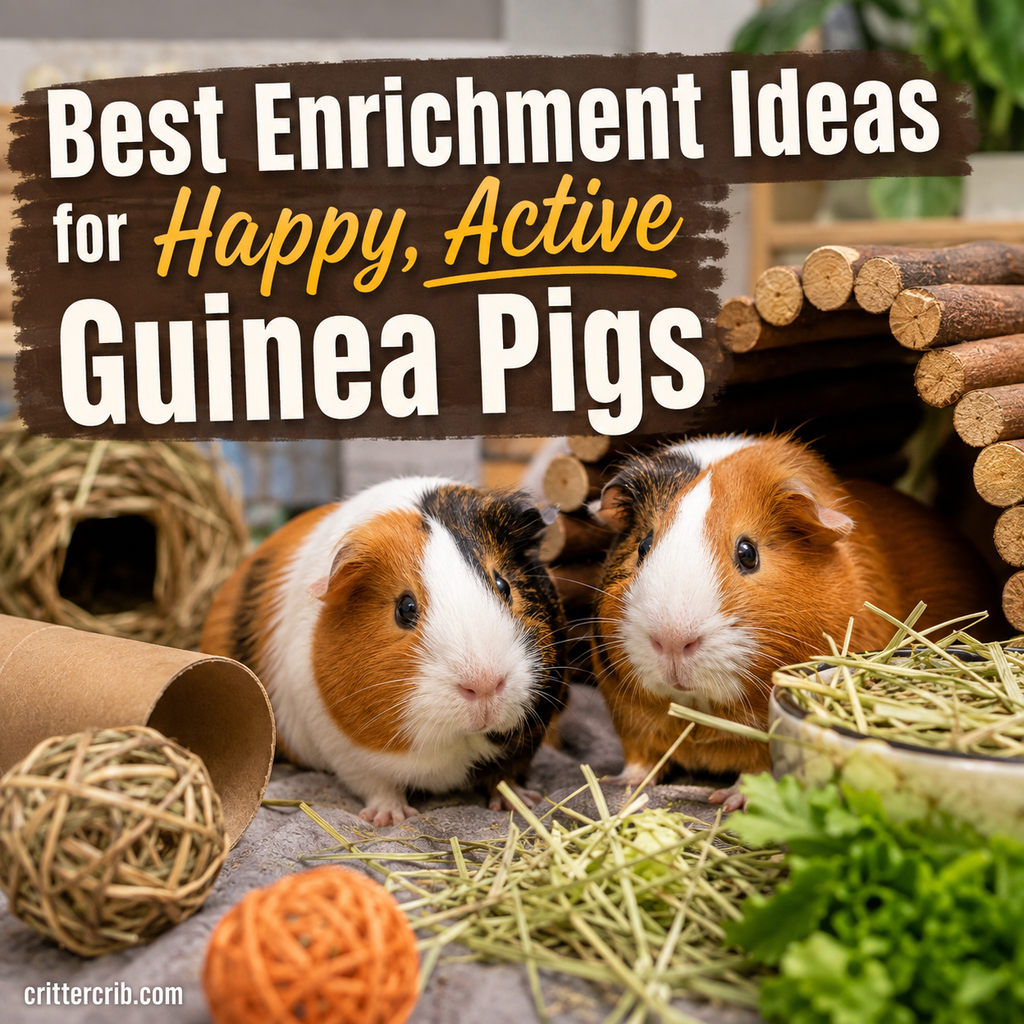
Guinea pigs may spend plenty of time eating hay and relaxing, but that doesn’t mean they’re content with a boring enclosure. These curious little animals benefit from opportunities to explore, forage, hide, investigate new objects, and interact with their surroundings.
Good enrichment doesn’t have to mean buying a pile of expensive guinea pig toys, either. Some of the best activities are surprisingly simple: a cardboard box with a few entrances, hay hidden around the enclosure, a rearranged tunnel, or floor time in a safe area.
The goal is to give your guinea pigs appropriate ways to use their natural behaviors while still making sure they feel secure.
Here are some of the best enrichment ideas for keeping guinea pigs happy, active, and interested in their environment.
Why Is Enrichment Important for Guinea Pigs?
Enrichment gives guinea pigs more opportunities to make choices and interact with their surroundings instead of spending every day following exactly the same routine.
In the wild, guinea pig relatives spend much of their time searching for food, moving between sheltered areas, investigating their environment, and staying alert to potential threats.
Pet guinea pigs don’t need to search far and wide for dinner, of course, but those behavioral instincts haven’t disappeared.
A good enrichment routine can encourage:
- Foraging
- Exploration
- Physical activity
- Problem-solving
- Social interaction
- Natural chewing behavior
- A greater sense of security
It also makes their enclosure more interesting.
The key is variety. Rather than trying to find one “perfect” guinea pig toy, provide several types of enrichment and change things occasionally.
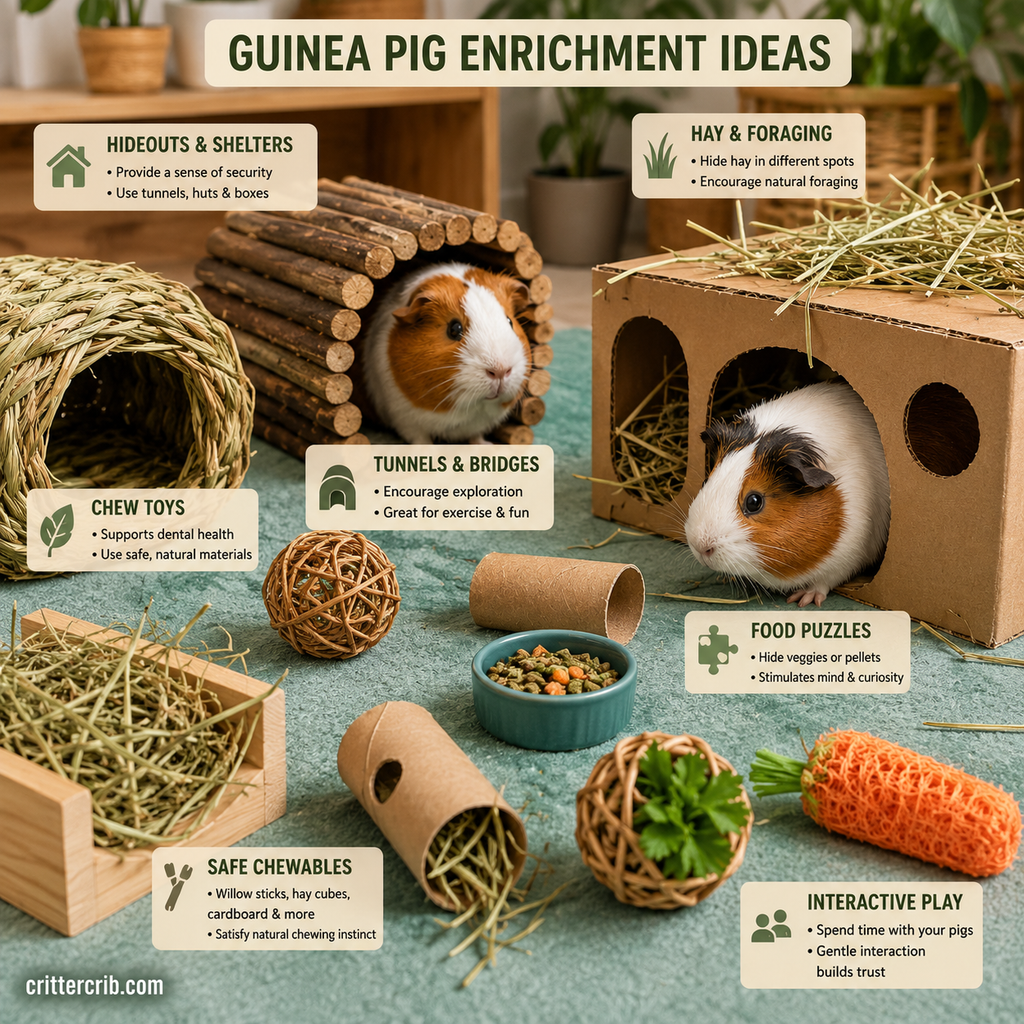
1. Turn Hay Into a Foraging Activity
Hay is already one of the most important parts of a guinea pig’s daily life, so it provides an easy opportunity for enrichment.
Instead of presenting every bit of hay in exactly the same location, occasionally encourage your guinea pigs to search for it.
You might place small amounts of hay:
- In different safe areas of the enclosure
- Inside an open cardboard box
- Around tunnels and hideouts
- In several hay piles
- Inside safe paper bags with handles removed
The activity doesn’t need to be difficult. Guinea pigs aren’t supposed to struggle to get their food.
The idea is simply to encourage them to move around and investigate.
Always make sure plenty of hay remains easily accessible. Enrichment should supplement normal feeding rather than make essential food difficult to obtain.
2. Provide Plenty of Tunnels
Tunnels are excellent guinea pig enrichment because they combine movement, exploration, and hiding.
Many guinea pigs love running through one tunnel, turning around, and immediately running through it again.
Good options can include:
- Guinea pig-sized fabric tunnels
- Cardboard tunnels
- Large cardboard tubes designed for small pets
- Open-ended hideaways
- Safe tunnel systems with multiple entrances
Size matters.
Your guinea pig should be able to move through a tunnel comfortably without squeezing through an opening that is too small.
Tunnels with more than one exit are especially useful in multi-guinea-pig homes because one animal is less likely to become trapped inside by another.
3. Create a Guinea Pig Maze
A simple maze can transform floor time into an exploration session.
You don’t need anything elaborate. Cardboard boxes and panels can create pathways that encourage your guinea pigs to investigate.
Try creating a maze containing:
- Wide pathways
- Tunnels
- Multiple exits
- Small hay piles
- Hideaways
- A few favorite vegetables as occasional rewards
Keep the maze relatively simple at first.
You can change the layout later as your guinea pigs become familiar with it.
Never create narrow dead ends where one guinea pig could corner another.
4. Give Them Cardboard Boxes to Explore
Before recycling your next delivery box, consider whether your guinea pigs might enjoy it.
A plain cardboard box can become a hideout, tunnel, exploration area, or chewing object.
Cut two or more guinea-pig-sized entrances into the sides and remove tape, staples, labels, plastic, or other potentially unsafe materials.
Why multiple entrances?
Guinea pigs are prey animals and generally feel safer when they know they have an escape route. Multiple openings are particularly important when several guinea pigs share an enclosure.
Boxes will eventually become dirty or heavily chewed, so replace them as needed.
5. Make Vegetable Hunting More Interesting
Fresh vegetables can occasionally become part of an enrichment activity instead of always arriving in a bowl.
For example, place appropriate portions in several locations around a safe enclosure or floor-time area.
Your guinea pigs then have to walk around and find them.
You could put a small piece:
- Near a tunnel
- Beside a hideout
- In an open cardboard box
- At the opposite end of the enclosure
- Under a small pile of hay
Keep the total amount of food appropriate for their normal diet. An enrichment activity shouldn’t accidentally turn into double dinner.
6. Provide Safe Chewing Opportunities
Chewing is a normal guinea pig behavior.
Providing appropriate materials gives them something constructive to investigate and gnaw.
Depending on the product and material, suitable options may include guinea-pig-safe:
- Wooden chew items
- Untreated willow products
- Cardboard
- Hay-based toys
- Natural chew toys intended specifically for small animals
Be selective when shopping.
A product being marketed as a “small animal toy” doesn’t automatically mean it’s appropriate for every small pet. Check the materials and avoid anything with unsafe coatings, small detachable pieces, or questionable ingredients.
Chew items should also complement rather than replace unlimited access to hay.
7. Build a Digging or Burrowing Area
Guinea pigs aren’t extreme burrowers like some other small pets, but many enjoy pushing into soft materials and exploring covered spaces.
A simple exploration box can provide that experience.
Use a shallow container or cardboard box filled with safe material such as crumpled plain paper or hay. You can scatter a little hay or a few appropriate food pieces throughout it to encourage exploration.
Keep the material loose enough that your guinea pig can move through it easily.
Avoid anything dusty or anything that could wrap tightly around the body or feet.
8. Rearrange Their Environment Occasionally
One of the easiest enrichment ideas costs nothing.
Change the layout.
Moving a tunnel from one side of the enclosure to another may not sound exciting to us, but suddenly the familiar environment has something new to investigate.
Try occasionally changing the location of:
- Tunnels
- Beds
- Cardboard boxes
- Hay areas
- Toys
- Hideouts
Don’t completely redesign everything constantly, though.
Guinea pigs also benefit from familiarity and predictable places where they feel secure. A few small changes are usually enough to create interest without making the environment unnecessarily stressful.
9. Give Your Guinea Pigs Safe Floor Time
A suitable enclosure provides their everyday living space, while a larger secure area can give them additional room to explore.
Floor time can be particularly useful for encouraging movement.
Set up a guinea-pig-safe area containing tunnels, boxes, hay, and hiding places. Block access to electrical cords, furniture gaps, stairs, other pets, toxic plants, and anything else that could cause trouble.
Then allow your guinea pigs to explore at their own pace.
Some will immediately start running around.
Others may sit inside a hideout for a while before deciding that exploration sounds worthwhile.
Both responses are normal.
10. Use Fleece Forests and Covered Areas
Guinea pigs often appreciate overhead cover.
A fleece forest consists of strips of fleece hanging down to create a sheltered area the guinea pig can walk through or rest underneath.
It can provide:
- A feeling of security
- Another texture to investigate
- A resting area
- A place to move through and explore
Make sure any fabric enrichment is safely constructed and regularly inspected.
Remove items if they become damaged or develop loose threads or openings that could create an entanglement hazard.
11. Try Simple Food Puzzles
Food puzzles don’t have to be complicated.
In fact, simple is usually better.
A guinea pig should be encouraged to investigate rather than become frustrated trying to solve an elaborate puzzle.
For example, you might hide a small piece of an appropriate vegetable underneath some hay or place food in an open cardboard container.
You can gradually introduce slightly different challenges once your guinea pig understands the activity.
Avoid tightly enclosed food puzzles designed for animals that manipulate objects differently. Guinea pigs should always be able to access food safely.
12. Introduce New Safe Textures
Different surfaces can make an exploration area more interesting.
During supervised floor time, you could provide safe areas containing textures such as:
- Fleece
- Soft bedding
- Cardboard
- Hay
- Pet-safe mats
The goal isn’t to overwhelm the enclosure with different materials. You’re simply giving your guinea pigs something new to investigate with their paws, noses, and whiskers.
Avoid slippery surfaces or materials that can snag nails.
13. Create Multiple Hideouts
Hideouts aren’t just places for sleeping.
They’re an important part of helping guinea pigs feel secure enough to explore.
A guinea pig that can quickly retreat to safety may feel more comfortable investigating the rest of its environment.
In a multi-guinea-pig enclosure, provide enough hiding opportunities that animals aren’t constantly competing for the same space.
Whenever practical, choose hideouts with multiple entrances.
This helps reduce the chance of one guinea pig blocking another inside.
14. Encourage Social Enrichment
For guinea pigs, enrichment isn’t limited to objects.
Social interaction is a major part of their lives.
Guinea pigs are social animals, and compatible guinea pigs can communicate, eat, explore, rest, and interact together.
You might hear a surprisingly large vocabulary of:
- Wheeks
- Purr-like sounds
- Rumbles
- Squeaks
- Chirps and other vocalizations
You’ll also notice body language and social behaviors between them.
Human interaction can be enriching too, particularly when your guinea pig feels comfortable around you. Quietly sitting nearby, hand-feeding an appropriate vegetable, or allowing a confident guinea pig to approach you can help create positive interactions.
Respect their boundaries. Not every guinea pig enjoys being picked up frequently, even if they’re otherwise friendly.
15. Use Paper Bags as Temporary Hideouts
A plain paper bag can become an inexpensive exploration toy.
Remove any handles and make sure the bag doesn’t contain plastic coatings, adhesives, or other unsafe additions.
Place it on its side and add some hay.
Many guinea pigs will immediately climb inside to investigate.
As with cardboard, paper bags aren’t permanent enclosure furniture. Throw them away once they become wet, dirty, or heavily damaged.
16. Make a Guinea Pig Obstacle Course
An obstacle course can encourage activity during supervised floor time.
Keep everything low to the ground. Guinea pigs aren’t natural climbers, and enrichment should never require risky jumps or falls.
A simple course could include:
- A tunnel to walk through
- A cardboard box with two entrances
- A pile of hay to investigate
- Another tunnel
- A favorite hideout at the end
Place a few small food rewards around the course if you want to encourage exploration.
Don’t force your guinea pig through it. Let curiosity do the work.
17. Rotate Toys Instead of Providing Everything at Once
If every toy stays in exactly the same place for months, it may eventually become part of the background.
Try keeping a small rotation of safe enrichment items.
You might use one tunnel arrangement for several days and then swap in a cardboard box or different hideaway.
Rotating enrichment has another advantage: you don’t need dozens of toys filling the enclosure simultaneously.
A few well-chosen items can go a long way.
18. Let Them Use Their Sense of Smell
A guinea pig’s world is heavily influenced by scent.
Fresh hay alone provides plenty to investigate. Different appropriate varieties of hay or guinea-pig-safe foods can introduce new smells without requiring artificial scents.
Avoid scented bedding, perfumes, essential oils, air fresheners, or fragranced toys as enrichment.
Your guinea pig doesn’t need its enclosure to smell like lavender or vanilla.
Natural, safe smells are much more appropriate.
19. Teach Simple Behaviors
Guinea pigs can learn.
Using patience and positive reinforcement, you may be able to teach simple behaviors such as:
- Coming when called
- Following a target
- Entering a carrier voluntarily
- Walking through a tunnel
- Standing briefly on a safe platform
- Returning to a particular area
Small pieces of appropriate vegetables can work as rewards.
Keep training sessions short and relaxed. A few minutes can be plenty.
Training should feel like an optional game rather than something your guinea pig is forced to complete.
20. Create a Predictable Enrichment Routine
Constant novelty isn’t necessary.
Guinea pigs can benefit from having a predictable routine with small amounts of variation.
For example:
Daily enrichment
Provide hay, hiding places, social interaction, and opportunities to move around the enclosure.
Several times per week
Scatter appropriate food, introduce a cardboard box, change a tunnel position, or provide another simple activity.
During floor time
Create a larger exploration area with tunnels, hideouts, and safe objects.
Occasionally
Rotate toys or change part of the enclosure layout.
This balance gives guinea pigs both familiarity and novelty.
Signs Your Guinea Pig Is Enjoying Enrichment
Every guinea pig has a different personality.
Some confidently investigate anything new within seconds. Others approach unfamiliar objects much more cautiously.
Positive responses may include:
- Exploring new objects
- Walking through tunnels
- Foraging enthusiastically
- Chewing appropriate items
- Moving around the enclosure
- Returning repeatedly to an enrichment activity
- Relaxing inside or around new hideouts
You may also see “popcorning,” where a guinea pig suddenly jumps or twists into the air.
It’s one of the more entertaining behaviors guinea pig owners get to witness.
What If My Guinea Pig Ignores New Toys?
Don’t assume you’ve failed.
Guinea pigs don’t automatically understand that something you’ve purchased is supposed to be entertaining.
Give them time.
You can make an unfamiliar object more appealing by placing some hay nearby or allowing them to investigate without interference.
Personality also matters.
One guinea pig may become obsessed with a cardboard tunnel while another barely acknowledges its existence.
Pay attention to what your individual animals actually enjoy instead of assuming every guinea pig needs the same collection of toys.
Guinea Pig Enrichment Safety
Enrichment should always make your guinea pig’s environment better, not introduce unnecessary risks.
Before adding something new, inspect it carefully.
Avoid items with:
- Sharp edges
- Staples
- Exposed tape
- Toxic paints or coatings
- Small detachable pieces
- Unsafe strings
- Loose threads
- Openings where a guinea pig could become stuck
- Materials that become dangerous when chewed
- Tall surfaces that create a falling risk
Remember that guinea pigs aren’t built for climbing.
Tall climbing structures, exercise wheels, and exercise balls are not appropriate substitutes for floor-level activity.
When you’re unsure about a particular product or material, check whether it is specifically appropriate for guinea pigs rather than assuming anything sold for small animals is safe.
Don’t Forget the Basics
Toys can’t compensate for an unsuitable living environment.
Before worrying about elaborate enrichment activities, make sure your guinea pigs have the fundamentals they need.
That includes:
- An appropriately sized living space
- Constant access to suitable hay
- Fresh water
- A nutritionally appropriate diet
- Safe bedding or flooring
- Comfortable hiding places
- Regular cleaning
- Opportunities for movement
- Appropriate veterinary care
- Suitable social interaction
Think of enrichment as an additional layer on top of good everyday care.
You Don’t Need Expensive Guinea Pig Toys
It’s easy to assume that enrichment means buying something.
It doesn’t.
A large cardboard box might entertain a guinea pig more than an expensive toy. Moving an existing tunnel can suddenly make it interesting again. Scattering part of their normal food encourages foraging without adding anything extra to their diet.
Some inexpensive enrichment options include:
- Cardboard boxes
- Plain paper bags
- Cardboard tunnels
- Hay piles
- Rearranged hideouts
- Food searches
- Homemade cardboard mazes
You can combine several of these ideas and change the arrangement over time.
How Much Enrichment Do Guinea Pigs Need?
There’s no magic number of toys or activities.
Instead, focus on whether your guinea pigs have regular opportunities to perform natural behaviors.
Can they hide when they want to?
Can they explore?
Do they have enough room to move around?
Can they forage and chew?
Do they have appropriate social opportunities?
If those needs are being met, you don’t need to redesign their enclosure every morning.
Too much constant change may even be counterproductive for an animal that values familiar hiding places and predictable surroundings.
Frequently Asked Questions About Guinea Pig Enrichment
What toys do guinea pigs like the most?
Many guinea pigs enjoy tunnels, cardboard boxes, hideaways, hay-based toys, safe chew items, and simple food-foraging activities. Individual preferences vary, so try several safe options and see which ones your guinea pigs repeatedly use.
Do guinea pigs get bored?
Guinea pigs can benefit from environmental variety and opportunities to explore, forage, chew, move, and interact socially. A bare enclosure with little opportunity to perform these behaviors provides far less stimulation than a thoughtfully arranged environment.
Are exercise wheels good for guinea pigs?
No. Exercise wheels are not appropriate for guinea pigs. Their bodies aren’t designed to run with the curved posture required by typical small-animal wheels.
Give them adequate floor space and opportunities to walk and run naturally instead.
Can guinea pigs use hamster balls?
Exercise balls are not appropriate enrichment for guinea pigs. They restrict the animal’s ability to interact normally with its surroundings and aren’t suited to guinea pig anatomy.
A secure floor-time area is a much better way to encourage exercise.
How often should I change my guinea pig’s toys?
There’s no required schedule. You can rotate or rearrange enrichment items periodically when they seem to lose their novelty.
Keep some familiar hiding areas available so your guinea pigs continue to feel secure.
Can I make homemade guinea pig toys?
Yes. Simple cardboard boxes, tunnels, paper bags with handles removed, hay-filled exploration areas, and cardboard mazes can all provide inexpensive enrichment.
Always inspect homemade items for potentially dangerous materials before offering them.
Is floor time necessary if my guinea pig has a large enclosure?
A spacious, well-designed enclosure gives guinea pigs more opportunities for everyday movement. A secure floor-time area can still provide additional exploration and environmental variety, especially when you occasionally change the layout.
Final Thoughts
Keeping guinea pigs entertained doesn’t require turning their home into an amusement park.
The best enrichment encourages behaviors guinea pigs naturally want to perform: exploring, hiding, foraging, chewing, moving, and interacting with their companions and environment.
Start with the basics. Give them adequate space, plenty of hay, multiple hiding areas, and safe opportunities to explore. Then introduce simple enrichment such as tunnels, cardboard boxes, food searches, floor-time activities, and occasional layout changes.
Most importantly, watch your guinea pigs.
Their behavior will tell you far more about what they enjoy than the price tag on any toy. One guinea pig might love racing through tunnels, while another would happily spend an afternoon investigating a cardboard box stuffed with hay.
Finding those individual preferences is part of what makes enrichment enjoyable for them—and for you.