Pet rats are pretty adaptable, but that doesn’t mean they’re comfortable in every indoor environment. Temperature, humidity, ventilation, drafts, and even where you place their cage can all affect how comfortable they feel.
Heat deserves particular attention. Rats can’t cool themselves by sweating the way people do, so excessively warm conditions can become dangerous. High humidity can make the problem worse.
Cold conditions aren’t ideal either, especially when a cage sits near a drafty window or exterior door. And because rats are prone to respiratory problems, keeping their environment clean, dry, and well ventilated is especially important.
Fortunately, most rats are comfortable at normal indoor temperatures. You don’t need to turn your home into a carefully controlled laboratory.
A basic thermometer and hygrometer, a sensible cage location, and a little extra attention during extreme weather can go a long way.
Here’s what you should know about the ideal temperature and humidity for rats.
What Is the Ideal Temperature for Pet Rats?
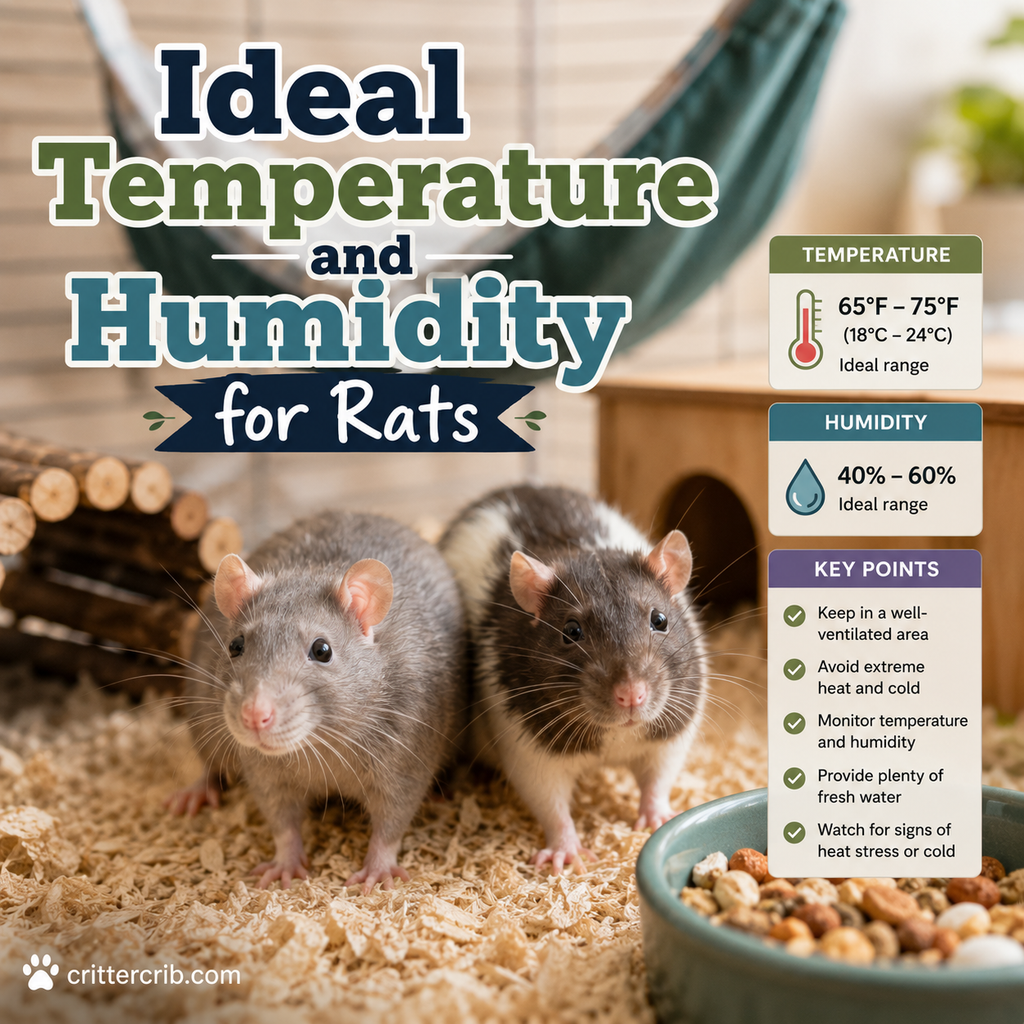
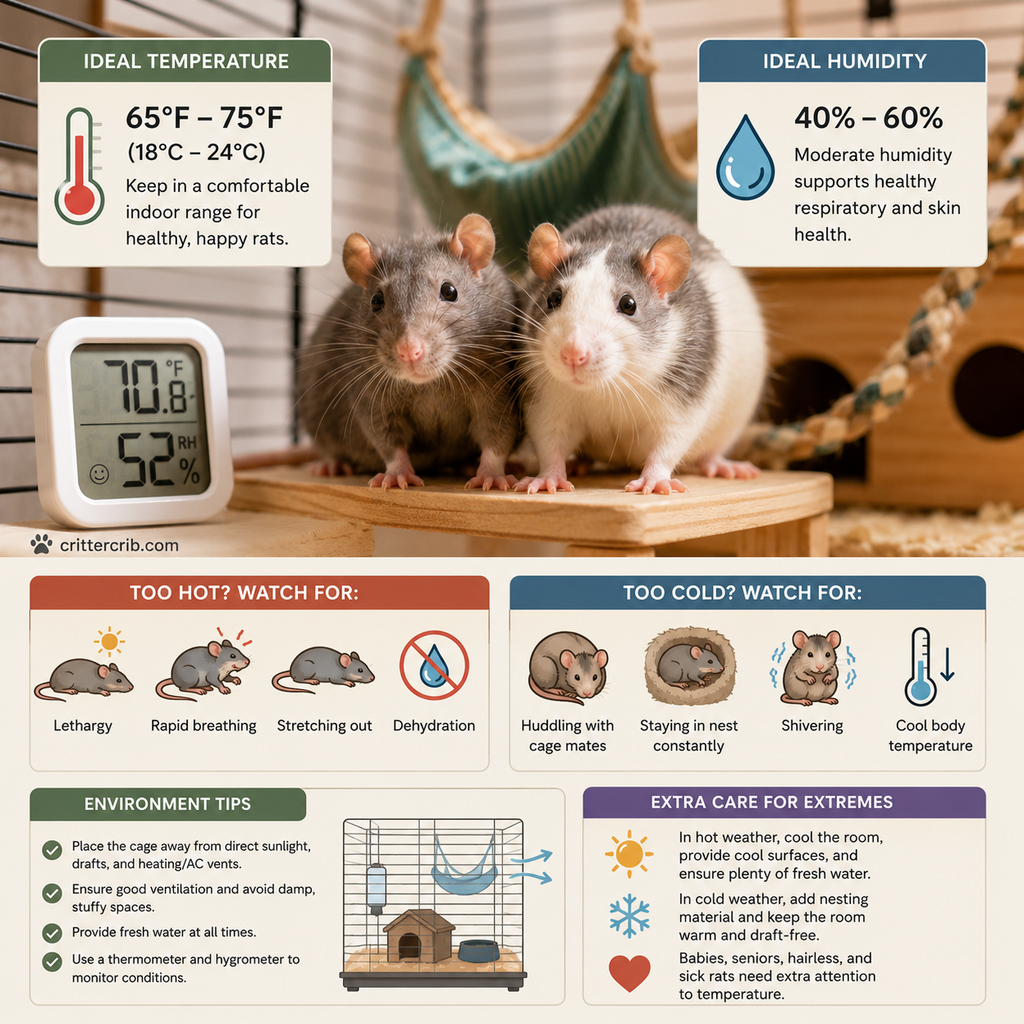
A comfortable temperature for most pet rats is generally around 65°F to 75°F (18°C to 24°C).
Healthy adult rats can usually tolerate normal fluctuations within a comfortable household environment. The room doesn’t need to remain at exactly 70°F around the clock.
The bigger concern is prolonged exposure to excessive heat or cold.
Factors that can affect an individual rat’s comfort include:
- Age
- Health
- Body condition
- Coat type
- Activity level
- Humidity
- Ventilation
- Bedding
- Whether other rats are available for warmth
Very young, elderly, sick, or hairless rats may require additional attention.
Instead of relying entirely on how the room feels to you, place a digital thermometer near the cage. This gives you a much better idea of the conditions your rats are actually experiencing.
What Temperature Is Too Hot for Rats?
Once room temperatures begin climbing toward 80°F (27°C) and above, it’s a good idea to pay much closer attention to your rats.
The hotter the environment becomes, the greater the risk of heat stress.
High humidity, poor airflow, direct sunlight, dehydration, obesity, age, and illness can make warm conditions more difficult to tolerate.
A cage positioned in direct sunlight can also become considerably warmer than the rest of the room.
Don’t assume that because your thermostat reads 75°F, every part of the room is the same temperature.
Signs a Rat May Be Too Hot
Watch for changes such as:
- Lethargy
- Rapid or unusual breathing
- Lying stretched out
- Reduced activity
- Weakness
- Excessive salivation
- Reluctance to move
- Reduced responsiveness
Severe overheating can become an emergency.
If a rat appears seriously overheated, move it to a cooler environment and contact a veterinarian promptly.
Avoid extreme cooling methods such as plunging an overheated rat into ice water. Sudden temperature changes can create additional stress.
How Do Rats Keep Themselves Cool?
Rats don’t rely on sweating over their bodies to cool themselves like humans.
They use other strategies to regulate heat, including behavioral changes and increased blood flow to areas such as the tail.
You may notice a warm rat:
- Stretching out
- Choosing cooler surfaces
- Becoming less active
- Sleeping away from cage mates
- Seeking areas with better airflow
These behaviors can help, but they only work up to a point.
A rat can’t compensate indefinitely for an excessively hot room.
That’s why controlling the surrounding environment is so important during summer.
How to Keep Rats Cool in Summer
If your home gets warm, start cooling the environment before conditions become extreme.
Air conditioning is one of the most effective options.
You can also:
- Close blinds or curtains during the hottest part of the day
- Move the cage away from sunny windows
- Improve room ventilation
- Provide cool ceramic tiles or similar safe surfaces
- Keep fresh water constantly available
- Use chilled items wrapped safely so rats can choose to rest nearby
- Check the room temperature more frequently
Your rats should always be able to move away from any cooling item.
Can You Use a Fan Around Rats?
A fan can help circulate air through the room, but don’t aim a strong stream of air directly into the cage for hours at a time.
Fans also don’t actually reduce room temperature in the same way an air conditioner does.
During very hot weather, simply pointing a fan at the cage may not be enough.
Use it as part of your overall temperature-control strategy rather than your only cooling method.
What Temperature Is Too Cold for Rats?
Pet rats should be protected from prolonged exposure to low temperatures, especially when cold conditions are combined with drafts or damp bedding.
Once the room begins dropping below roughly 60°F (16°C), monitor your rats and their environment more carefully.
A brief temperature fluctuation isn’t necessarily an emergency for a healthy adult rat, but persistently cold conditions aren’t ideal.
Some rats are more vulnerable than others.
Rats That May Be More Sensitive to Cold
Take additional precautions with:
- Hairless rats
- Young rats
- Senior rats
- Underweight rats
- Sick rats
- Rats recovering from surgery or illness
Hairless rats deserve particular attention because they don’t have a normal coat providing insulation.
Signs Your Rat May Be Too Cold
A cold rat may:
- Huddle closely with cage mates
- Spend more time inside nests
- Curl tightly while resting
- Become less active
- Seek warm areas
- Feel unusually cool
- Shiver
Some of these behaviors can also occur when a rat is sick.
If your rat becomes unusually lethargic, stops eating, has breathing problems, or behaves significantly differently from normal, don’t assume the room temperature is the only explanation.
Contact a veterinarian.
How to Keep Rats Warm in Winter
The easiest solution is usually maintaining a comfortable room temperature.
Avoid placing the cage directly next to a heater.
Instead, warm the room itself.
You can also:
- Move the cage away from drafty windows and doors.
- Provide plenty of clean, dry nesting material.
- Make sure sleeping areas are comfortable and protected.
- Monitor temperatures near the cage.
- Keep bedding dry.
- Avoid sudden changes in temperature.
Don’t use unsafe heating pads or electrical devices where rats can reach and chew the cords.
Rats are extremely good at finding electrical cables that you thought were inaccessible.
What Is the Ideal Humidity for Rats?
A moderate relative humidity of around 40% to 60% is a reasonable target for a pet rat’s indoor environment.
Small fluctuations outside that range aren’t necessarily a problem.
The goal is to avoid persistently extreme humidity.
Excessive humidity can make hot temperatures more uncomfortable and contribute to a damp cage environment.
Very dry air may irritate the respiratory tract and dry the skin, particularly during winter when indoor heating is running constantly.
A digital hygrometer makes humidity easy to monitor.
Many inexpensive devices display both temperature and humidity at the same time.
Why Humidity Matters for Pet Rats
Rats have sensitive respiratory systems.
That makes overall air quality especially important.
Humidity is only one part of the equation.
You should also pay attention to:
- Ventilation
- Ammonia buildup
- Dust
- Bedding quality
- Cage cleanliness
- Smoke
- Strong fragrances
- Household chemicals
A room with moderate humidity can still be unhealthy if the cage has poor ventilation or heavily soiled bedding.
Likewise, constantly trying to achieve an exact humidity percentage won’t compensate for poor cage maintenance.
Think of humidity as one part of maintaining clean, comfortable air.
Why Temperature and Humidity Work Together
Temperature and humidity affect how comfortable an environment feels.
Consider two rooms that are both 78°F.
One has moderate humidity and good air circulation.
The other is extremely humid with stagnant air.
The second room can be much harder for your rats to tolerate even though the thermometer shows the same temperature.
That’s especially important during summer.
If both temperature and humidity are climbing, start making adjustments early rather than waiting for obvious signs of heat stress.
Where Should You Put a Rat Cage?
Cage location can make a surprisingly big difference.
Choose an indoor area with relatively stable temperature, good airflow, and normal household activity.
Avoid putting the cage:
- In direct sunlight
- Beside a radiator
- Directly in front of a heater
- Beneath an air-conditioning vent
- Next to a drafty window
- Against an exterior door that’s frequently opened
- In a damp basement
- In an uninsulated garage
- In a poorly ventilated closet or small enclosed room
Rats are social animals, so placing the cage somewhere they’re completely isolated from household activity isn’t ideal either.
Look for a balance: a comfortable room where they can interact with you without being exposed to constant noise or environmental extremes.
Watch for Direct Sunlight
A cage beside a window may seem fine when you leave for work in the morning.
Several hours later, the sun may be shining directly onto it.
Direct sunlight can create localized heat quickly.
This is particularly concerning when rats can’t move completely away from the heated portion of the cage.
Check the cage location at different times of day.
Seasonal changes also affect where sunlight enters your home, so a safe location in winter may receive much stronger sun during another part of the year.
Should You Keep a Thermometer Near the Rat Cage?
Yes.
A small digital thermometer and hygrometer is one of the easiest additions you can make to your rat setup.
Place it near the cage at approximately the same height as your rats.
Avoid putting the sensor:
- Directly beside an AC vent
- Against a radiator
- In direct sunlight
- Right next to a humidifier or dehumidifier
Those locations can produce readings that don’t accurately represent the overall cage environment.
A device that records daily high and low readings can be especially useful.
You’ll be able to see how warm or cold the room became while you were sleeping or away from home.
Cage Ventilation Is Extremely Important
A rat enclosure needs good ventilation.
This is one reason wire cages are commonly used for pet rats.
Solid-sided containers with poor airflow can allow moisture, odor, and ammonia from urine to accumulate.
That can create an unhealthy environment for animals with sensitive respiratory systems.
Good ventilation doesn’t mean exposing your rats to strong drafts.
You want consistent air exchange throughout the room and cage without continuously blowing cold or hot air directly at them.
How Bedding Affects Humidity and Air Quality
Bedding plays a major role in managing moisture.
Good rat bedding should be absorbent and relatively low in dust.
Wet bedding can:
- Increase moisture inside the cage
- Create unpleasant odors
- Allow ammonia to accumulate
- Make cold conditions more uncomfortable
- Reduce overall air quality
Spot-clean heavily soiled areas regularly.
Pay particular attention to:
- Litter boxes
- Favorite sleeping areas
- Corners
- Areas beneath water bottles
- Fabric hammocks
- Nesting material
Fabric bedding and hammocks can hold urine even when they don’t immediately look dirty.
Wash them regularly.
Avoid Strong Fragrances Around Rats
Good air quality isn’t just about temperature and humidity.
Rats have sensitive respiratory systems, so be cautious with strongly scented products around their cage.
Avoid using products such as:
- Aerosol air fresheners
- Strongly scented bedding
- Heavy perfumes near the cage
- Scented cleaning sprays
- Smoke
- Essential oil diffusers near the enclosure
Don’t use fragrance to hide cage odor.
If the enclosure smells strongly, clean the source.
Fresh air and good hygiene are better solutions than adding another scent.
Should You Use a Humidifier?
A humidifier may be useful if your home becomes extremely dry, but it isn’t automatically necessary for pet rats.
Check the actual humidity first.
If humidity is already within a moderate range, adding more moisture could create a different problem.
If you do use a humidifier:
- Keep it clean
- Follow the manufacturer’s maintenance instructions
- Monitor humidity with a hygrometer
- Don’t direct mist into the cage
- Avoid adding fragrances or essential oils
Poorly maintained humidifiers can spread microorganisms into the air.
The goal is comfortable room humidity, not a damp enclosure.
Should You Use a Dehumidifier?
A dehumidifier can be helpful in persistently humid homes.
This is especially useful in warm climates or damp rooms where humidity regularly becomes excessive.
As with a humidifier, monitor the room rather than guessing.
Place the unit somewhere safe where rats can’t reach electrical cords during free-roaming time.
Hairless Rats and Temperature
Hairless rats may require a little more attention to environmental temperature because they don’t have a normal fur coat.
They can lose body heat more easily.
Provide warm, comfortable sleeping areas with suitable nesting material and keep their enclosure away from drafts.
Compatible cage mates can also provide warmth when sleeping together.
At the same time, don’t overheat the room.
Hairless rats still need a comfortable, moderate environment rather than excessive heat.
Baby, Senior, and Sick Rats
General temperature guidelines are most useful for healthy adult rats.
Individual needs can vary.
Young, elderly, underweight, or ill rats may have more difficulty regulating body temperature.
A rat recovering from surgery may also have specific environmental requirements.
If your veterinarian recommends a particular temperature range for a sick or recovering rat, follow that advice rather than relying on general guidelines.
Common Temperature and Humidity Mistakes
Most environmental problems are fairly easy to prevent.
Common mistakes include:
- Putting the cage in direct sunlight
- Keeping rats in an unventilated enclosure
- Placing the cage directly beside a heater
- Blowing an AC vent or fan continuously into the cage
- Allowing bedding to remain damp
- Ignoring high humidity during hot weather
- Letting ammonia odors build up
- Using heavily scented products to cover cage smells
- Assuming the temperature is the same throughout the house
- Not monitoring conditions during heat waves
- Leaving rats in garages, sheds, or other poorly controlled spaces
A simple temperature and humidity monitor eliminates much of the guesswork.
Keeping Rats Comfortable During a Power Outage
Power outages can become a problem during extreme summer or winter weather.
If air conditioning stops during a heat wave, move your rats to the coolest safe part of the home.
Keep them out of sunlight and provide fresh water.
During cold weather, move the cage away from exterior walls and drafts and provide extra nesting material.
If indoor conditions are becoming unsafe and you have access to another climate-controlled location, temporary relocation may be the safest option.
Planning ahead is especially worthwhile if extreme weather is common where you live.
Creating a Comfortable Environment Year-Round
Keeping pet rats comfortable doesn’t require obsessing over the thermostat.
For most homes, aim for a room temperature around 65°F to 75°F (18°C to 24°C) and moderate relative humidity of roughly 40% to 60%.
Then focus on the bigger picture.
Provide good ventilation, absorbent low-dust bedding, clean sleeping areas, fresh water, and protection from direct sunlight and drafts.
Keep a digital thermometer and hygrometer near the cage so you know what’s actually happening rather than relying entirely on how the room feels.
During heat waves and cold snaps, check conditions more frequently.
Most importantly, learn your rats’ normal behavior.
If they suddenly become unusually lethargic, stop eating, have difficulty breathing, or otherwise appear unwell, don’t assume adjusting the thermostat will solve the problem.
Environmental comfort matters, but significant behavioral or physical changes may require veterinary attention.
With a stable indoor environment, good ventilation, and basic monitoring, keeping rats comfortable throughout the year is usually straightforward.