

Pet rats may be small, but their housing shouldn’t be.
Rats are active, intelligent, social animals. They climb, explore, wrestle, forage, sleep together, hide food, investigate new objects, and sometimes decide the entire cage needs rearranging at three in the morning.
All of that takes space.
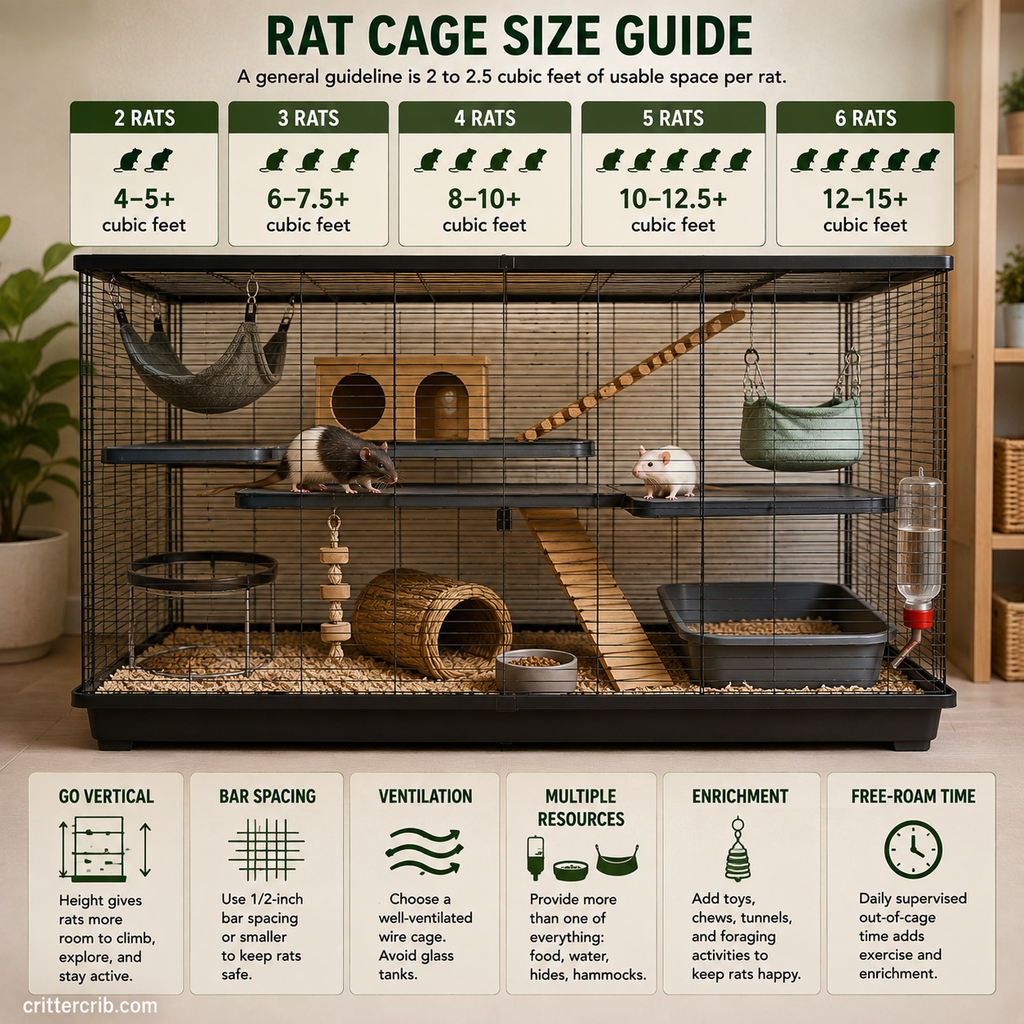
As a general starting point, many rat owners plan for roughly 2 to 2.5 cubic feet of cage space per rat, but cage volume alone doesn’t tell the whole story. The shape of the enclosure, bar spacing, ventilation, number of rats, usable floor area, climbing opportunities, and interior layout all matter.
A tall empty cage isn’t automatically a good rat cage, and neither is a wide enclosure packed so tightly with accessories that the rats can barely move.
Here’s how to figure out how much space your rats need and create a habitat that actually works for them.
Why Rats Need Plenty of Space
Rats aren’t animals that simply eat, sleep, and occasionally use an exercise wheel.
They’re highly interactive with their surroundings.
A well-designed enclosure allows rats to:
- Climb
- Explore
- Forage
- Play
- Wrestle
- Hide
- Rest
- Build nests
- Move away from cage mates
- Investigate enrichment
Space becomes especially important because rats generally shouldn’t be housed alone without a specific reason.
If you’re keeping two, three, four, or more rats together, the enclosure needs enough room for the entire group to use resources without constantly crowding one another.
How Much Cage Space Does a Rat Need?
A commonly used starting guideline is approximately 2 to 2.5 cubic feet of cage volume per rat.
Using that guideline:
- 2 rats: approximately 4–5+ cubic feet
- 3 rats: approximately 6–7.5+ cubic feet
- 4 rats: approximately 8–10+ cubic feet
- 5 rats: approximately 10–12.5+ cubic feet
- 6 rats: approximately 12–15+ cubic feet
These numbers should be treated as a starting point rather than a goal to stay underneath.
More appropriate usable space is generally beneficial when the enclosure is safely designed and furnished.
Why Cage Calculators Aren’t Perfect
You may encounter online rat cage calculators that estimate how many rats can fit inside an enclosure based on its dimensions.
These can be useful for an initial check.
However, a calculator doesn’t know whether the cage has:
- Poor ventilation
- Unsafe bar spacing
- Huge gaps between levels
- Very little usable floor space
- Dangerous shelves
- An awkward shape
- Too many accessories
- Inadequate climbing opportunities
Use volume as one measurement, not the only measurement.
How Much Space Do Two Rats Need?
For two rats, aim for at least roughly 4 to 5 cubic feet of appropriately designed cage space, with additional room strongly preferred.
A pair needs enough room to interact while still being able to separate when desired.
The cage should comfortably accommodate:
- Multiple sleeping areas
- Food and water
- Litter areas
- Hammocks
- Climbing routes
- Enrichment
- Open movement
Don’t buy the smallest cage advertised for “two rats” without checking its actual dimensions.
Manufacturer animal recommendations aren’t always reliable.
Why You Should Plan for at Least Two Rats
Rats are highly social.
Human interaction is valuable, but it doesn’t fully replace living with compatible members of their own species.
A companion can provide:
- Social grooming
- Wrestling
- Sleeping together
- Communication
- Play
- Constant companionship
If you’re getting rats for the first time, designing your habitat around a pair or small compatible group makes more sense than buying a tiny enclosure for one.
How Much Space Do Three Rats Need?
For three rats, approximately 6 to 7.5 cubic feet is a useful minimum starting range.
Again, larger is often preferable.
A trio needs more than just additional physical volume.
You’ll also need to think about resource distribution.
Can all three rats access water?
Are there several sleeping spots?
Can one rat leave an interaction without becoming trapped in a corner?
A good enclosure gives the rats options.
How Much Space Do Four Rats Need?
For four rats, roughly 8 to 10 cubic feet is a reasonable starting point, but a spacious enclosure designed for groups is preferable.
At this size, cage layout becomes increasingly important.
You’ll likely need:
- Multiple hammocks
- Several hides
- More than one water source
- Plenty of climbing routes
- Multiple feeding opportunities
- More litter capacity
- Open areas for movement
Simply adding rats to an enclosure that was comfortable for two isn’t a good long-term plan.
If you expect your group to grow, buying a larger cage from the beginning can save money later.
What About Five or Six Rats?
Larger groups need substantially more room.
Using the rough 2 to 2.5 cubic feet per rat guideline:
- 5 rats: around 10–12.5+ cubic feet
- 6 rats: around 12–15+ cubic feet
With groups this size, look beyond the raw numbers.
Watch how the animals use the cage.
There should be enough space and resources that one dominant rat can’t easily control every desirable sleeping area, food location, or water source.
Large cages also need to remain practical to clean.
A massive enclosure isn’t useful if its design prevents you from reaching half of it.
How to Calculate Rat Cage Size
To calculate cage volume, measure the usable interior:
Length × Width × Height = Cubic Volume
If you’re measuring in inches, divide the result by 1,728 to convert cubic inches to cubic feet.
For example, imagine a cage measuring:
36 inches × 24 inches × 36 inches
Multiply:
36 × 24 × 36 = 31,104 cubic inches
Then divide by 1,728:
31,104 ÷ 1,728 = 18 cubic feet
The enclosure has approximately 18 cubic feet of total interior volume.
That sounds enormous compared with the minimum guidelines, but remember that total volume isn’t the same thing as usable living space.
The cage still needs to be safely furnished.
Is Floor Space or Height More Important for Rats?
Unlike guinea pigs, rats can make excellent use of vertical space.
They are natural climbers and often enjoy moving between different levels.
That makes a tall cage useful—but only if the height is actually usable.
An empty vertical box isn’t enough.
Your rats need ways to move through the space safely.
You can create usable vertical territory with:
- Shelves
- Ropes
- Hammocks
- Ladders
- Bridges
- Perches
- Baskets
- Climbing nets
- Safe branches
At the same time, don’t neglect horizontal floor space.
Rats still need room to walk, wrestle, forage, and move around without climbing every second of the day.
How Tall Should a Rat Cage Be?
There’s no single ideal height that works for every cage.
Instead, focus on whether the cage allows climbing and multiple activity zones without creating dangerous falls.
A taller cage can be excellent for young, active rats when it’s furnished thoughtfully.
For older rats or rats with mobility problems, a very tall setup may require modifications.
You may need:
- Lower hammocks
- More intermediate shelves
- Gentle ramps
- Fall-breakers
- Easier access to food and water
The best cage adapts to the rats living in it.
Rat Cage Bar Spacing Matters
A spacious cage is useless if your rats can squeeze through the bars.
Young rats and smaller females can fit through surprisingly narrow openings.
Around 1/2-inch bar spacing is often preferred for rats because it can safely accommodate smaller individuals.
Larger adult males may be contained by wider spacing in some cases, but choosing narrower spacing from the beginning gives you greater flexibility.
If a rat can get its head through an opening, escape may be possible.
Horizontal Bars Are Useful
Horizontal bars can provide additional climbing opportunities.
They also make it easier to attach:
- Hammocks
- Shelves
- Toys
- Ropes
- Baskets
- Water bottles
Good cage bars become part of the habitat rather than simply the walls around it.
Why Ventilation Is Important
Rats produce urine and waste, and ammonia can accumulate in poorly ventilated housing.
For this reason, good airflow is essential.
Wire-sided cages are generally preferred over enclosed glass tanks as permanent rat housing because they provide much better ventilation.
A large aquarium may look spacious, but limited airflow can make it unsuitable as a primary habitat.
Don’t Confuse Drafts With Ventilation
Rats need fresh airflow, but that doesn’t mean placing the cage directly beside an air-conditioning vent or open window.
Choose a well-ventilated room without exposing the animals to strong drafts or extreme temperature changes.
What Should Go Inside a Rat Cage?
Once you choose a suitable cage, you’ll need to turn that empty space into a functional habitat.
A good rat enclosure may include:
- Bedding or substrate
- Litter trays
- Hammocks
- Hides
- Nesting materials
- Food
- Water
- Chew items
- Ropes
- Platforms
- Tunnels
- Baskets
- Foraging activities
- Climbing structures
The goal isn’t to create an interior-design showroom.
Rats don’t care whether the hammocks match.
They care whether the environment gives them interesting things to do.
How Much Bedding Do Rats Need?
The bottom of the cage should provide an appropriate surface for walking, digging, foraging, and absorbing waste.
The best bedding arrangement depends on your cage design.
A deeper substrate area can encourage:
- Digging
- Foraging
- Nesting
- Exploration
Choose a rat-appropriate, absorbent, low-dust substrate.
Avoid strongly scented materials or excessively dusty bedding.
Give Rats Somewhere to Dig
Even if your cage can’t accommodate deep bedding across the entire bottom, you can provide a dedicated digging area.
A dig box can add valuable enrichment.
Just make sure whatever substrate you use is safe and suitable for rats.
Hammocks and Sleeping Areas
Many rats love hammocks.
Some love them so much that they immediately chew a new entrance through the side.
Provide several sleeping options throughout the enclosure.
These might include:
- Hammocks
- Fabric cubes
- Baskets
- Boxes
- Wooden hides
- Covered sleeping areas
Multiple sleeping locations allow rats to choose whether they want to pile together or sleep separately.
Check fabric accessories frequently for loose threads or damage.
How Many Hides Do Rats Need?
There’s no exact number, but a group should have multiple places to retreat.
Avoid creating one highly desirable sleeping location and nothing else.
Provide options at different levels.
A shy rat may prefer an enclosed hide near the bottom while another spends every afternoon asleep in the highest hammock.
Variety gives them choice.
Food and Water Setup for Multiple Rats
Rats living together need reliable access to food and water.
For larger groups, multiple water sources are a smart precaution.
If one bottle stops working, the animals still have another source.
Check water bottles every day for:
- Leaks
- Blockages
- Damage
- Low water
- Dirty drinking tubes
You can also distribute food in ways that encourage foraging rather than always using one bowl.
Scatter feeding appropriate dry food through clean substrate can encourage natural searching behavior.
Do Rats Need an Exercise Wheel?
A properly sized wheel can provide additional exercise, although it isn’t a substitute for a spacious cage or out-of-cage activity.
If you offer one, it needs to be large enough for the rat to run without severely curving its spine.
Tiny hamster wheels aren’t appropriate.
Choose a wheel with:
- A large diameter
- Solid running surface
- Stable construction
- No dangerous gaps
Some rats love wheels.
Others will completely ignore them.
Rats Need Climbing Opportunities
One of the biggest advantages of a tall rat cage is the ability to create climbing routes.
Ropes, nets, branches, bridges, and hammocks can turn unused airspace into valuable activity areas.
Arrange climbing objects so rats have more than one route through the cage.
This creates a more interesting environment and prevents the setup from depending on a single ladder.
Prevent Dangerous Falls
Rats are capable climbers, but they can still fall.
A very tall cage should include fall-breakers.
Strategically placed hammocks, nets, baskets, and platforms can prevent a rat from falling all the way from the top of the enclosure to the bottom.
This becomes increasingly important for:
- Older rats
- Overweight rats
- Rats with mobility problems
- Rats recovering from illness or injury
Reevaluate the cage as your rats age.
Do Rats Need Free-Roam Time?
A spacious cage is essential, but rats also benefit from regular opportunities to explore outside it in a safe, controlled environment.
Out-of-cage time can provide:
- Additional exercise
- Interaction with you
- New smells and objects
- Training opportunities
- Foraging
- Exploration
The area must be thoroughly rat-proofed.
Rat-Proofing a Play Area
Before letting rats explore, check for:
- Electrical cords
- Toxic plants
- Small holes
- Reclining furniture
- Open doors
- Unsafe foods
- Cleaning chemicals
- Medications
- Small swallowable objects
- Access behind appliances
Don’t underestimate their ability to find tiny gaps.
If you’re wondering whether a rat can squeeze behind something, assume the answer is probably yes until you’ve checked.
Does Free-Roam Time Make Up for a Small Cage?
No.
Out-of-cage exercise is valuable, but it doesn’t replace appropriate permanent housing.
Your rats still spend a substantial amount of time inside their enclosure.
They need enough room to climb, play, sleep, forage, and interact even when you’re unavailable to supervise them.
Think of free-roam time as additional enrichment, not compensation for an undersized cage.
Where Should You Put a Rat Cage?
Choose an indoor location where your rats can experience normal household activity without being overwhelmed by it.
A good cage location should be:
- Away from direct sunlight
- Away from strong drafts
- Away from heating vents
- Protected from extreme temperatures
- Safe from other pets
- Away from constant loud noise
- Easy for you to access
Don’t hide the cage in a forgotten room simply because rats are nocturnal.
Rats benefit from regular interaction and observation.
How Cage Size Affects Cleaning
Bigger cages aren’t necessarily harder to maintain.
In some ways, they can be easier.
Waste is distributed across a larger area, and you can create specific zones for:
- Litter
- Sleeping
- Feeding
- Digging
- Foraging
However, cage design matters.
Large front doors can make an enormous difference.
A cage with tiny access doors can turn a five-minute hammock change into an unnecessarily frustrating project.
Before buying a cage, imagine trying to remove a litter tray from the back corner.
If that already sounds difficult, keep looking.
How Often Should You Clean a Rat Cage?
Cleaning frequency depends on:
- Number of rats
- Cage size
- Bedding
- Litter habits
- Cage layout
- Individual behavior
Spot clean regularly by removing wet substrate, spoiled food, and heavily soiled material.
Perform more thorough cleaning as needed.
Avoid allowing urine and waste to build up until odor becomes overwhelming.
At the same time, you don’t necessarily need to sterilize every accessory constantly.
A consistent cleaning routine is easier than waiting for the cage to become extremely dirty.
Signs Your Rat Cage May Be Too Small
There isn’t one behavior that proves a cage is undersized, but some practical signs suggest you should reassess the setup.
Ask yourself:
- Is there enough room for all rats to move comfortably?
- Can they climb and explore?
- Are sleeping areas constantly overcrowded?
- Can rats get away from one another?
- Is there room for enrichment?
- Can you provide multiple resources?
- Does the cage become dirty extremely quickly?
- Is most usable space occupied by basic necessities?
If adding a hammock means there’s no longer room to move through half the cage, you probably need more space.
Common Rat Housing Mistakes
A large cage alone doesn’t guarantee good housing.
Avoid these common problems.
Keeping a Rat Alone
Rats are highly social animals.
Unless there’s a specific reason for solitary housing, plan for compatible rat companionship.
Choosing a Cage Based on the Pet Store Label
A cage being marketed for rats doesn’t automatically mean it’s appropriately sized.
Check the actual measurements.
Using an Aquarium as Permanent Housing
Poor ventilation makes enclosed glass tanks a poor choice for long-term rat housing.
Ignoring Bar Spacing
A large cage with wide bars may become an expensive escape route for young or small rats.
Leaving the Cage Empty
Rats need more than physical volume.
Turn that volume into usable space with climbing structures, hides, hammocks, substrate, and enrichment.
Overcrowding the Cage With Accessories
There’s a difference between enrichment and clutter.
Rats need pathways and room to move.
Forgetting Fall Protection
Tall cages need intermediate surfaces to reduce dangerous fall distances.
Using a Tiny Wheel
Exercise equipment should match the animal’s size.
Don’t assume a product is appropriate just because it’s located in the small-animal aisle.
Relying on Free-Roam Time to Compensate
Even rats that receive regular out-of-cage exercise need suitable permanent housing.
Choosing a Cage for Young Rats
Young rats create a special challenge because they’re smaller and often more energetic than adults.
Pay particular attention to bar spacing.
A cage that easily contains a large adult male may not contain a young female.
Young rats also benefit from plenty of:
- Climbing
- Foraging
- Chewing
- Exploration
- Social play
Make sure the layout is interesting without creating dangerous fall distances.
Adjusting Housing for Senior Rats
A cage that worked perfectly when your rats were six months old may need changes as they age.
Senior rats can develop reduced mobility.
You might need to:
- Lower food and water
- Add ramps
- Reduce climbing difficulty
- Add more fall-breakers
- Lower hammocks
- Provide softer resting areas
- Move litter trays closer
- Create easier routes between levels
You don’t necessarily need to remove all climbing opportunities.
Instead, make important resources accessible without requiring difficult movement.
Should You Buy a Bigger Rat Cage Than You Need?
If you have the space, budget, and ability to furnish it properly, buying a larger cage can be a smart choice.
It gives you:
- More enrichment options
- Better resource distribution
- More room for a growing group
- Additional sleeping areas
- More climbing routes
- Greater flexibility as rats age
Just remember that bigger isn’t automatically better if the cage has unsafe spacing, poor accessibility, or an impractical layout.
Quality of space matters alongside quantity.
Rat Cage Size Checklist
Before buying an enclosure, ask:
Size
- Is there enough total space for my number of rats?
- Is there useful horizontal floor space?
- Is there enough height for climbing?
Safety
- Is the bar spacing appropriate?
- Are the doors secure?
- Can I prevent dangerous falls?
- Are there sharp edges or trapping hazards?
Ventilation
- Does the cage provide good airflow?
- Can I keep it away from strong drafts?
Accessibility
- Are the doors large?
- Can I reach every corner?
- Can litter trays and accessories be removed easily?
Enrichment
- Is there room for hammocks?
- Can I add climbing routes?
- Is there room for hides and digging?
- Will the rats still have open movement space?
Long-Term Use
- Will this cage work as my rats grow?
- Can I modify it for senior rats?
- Is there room if I eventually expand the group?
Thinking about these questions before buying can prevent an expensive upgrade a few months later.
Frequently Asked Questions About Rat Cage Size
How much cage space do two rats need?
A useful starting point is approximately 4 to 5 cubic feet for two rats, based on a rough guideline of 2 to 2.5 cubic feet per rat.
However, more usable space is preferable.
The cage should also provide adequate floor area, height, ventilation, enrichment, and appropriate bar spacing.
Is 2 cubic feet per rat enough?
Two cubic feet per rat is commonly used as a minimum guideline, but it shouldn’t be treated as an ideal maximum.
Cage design and usable space matter just as much as calculated volume.
Whenever practical, give your rats more room.
Do rats need a tall cage?
Rats benefit from vertical space because they’re capable climbers.
A tall cage works best when you turn that height into usable territory with hammocks, platforms, ropes, branches, and other climbing structures.
Is a tank okay for rats?
Glass tanks generally aren’t recommended as primary long-term housing for rats because they provide much less ventilation than a wire cage.
Good airflow is important for maintaining a healthy environment.
What bar spacing is best for rats?
Approximately 1/2-inch bar spacing is a versatile choice, especially if you keep young rats or smaller females.
Larger spacing may allow smaller rats to escape.
Can rats live alone?
Rats are highly social and generally benefit from compatible rat companionship.
There are individual circumstances where temporary or long-term solitary housing may be necessary, but keeping one rat alone shouldn’t be the default plan.
Do rats need bedding if they have fleece?
Cage flooring systems vary.
Even when fleece or another washable liner is used in part of the enclosure, rats can benefit from opportunities to dig and forage in an appropriate substrate.
A dedicated dig box or deeper substrate area can provide this enrichment.
How much space do four rats need?
Using a rough guideline of 2 to 2.5 cubic feet per rat, four rats would need at least approximately 8 to 10 cubic feet as a starting point.
A larger well-designed enclosure can provide more flexibility for a group.
Can a rat cage be too big?
For a healthy group, a larger appropriately furnished enclosure is generally beneficial.
The bigger concern is whether the space is safe and usable.
A huge cage with dangerous falls, inaccessible resources, or no enrichment isn’t automatically better than a somewhat smaller cage with an excellent layout.
Final Thoughts: Give Rats Space to Explore
So, how much space do rats need?
A rough starting guideline of around 2 to 2.5 cubic feet per rat can help you compare cages, but don’t let one calculation make the decision for you.
For two rats, that means roughly 4 to 5 cubic feet or more. Three rats need around 6 to 7.5 cubic feet or more, while four need roughly 8 to 10 cubic feet or more.
Whenever practical, go larger.
Then make that space useful.
Add hammocks, hides, climbing routes, appropriate substrate, foraging opportunities, litter areas, and safe enrichment while preserving enough open space for your rats to move comfortably.
Pay attention to ventilation and bar spacing. Make sure the cage is easy to clean. Add fall protection to tall setups, and adjust the layout as your rats get older.
Most importantly, remember that rats don’t experience a cage as a set of dimensions.
To them, it’s where they sleep, play, climb, wrestle, eat, explore, hide things, and spend time with their companions.
Give them enough room to do all of it.