Isopods might not be the first animals that come to mind when you think about handling a pet. They’re tiny, delicate, and often much more interested in hiding beneath a piece of cork bark than interacting with a human.
Still, if you keep isopods as pets, there will be times when you need to move or inspect them. You might want to check on a colony, transfer individuals to a new enclosure, photograph an interesting color morph, or simply get a closer look.
The key is learning how to handle isopods without injuring or unnecessarily stressing them.
And what about building trust? Isopods don’t bond with people the way a dog, bird, or even some reptiles might. But you can create a predictable environment where they are less likely to immediately retreat whenever you open the enclosure.
Here’s how to interact with isopods safely while keeping their needs first.
Can You Handle Isopods?
Yes, most commonly kept terrestrial isopods can be handled briefly and carefully.
That doesn’t necessarily mean they enjoy it.
Isopods are small crustaceans with behaviors centered largely around finding food, maintaining moisture, reproducing, and avoiding threats. Being picked up by something hundreds or thousands of times their size isn’t a natural social interaction.
For that reason, handling is best kept occasional rather than becoming a daily routine.
Brief handling is useful for:
- Moving isopods between enclosures
- Inspecting an individual
- Checking health or coloration
- Separating juveniles or adults
- Taking photographs
- Showing an isopod to someone carefully
If there’s no reason to disturb them, observing them inside their enclosure is usually the better choice.
Do Isopods Recognize Their Owners?
There’s no good reason to assume pet isopods recognize their owners in the same way that more socially complex animals can.
They respond primarily to environmental cues such as moisture, light, temperature, food, shelter, and physical disturbance.
So when people talk about “building trust” with isopods, it’s helpful to keep expectations realistic.
You’re not trying to make an isopod emotionally attached to you.
Instead, you’re creating predictable, low-stress interactions.
An established colony kept under appropriate conditions may become more visible and active over time. That can feel like the animals are becoming comfortable with you, but it’s more useful to think of it as them becoming comfortable within their environment.
Are Isopods Safe to Touch?
Common pet isopods are generally safe to handle with clean hands.
They aren’t venomous and don’t have stingers. Some species have stronger defensive behaviors than others, but pet isopods aren’t animals you generally need to fear touching.
The greater risk during normal handling is usually to the isopod rather than the person.
Because they’re so small, an accidental squeeze, fall, or rough movement can cause injury.
There are also hygiene considerations whenever you’re interacting with animals, substrate, decaying leaves, soil, or enclosure materials.
Wash your hands after working with an isopod enclosure and avoid touching your face or eating while handling enclosure contents.
Why Isopods Are More Delicate Than They Look
An isopod’s armored appearance can make it seem surprisingly tough.
Their segmented exoskeleton provides protection, but they’re still tiny animals that can be injured by relatively little force.
Terrestrial isopods also rely on specialized respiratory structures that need appropriate moisture to function properly. Keeping an isopod in a dry environment for too long isn’t a good idea.
Handling introduces several potential risks:
- Accidental crushing
- Dropping
- Excessive dryness
- Sudden temperature changes
- Chemical residue on your hands
- Prolonged stress
- Escape
Most of these problems are easy to avoid with gentle, brief handling.
How to Handle an Isopod Safely
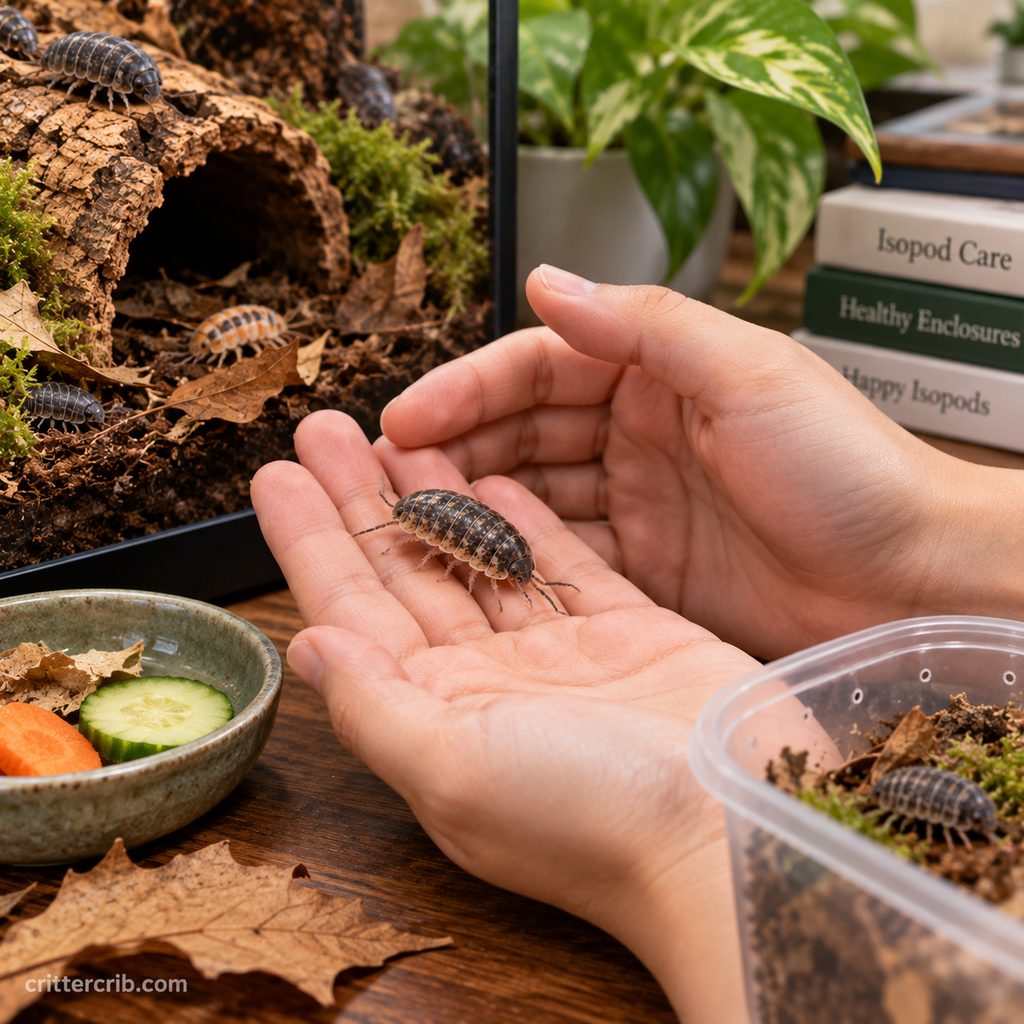
If you need to pick up an isopod, prepare before touching it.
You don’t want to be holding a tiny animal while suddenly realizing you haven’t opened the destination container.
1. Wash and Rinse Your Hands
Make sure your hands are clean and thoroughly rinsed.
Soap residue, lotion, sanitizer, perfume, cleaning products, nicotine, pesticides, and other chemicals may be harmful to small invertebrates.
If you’ve recently applied something to your hands, using a clean spoon, leaf, piece of bark, or soft tool to transfer the isopod may be preferable.
2. Handle Close to a Surface
Don’t hold an isopod several feet above the floor.
Instead, work directly over:
- The enclosure
- A table
- A shallow container
- Another protected surface
Keeping your hands low greatly reduces the consequences if the isopod walks off unexpectedly.
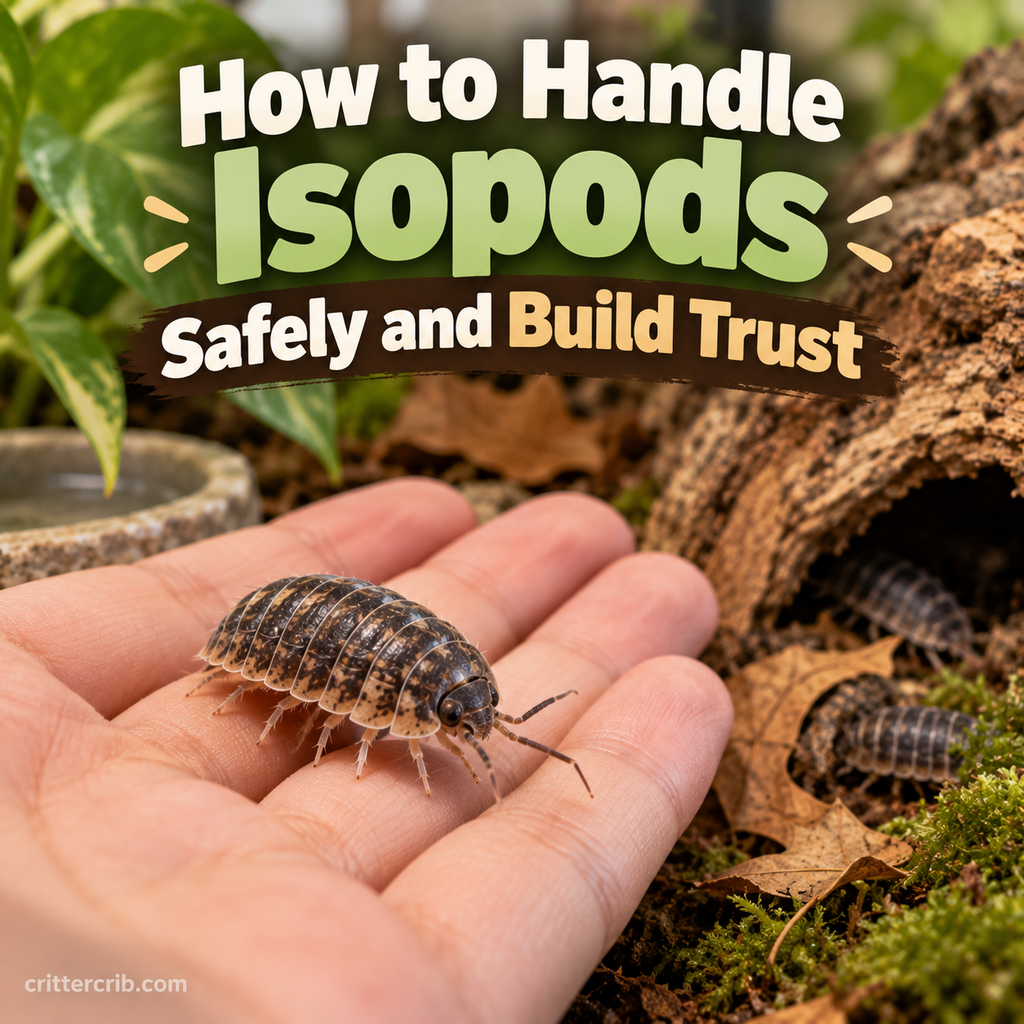
3. Let the Isopod Walk Onto You
Whenever possible, avoid pinching an isopod between your fingers.
Place your hand nearby and gently encourage the animal to walk onto your palm or finger.
Another option is to let it crawl onto a leaf or small piece of bark and then move the entire object.
This is often easier on both you and the isopod.
4. Keep Your Hand Flat
A flat palm provides a large, stable surface.
Let the isopod explore without constantly repositioning it.
If it approaches the edge of your hand, place your other hand beside it and allow it to walk across naturally.
Think of your hands as moving platforms rather than something used to restrain the animal.
5. Keep Handling Sessions Short
A few minutes is plenty for most interactions.
Remember that the conditions outside the enclosure may be warmer, colder, brighter, or considerably drier than the environment the isopod normally experiences.
Once you’ve finished inspecting or moving it, return it gently to the enclosure.
The Safest Way to Pick Up a Tiny Isopod
Very small isopods and juveniles can be especially difficult to handle directly.
Rather than trying to grab them with your fingers, use something they’re already standing on.
For example, you can move:
- A small leaf
- A piece of cork bark
- A spoonful of substrate
- A small piece of decaying wood
You can also gently guide the isopod into a small container.
This dramatically reduces the chance of accidentally applying too much pressure.
For extremely tiny juveniles, transferring some of the surrounding substrate is often safer than attempting to handle them individually.
Never Grab an Isopod by Its Legs or Antennae
Isopod legs and antennae are small and vulnerable.
Don’t attempt to stop an escaping isopod by grabbing one of its appendages.
Instead, place your hand or another surface in front of it and allow the animal to walk onto it.
If an isopod is clinging firmly to bark, don’t forcibly pull it away.
Encourage it to move or transfer the bark along with the animal.
Patience is much safer than force.
What If Your Isopod Rolls Into a Ball?
Some isopods, particularly species capable of conglobation, defend themselves by curling into a ball.
If an isopod rolls up while you’re handling it, don’t try to force it open.
Place it gently on your palm or return it to the enclosure and give it time.
Curling up is a defensive response. Repeatedly poking or manipulating the animal until it uncurls only adds more disturbance.
Once it feels safe again, it should eventually resume normal activity.
How to Build “Trust” With Isopods
Building trust with isopods isn’t about training them to seek human attention.
Instead, focus on reducing unnecessary disturbance and making their environment predictable.
Maintain Stable Enclosure Conditions
A healthy colony is more likely to display normal behaviors.
Make sure your setup provides:
- A proper moisture gradient
- Adequate ventilation
- Deep enough substrate
- Plenty of leaf litter
- Decaying wood when appropriate
- Calcium sources
- Suitable supplemental foods
- Hiding places
- Species-appropriate temperature
An isopod that constantly feels exposed or is struggling with poor conditions isn’t going to behave naturally.
Approach the Enclosure Gently
Opening the enclosure doesn’t need to resemble an earthquake.
Avoid slamming the lid, rapidly flipping pieces of bark, or digging through the substrate unnecessarily.
Slow, deliberate movements reduce disturbance.
Use Food to Encourage Observation
Food is one of the easiest ways to see isopods without handling them.
Small amounts of suitable supplemental food can encourage individuals to emerge from hiding.
Depending on the species and colony, appropriate foods may include:
- Vegetables
- Small amounts of fruit
- Dried leaves
- Decaying hardwood
- Species-appropriate protein sources
- Commercial isopod foods
Remove fresh foods before they become excessively moldy or attract unwanted pests.
Over time, you may learn when your colony is most active and which foods reliably bring them into view.
Don’t Constantly Lift Their Hides
It’s tempting to check underneath every piece of cork bark whenever you walk past the enclosure.
Try to resist.
Hides provide the dark, humid microhabitats isopods depend on. Constantly exposing them to light and disturbance defeats the purpose.
Observe exposed individuals and save more invasive colony checks for when they’re actually necessary.
How Often Should You Handle Isopods?
There’s no required handling schedule.
Unlike pets that benefit from regular social interaction, isopods don’t need handling for companionship.
For casual pet keeping, occasional brief handling is enough.
If you find yourself picking up the animals every day purely for entertainment, consider observing them in their enclosure instead.
A well-designed isopod habitat can be fascinating to watch.
You may see feeding, burrowing, climbing, mating, juveniles gathering around food, and individuals exploring after the lights go down—all without touching them.
When You Should Avoid Handling Isopods
There are situations where it’s better to leave an isopod alone.
During or Immediately After Molting
Isopods molt their exoskeleton in two stages, typically shedding the rear portion and then the front portion.
A freshly molted isopod can appear unusually pale or soft.
Its new exoskeleton needs time to harden.
Avoid handling an isopod that appears to be molting or has recently molted. Moving it unnecessarily during this vulnerable period can increase the risk of injury.
When the Isopod Is Very Small
Tiny juveniles are difficult to manipulate safely.
If they need to be transferred, move the substrate or material they’re sitting on instead.
When Your Hands Have Chemical Residue
Don’t handle isopods after applying:
- Hand sanitizer
- Lotion
- Sunscreen
- Insect repellent
- Cleaning products
- Fragrances
- Medicated creams
Wash and rinse your hands thoroughly first, or use a safe transfer method that doesn’t require direct contact.
When Conditions Outside the Enclosure Are Extreme
Avoid prolonged handling in very hot, cold, or dry conditions.
The enclosure exists partly to maintain the microclimate your isopods require.
There’s little benefit in removing them from it unnecessarily.
Can Children Handle Isopods?
Isopods can be interesting animals for children to observe, but handling should be closely supervised.
The biggest concern is accidental injury to the animal.
Children may squeeze an isopod without realizing how little pressure they’re applying or drop one while trying to prevent it from crawling away.
If a child is going to handle an isopod:
- Have them sit at a table or on the floor.
- Ask them to keep their hand open and flat.
- Place the isopod gently onto their palm.
- Don’t allow squeezing or poking.
- Keep the interaction brief.
- Return the isopod to its enclosure.
- Have them wash their hands afterward.
For younger children, observing the colony through the enclosure may be a better option.
Moving Isopods to a New Enclosure
Transferring an entire colony is different from handling a single isopod.
Trying to pick up every individual by hand is unnecessary and makes it easy to overlook tiny juveniles.
Instead, move habitat materials gradually.
You can transfer:
- Substrate
- Leaf litter
- Cork bark
- Decaying wood
- Moss
- Other colony materials
Inspect both the old enclosure and transferred materials carefully.
Juveniles can be extremely small and easy to miss.
Leaving a little food in the old enclosure after the main transfer can sometimes help reveal individuals that remained hidden.
What to Do If You Drop an Isopod
Accidents happen.
If you drop an isopod, don’t immediately grab at it.
First, locate it carefully and prevent it from disappearing beneath furniture or into carpet.
Place your hand, a leaf, a spoon, or a small container in its path and gently encourage it aboard.
Inspect the isopod for obvious injury and return it to its enclosure.
If it appears injured, minimize further disturbance and keep its environmental conditions stable.
This is another reason handling close to a table or directly over the enclosure is so important.
Can Isopods Bite?
Isopods have mouthparts designed for feeding, and some species may investigate surfaces they encounter. However, commonly kept terrestrial isopods aren’t generally considered a biting hazard to people.
You don’t need gloves because you’re worried about being attacked.
If you prefer not to touch them directly, that’s perfectly fine too. Using leaves, bark, spoons, or small containers can be just as effective for routine transfers.
Signs an Isopod Wants to Be Left Alone
We can’t know exactly how an isopod experiences stress, but defensive or escape behaviors are good reasons to end an interaction.
Return the isopod to its enclosure if it:
- Repeatedly attempts to escape your hand
- Curls tightly into a defensive ball
- Remains unusually motionless after disturbance
- Frantically searches for cover
You don’t need to make an isopod “get used to” being handled.
If it clearly responds defensively, putting it back is the simplest solution.
Observation Is Better Than Frequent Handling
One of the best parts of keeping isopods is watching a miniature ecosystem develop.
Instead of treating them like traditional handling pets, create an enclosure that lets you observe natural behavior.
Add cork bark, leaf litter, decaying wood, moss where appropriate, and varied terrain. Then watch what happens.
Once a colony becomes established, you may notice far more activity than you expected from animals often dismissed as simple “cleanup crews.”
You’ll see individuals searching for food, disappearing into the substrate, gathering beneath hides, and eventually tiny juveniles appearing throughout the enclosure.
That natural behavior is usually much more interesting than repeatedly holding an individual isopod.
Common Isopod Handling Mistakes
Safe handling mostly comes down to avoiding unnecessary risks.
Some of the most common mistakes include:
- Pinching an isopod between your fingertips
- Pulling one from a surface it’s gripping
- Handling from standing height
- Keeping an isopod out of its enclosure too long
- Handling with lotion or chemical residue on your hands
- Disturbing freshly molted individuals
- Picking up tiny juveniles unnecessarily
- Constantly opening the enclosure to interact with the colony
- Assuming frequent handling is necessary for socialization
Gentle handling is much easier when you allow the isopod to do most of the moving itself.
Frequently Asked Questions
Do isopods like being handled?
There’s no evidence that isopods enjoy human handling. It’s better to view handling as something they can tolerate briefly when done carefully rather than an activity they need or seek out.
Can I hold my isopods every day?
You could potentially handle some individuals frequently without obvious problems, but there’s little reason to do so. Isopods don’t require daily handling for socialization, and unnecessary handling introduces additional opportunities for stress or injury.
Can isopods recognize you?
There isn’t good evidence that terrestrial isopods recognize individual owners in the way many vertebrate pets can. Their behavior is strongly influenced by environmental conditions and sensory cues.
Should I wet my hands before handling an isopod?
Your hands shouldn’t be dripping wet. More importantly, they should be clean and free of chemical residue. Keep handling brief so the isopod isn’t exposed to unsuitable conditions for long.
Can you pick an isopod up with your fingers?
It’s possible, but allowing the isopod to walk onto your hand or transferring it on a leaf, bark, or other surface is generally safer than pinching it between your fingers.
Why does my isopod curl into a ball when I touch it?
For species capable of curling up, or conglobating, this is a defensive response. Leave the isopod alone rather than trying to force it open.
Are isopods good handling pets?
Not particularly. They’re better suited to observation than frequent physical interaction. If you enjoy creating naturalistic enclosures and watching small animals behave naturally, however, isopods can be fascinating pets.
Final Thoughts
Learning how to handle isopods safely is mostly about recognizing how small and delicate they are.
Keep your hands clean, work close to a protected surface, avoid pinching or grabbing, and let the isopod walk onto you whenever possible. Most importantly, keep handling sessions short.
As for building trust, don’t expect your isopods to form a relationship with you like a dog or other social pet would. A better goal is to create a stable environment and interact with the colony in a calm, predictable way.
Give them suitable moisture, food, leaf litter, shelter, and plenty of places to hide. Disturb the enclosure only when necessary.
You may find that the less you try to force interaction, the more interesting your isopods become to watch.