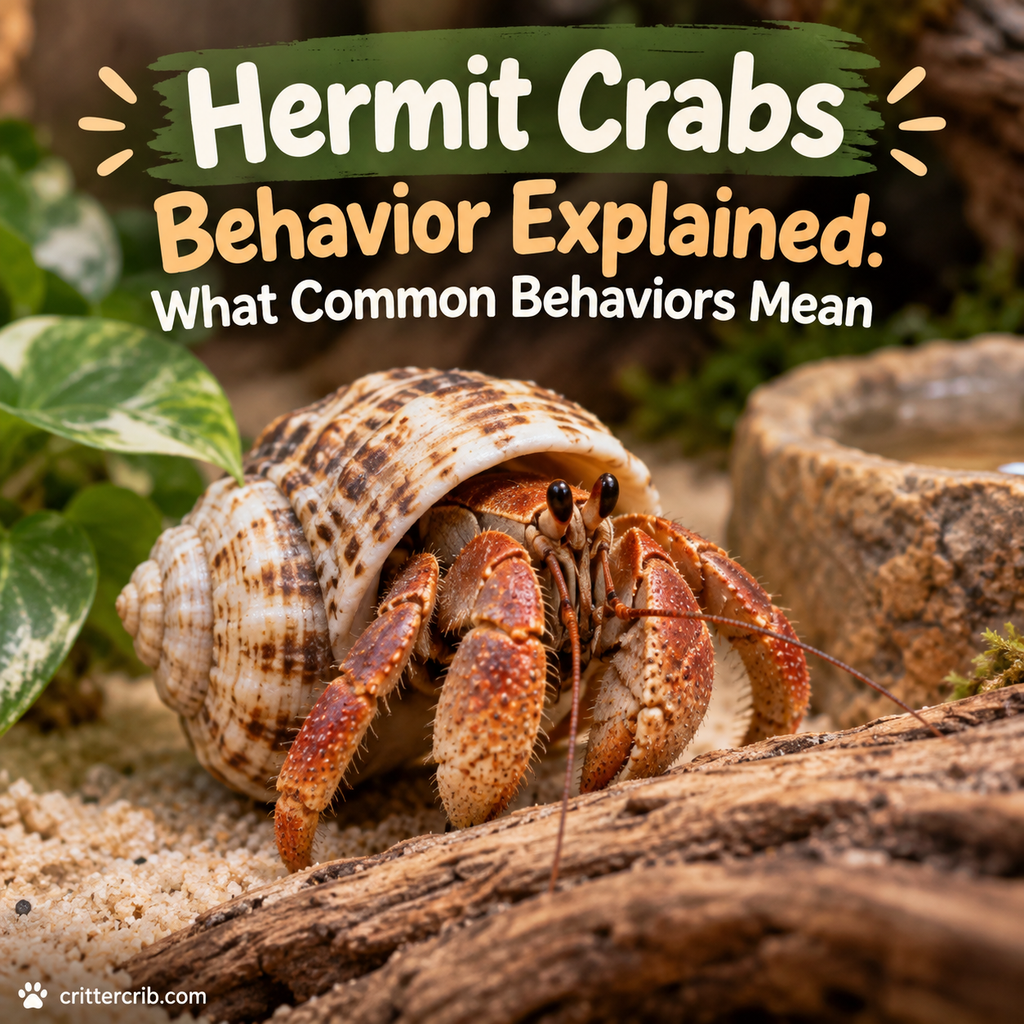
Hermit crabs can be surprisingly expressive little animals. They climb, dig, swap shells, disappear underground, knock things over, and sometimes spend hours doing what looks like absolutely nothing.
If you’re new to keeping hermit crabs, some of these behaviors can be confusing. A crab that suddenly buries itself might seem sick. One that keeps changing shells might look uncomfortable. And when two crabs interact, it isn’t always obvious whether they’re socializing or fighting.
Many of these behaviors are completely normal. Others can tell you something important about your hermit crab’s environment, health, or relationships with its tank mates.
Understanding the difference makes hermit crab care much easier.
Why Hermit Crab Behavior Can Be Hard to Read
Hermit crabs don’t behave like mammals, and they aren’t always easy to interpret.
They are prey animals with strong instincts to hide, protect themselves, and conserve moisture. They are also primarily nocturnal, so a tank that seems quiet during the afternoon may become surprisingly active after the lights go out.
Their behavior is influenced by several factors, including:
- Temperature
- Humidity
- Light and darkness
- Molting
- Shell availability
- Food
- Stress
- Tank mates
- Recent changes to their enclosure
- Individual personality
This means one behavior doesn’t always have one explanation.
Digging, for example, can mean a crab is preparing to molt, looking for moisture, exploring the substrate, cooling down, or simply doing what hermit crabs naturally do.
Context matters.
Why Is My Hermit Crab Digging?
Digging is one of the most common hermit crab behaviors, and in most cases, it’s perfectly normal.
Land hermit crabs naturally spend time digging and burrowing. In captivity, they may dig to explore, regulate moisture and temperature, hide, or prepare for a molt.
A crab may also dig after being introduced to a new enclosure. Everything is unfamiliar, and burrowing provides a secure place to retreat.
Digging Before a Molt
One important reason hermit crabs dig is to molt.
As a hermit crab grows, it periodically sheds its old exoskeleton and develops a new one. Because the crab is extremely vulnerable during this process, it usually buries itself beneath the substrate.
A crab preparing to molt may:
- Dig more frequently
- Spend more time near the substrate
- Eat more than usual before disappearing
- Become less active
- Seek secluded areas
- Stay underground for an extended period
If a hermit crab buries itself, avoid digging it up just to check on it. Disturbing an underground molting crab can seriously interfere with the process.
Why Does My Hermit Crab Hide All the Time?
Hiding is another normal hermit crab behavior.
Hermit crabs naturally seek protected areas where they feel less exposed. In an enclosure, they may hide beneath cork bark, inside caves, behind decorations, under plants, or beneath the substrate.
They’re especially likely to hide during the day because many land hermit crabs become more active at night.
A crab may also hide more than usual after:
- Being moved to a new enclosure
- Coming home from a pet store
- A major tank rearrangement
- A stressful interaction with another crab
- Changes in temperature or humidity
- Preparing to molt
A newly acquired hermit crab may take time to settle in. Constantly removing it from hiding places or handling it can make that adjustment harder.
Why Is My Hermit Crab More Active at Night?
If your hermit crab seems boring all day and suddenly turns into an explorer after dark, that’s normal.
Land hermit crabs tend to be much more active during the evening and nighttime hours. Darkness offers protection and often coincides with environmental conditions that are more comfortable for them.
At night you may notice your crab:
- Climbing
- Digging
- Eating
- Drinking
- Exploring the enclosure
- Trying different shells
- Interacting with other crabs
- Rearranging lightweight decorations
You may even hear scratching or tapping from the enclosure.
Owners sometimes assume their hermit crab isn’t active because they rarely see it moving. Checking the tank shortly after dark may reveal a completely different animal.
Why Is My Hermit Crab Climbing Everything?
Hermit crabs are enthusiastic climbers.
In nature, land hermit crabs encounter roots, branches, rocks, vegetation, bark, and uneven terrain. Climbing allows them to explore their surroundings and search for resources.
A crab climbing around its enclosure is generally a good sign that it’s active and engaging with its environment.
Safe climbing opportunities can include:
- Cork bark
- Natural branches
- Cholla wood
- Climbing nets made from safe materials
- Sturdy artificial plants
- Textured enclosure decorations
Make sure climbing structures are stable. Hermit crabs are stronger than they look and can shift lightweight objects.
They aren’t particularly graceful, either. Falls happen.
Avoid placing hard or sharp objects where a falling crab could be injured.
Why Is My Hermit Crab Trying to Escape?
Climbing and exploring shouldn’t automatically be mistaken for an escape attempt.
Hermit crabs are naturally curious and may repeatedly investigate the walls, corners, lid, and equipment inside their enclosure.
However, persistent attempts to get out can be a reason to double-check the habitat.
Look at:
- Temperature
- Humidity
- Substrate depth and condition
- Access to fresh and marine-grade saltwater
- Hiding places
- Overcrowding
- Overall enclosure security
An unsuitable environment can contribute to restless behavior.
At the same time, a crab climbing toward the top of the enclosure isn’t proof that something is wrong. Some crabs simply love climbing.
Why Does My Hermit Crab Keep Changing Shells?
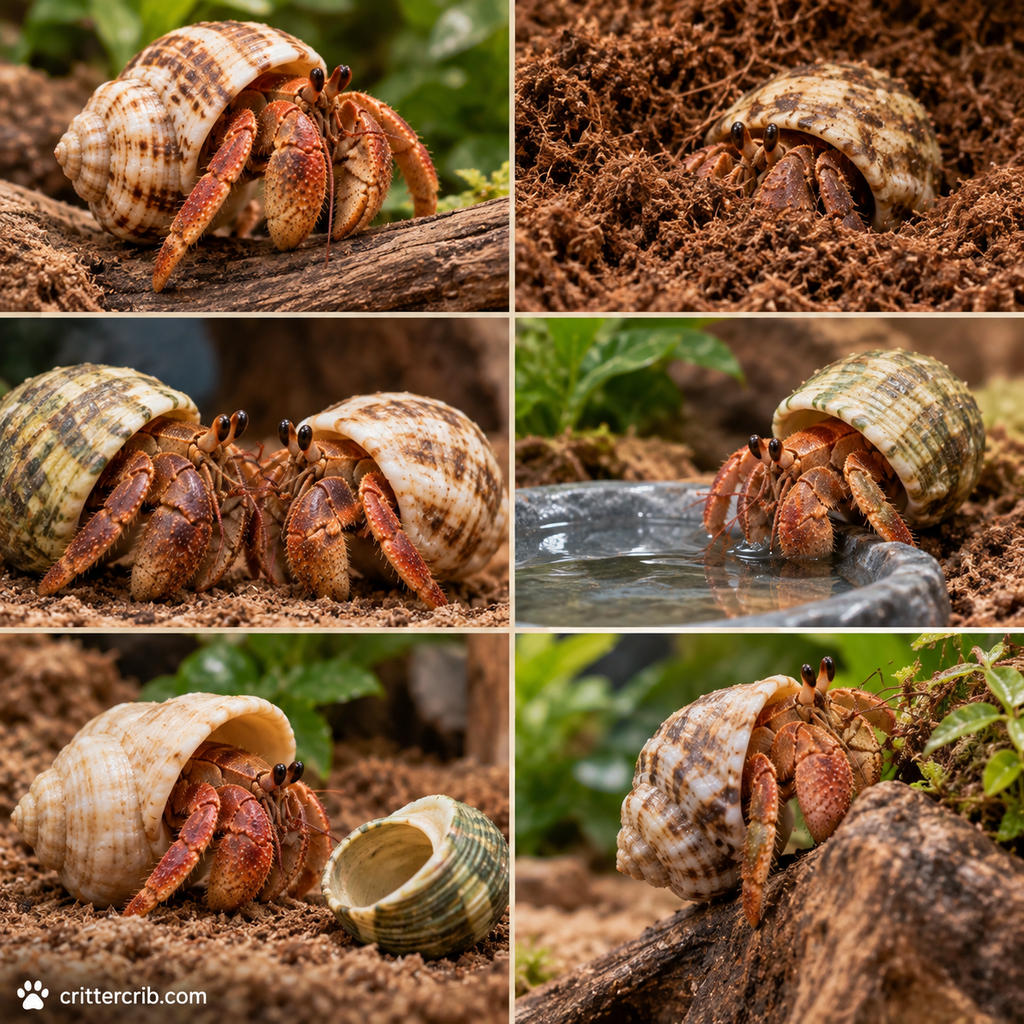
Shell changing is one of the most fascinating hermit crab behaviors.
Unlike snails, hermit crabs don’t grow their own protective shell. Instead, they occupy empty gastropod shells and switch to different ones as their bodies grow or their preferences change.
A hermit crab may inspect several shells before choosing one.
It might:
- Tap a shell with its legs
- Turn the shell around
- Examine the opening
- Reach inside
- Switch shells and immediately switch back
- Try several shells in a short period
This can look indecisive, but shell selection is important.
Why Shell Choice Matters
A shell needs to provide protection while still allowing the crab to move comfortably.
Hermit crabs can be surprisingly picky about shell shape, opening, weight, and condition. Preferences can also vary by species.
Provide multiple appropriately sized natural shells rather than assuming one spare shell is enough.
Having plenty of suitable choices also reduces competition between tank mates.
Painted shells are best avoided. Natural, appropriately sized shells are the safer choice.
Why Is My Hermit Crab Sitting Still?
A motionless hermit crab isn’t necessarily sick.
Hermit crabs regularly rest, especially during daylight hours. They may sit in one location for long periods before becoming active later.
A crab may also remain still when:
- Sleeping or resting
- Feeling threatened
- Adjusting to a new environment
- Conserving moisture
- Preparing to molt
- Recovering from stress
The surrounding circumstances are more useful than inactivity alone.
If the crab remains unusually inactive and other changes appear at the same time, check the enclosure conditions carefully.
Why Does My Hermit Crab Freeze When I Approach?
Freezing is a defensive response.
Hermit crabs are prey animals, and sudden movement nearby can trigger an instinct to stop moving or retreat into their shell.
Your crab doesn’t understand that the enormous creature approaching the tank is only there to refill the food dish.
Some crabs become more accustomed to normal household activity over time, while others remain cautious.
Move calmly around the enclosure and avoid repeatedly tapping the glass, grabbing the crab, or forcing it out of its shell.
Why Does My Hermit Crab Retreat Into Its Shell?
The shell is a hermit crab’s portable shelter.
When frightened or disturbed, a crab can pull its body deep inside. Larger claws may help block the shell opening and protect the softer abdomen.
Common triggers include:
- Being picked up
- Sudden movement
- Loud vibrations
- Another crab approaching
- Changes inside the enclosure
Occasional retreating is completely normal.
A crab that spends nearly all of its time withdrawn, however, may be stressed or uncomfortable. Check its habitat and observe whether anything has recently changed.
Why Is My Hermit Crab Chirping?
Yes, hermit crabs can make sounds.
Depending on the species, owners sometimes describe hermit crab vocalizations as chirping, croaking, squeaking, or rasping.
The sound can occur during interactions between crabs or when a crab is disturbed.
If you hear frequent chirping while two crabs are interacting aggressively, pay attention. It may indicate that one crab is being stressed or threatened.
Don’t rely on sound alone, though. Watch their body language and behavior as well.
Why Are My Hermit Crabs Pushing Each Other?
Not every physical interaction is a serious fight.
Hermit crabs may climb over one another, push each other aside, investigate shells, or compete for access to food and preferred locations.
However, aggressive interactions can happen.
One particularly important behavior to watch for is a crab attempting to pull another crab from its shell.
Shell competition can become dangerous.
Providing a generous selection of appropriately sized shells helps reduce one major source of conflict.
You can also reduce competition by providing adequate space and multiple access points to important resources.
How Can I Tell If Hermit Crabs Are Fighting?
Normal interaction and aggression can sometimes look similar.
Pay closer attention if you see:
- Repeatedly grabbing another crab
- Aggressively rocking another crab’s shell
- Attempting to pull a crab from its shell
- Persistent chasing
- Blocking access to food or water
- Repeated distress sounds during confrontations
- Injuries or lost limbs following interactions
If serious aggression occurs, intervention may be necessary.
First look for the reason behind the conflict. Limited shells, overcrowding, inadequate resources, or poor enclosure conditions can increase competition.
Why Does My Hermit Crab Rearrange the Tank?
You carefully arrange the enclosure.
Your hermit crab disagrees.
Many hermit crabs push, drag, climb over, and burrow underneath enclosure decorations. Food dishes may move. Moss gets scattered. Lightweight plants end up somewhere completely different.
This is normal exploratory behavior.
Instead of trying to prevent every bit of rearranging, design the habitat so the crab can explore safely.
Secure heavy objects and make sure decorations can’t collapse onto a crab that digs beneath them.
Think of the enclosure as the crab’s environment rather than a display that needs to remain perfectly arranged.
Why Does My Hermit Crab Dig Under the Water Dish?
Hermit crabs often dig beneath objects because those areas feel protected.
The substrate underneath or around a water dish may also have different moisture characteristics than the surrounding substrate.
The concern isn’t necessarily the digging itself. The concern is whether a heavy dish can shift or collapse onto a buried crab.
Large enclosure items should be positioned securely so digging doesn’t create a hazard.
Why Does My Hermit Crab Spend So Much Time in the Water?
Land hermit crabs need access to water even though they aren’t fully aquatic animals.
They may enter their water pools to wet themselves and maintain the moisture needed for proper respiratory function.
They should generally have access to both:
- Properly treated fresh water
- Properly prepared marine saltwater
Pools should be arranged so the crab can safely enter and climb back out.
Occasional soaking is normal. If behavior suddenly changes and a crab begins spending dramatically more time around water, check the enclosure’s humidity and other environmental conditions.
Why Is My Hermit Crab Eating Strange Things?
Hermit crabs are opportunistic omnivores and natural scavengers.
Their diet can include a wide variety of plant and animal material. They may investigate foods that don’t seem particularly appetizing from a human perspective.
A varied diet can include appropriate sources of:
- Protein
- Calcium
- Healthy fats
- Fruits
- Vegetables
- Leaf litter and other safe natural plant materials
Hermit crabs may also nibble on natural materials inside their habitat.
Always research whether a material is safe before adding it to the enclosure.
Why Is My Hermit Crab Eating Its Molted Exoskeleton?
This behavior can look alarming, but it’s normal and beneficial.
After molting, hermit crabs often consume much of their shed exoskeleton. The old exoskeleton contains valuable nutrients, including minerals that help support recovery.
Don’t automatically remove an exoskeleton from a molting crab.
What looks like discarded waste to us can be an important post-molt food source for the crab.
Why Did My Hermit Crab Disappear Underground?
Few hermit crab behaviors worry new owners more than a crab suddenly vanishing.
A buried crab may stay underground for days or much longer, particularly if it’s molting. The amount of time involved can vary considerably depending on the individual crab and its size.
The most important rule is simple:
Don’t dig up a buried hermit crab unless there is a genuine emergency requiring it.
A molting crab needs protection and isolation while its new exoskeleton hardens. Digging through the substrate to “make sure it’s alive” can cause more harm than leaving it alone.
Continue maintaining appropriate enclosure conditions and allow the crab to emerge when it’s ready.
Why Is My Hermit Crab Suddenly Very Active?
A burst of activity isn’t necessarily a problem.
Hermit crabs may become especially active:
- After dark
- After enclosure conditions improve
- When fresh food is introduced
- After emerging from a molt
- When exploring new decorations
- When new shells become available
Individual personalities matter too.
Some hermit crabs spend much of their time hidden, while others seem determined to inspect every centimeter of their habitat.
Get familiar with your crab’s normal routine. Changes become easier to recognize once you know what “normal” looks like for that particular animal.
Is Glass Surfing Normal in Hermit Crabs?
Repeatedly walking or climbing along the enclosure walls is sometimes called glass surfing.
Occasional glass climbing may simply be exploration. Hermit crabs don’t necessarily understand transparent barriers the way we do.
Persistent glass surfing, however, is worth investigating.
Check whether the crab has enough:
- Space
- Substrate
- Climbing opportunities
- Hiding places
- Shell choices
- Food variety
- Appropriate temperature and humidity
Enrichment matters. A bare enclosure gives an active animal very little to explore.
How Stress Can Affect Hermit Crab Behavior
Stress can cause temporary behavioral changes.
Common sources of stress include:
- Transport
- Frequent handling
- Improper temperature
- Improper humidity
- Poor substrate
- Lack of hiding places
- Inadequate shell choices
- Aggressive tank mates
- Frequent enclosure disturbances
Newly purchased hermit crabs may be especially stressed after transportation and changes in environment.
Give them time to adjust rather than expecting immediate activity.
Normal Behavior vs. Signs Something May Be Wrong
One unusual behavior doesn’t automatically mean your hermit crab is sick.
Look for patterns.
Normal behaviors commonly include:
- Digging
- Burrowing
- Hiding during the day
- Becoming active at night
- Climbing
- Trying different shells
- Rearranging decorations
- Sitting still for extended periods
- Eating a shed exoskeleton
- Spending long periods underground while molting
Behavior deserves closer attention when there is a major unexplained change accompanied by other warning signs.
Potential concerns can include severe lethargy combined with poor enclosure conditions, repeated dangerous aggression, inability to use the legs normally, dropping limbs, or leaving the shell and remaining without one.
If you’re concerned about your hermit crab’s health, first verify temperature, humidity, water, substrate, diet, and shell availability. For suspected illness or injury, seek advice from a veterinarian experienced with exotic invertebrates when possible.
How to Encourage Natural Hermit Crab Behavior
A good hermit crab habitat shouldn’t prevent natural behavior. It should make that behavior possible.
Provide Deep, Suitable Substrate
Hermit crabs need substrate that allows them to dig and create stable burrows, particularly for molting.
The enclosure should provide enough appropriate substrate for the crabs to fully bury themselves.
Offer Plenty of Shell Choices
Don’t wait until a crab obviously needs another shell.
Keep multiple natural shells available in suitable sizes and styles for the species you’re keeping.
Add Places to Climb
Create a three-dimensional environment with safe climbing surfaces such as cork bark, branches, and other appropriate structures.
Provide Hiding Areas
Give your crabs several secure places where they can retreat during the day.
Maintain Proper Humidity and Temperature
Land hermit crabs depend on appropriate environmental conditions.
Research the requirements of the particular species you keep rather than relying on a single generic number for every hermit crab.
Provide Fresh and Saltwater
Offer appropriately prepared fresh and marine saltwater in accessible pools that allow safe entry and exit.
Offer a Varied Diet
Hermit crabs naturally encounter diverse foods. A varied, nutritionally appropriate diet provides both nutrition and enrichment.
Frequently Asked Questions About Hermit Crab Behavior
Do hermit crabs recognize their owners?
Hermit crabs can become accustomed to regular activity around their enclosure, but their behavior shouldn’t be interpreted in the same way as a dog or cat recognizing and bonding with a person.
A crab that stops retreating every time you approach may simply have become more accustomed to your presence and routine.
Are hermit crabs social?
Many commonly kept land hermit crabs naturally occur around other members of their species and can show social interactions in captivity.
However, keeping multiple crabs also means providing enough space and resources to minimize competition.
Why does my hermit crab come out only when I’m asleep?
Hermit crabs are often most active at night. Your crab may spend the day hidden and begin exploring once the enclosure becomes dark and quiet.
Should I dig up a hermit crab that has been buried for a long time?
Generally, no. A buried crab may be molting, and disturbing it can be dangerous.
Maintain appropriate habitat conditions and give it time to emerge naturally unless you’re dealing with a genuine emergency.
Why is my hermit crab staring at me?
What looks like staring is usually the crab observing movement in its surroundings. Hermit crabs use their eyes and other sensory organs to monitor their environment.
It’s probably curious or cautious—not silently judging your enclosure-cleaning technique.
Final Thoughts
Hermit crabs are much more active and complex than their quiet appearance suggests.
Digging, climbing, hiding, changing shells, soaking, rearranging the tank, and disappearing underground are all part of normal hermit crab life. Once you understand these behaviors, the enclosure starts looking less random. You begin to see why your crab is doing what it’s doing.
The key is to look at behavior in context.
A crab hiding during the afternoon is usually nothing to worry about. A crab disappearing underground may simply be molting. A crab climbing all night may be doing exactly what a healthy, curious hermit crab wants to do.
Learn your crab’s routine, provide an environment that supports its natural instincts, and pay attention when several unusual changes happen at once.
The more closely you observe hermit crabs, the easier their strange little habits become to understand.