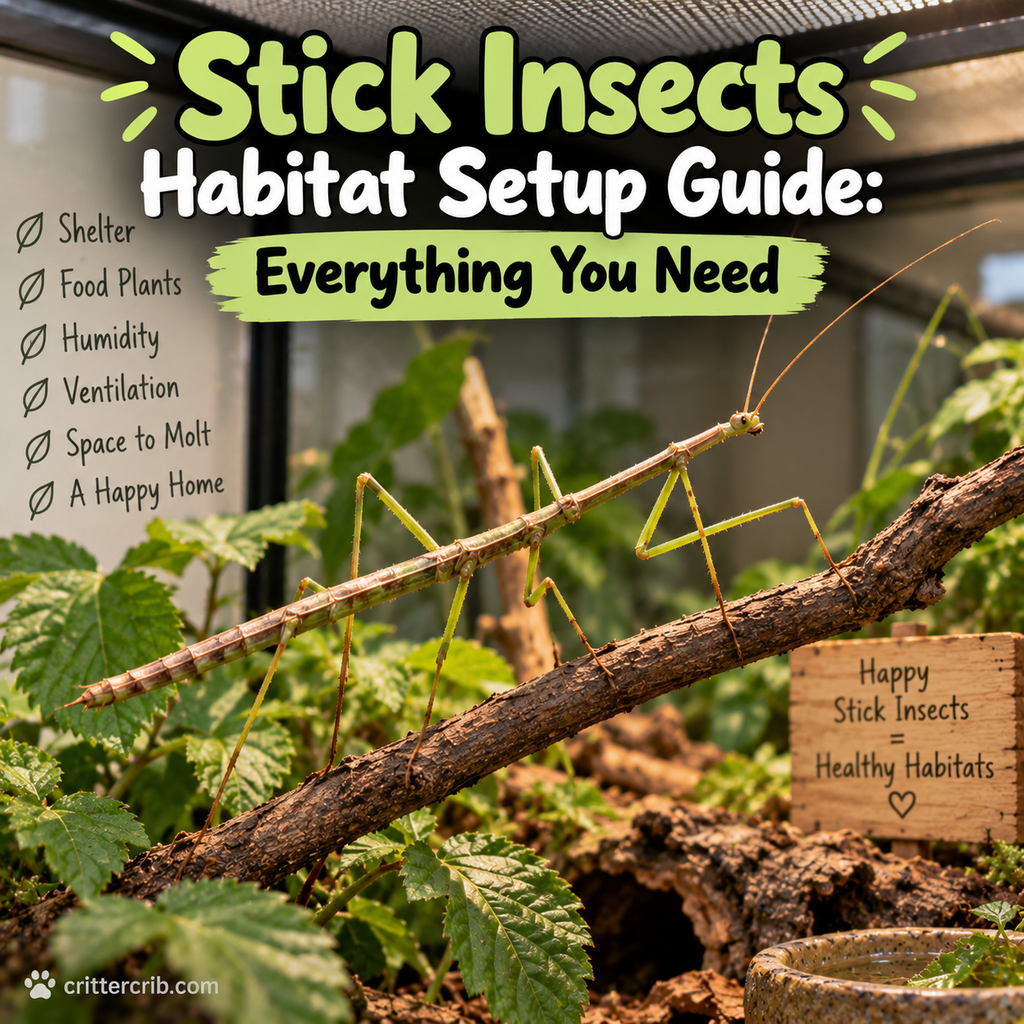
Stick insects are masters of disguise. Put one among a few branches and leaves, look away for a moment, and you may have trouble finding it again.
That natural camouflage is part of what makes them such interesting pets. They’re quiet, don’t require much space compared with traditional pets, and watching them climb, feed, and molt can be surprisingly fascinating.
Their enclosure isn’t difficult to set up, either—but there are a few details you really need to get right.
Vertical space is especially important because stick insects hang upside down while molting. Ventilation, humidity, temperature, and access to fresh food plants also play major roles in keeping them healthy.
If you’re setting up your first stick insect habitat, this guide covers the essentials from choosing an enclosure to maintaining it over the long term.
What Do Stick Insects Need in Their Habitat?
A good stick insect habitat doesn’t need to be elaborate.
At its most basic, the enclosure needs to provide:
- Enough vertical space for climbing and molting
- Good ventilation
- Appropriate temperature
- Species-appropriate humidity
- Fresh food plants
- Secure climbing surfaces
- A safe substrate or enclosure floor
- An escape-proof lid or door
- Easy access for cleaning
The exact requirements depend on the species.
That’s important because “stick insect” describes a huge group of insects found in many different environments. A species from a humid tropical forest won’t necessarily have the same requirements as one adapted to comparatively dry conditions.
Always identify your species before finalizing the habitat.
Choosing the Right Stick Insect Enclosure
Height should be one of your first considerations.
Stick insects are primarily climbing animals. They spend much of their time among branches and vegetation rather than walking around on the enclosure floor.
A tall enclosure generally makes more sense than a short, wide one.
Glass terrariums, mesh enclosures, plastic habitats, and purpose-built insect enclosures can all work depending on the species and conditions you need to maintain.
Whatever you choose, make sure it provides adequate ventilation and closes securely.
Stick insects can squeeze through surprisingly small gaps, particularly when they’re young.
How Big Should a Stick Insect Enclosure Be?
A commonly used guideline is to provide an enclosure at least three times the insect’s body length in height and around two times its body length in width.
For example, a 4-inch stick insect would need approximately 12 inches of usable vertical height at minimum.
More room may be appropriate when keeping multiple insects.
The most important measurement is the unobstructed vertical space beneath a suitable molting perch.
A tall enclosure isn’t useful if decorations fill the entire interior and leave nowhere for the insect to hang.
Why Vertical Space Is So Important
Stick insects grow by shedding their exoskeleton.
During a molt, the insect hangs upside down and gradually pulls itself free from its old skin.
It then hangs beneath the old exoskeleton while its new body expands and hardens.
If the insect touches the floor, a branch, or another obstruction before the molt is complete, it may not be able to fully emerge or straighten its new legs.
That can cause permanent deformities or even death.
Your habitat therefore needs both height and clear open space.
Glass or Mesh: Which Is Better?
Both can work, but they have different advantages.
Glass and Plastic Enclosures
Solid-sided enclosures generally retain humidity more easily.
They can be useful for species that prefer higher humidity, provided adequate ventilation is built into the enclosure.
The downside is that poorly ventilated solid enclosures can become stagnant.
Mesh Enclosures
Mesh provides excellent airflow and lots of climbing surface.
It can also make maintaining high humidity more difficult because moisture escapes quickly.
Mesh enclosures may work particularly well for species that require strong ventilation or moderate humidity.
Your local environment matters too.
A mesh enclosure in humid Florida behaves very differently from the same enclosure in a dry, air-conditioned home.
Choose the enclosure based on both your species and your household conditions.
Ventilation Is Essential
Stick insects need fresh airflow.
An enclosure that is constantly wet with little ventilation can encourage mold and create unhealthy conditions.
At the same time, excessive ventilation may cause the enclosure to dry too quickly.
The goal is balance.
Cross ventilation can be particularly useful. This involves placing ventilation areas at different points so fresh air can move through the habitat.
Signs that ventilation may be inadequate include:
- Persistent heavy condensation
- Musty odors
- Excessive mold
- Surfaces remaining wet for long periods
Don’t solve every humidity problem by sealing the enclosure.
Sometimes the answer is adjusting your misting routine or enclosure type instead.
What Temperature Do Stick Insects Need?
Temperature requirements vary by species.
Many commonly kept stick insects can live comfortably around typical indoor temperatures, but some tropical species prefer warmer conditions.
Research your particular species rather than relying on one universal temperature range.
Avoid sudden temperature swings.
Also keep the enclosure away from:
- Direct sunlight
- Radiators
- Heating vents
- Air-conditioning vents
- Drafty windows
- Hot electronics
Direct sunlight is particularly dangerous.
A clear enclosure can heat up rapidly near a sunny window, potentially reaching dangerous temperatures even when the room itself feels comfortable.
Do Stick Insects Need a Heat Lamp?
Many stick insects kept in climate-controlled homes don’t require a heat lamp.
If the room already remains within an appropriate range for the species, additional heating may be unnecessary.
If supplemental heat is required, use equipment appropriate for small invertebrate enclosures and monitor temperatures carefully with a thermometer.
Avoid creating a habitat where the insect has no way to move away from excessive heat.
Overheating can also dry the enclosure and food plants much faster.
What Humidity Do Stick Insects Need?
There is no single ideal humidity level for all stick insects.
Some species need fairly humid conditions, while others prefer considerably more ventilation and less moisture.
Humidity is especially important around molting because excessively dry conditions may contribute to problems shedding the old exoskeleton.
But constantly soaking the enclosure isn’t the answer.
High moisture combined with poor ventilation can create its own problems.
Aim for the humidity appropriate to your species while maintaining good airflow.
Should You Mist a Stick Insect Enclosure?
For many species, light misting is part of routine care.
Misting can:
- Increase humidity temporarily
- Provide drinking droplets
- Add moisture around food plants
- Help maintain appropriate molting conditions
Stick insects may drink droplets from leaves and enclosure surfaces.
Use a fine mist rather than blasting the insects directly with water.
How often you need to mist depends on the species, enclosure, ventilation, temperature, and humidity in your home.
Some setups dry within hours. Others retain moisture much longer.
Watch the enclosure rather than automatically following a rigid schedule.
What Should You Use for Substrate?
Stick insects don’t usually need a complicated substrate because most of their activity happens above the ground.
Several options can work.
Paper Towel
Paper towel is one of the easiest choices for beginners.
It is inexpensive, makes waste easy to spot, and can be replaced quickly during cleaning.
It’s especially practical if you’re keeping the enclosure primarily for observation and easy maintenance.
Soil or Naturalistic Substrate
Organic soil, coconut fiber, or other appropriate substrates can create a more natural appearance.
They may also help retain humidity.
However, natural substrates require more monitoring for mold and waste.
If your species lays eggs by dropping them onto the ground, substrate choice can also affect how easily you locate and collect the eggs.
Avoid substrates containing pesticides, fertilizers, fragrances, or other potentially harmful additives.
What Branches Should You Put in the Enclosure?
Stick insects need plenty of climbing opportunities.
Branches should extend throughout the enclosure and provide access to the upper areas.
You can use suitable natural branches, food plant stems, or safe artificial structures.
Make sure everything is stable.
A branch shouldn’t collapse when an insect climbs onto it.
Arrange branches so there are good perches near the top while preserving open vertical space underneath for molting.
Can You Use Live Plants?
Live plants can make a stick insect enclosure look fantastic.
They can also provide climbing surfaces and, in some cases, food.
But they add complexity.
You need to make sure:
- The plant is safe for the species
- It hasn’t been treated with pesticides
- Soil doesn’t contain harmful chemicals
- The plant tolerates the enclosure conditions
- It doesn’t overcrowd molting space
For beginners, cut branches of the insect’s food plant are often simpler than maintaining a fully planted enclosure.
What Do Stick Insects Eat?
Stick insects are herbivores, but they don’t all eat the same plants.
Many commonly kept species eat leaves such as:
- Bramble or blackberry
- Rose
- Oak
- Privet
- Ivy
- Eucalyptus
This does not mean every stick insect can eat everything on that list.
Diet is species-specific.
Before getting a stick insect, find out exactly which plants it accepts and make sure you can obtain them throughout the year.
That last part matters more than many beginners realize.
It’s easy to find fresh leaves in summer. Winter can be much more challenging.
How to Keep Food Plants Fresh
Cut branches can be placed in a small container of water to keep them fresh longer.
However, open water creates a drowning risk.
Cover the opening securely with mesh, foil, cotton, or another suitable barrier so the stems can pass through but the insects cannot fall into the water.
This is particularly important for small nymphs.
Replace food when it begins to wilt or dry out.
Fresh leaves are much more appealing and provide moisture as well as nutrition.
Be Careful With Wild-Collected Leaves
Leaves collected outdoors can be excellent food when they’re from a safe plant.
But location matters.
Avoid collecting from areas that may have been treated with pesticides or herbicides, including:
- Roadsides
- Professionally landscaped properties
- Public parks with chemical treatments
- Agricultural areas
- Recently sprayed gardens
When possible, collect from a location you know hasn’t been chemically treated.
Correct plant identification is also essential.
If you’re unsure what a plant is, don’t feed it.
How Should You Arrange a Stick Insect Habitat?
A simple layout usually works best.
Try arranging the enclosure in layers.
Upper Area
Provide secure branches, mesh, or other suitable surfaces for hanging and molting.
Middle Area
Add food branches and additional climbing structures.
Lower Area
Keep the floor relatively open and easy to clean.
The exact arrangement will depend on the species, but avoid turning the habitat into an impenetrable jungle of decorations.
You should still be able to find the insects, replace food, remove waste, and monitor their condition.
Setting Up a Stick Insect Habitat Step by Step
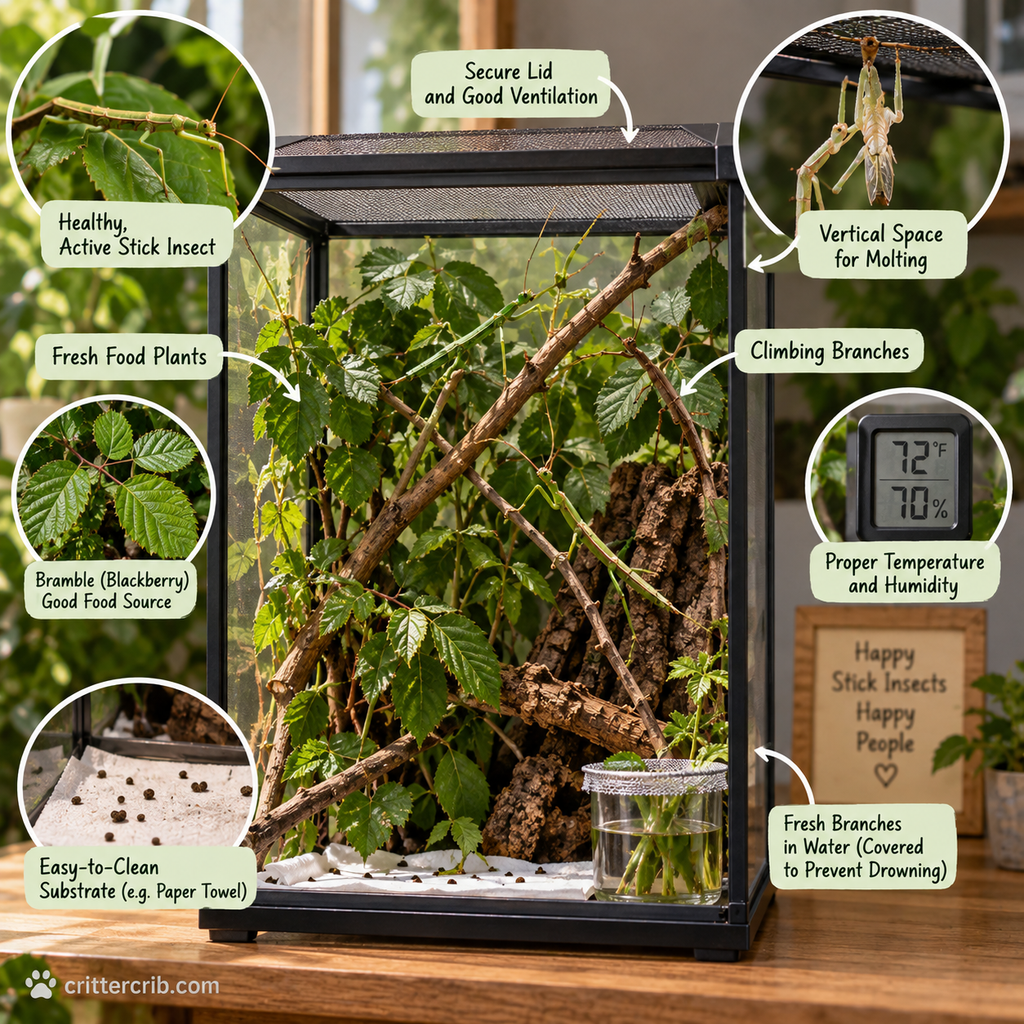
If you’re starting from scratch, use this basic process.
1. Research Your Species
Before buying equipment, determine:
- Adult size
- Temperature range
- Humidity requirements
- Food plants
- Ventilation needs
- Reproductive method
- Expected lifespan
Species identification comes first.
2. Choose a Tall Enclosure
Select a habitat that provides enough vertical space for the insect’s adult size.
Remember to account for decorations and substrate.
3. Establish Ventilation
Make sure air can circulate without creating escape routes.
Ventilation openings must be small enough to contain young nymphs if you’re breeding the species.
4. Add the Floor or Substrate
Paper towel works well for a simple setup.
Use an appropriate natural substrate if you prefer a more naturalistic enclosure.
5. Install Climbing Branches
Provide secure routes throughout the enclosure.
Leave clear vertical space beneath potential molting positions.
6. Add Fresh Food
Provide safe, correctly identified food plants appropriate to the species.
Secure any water container used for cut stems.
7. Check Temperature and Humidity
Make sure the enclosure has stabilized before introducing the insects.
Adjust misting, ventilation, or heating if necessary.
8. Introduce the Stick Insects
Transfer them gently.
Avoid grabbing them by the legs because stick insect limbs can be delicate.
Allow the insect to walk onto your hand or another branch whenever possible.
How Often Should You Clean a Stick Insect Enclosure?
Stick insects produce small droppings called frass.
Routine maintenance usually involves removing:
- Frass
- Dead leaves
- Wilted food
- Shed skins when appropriate
- Moldy material
How frequently you need to clean depends on the number and size of the insects.
A small enclosure containing several adults will become dirty faster than a large enclosure housing one juvenile.
Spot-clean regularly rather than waiting for waste to build up.
Replace paper towel or refresh substrate as necessary.
Don’t Accidentally Throw Away Eggs
This is one of the most important things to know before cleaning.
Many stick insect species simply drop their eggs onto the enclosure floor.
The eggs can look surprisingly similar to seeds, bits of soil, or debris.
If you have mature females, inspect the enclosure floor carefully before throwing anything away.
Depending on the species, females may reproduce sexually or through parthenogenesis, meaning viable offspring may sometimes be produced without mating.
If you don’t want more stick insects, learn how eggs from your particular species should be managed responsibly.
Never release unwanted stick insects or eggs outdoors.
How Many Stick Insects Can Live Together?
Many stick insects can be kept communally when given adequate space and food.
Overcrowding should still be avoided.
Too many insects can lead to:
- Competition for food
- Difficulty finding safe molting locations
- Increased disturbance during molts
- Faster waste accumulation
- Greater humidity and ventilation challenges
Make sure each insect has enough space to hang freely.
This becomes particularly important as nymphs grow.
Can Different Stick Insect Species Live Together?
It’s generally easier and safer to keep species separately.
Different species may have different requirements for:
- Temperature
- Humidity
- Food
- Ventilation
- Enclosure size
There can also be differences in behavior and size.
A setup that’s ideal for one species may be inappropriate for another.
Separate enclosures also make eggs, hatchlings, feeding, and recordkeeping much easier to manage.
What Does a Healthy Stick Insect Habitat Look Like?
A good enclosure doesn’t need to look like a miniature rainforest.
It needs to function properly.
Signs of a well-maintained habitat include:
- Fresh food is readily available
- Insects can move and climb normally
- Plenty of molting space is available
- Ventilation is adequate
- Humidity matches the species’ needs
- There is no persistent heavy condensation
- Mold isn’t taking over
- Waste isn’t accumulating
- Temperatures remain stable
- Insects are feeding and molting normally
Function should come before decoration.
A simple enclosure that meets the animal’s needs is much better than a beautiful habitat that makes molting difficult.
Common Stick Insect Habitat Mistakes
Most beginner problems come from a handful of setup mistakes.
Not Providing Enough Height
A short enclosure can interfere with molting.
Plan around the adult size, not just the size of the young insect you bring home.
Overcrowding the Enclosure
Too many branches and decorations can eliminate valuable molting space.
Leave open areas.
Poor Ventilation
Trying to maintain humidity by sealing the enclosure can result in stagnant conditions.
Humidity and airflow need to work together.
Using Unsafe Food Plants
Never assume a plant is safe because you’ve seen insects eating something similar outdoors.
Identify both the plant and the dietary requirements of your species.
Allowing Open Water
Water containers used for food branches should be covered so insects can’t fall inside.
Keeping the Enclosure in Direct Sunlight
This can cause rapid overheating.
Bright indirect light is safer than placing the habitat directly against a sunny window.
Using Pesticide-Treated Leaves
Chemical exposure can be deadly to insects.
Know where your food plants came from.
Disturbing a Molting Stick Insect
Never pull on or attempt to assist a normally molting insect.
Give it space and allow the process to happen naturally.
Where Should You Put the Enclosure?
Choose a stable area away from major environmental changes.
A good location is generally:
- Out of direct sunlight
- Away from heating and cooling vents
- Away from kitchen fumes and household sprays
- Protected from other pets
- Somewhere temperatures remain relatively stable
- Easy for you to access for feeding and maintenance
Be especially cautious with insecticides, air fresheners, and household pest-control products.
Stick insects are insects, after all. Products designed to kill household insects can also harm your pets.
Stick Insect Habitat Setup Checklist
Before introducing your stick insects, check the basics.
Your enclosure should have:
- Appropriate dimensions for the species
- Plenty of vertical molting space
- Secure ventilation
- An escape-proof lid or door
- Safe substrate or floor covering
- Stable climbing branches
- Fresh food plants
- A protected container for food stems
- Appropriate temperature
- Appropriate humidity
- A safe location away from direct sunlight
Once everything is ready, let the enclosure settle and check the conditions again.
It’s much easier to make adjustments before the insects move in.
Stick Insect Habitat Setup: The Bottom Line
Creating a good stick insect habitat is surprisingly straightforward once you understand what matters most.
Start with height.
Your enclosure needs enough vertical space for the insect to hang freely during a molt. Then provide secure climbing surfaces, good ventilation, species-appropriate temperature and humidity, and a reliable supply of fresh food plants.
You don’t need an elaborate display filled with expensive decorations.
In fact, simpler is often better.
A thoughtfully arranged habitat makes feeding easier, cleaning faster, and your insects easier to monitor. Most importantly, it gives them room to perform the behaviors that actually matter—climbing, feeding, resting, hiding among leaves, and molting safely.
Research your exact species before setting up the enclosure, especially its adult size and preferred food plants.
Get those fundamentals right, and you’ll have a habitat that’s both practical for you and well suited to the unusual little masters of camouflage living inside it.