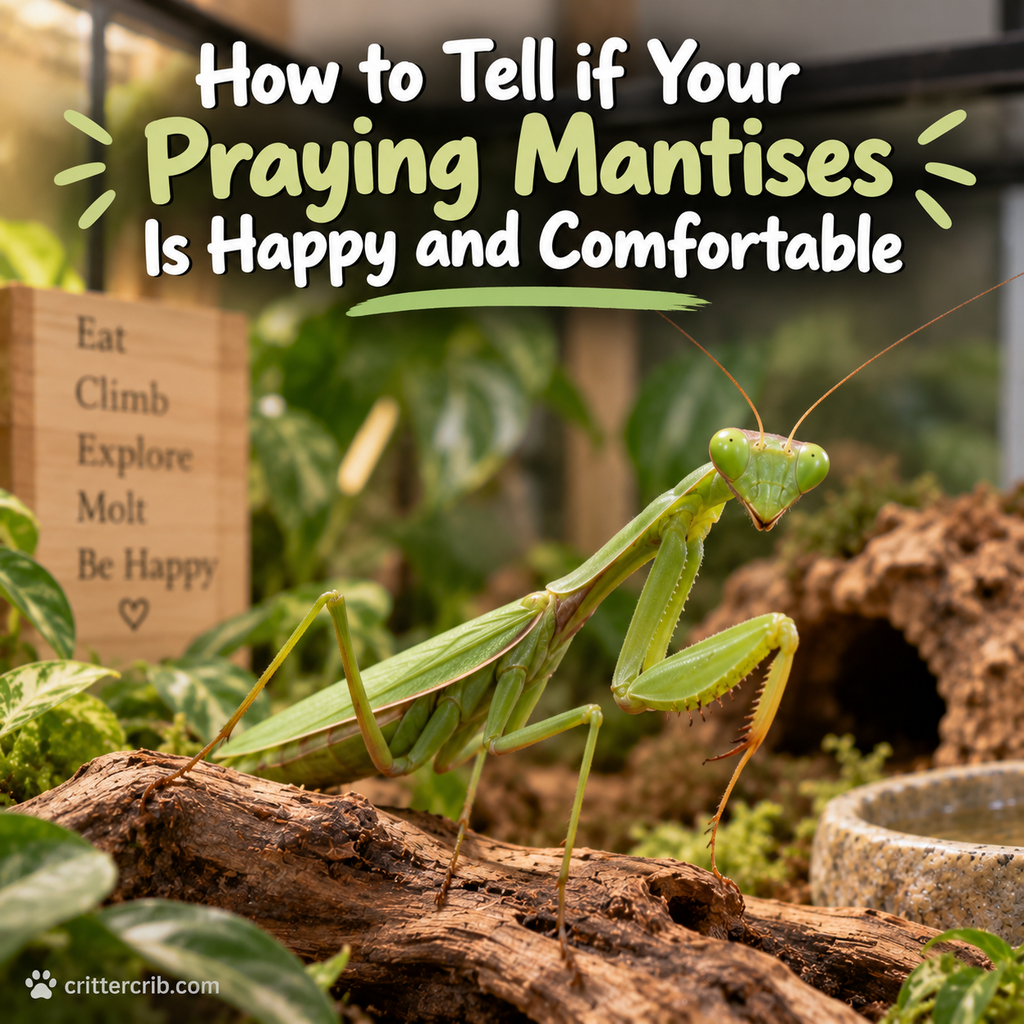
Praying mantises aren’t exactly expressive pets. They won’t wag a tail when they’re excited or come running when you enter the room. Much of their day may be spent sitting perfectly still, watching their surroundings and waiting for prey.
So how can you tell if your praying mantis is happy?
“Happiness” is difficult to measure in an insect the way we might think about it in a dog or cat. A better goal is to look for signs that your mantis is healthy, comfortable, and behaving normally.
A comfortable praying mantis should generally be alert, able to move and climb normally, interested in food when hungry, and capable of resting without constantly trying to escape its enclosure. Its habitat should also give it enough room to molt safely.
Once you learn your mantis’s normal behavior, subtle changes become much easier to spot.
Can Praying Mantises Be Happy?
We can’t know whether a praying mantis experiences happiness in the same emotional sense that humans do.
What we can observe is whether its physical and environmental needs appear to be met.
For a pet mantis, being “happy and comfortable” generally means it has:
- Appropriate temperature and humidity
- Enough space to move and molt
- Suitable climbing surfaces
- Proper ventilation
- Access to appropriate live prey
- Water and moisture appropriate for its species
- Places to perch and feel secure
- Minimal unnecessary disturbance
Behavior matters too.
A mantis that regularly eats, climbs, rests, hunts, and molts successfully is giving you useful clues that its basic husbandry is working.
Signs Your Praying Mantis Is Comfortable
Individual behavior varies by species, age, and personality, but several general signs can help you evaluate your mantis.
It Is Alert and Responsive
A healthy mantis often appears remarkably aware of its surroundings.
You may notice it turning its head toward movement, tracking prey, adjusting its position when you approach, or watching activity outside the enclosure.
That doesn’t mean it needs to constantly move.
Praying mantises are ambush predators. Remaining motionless for long periods is completely normal.
What you’re looking for is appropriate responsiveness when something interesting happens.
It Moves and Climbs Normally
A comfortable mantis should generally be able to walk and climb without obvious difficulty.
Mantises frequently spend time:
- Hanging from branches
- Climbing enclosure walls
- Perching on plants
- Resting upside down
- Moving between hunting positions
Their feet are specialized for gripping surfaces, so climbing is an important part of normal behavior.
If your mantis suddenly struggles to grip surfaces, repeatedly falls, or moves unusually, take the change seriously.
It Hunts and Eats
A mantis that notices prey and successfully hunts is displaying one of its most natural behaviors.
You may see it slowly turn toward an insect, sway, stalk closer, and then strike rapidly with its powerful front legs.
Appetite varies with age, species, feeding schedule, and reproductive condition.
A temporary loss of appetite isn’t automatically a sign of trouble because mantises commonly stop eating before a molt.
The overall pattern matters more than whether your mantis accepts every meal.
It Rests Calmly
A mantis doesn’t need to constantly explore its enclosure to be comfortable.
Sitting quietly on a branch for hours can be perfectly normal.
Ambush predators conserve energy and wait for prey rather than wandering continuously.
A calm mantis may select a favorite perch and return to it regularly.
That’s very different from an animal repeatedly scrambling around the enclosure as though it cannot find a suitable resting place.
Normal Praying Mantis Behavior Can Look Strange
One of the challenges of keeping an unusual pet is learning which behaviors are actually normal.
Mantises do several things that can initially worry new owners.
Staying Completely Still
Your mantis may remain motionless for an impressively long time.
That’s normal.
Staying still helps wild mantises avoid detection and wait for prey.
Swaying Back and Forth
A mantis may gently rock or sway its body while moving.
This behavior can help mimic vegetation moving in the wind and may also assist the mantis with judging distance.
Occasional swaying isn’t necessarily a sign that something is wrong.
Hanging Upside Down
Mantises frequently hang upside down from branches, mesh, or the top of their enclosure.
This is especially important around molting.
Don’t automatically move a mantis simply because it is hanging from the ceiling.
Watching You
Praying mantises have excellent visual awareness compared with many other insects.
Your mantis may turn its head and appear to stare directly at you.
It’s probably tracking your movement rather than asking for attention, but it’s one of the behaviors that makes mantises such fascinating pets.
Signs Your Praying Mantis May Be Stressed or Uncomfortable
Understanding normal behavior makes unusual behavior easier to recognize.
One isolated behavior doesn’t always mean something is wrong, but persistent changes deserve attention.
Constantly Trying to Escape
Occasional exploration is normal.
Repeatedly climbing the same walls, pushing against the enclosure, or appearing unable to settle may indicate that something about the environment isn’t ideal.
Check:
- Enclosure size
- Temperature
- Humidity
- Ventilation
- Perching options
- Disturbance around the enclosure
Also consider the species. Some mantises are naturally more active than others.
Repeatedly Falling
A healthy mantis should normally have a strong grip.
Repeated falls can be concerning, especially if the mantis previously climbed without difficulty.
Possible causes can include unsuitable climbing surfaces, physical problems, age, injury, or issues related to molting.
Falls are particularly dangerous during a molt.
Refusing Food for an Extended Period
Food refusal isn’t always an emergency.
Mantises commonly stop eating before molting, and adults may show changing appetites.
However, prolonged food refusal combined with weakness, unusual posture, dehydration, or other concerning symptoms deserves closer attention.
Look at the whole animal rather than appetite alone.
Weak or Uncoordinated Movement
A mantis that appears unable to stand, climb, or coordinate its movements normally may be experiencing a problem.
Check the enclosure conditions first.
Extreme temperatures, dehydration, injury, age, or unsuccessful molting can all affect mobility.
A Comfortable Mantis Needs the Right Enclosure
You can’t judge your mantis’s comfort only by watching its behavior.
The enclosure itself needs to support normal mantis biology.
One of the most important considerations is vertical space.
Give Your Mantis Enough Room to Molt
Molting is one of the most vulnerable moments in a praying mantis’s life.
To grow, a mantis must shed its old exoskeleton.
It typically hangs upside down and gradually pulls itself free. During this process, its new body is soft and vulnerable.
The mantis needs enough empty space beneath its perch to complete the molt without hitting the ground or decorations.
A commonly used guideline for many mantises is an enclosure roughly three times the mantis’s body length in height and around twice its body length in width.
Treat this as a general starting point rather than a universal rule. Species and life stage matter.
The important thing is providing adequate vertical clearance for a safe molt.
Provide Good Climbing and Hanging Surfaces
Your mantis needs surfaces it can reliably grip.
Depending on the enclosure, these might include:
- Natural branches
- Twigs
- Suitable artificial plants
- Live plants
- Appropriate mesh
- Textured surfaces
Arrange climbing structures so the mantis can reach the upper portion of the enclosure easily.
At the same time, don’t fill every inch with decorations.
The mantis needs open space beneath its molting position.
Temperature Matters
Praying mantis temperature requirements vary considerably by species.
A mantis adapted to a tropical environment may need different conditions from one originating in a temperate region.
That’s why generic advice like “keep your mantis warm” isn’t particularly useful.
Research the exact species you’re keeping.
If your home already remains within its appropriate range, additional heating may not be necessary.
If supplemental heat is required, monitor it carefully. Small enclosures can overheat quickly.
Never place the enclosure in direct sunlight.
A glass or plastic habitat near a sunny window can become dangerously hot even when the surrounding room feels comfortable.
Humidity Matters Too
Humidity requirements also vary by species.
Appropriate moisture supports hydration and successful molting, but excessive humidity combined with poor airflow can create unhealthy conditions.
Instead of trying to make the enclosure constantly wet, balance humidity with ventilation.
Depending on the species, lightly misting the enclosure can provide moisture and drinking droplets.
Monitor how quickly the habitat dries between mistings.
If everything stays soaked for long periods, you may have insufficient ventilation.
If the enclosure becomes completely dry almost immediately, you may need to adjust your routine.
Ventilation Is Easy to Overlook
A humid enclosure still needs fresh air.
Poor ventilation can contribute to stagnant conditions, condensation, and mold.
Many mantis enclosures use cross ventilation or well-ventilated sides and tops to maintain airflow.
The exact setup depends on the species and enclosure style.
Your goal is a habitat that maintains appropriate humidity without remaining wet and stagnant.
How Can You Tell if Your Mantis Is Dehydrated?
Dehydration can become a serious problem for a small insect.
Possible warning signs may include weakness, difficulty moving, or a general decline in activity.
Prevention is easier than trying to correct severe dehydration.
Provide moisture according to your species’ needs and make sure your mantis has opportunities to drink.
Many mantises drink droplets from enclosure surfaces and vegetation after misting.
Avoid spraying the mantis forcefully.
A gentle mist on appropriate enclosure surfaces is usually a better approach.
Feeding Behavior Can Tell You a Lot
Watching your mantis hunt provides useful information about its condition.
A hungry, healthy mantis may quickly focus on moving prey.
Its head turns.
Its body becomes still.
The front legs shift into position.
Then the strike happens almost instantly.
That hunting sequence is a great example of normal mantis behavior.
What Should You Feed a Praying Mantis?
Praying mantises are predators and generally require live prey.
Depending on the size and species of your mantis, appropriate feeders may include:
- Fruit flies
- Houseflies
- Blue bottle flies
- Small roaches
- Crickets
- Other appropriately sized feeder insects
Variety can be beneficial when suitable feeders are available.
Feeders should come from safe sources. Avoid routinely collecting random insects outdoors because they may have been exposed to pesticides or carry parasites.
Remove uneaten prey when necessary, particularly if your mantis appears ready to molt.
Don’t Confuse Premolt With Illness
A mantis preparing to molt may suddenly behave differently.
Possible premolt behavior includes:
- Refusing food
- Becoming less active
- Spending more time hanging upside down
- Choosing a secure molting location
- Showing subtle physical changes
This can make new keepers nervous.
If your mantis appears healthy otherwise and is approaching a molt, the best thing you can often do is leave it undisturbed.
Don’t handle it.
Don’t keep offering insects that crawl over it.
Give it the environmental conditions and space it needs to complete the molt.
Successful Molting Is an Important Sign
A successful molt is one of the strongest indicators that a juvenile mantis has suitable basic conditions.
After molting, the mantis will be soft.
Leave it alone while the new exoskeleton hardens.
Don’t immediately handle or feed it.
The amount of recovery time can vary with the size and species of the mantis, so research your particular animal.
Molting problems can occur even with good care, but repeated issues may suggest that enclosure size, humidity, climbing surfaces, or other husbandry factors need attention.
Does a Praying Mantis Recognize Its Owner?
Your mantis may clearly notice you.
It may turn its head when you approach, watch your hands, or react differently to movements outside the enclosure.
That doesn’t necessarily mean it recognizes you as its “owner” in the way a dog might.
Mantises are visually oriented predators that pay close attention to movement.
It’s best to appreciate this behavior for what it is rather than assuming human-like emotions.
Your mantis doesn’t need to love you to be an incredibly interesting pet.
Do Praying Mantises Like Being Handled?
Some mantises tolerate gentle handling better than others.
A calm individual may willingly step onto a hand and walk across your fingers without showing obvious defensive behavior.
Others would rather be left alone.
Handling isn’t required for a mantis to have a good quality of life.
If you do handle yours, keep the interaction gentle and avoid forcing it onto your hand.
Let the mantis step onto you whenever possible.
Signs Your Mantis Doesn’t Want to Be Handled
Pay attention to defensive behavior.
Depending on the species, a threatened mantis may:
- Attempt to move away
- Raise its front legs defensively
- Spread its wings
- Display warning colors
- Strike
- Adopt a defensive posture
If your mantis becomes defensive, give it space.
Repeatedly provoking dramatic threat displays may look interesting, but intentionally stressing an animal for entertainment isn’t good husbandry.
How to Help Your Praying Mantis Feel Secure
A secure environment allows the mantis to behave naturally without constant disturbance.
A few simple habits make a difference:
- Keep the enclosure in a stable location.
- Provide appropriate branches and perches.
- Maintain species-appropriate temperature and humidity.
- Ensure adequate ventilation.
- Provide enough vertical space for molting.
- Offer appropriately sized live prey.
- Remove uneaten feeders when necessary.
- Avoid excessive handling.
- Keep other pets away from the enclosure.
- Observe your mantis before making unnecessary changes.
Consistency is valuable.
Constantly rearranging the habitat or moving the enclosure around can create unnecessary disturbance.
Is My Praying Mantis Bored?
It’s tempting to apply human ideas about boredom to pets.
A mantis doesn’t need toys, daily play sessions, or constant entertainment.
Its enclosure should instead allow natural behaviors.
That means opportunities to:
- Climb
- Perch
- Hunt
- Observe movement
- Hide among vegetation
- Choose different positions
- Molt safely
A thoughtfully arranged enclosure provides what a mantis actually needs without trying to entertain it like a mammal.
Get to Know Your Individual Mantis
One of the most useful things you can do is learn what’s normal for your particular animal.
Pay attention to:
- Favorite perching locations
- Typical activity levels
- Feeding responses
- Hunting behavior
- Molting patterns
- How it reacts when you approach
- How often it drinks
- Changes before and after molts
Over time, you’ll develop a baseline.
Then, if something changes significantly, you’ll notice much sooner.
When Should You Be Concerned?
A single unusual behavior isn’t necessarily an emergency.
Look for combinations of symptoms or significant departures from your mantis’s normal behavior.
Potential reasons for concern include:
- Persistent inability to grip or climb
- Repeated falls
- Serious injury
- Severe weakness
- Difficulty using the legs
- Major problems during a molt
- Abnormal behavior combined with prolonged food refusal
- A sudden dramatic change in condition
First, double-check your husbandry.
Confirm that temperature, humidity, ventilation, enclosure size, food, and molting space are appropriate for the species.
For serious problems, seek advice from a veterinarian experienced with invertebrates or another appropriately qualified exotic-animal professional when available.
Signs of a Healthy, Comfortable Praying Mantis
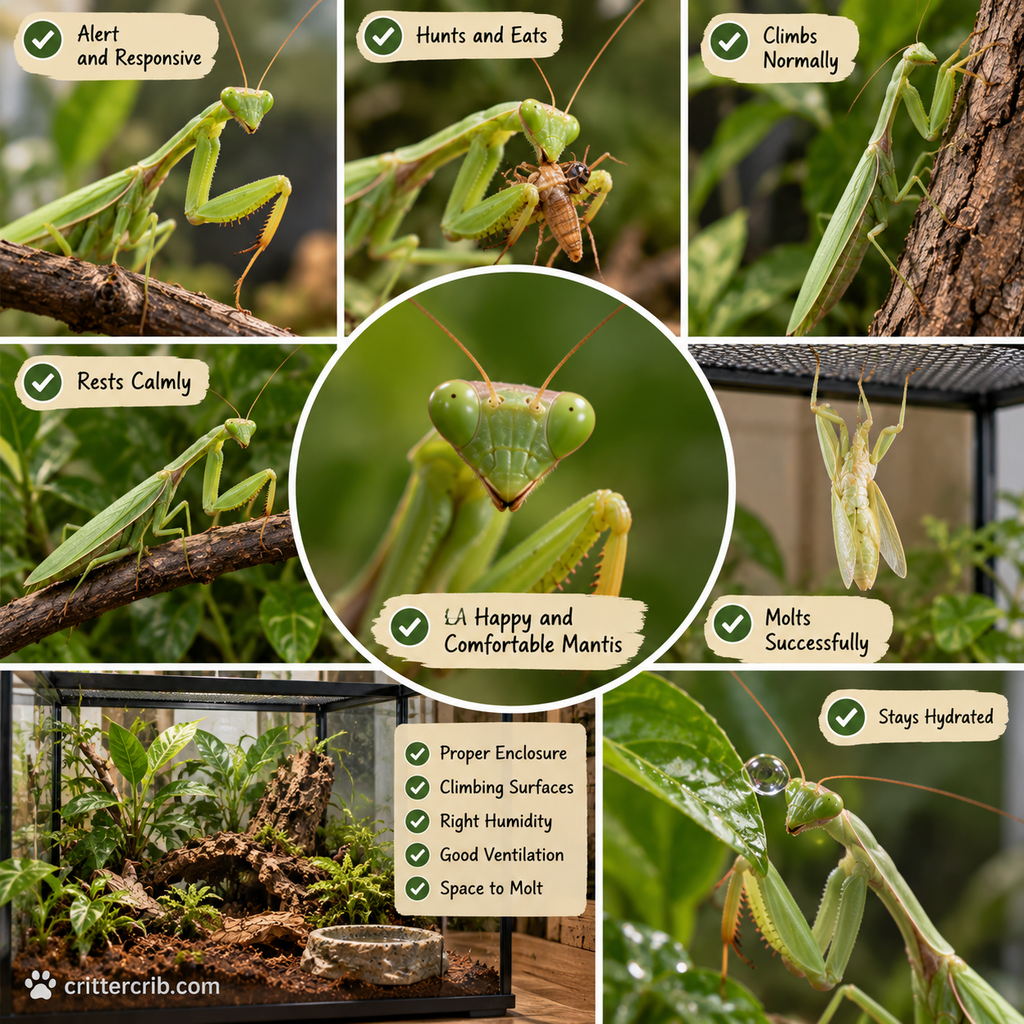
Rather than searching for one behavior that proves your mantis is “happy,” look at the overall picture.
A comfortable mantis will generally:
- Remain alert and responsive
- Grip and climb normally
- Rest calmly for long periods
- Display normal hunting behavior
- Eat appropriately for its life stage
- Drink when moisture is available
- Use perches throughout the enclosure
- Molt successfully while growing
- Show normal posture and movement
- Spend much of its time behaving like a mantis
That last point is important.
A healthy mantis doesn’t need to constantly interact with you.
How to Tell if Your Praying Mantis Is Happy: The Bottom Line
We can’t ask a praying mantis whether it’s happy, and we shouldn’t assume it experiences comfort or affection exactly as humans do.
What we can do is look for signs of good health and normal behavior.
An alert mantis that climbs well, hunts appropriately, rests comfortably, and molts successfully is giving you encouraging signs that its basic needs are being met.
Your enclosure plays a major role. Provide adequate vertical space, reliable climbing surfaces, species-appropriate temperature and humidity, good ventilation, suitable live prey, and enough moisture for hydration.
Then give your mantis something equally important: the freedom to behave naturally.
Sometimes that means hunting dramatically in front of you. Other times it means hanging upside down and doing absolutely nothing for several hours.
Both can be perfectly normal.
The more time you spend observing your mantis without constantly interfering, the easier it becomes to recognize what comfortable, healthy behavior looks like.