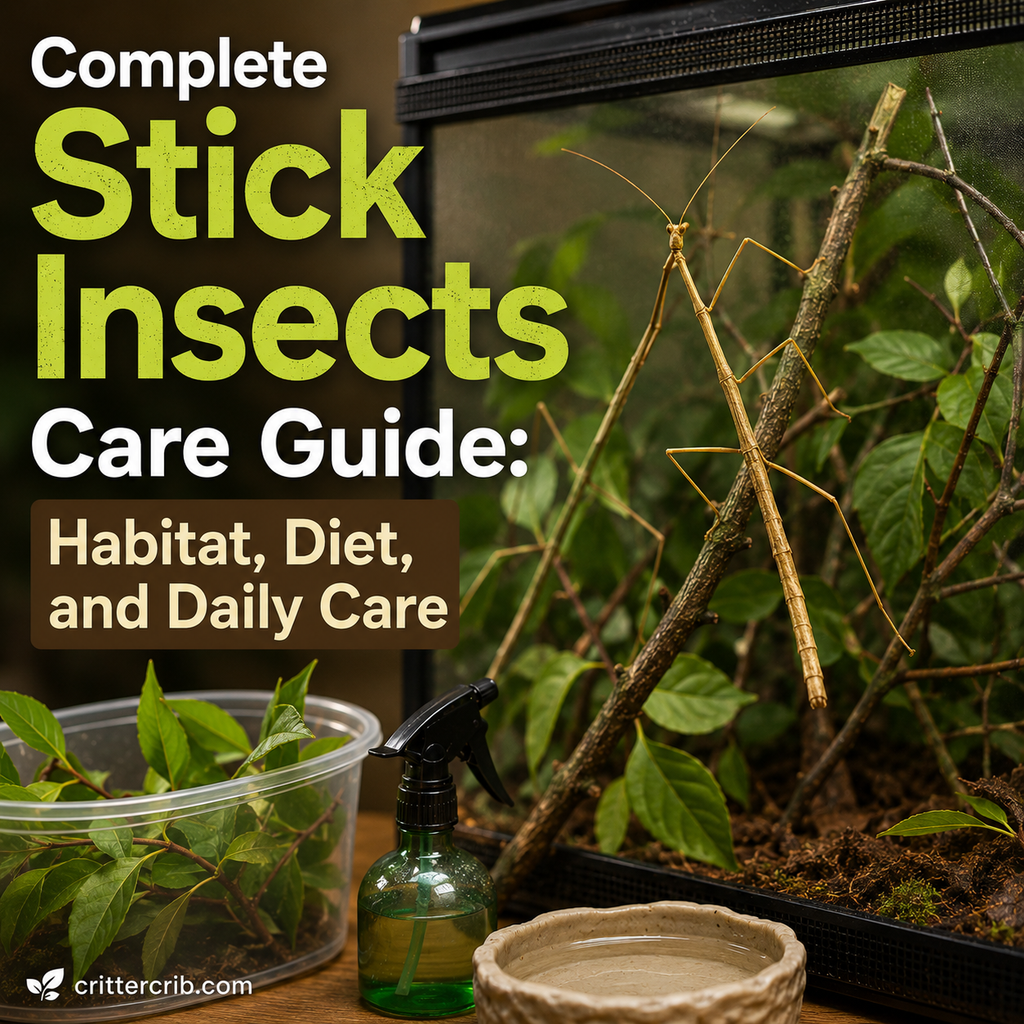
Stick insects are masters of disguise. Sitting perfectly still among leaves and branches, they can look so much like twigs that it’s easy to overlook them even when you know exactly where they are.
That unusual appearance is a big part of their appeal as pets. They’re quiet, don’t require a huge enclosure, and can be fascinating to observe as they climb, feed, molt, and blend into their surroundings.
Stick insect care isn’t difficult once you understand their basic needs, but there are a few things you need to get right. They require plenty of vertical space for molting, fresh leaves from safe plants, appropriate humidity and ventilation, and an enclosure designed around climbing rather than floor space.
There are also thousands of stick insect species, or phasmids, around the world. Their exact care requirements can vary considerably.
This guide covers the fundamentals of keeping commonly maintained pet stick insects while highlighting where species-specific research matters.
Stick Insect Care at a Glance
Before getting into the details, here’s a quick overview:
- Habitat: Tall, well-ventilated enclosure
- Space: Enough vertical room for safe molting
- Temperature: Often comfortable at typical warm room temperatures, depending on species
- Humidity: Species-specific; usually maintained through appropriate misting and ventilation
- Diet: Fresh leaves from suitable host plants
- Water: Primarily obtained from fresh leaves and droplets
- Substrate: Simple, easy-to-clean substrate or naturalistic material
- Activity: Often most active at night
- Handling: Gentle and minimal
- Special requirement: Secure climbing and hanging surfaces
- Lifespan: Varies considerably by species
Before bringing one home, identify the species you’re getting. Care advice for one stick insect shouldn’t automatically be applied to every other species.
What Are Stick Insects?
Stick insects belong to the order Phasmatodea and are sometimes called walking sticks or phasmids.
Their most obvious feature is camouflage.
Many species have long, narrow bodies that resemble twigs. Others imitate leaves, bark, or other vegetation. Some even sway gently while walking, which may help them resemble plant material moving in the breeze.
Most pet species are herbivorous and spend much of their time climbing and eating vegetation.
They generally aren’t highly interactive pets. The enjoyment comes from observing their appearance, feeding behavior, growth, molting, and camouflage.
Are Stick Insects Good Pets for Beginners?
For the right person, yes.
Stick insects can make excellent beginner invertebrates because their daily care is relatively straightforward.
If you’re still deciding whether they’re the right pet for you, our guide to stick insects as pets for beginners covers their care difficulty, costs, feeding requirements, handling, lifespan, enclosure needs, and what ownership is actually like.
They don’t need:
- Large amounts of space
- Complicated lighting systems in many setups
- Live feeder insects
- Frequent handling
- Expensive equipment
The biggest challenge is often food.
You need a reliable supply of fresh, pesticide-free leaves from plants your particular species will eat. Depending on where you live, maintaining that supply throughout the year may require planning.
You also need to be comfortable keeping an animal that’s primarily for observation rather than interaction.
Choosing the Right Stick Insect Enclosure
A stick insect enclosure should be tall, secure, and well ventilated.
If you’re building an enclosure from scratch, our stick insect habitat setup guide goes deeper into enclosure size, vertical molting space, ventilation, temperature, humidity, substrate, climbing surfaces, and safely providing fresh food plants.
Popular options include:
- Mesh enclosures
- Glass terrariums with good ventilation
- Acrylic invertebrate enclosures
- Modified plastic containers
- Purpose-built phasmid cages
Mesh can provide excellent climbing surfaces and airflow, although it may make maintaining humidity more challenging for species that prefer moister conditions.
Glass and plastic retain humidity more effectively but need sufficient ventilation.
The best enclosure depends on the species and your home environment.
How Big Should a Stick Insect Enclosure Be?
Height is especially important.
A commonly used guideline is to provide an enclosure at least three times the adult stick insect’s body length in height.
Width should generally be at least around two times its body length, with additional room needed for multiple insects.
Why so much height?
Molting.
Stick insects shed their exoskeletons as they grow. During a molt, the insect hangs from a branch or the enclosure ceiling and gradually works its body free.
If there isn’t enough clear space underneath, a molt can go badly.
For that reason, don’t judge enclosure size based solely on whether the insect physically fits inside.
Ventilation Is Essential
Humidity gets a lot of attention in invertebrate care, but airflow is just as important.
A constantly wet enclosure with poor ventilation can encourage:
- Mold
- Fungal growth
- Stagnant conditions
- Excess condensation
- Rapid food spoilage
The ideal balance varies by species.
Some stick insects prefer relatively humid conditions, while others need more airflow and tolerate drier environments.
Cross ventilation can be particularly useful because it allows air to move through the enclosure instead of relying entirely on openings at the top.
Temperature for Stick Insects
Many commonly kept stick insect species can live comfortably within typical indoor temperature ranges.
However, there is no universal temperature that’s appropriate for every species.
Some tropical species prefer warmer conditions, while others tolerate cooler temperatures.
Before adding supplemental heat, find out what your species actually requires.
If your home is already warm enough, additional heating may do more harm than good.
Use a digital thermometer to monitor the enclosure rather than relying on guesswork.
Do Stick Insects Need a Heat Lamp?
Not necessarily.
A heat lamp can quickly dry or overheat a small enclosure.
If supplemental heating is genuinely required, choose equipment appropriate for the enclosure and monitor it carefully.
Never place the habitat in direct sunlight. Even if the room itself feels comfortable, sunlight through glass or plastic can cause temperatures inside a small enclosure to rise rapidly.
Humidity and Misting
Stick insects need access to appropriate moisture, but the correct humidity level depends on species.
Many keepers lightly mist the enclosure to:
- Provide drinking droplets
- Increase humidity
- Keep foliage from drying too quickly
How often you should mist depends on:
- Species
- Enclosure ventilation
- Room humidity
- Temperature
- Enclosure material
The habitat generally shouldn’t remain dripping wet all the time.
Misting followed by some drying can provide moisture without creating permanently stagnant conditions.
Do Stick Insects Drink Water?
Stick insects commonly drink droplets from leaves and enclosure surfaces.
A traditional water bowl usually isn’t necessary for many species and may present a drowning risk to small nymphs.
Light misting helps provide accessible droplets.
Don’t assume misting frequency alone determines whether conditions are correct. Observe condensation, ventilation, substrate moisture, and the requirements of the species you’re keeping.
Best Substrate for Stick Insects
Stick insects don’t generally require deep substrate for burrowing.
That gives you several options.
For a simple enclosure, you can use:
- Paper towel
- Plain paper
- Safe soil
- Coconut fiber
- Other species-appropriate naturalistic substrates
Paper towel is especially convenient for beginners because it’s easy to replace and makes waste and eggs easier to see.
Natural substrates create a more attractive display and can help with humidity, but they make locating eggs more difficult.
Your choice may depend on whether you’re keeping the insects as pets, breeding them, or building a naturalistic display.
What Do Stick Insects Eat?
Stick insects are herbivores, and fresh leaves form the foundation of their diet.
However, different species eat different plants.
Commonly accepted host plants among various captive species may include:
- Bramble or blackberry
- Rose
- Oak
- Hawthorn
- Privet
- Ivy
- Eucalyptus
- Raspberry
- Hazel
This does not mean every stick insect can safely or successfully eat everything on this list.
Research your species and provide known host plants appropriate for it.
Bramble Is a Common Stick Insect Food
Bramble, including blackberry leaves, is widely used for many commonly kept species.
One advantage is availability. In some climates, suitable leaves remain accessible for much of the year.
Still, don’t assume your species accepts bramble just because many others do.
Species identification comes first.
Never Use Plants Exposed to Pesticides
This is one of the most important feeding rules.
Stick insects eat the leaves directly, so pesticide residue can be dangerous.
Avoid collecting food plants:
- Along heavily treated landscaping
- From recently sprayed gardens
- Near areas treated with herbicides
- From plants exposed to insecticides
- From locations where chemical use is unknown and likely
Roadside plants can also be exposed to pollutants.
If you’re collecting leaves outdoors, choose a location you trust.
Wash plant material appropriately before placing it in the enclosure.
How to Keep Leaves Fresh
Cut branches can be placed in a container of water to keep them fresh longer.
However, open water creates a drowning hazard, particularly for young stick insects.
Cover the opening around the stems.
You can use a secure lid with small holes for branches or another barrier that prevents insects from reaching the water.
Replace wilted or dried leaves as necessary.
Fresh foliage isn’t just food. It also provides climbing surfaces, hiding places, and a more natural environment.
How Often Should You Feed Stick Insects?
Stick insects should have suitable fresh leaves available consistently.
This isn’t a pet you feed one measured meal each morning.
Instead, check the foliage regularly and replace it when:
- Leaves are heavily eaten
- Branches begin wilting
- Leaves dry out
- Mold develops
- The plant material becomes dirty
How quickly this happens depends on the number and size of the insects, plant species, enclosure humidity, and temperature.
Large stick insects can eat more foliage than you might expect.
Climbing Surfaces and Enclosure Furnishings
A stick insect enclosure should provide plenty of opportunities to climb.
The food branches themselves provide much of this structure.
You can also include:
- Safe twigs
- Branches
- Mesh surfaces
- Artificial plants
- Natural vegetation
Keep everything secure.
More importantly, don’t overcrowd the enclosure.
A dense jungle may look attractive, but the insects need open vertical areas where they can hang freely while molting.
Understanding Stick Insect Molting
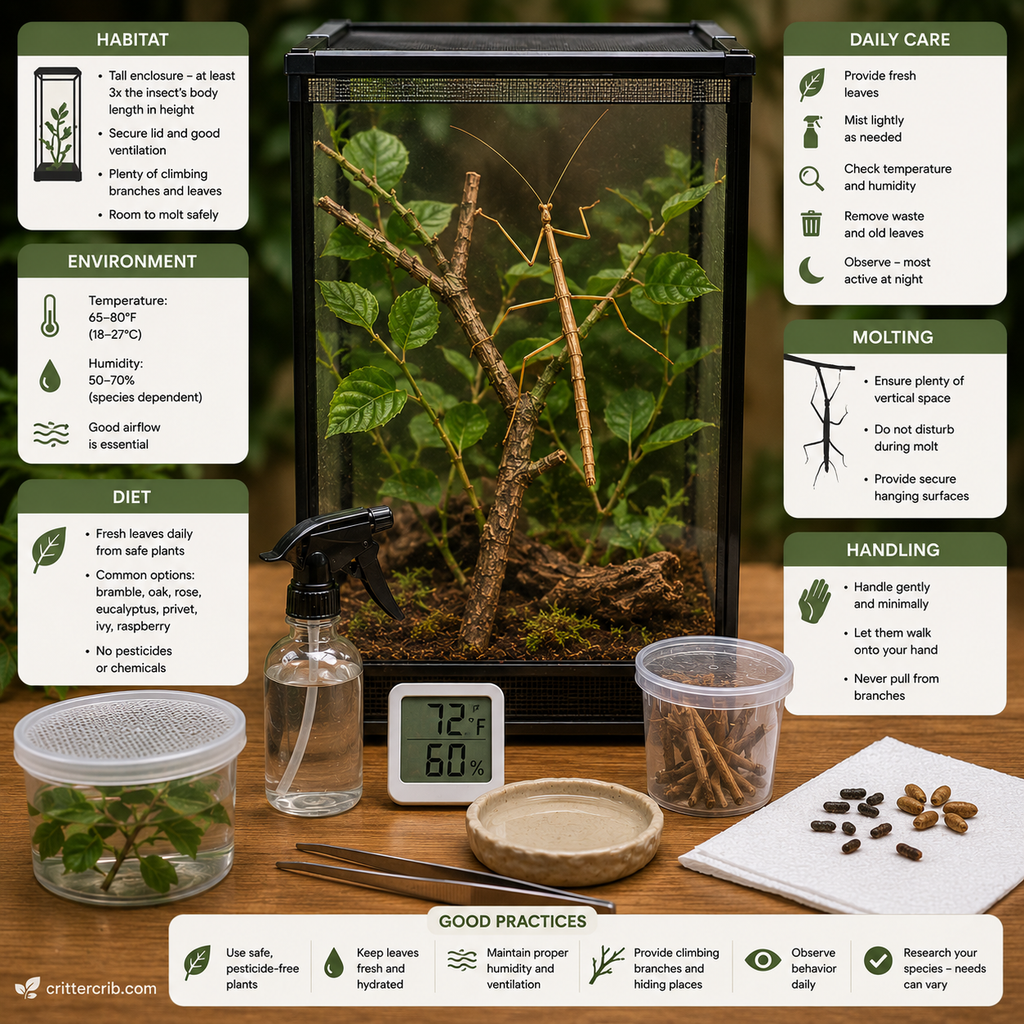
Stick insects have rigid exoskeletons that cannot expand continuously as they grow.
Instead, young stick insects molt multiple times before reaching adulthood.
During a molt, the insect typically hangs securely and gradually emerges from its old exoskeleton.
This is a vulnerable process.
A successful molt requires:
- Secure grip
- Sufficient height
- Appropriate environmental conditions
- Space beneath the insect
- Minimal disturbance
Never Pull Off a Stick Insect’s Old Exoskeleton
Don’t attempt to “help” a molting insect by pulling at the old skin.
Interfering can cause serious injury.
Allow the process to happen naturally unless you’re dealing with a genuine emergency and have expert guidance.
What Happens After Molting?
A freshly molted stick insect may appear pale or unusually soft.
The new exoskeleton needs time to harden.
Leave the insect alone during this period.
You may also find the shed exoskeleton in the enclosure. Some stick insects may consume part or all of it.
Why Is My Stick Insect Hanging Upside Down?
Hanging is normal.
Stick insects spend a great deal of time attached to branches, leaves, and enclosure surfaces.
If the insect becomes unusually still while hanging, it may also be preparing to molt.
Don’t disturb it simply because it hasn’t moved for several hours.
Watch from outside the enclosure and give it time.
Why Is My Stick Insect Swaying?
One of the most interesting stick insect behaviors is their tendency to sway gently from side to side.
This is normal.
The movement may enhance camouflage by helping the insect resemble a twig or leaf moving in the breeze.
It can look strange the first time you see it, but it doesn’t necessarily indicate a balance problem.
Swaying is just one of several behaviors that can look unusual to new keepers. Our guide to common stick insect behaviors and what they mean also covers staying still, hanging upside down, climbing, hiding, dropping, feeding changes, and behavior around molting.
Why Is My Stick Insect Not Moving?
Remaining motionless is part of being a convincing stick.
Many species rely on camouflage rather than speed or aggression for protection.
Activity can also increase after dark because many stick insects are primarily nocturnal.
A healthy insect may spend much of the day barely moving and become considerably more active at night.
Can You Keep Multiple Stick Insects Together?
Many commonly kept species can be housed in groups when given sufficient space and food.
However, compatibility depends on species.
Crowding can create problems, especially during molting.
Each insect needs room to hang without bumping into another animal or surrounding decorations.
If you’re keeping several individuals, increase enclosure size accordingly.
Also consider reproduction.
Some stick insects can produce large numbers of eggs, so a small group can eventually become a much larger population.
Can Different Stick Insect Species Live Together?
It’s usually simpler to keep species separately.
Different species may have different requirements for:
- Temperature
- Humidity
- Food plants
- Ventilation
- Enclosure size
Mixing species can also complicate egg identification and population management.
For beginners, a single-species enclosure is generally easier.
Handling Stick Insects Safely
Stick insects are delicate.
They may tolerate occasional handling, but they don’t need it for social interaction.
If you do handle one:
- Move slowly.
- Offer your hand or a branch in front of the insect.
- Allow it to climb voluntarily.
- Keep it close to a safe surface.
- Avoid squeezing or restraining it.
- Return it gently to the enclosure.
Never pull a stick insect from a branch.
Its feet can grip surprisingly well, and forcing it loose may damage its legs.
Can Stick Insects Lose Legs?
Yes.
A leg can be injured or lost through falls, improper handling, enclosure accidents, or molting problems.
Young stick insects may be able to regenerate some lost limb tissue over subsequent molts, although recovery depends on age and circumstances.
Adults no longer have repeated juvenile molts available for the same type of regeneration.
Preventing injuries is much better than relying on regeneration.
Cleaning a Stick Insect Enclosure
Routine cleaning is fairly straightforward.
Remove:
- Droppings
- Dead leaves
- Moldy foliage
- Shed material when appropriate
- Other accumulated debris
Replace simple paper substrate regularly if you’re using it.
Naturalistic substrates may require a different maintenance routine.
Clean enclosure walls when necessary, but avoid spraying household cleaners around the insects.
Plain water and physical cleaning are sufficient for much routine maintenance.
What Do Stick Insect Droppings Look Like?
Stick insect droppings are generally small, firm pellets.
They can accumulate quickly beneath feeding areas.
If you’re using paper towel or paper substrate, droppings are easy to see and remove.
Don’t confuse droppings with eggs.
Depending on the species, stick insect eggs can look surprisingly similar to seeds or small pellets.
Stick Insect Eggs and Reproduction
Reproduction is something every prospective keeper should understand before choosing a species.
Some stick insects reproduce sexually, while others are capable of parthenogenesis, meaning females can produce viable offspring without mating with a male.
That can surprise new owners.
You may purchase what appears to be one simple pet and eventually discover eggs throughout the enclosure.
What Do Stick Insect Eggs Look Like?
Appearance varies widely by species.
Many resemble:
- Tiny seeds
- Small capsules
- Dark pellets
Some species drop eggs onto the ground.
Others attach or place them in different ways.
Incubation time can range from months to much longer depending on species and environmental conditions.
Don’t Dispose of Eggs Outdoors
Never release unwanted stick insects or eggs into the environment.
Non-native species can potentially become invasive or affect local ecosystems.
Make sure you understand applicable regulations and responsible disposal practices for the species you’re keeping.
Are Stick Insects Legal to Keep?
This is an important question because regulations vary by country and region.
Some stick insect species are regulated because of their potential impact on agriculture and native plants if they escape and establish wild populations.
Before purchasing a species, check the rules where you live.
Don’t assume that an insect offered online is automatically legal to own, transport, or receive in your area.
Daily Stick Insect Care Routine
Once the enclosure is established, everyday care doesn’t take much time.
A simple routine looks like this:
- Check that suitable leaves are available.
- Replace wilted food plants when needed.
- Check enclosure temperature.
- Monitor humidity and ventilation.
- Mist according to species requirements.
- Look for mold or excessive condensation.
- Observe the insects without disturbing molting individuals.
- Make sure the enclosure is secure.
Most days, this only takes a few minutes.
Weekly and Periodic Maintenance
Every few days or weekly, depending on your setup:
- Remove droppings
- Remove dead foliage
- Clean dirty enclosure surfaces
- Replace simple substrate
- Check branches for stability
- Inspect ventilation
- Look for eggs
- Check for mold
- Review enclosure space as nymphs grow
As your stick insects increase in size, make sure their habitat still provides enough molting clearance.
Common Stick Insect Care Mistakes
Most problems come from a handful of preventable husbandry mistakes.
Using an Enclosure That’s Too Short
An enclosure may look spacious while still lacking the vertical clearance necessary for molting.
Height matters.
Feeding the Wrong Plants
Don’t experiment randomly with leaves.
Know your species and provide appropriate host plants.
Using Pesticide-Treated Leaves
A plant can look perfectly healthy while carrying harmful chemical residues.
Collect food carefully.
Keeping the Enclosure Constantly Wet
Humidity and moisture are important for many species, but stagnant, soaked conditions aren’t automatically better.
Balance humidity with ventilation.
Allowing Food Branches to Dry Out
Stick insects rely on fresh foliage.
Check branches frequently.
Leaving Open Water Containers
If stems are sitting in water, block access to the opening so insects can’t fall inside.
Overcrowding
Crowding can interfere with molting and access to food.
Increase space as the population grows.
Handling Too Roughly
Never pull a stick insect away from a surface.
Allow it to walk onto you voluntarily.
Forgetting About Eggs
Some species reproduce surprisingly efficiently.
Know what their eggs look like and decide how you’ll manage offspring before the population grows.
Signs Your Stick Insect Setup Needs Attention
Take a closer look at husbandry if you notice:
- Repeated molting problems
- Insects frequently falling
- Persistent mold
- Heavy condensation
- Rapidly wilting food plants
- Poor feeding
- Unusual weakness
- Overcrowding
- Insufficient climbing space
- An enclosure that’s becoming too small
One unusual behavior doesn’t necessarily indicate a problem.
Look at the entire setup, including temperature, humidity, ventilation, food quality, enclosure size, and the insect’s stage of development.
Stick Insect Habitat Checklist
Before bringing your insects home, make sure you have:
- Tall, appropriately sized enclosure
- Secure lid
- Adequate ventilation
- Digital thermometer
- Hygrometer if useful for your species
- Suitable substrate
- Safe climbing surfaces
- Fresh host plants
- Safe container for keeping cut branches fresh
- Barrier covering exposed water
- Misting bottle
- Basic cleaning supplies
- Reliable source of pesticide-free leaves
Most importantly, know exactly which species you’re getting and what plants it eats.
Frequently Asked Questions About Stick Insect Care
How Big Does a Stick Insect Enclosure Need to Be?
A commonly used guideline is at least three times the insect’s adult body length in height and around twice its body length in width.
More space is needed for groups.
What Do Stick Insects Eat?
Stick insects eat leaves, but accepted host plants vary by species.
Bramble, rose, oak, eucalyptus, privet, and other plants are used for different captive species. Always verify what’s appropriate for yours.
How Often Do Stick Insects Need Feeding?
Suitable fresh leaves should be available continuously.
Replace foliage as it becomes eaten, wilted, dry, dirty, or moldy.
Do Stick Insects Need Water?
Many obtain water from their food and droplets produced by misting.
Traditional open water bowls usually aren’t necessary and can be hazardous to small insects.
How Often Should I Mist Stick Insects?
It depends on species, enclosure ventilation, temperature, and ambient humidity.
Research the requirements of your particular species rather than following a universal schedule.
Can Stick Insects Live Together?
Many species can be kept in groups when enough space and food are provided.
Avoid overcrowding, particularly because insects need unobstructed room to molt.
Do Stick Insects Bite?
Most commonly kept stick insects aren’t known for biting people as a normal defensive behavior.
Some species have other defensive strategies, however, including spines, pinching with their legs, or releasing defensive chemicals.
Handling practices should therefore be based on species.
How Long Do Stick Insects Live?
Lifespan varies considerably by species, sex, and environmental conditions.
Many captive species live around several months to more than a year, while some can live longer.
Why Isn’t My Stick Insect Moving?
Remaining still is normal camouflage behavior.
Stick insects may also be more active at night. An insect that becomes unusually still while hanging may be preparing to molt and should be left undisturbed.
Are Stick Insects Easy to Care For?
Many species are relatively easy to maintain once their habitat and food supply are established.
The biggest priorities are appropriate enclosure height, ventilation, humidity, safe food plants, and enough room for molting.
Final Thoughts on Stick Insect Care
Stick insects are a great example of a pet that doesn’t need complicated equipment to be fascinating.
Give them a tall, well-ventilated enclosure, safe climbing surfaces, enough room to molt, appropriate humidity, and a constant supply of fresh leaves, and much of their everyday care becomes straightforward.
The biggest rule is to know your species.
There are thousands of stick insects, and differences in food plants, temperature, humidity, size, defensive behavior, and reproduction mean there isn’t one perfect setup for all of them.
Once you’ve matched the habitat to the species, these remarkable insects are largely about observation.
You get to watch an animal almost disappear against a branch, sway like vegetation in the wind, emerge larger after a molt, and methodically turn fresh leaves into little more than stems.
For such quiet pets, stick insects can be surprisingly interesting.