Isopods are tiny, so it’s easy to assume they barely need any space. A small plastic container can certainly hold quite a few of them, but enclosure size isn’t just about fitting the animals inside.
A good isopod enclosure needs enough room for substrate, leaf litter, hides, ventilation, and—most importantly—a moisture gradient. You also need to think about what happens when a starter colony begins reproducing.
Fortunately, you don’t need a giant terrarium to keep isopods successfully. Even a modest enclosure can support a healthy colony when it’s set up correctly.
So, how much space do isopods actually need? Let’s look at practical enclosure sizes for starter cultures, growing colonies, display setups, and bioactive terrariums.
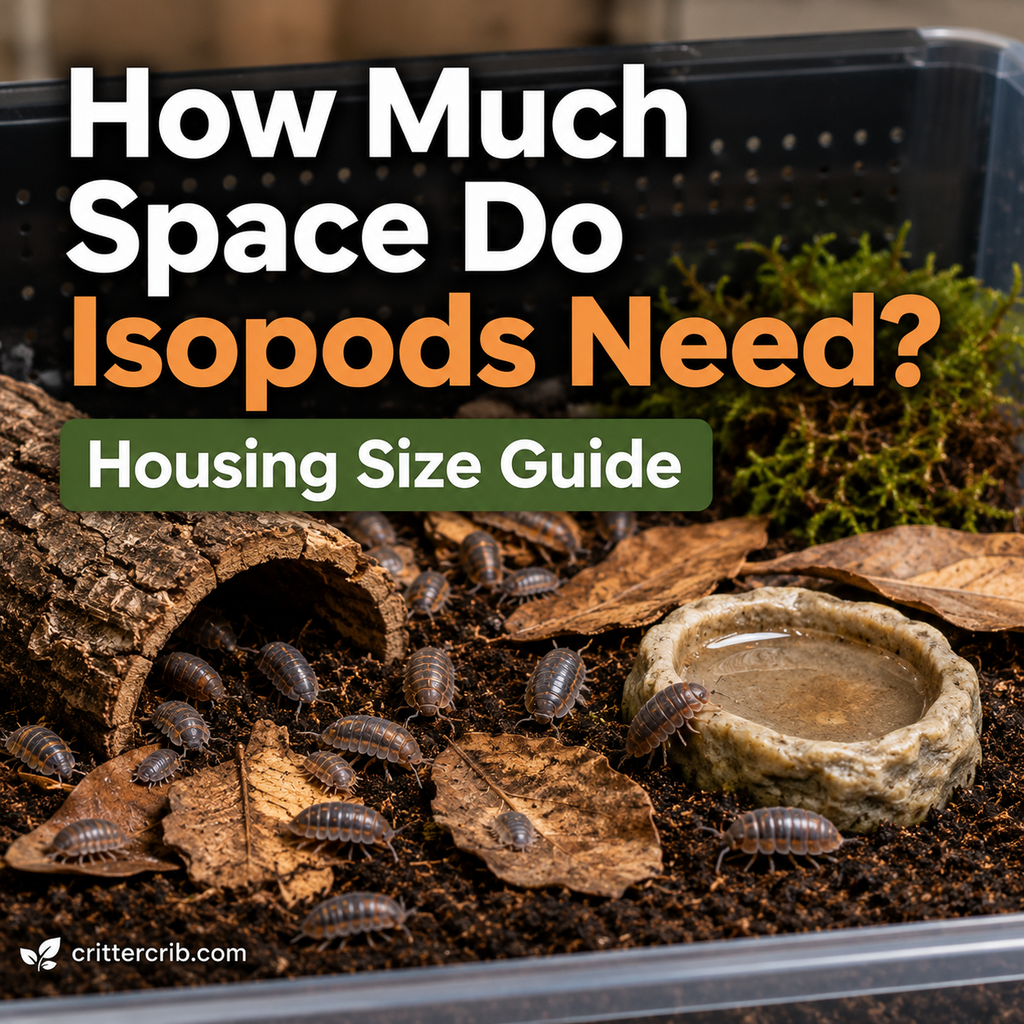
How Much Space Do Isopods Need?
For a small starter colony, an enclosure around 6 quarts can provide adequate space when properly set up. Many keepers prefer something in the 6- to 12-quart range because the extra room makes moisture management and colony growth easier.
Larger colonies may benefit from containers around 12–20 quarts or more, depending on the species, population, and how quickly the colony reproduces.
There isn’t one universal minimum enclosure size.
Instead, think about whether the enclosure provides enough usable habitat for the colony to:
- Find food
- Hide beneath cover
- Burrow into substrate
- Access moist and drier areas
- Reproduce
- Spread out as the population increases
A properly arranged smaller enclosure can work better than a large enclosure with poor substrate, ventilation, or moisture control.
Isopod Enclosure Size Chart
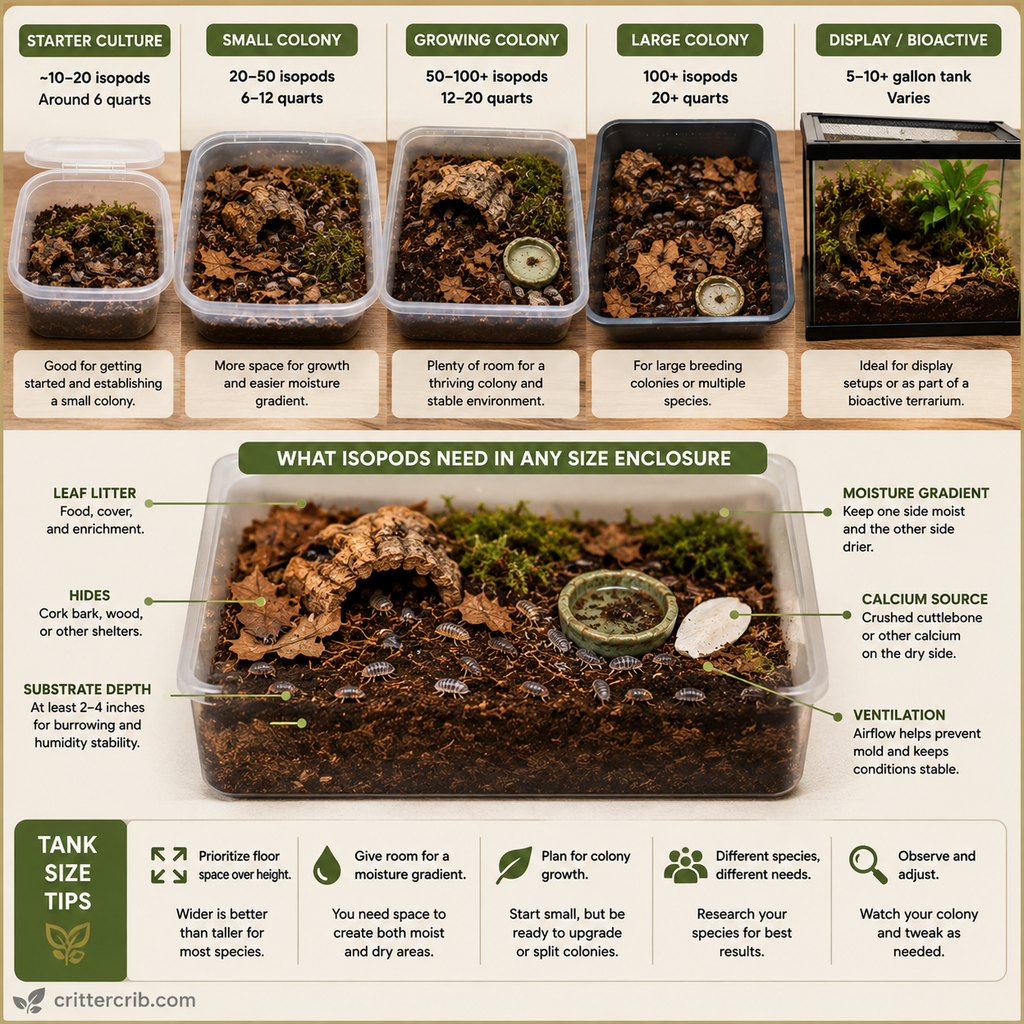
Here’s a practical starting point for choosing an enclosure.
| Colony Type | Suggested Enclosure Size |
|---|---|
| Very small starter culture | Around 6 quarts |
| Small established colony | 6–12 quarts |
| Growing colony | 12–20 quarts |
| Large breeding colony | 20+ quarts or multiple cultures |
| Display colony | 5–10+ gallon terrarium |
| Bioactive setup | Based primarily on the main animal’s enclosure |
These aren’t strict limits.
Species, colony density, enclosure dimensions, ventilation, and husbandry all influence how much space works well.
For most hobbyists starting a dedicated isopod colony, a container somewhere around 6–12 quarts is a practical starting point.
Why Isopods Don’t Need Huge Enclosures
Isopods spend much of their time beneath leaf litter, bark, decaying wood, and other cover.
They aren’t animals that require large open spaces for running or roaming.
In fact, an enormous enclosure can sometimes make a tiny starter colony harder to manage. Food becomes more spread out, animals are more difficult to observe, and it can take longer for individuals to encounter one another.
This matters when you’re trying to establish a breeding colony.
A moderately sized enclosure keeps resources accessible while still providing enough room to create different microclimates.
Once the population expands, you can move some isopods into another container or upgrade the colony.
Floor Space Matters More Than Height
For most terrestrial isopods, horizontal floor space is more useful than excessive vertical height.
They’re primarily ground-dwelling animals.
A wide, relatively shallow container provides room for:
- Leaf litter
- Cork bark
- Moisture gradients
- Feeding areas
- Burrowing
- Colony expansion
You still need enough height for several inches of substrate and surface materials, but a tall, narrow container usually offers less useful habitat than a wider container with the same overall volume.
When comparing two storage bins, look at the footprint rather than only the number of quarts printed on the label.
How Many Isopods Should You Start With?
Starter cultures commonly contain roughly 10–20 isopods, although the ideal number depends on species, availability, and your goals.
Starting with more individuals can help establish a colony faster and provides a broader breeding population.
However, don’t focus too heavily on the exact number.
A starter group of 10 animals from a slower-reproducing species may behave very differently from 20 individuals belonging to a prolific species.
The important thing is providing enough resources for the colony you have now while leaving room for reproduction.
Choosing an Enclosure for a Starter Colony
A small plastic storage container is one of the easiest ways to begin keeping isopods.
For approximately 10–20 individuals, a container around 6–12 quarts is usually manageable.
Clear or translucent containers make it easier to monitor the colony without opening the enclosure constantly.
A starter enclosure should have enough room for:
- Several inches of substrate
- A moisture-retaining area
- A somewhat drier area
- Leaf litter
- Cork bark or another hide
- Supplemental food
- Calcium
- Ventilation
You don’t need to fill every inch with decorations.
The goal is to create usable habitat rather than a miniature display terrarium.
How Much Space Does a Growing Isopod Colony Need?
This is where enclosure planning becomes more important.
A colony that starts with 15 isopods may eventually contain dozens or hundreds.
Some species reproduce much more rapidly than others, so colony growth can surprise new keepers.
You don’t necessarily need to upgrade the moment you see babies. Juvenile isopods are extremely small and don’t require much additional physical room.
Instead, watch the overall condition of the colony.
Signs that you may want to expand or split the culture include:
- Very high numbers of isopods covering feeding areas
- Rapid food consumption
- Difficulty maintaining clean conditions
- Increasing competition for resources
- Large numbers concentrated beneath every hide
- A colony that has clearly outgrown its original container
Splitting a successful colony into multiple cultures can also provide insurance. If one culture crashes unexpectedly, you still have another population.
Can an Isopod Enclosure Be Too Big?
Technically, you can keep isopods in a very large enclosure.
The bigger issue is whether that extra space provides any benefit.
For a tiny starter colony, an oversized enclosure may make it more difficult to:
- Locate the animals
- Monitor reproduction
- Observe feeding
- Keep food concentrated
- Maintain appropriate moisture
- Confirm that the colony is thriving
Imagine placing 10 tiny isopods into a huge terrarium. They have plenty of room, but you may rarely see them.
A compact starter enclosure is usually easier to manage.
Once the colony grows, additional space becomes more useful.
Can an Isopod Enclosure Be Too Small?
Yes.
A tiny cup may be useful temporarily, but cramped containers are harder to manage long term.
Very small enclosures can make it difficult to establish a proper moisture gradient. If you add water, the entire substrate may become wet. If you don’t add enough, the whole enclosure may dry out.
Small containers can also experience environmental changes more quickly.
There’s less room for:
- Moist and dry zones
- Deep substrate
- Leaf litter
- Hides
- Feeding areas
- Population growth
That’s one reason moving beyond tiny deli cups or transport containers is worthwhile for permanent cultures.
The Moisture Gradient Is More Important Than Exact Tank Size
One of the biggest reasons isopods benefit from adequate floor space is moisture control.
Most commonly kept terrestrial isopods need access to moisture because they breathe using specialized respiratory structures that must remain sufficiently moist.
However, keeping the entire enclosure soaking wet isn’t usually the answer.
Instead, create a moisture gradient.
Moist Side
One section of the enclosure stays consistently damp.
Many keepers use sphagnum moss or another moisture-retaining material in this area.
Drier Side
The opposite portion remains comparatively dry.
This allows the isopods to move between different conditions based on their needs.
How wet or dry each section should be depends on the species.
An enclosure doesn’t need to be enormous to create this gradient, but it does need enough horizontal space for the two zones to remain meaningfully different.
How Deep Should Isopod Substrate Be?
Substrate is more than something covering the bottom of the container.
It’s part of the isopods’ habitat and food system.
For many common species, approximately 2–4 inches of substrate is a useful range.
Some species burrow more than others and may benefit from additional depth.
A good substrate can contain organic materials that gradually break down and provide nutrition while retaining moisture.
Depending on your setup, components may include:
- Organic topsoil
- Decayed hardwood
- Leaf compost
- Sphagnum moss
- Other safe organic materials
Avoid soil containing pesticides, chemical fertilizers, or other potentially harmful additives.
Don’t Forget the Leaf Litter
If you’re deciding between more decorative open space and a good layer of leaf litter, the leaf litter wins.
Dead hardwood leaves are a major food source and habitat feature for many isopods.
They also provide cover.
Suitable leaves can include species such as:
- Oak
- Maple
- Beech
- Magnolia
Only use leaves collected from areas where you can reasonably avoid pesticide and chemical contamination.
Ideally, much of the substrate surface should have leaf litter available.
As the isopods consume it, add more.
How Much Ventilation Do Isopods Need?
Enclosure size and ventilation work together.
A sealed plastic bin may hold moisture extremely well, but completely stagnant conditions can encourage mold and other problems.
On the other hand, excessive ventilation can dry the enclosure too quickly.
Many keepers add small ventilation holes along the sides or lid.
Cross ventilation can help create airflow through the enclosure rather than only allowing air exchange through the top.
The amount of ventilation needed varies by species.
Some isopods prefer relatively humid conditions, while others do well with considerably more airflow.
This is another reason species-specific research matters.
Best Container Shape for Isopods
For most isopod colonies, look for a container that is:
- Wider than it is tall
- Deep enough for several inches of substrate
- Easy to ventilate
- Securely covered
- Easy to open for maintenance
- Large enough for a moisture gradient
Plastic storage containers work particularly well because they’re inexpensive and easy to modify.
Glass terrariums can also work, especially if you want a display enclosure.
Just remember that a beautiful enclosure still needs to function properly.
Plastic Bin vs. Glass Tank for Isopods
Both can work.
Plastic Storage Bins
Plastic bins are popular for breeding colonies because they’re practical.
Advantages include:
- Inexpensive
- Lightweight
- Easy to modify
- Good moisture retention
- Available in many sizes
- Easy to stack or store
They’re especially useful if you keep several species.
Glass Terrariums
Glass enclosures are more visually appealing and work well for display colonies.
They make it easier to watch isopods moving through leaf litter and exploring the habitat.
However, depending on the design, you may need to pay closer attention to ventilation and moisture retention.
For a breeding colony hidden on a shelf, plastic usually wins on practicality.
For a colony you want to display, glass may be worth the extra effort.
How Much Space Do Isopods Need in a Bioactive Terrarium?
Isopods are frequently used as part of a bioactive cleanup crew alongside springtails.
In this situation, you generally don’t choose the enclosure size based on the isopods.
The habitat should first be appropriately sized and designed for its primary animal.
The isopods then occupy the substrate, leaf litter, wood, and other microhabitats within that enclosure.
Make sure they have:
- Moist retreats
- Leaf litter
- Organic substrate
- Hiding places
- Calcium
- Supplemental food when necessary
The isopod population will often adjust over time based on available food, moisture, and habitat.
How Many Isopods Can Live in a 5-Gallon Tank?
There’s no useful hard maximum.
A 5-gallon enclosure can support a substantial colony when properly established, but carrying capacity depends on far more than gallons.
Important factors include:
- Species
- Substrate quality
- Moisture
- Ventilation
- Available food
- Leaf litter
- Colony age
- Waste accumulation
Rather than counting individual isopods, monitor the colony and habitat.
If the population becomes extremely dense, consider splitting it.
How Many Isopods Can Live in a 10-Gallon Tank?
A 10-gallon enclosure provides plenty of space for many dedicated isopod colonies.
It’s particularly useful for a display setup because there’s enough floor area to create distinct moisture zones, hides, feeding areas, and natural landscaping.
For a tiny starter colony, however, a 10-gallon tank isn’t necessary.
A smaller enclosure may actually make establishing and monitoring the colony easier.
Think of 10 gallons as an option rather than a requirement.
Do Different Isopod Species Need Different Amounts of Space?
Yes.
There are thousands of isopod species, and those kept in captivity don’t all behave the same way.
For example, commonly kept species and genera include:
- Armadillidium
- Porcellio
- Cubaris
- Porcellionides
Some reproduce quickly and create dense colonies.
Others grow and reproduce much more slowly.
Some spend considerable time on the surface, while others frequently burrow.
Humidity and ventilation preferences also vary.
Before choosing an enclosure, research the specific species you intend to keep rather than assuming all isopods require identical conditions.
Should You Mix Different Isopod Species?
For dedicated breeding cultures, keeping species separately is usually the simplest approach.
Different species may have different environmental requirements and reproduction rates. When several species share a small enclosure, one may eventually outcompete another.
Separate cultures also make it much easier to:
- Monitor population growth
- Identify juveniles
- Control breeding
- Adjust moisture
- Adjust ventilation
- Feed appropriately
A mixed bioactive environment is a different situation, but for maintaining pure hobby cultures, separate containers are generally preferable.
When Should You Upgrade an Isopod Enclosure?
You don’t need to move a colony simply because it has reproduced.
Instead, watch how the enclosure functions.
Consider upgrading or splitting the colony when:
- The population has become extremely dense.
- Food disappears unusually quickly.
- Maintaining the moisture gradient becomes difficult.
- The enclosure becomes harder to keep stable.
- Most available hiding areas are heavily crowded.
- You want to establish a backup culture.
Moving into an enormous container isn’t your only option.
Often, creating a second enclosure and dividing the colony works just as well.
Common Isopod Housing Mistakes
Enclosure size matters, but poor husbandry can cause problems in a container of any size.
Using a Container That’s Too Small
Tiny containers leave little room for moisture gradients, substrate, or colony growth.
Give permanent cultures enough room to establish different microclimates.
Choosing Height Instead of Floor Space
Most isopods benefit more from horizontal surface area than unnecessary vertical space.
Choose a wider enclosure when possible.
Keeping Everything Wet
Moisture is important, but constantly saturated substrate can create problems.
Provide a gradient unless the particular species requires otherwise.
Letting the Entire Enclosure Dry Out
The opposite extreme can also be dangerous.
Make sure your colony always has access to an appropriately moist area.
Using Too Little Substrate
A thin layer of substrate provides less moisture stability, less organic material, and fewer opportunities for burrowing.
Several inches is much more useful.
Not Providing Enough Leaf Litter
Leaf litter isn’t decoration.
It’s both habitat and food.
Keep a steady supply available.
Forgetting About Colony Growth
That small starter culture may not remain small.
Choose an enclosure that provides some room for expansion or be prepared to split the colony later.
Simple Isopod Enclosure Setup
A basic colony doesn’t need to be complicated.
Start with:
- A wide 6- to 12-quart plastic container.
- Around 2–4 inches of suitable substrate.
- A moisture-retaining area on one side.
- A comparatively drier area on the other.
- Plenty of hardwood leaf litter.
- Cork bark or similar hides.
- A calcium source.
- Appropriate ventilation.
- Supplemental food as needed.
Introduce your starter colony and give it time.
Isopods often spend much of their time beneath the surface, especially while a colony is small.
Frequently Asked Questions About Isopod Enclosure Size
Is a 6-Quart Container Big Enough for Isopods?
Yes, a 6-quart container can work well for a small starter culture when it has sufficient floor space, substrate, ventilation, and a moisture gradient.
Fast-growing colonies may eventually need to be divided or moved.
Is a 10-Gallon Tank Too Big for Isopods?
No, but it’s usually more space than a small starter colony needs.
A 10-gallon enclosure can make an excellent display habitat or home for an established colony.
Can Isopods Live in Small Containers?
They can live in relatively small containers, but extremely tiny enclosures make environmental stability more difficult.
Permanent cultures benefit from enough space to establish moist and drier areas.
Do Isopods Need More Floor Space or Height?
Floor space is generally more important.
Most terrestrial isopods spend their time on or beneath the substrate rather than climbing high above it.
How Many Isopods Should I Put in a Starter Colony?
Around 10–20 individuals is a common starting range.
Species and breeding goals can influence the ideal number.
Do Isopods Need a Lid?
Yes, a secure lid is useful for maintaining appropriate humidity and keeping the colony contained.
The enclosure should still have suitable ventilation.
How Quickly Will Isopods Outgrow Their Enclosure?
That depends heavily on species and environmental conditions.
Some species reproduce rapidly, while others take considerably longer to establish.
Rather than following a fixed timeline, monitor population density and enclosure conditions.
Final Thoughts: How Big Should an Isopod Enclosure Be?
Isopods don’t need enormous enclosures, but they need more than just enough room to physically fit inside a container.
For many small starter colonies, around 6–12 quarts provides a practical amount of space. It gives you enough room for deep substrate, leaf litter, hides, ventilation, and a useful moisture gradient without making a small colony difficult to monitor.
As the colony grows, you can move to a 12- to 20-quart container, create a larger display enclosure, or simply split the population into multiple cultures.
More important than chasing an exact gallon or quart measurement is creating a stable little ecosystem.
Give your isopods good substrate, plenty of leaves, appropriate moisture and ventilation, somewhere to hide, and enough room to reproduce. If those basics are right, even a relatively compact enclosure can support a thriving colony.