

Pet rats have an image problem.
Mention rats and some people immediately picture wild rodents running through alleys. Domestic rats are very different. Well-socialized pet rats can be intelligent, curious, playful, clean, and surprisingly affectionate companions.
They can learn routines, recognize familiar people, solve simple puzzles, and develop distinct personalities. Some happily climb onto their owners and settle down for attention. Others would rather spend their free time investigating every object within reach.
But rats aren’t effortless pets.
They need compatible companions, a spacious enclosure, daily interaction, enrichment, appropriate nutrition, regular cleaning, and access to veterinary care. Their relatively short lifespan can also be difficult for owners who become deeply attached to them.
If you’re considering rats for the first time, here’s what you should know before bringing them home.
Are Rats Good Pets for Beginners?
Yes, rats can be excellent pets for beginners who are prepared for their social and daily care needs.
They’re highly interactive compared with many small pets and can become comfortable around people with patient, positive handling.
Some advantages for beginners include:
- Intelligent and curious personalities
- Strong potential for bonding with people
- Relatively easy handling once socialized
- No need for outdoor walks
- Interesting social behavior
- Ability to learn routines and simple behaviors
- Plenty of opportunities for interactive enrichment
However, “good for beginners” doesn’t mean low maintenance.
Rats need attention every day and shouldn’t spend their entire lives sitting inside a cage with a food bowl and water bottle.
What Are Pet Rats Like?
It’s difficult to describe a typical rat personality because individual rats can be remarkably different.
One might be fearless and immediately climb onto you.
Another may approach cautiously, sniff your fingers, and retreat before returning a minute later.
Some rats seem determined to explore everything. Others become increasingly interested in relaxing with their owners as they mature.
That’s part of their appeal.
When you keep a small group, you quickly start recognizing each rat as an individual rather than simply “the rats.”
Rats Are Highly Intelligent
Intelligence is one of the characteristics that makes rats especially interesting companion animals.
They can learn through repetition and positive reinforcement and may become familiar with:
- Their names
- Feeding routines
- The sound of treat containers
- Familiar people
- Simple tricks
- Target training
- Coming when called
- Entering a carrier
Food rewards can be extremely motivating during training.
Keep sessions short and positive. Training should be an enrichment activity rather than something stressful.
Can Rats Bond With Their Owners?
Yes.
Pet rats can develop strong familiarity with the people who regularly care for them.
A rat that trusts you may:
- Approach when you enter the room
- Climb onto your hands
- Sit on your shoulder
- Explore your clothing
- Relax beside you
- Seek physical contact
- Take food gently from your fingers
- Follow you around a safe play area
Not every rat becomes equally affectionate.
Some prefer exploring to sitting still, particularly when they’re young.
A rat doesn’t need to become a tiny lap dog to have a strong relationship with you.
Rats Need Other Rats
One of the most important things beginners should understand is that rats are social animals.
Human companionship is valuable, but it doesn’t replace living with compatible rats.
Rats interact with each other throughout the day and night. They sleep together, groom each other, play, communicate, and establish social relationships that people can’t fully reproduce.
For that reason, pet rats generally shouldn’t be kept alone unless there’s an unusual medical or behavioral reason discussed with an experienced veterinarian.
How Many Rats Should You Get?
At minimum, beginners should generally plan around keeping a compatible same-sex pair rather than one rat.
Some owners prefer groups of three or more because the rats have additional opportunities for social interaction.
A larger group also means:
- More cage space
- More food
- More cleaning
- Higher veterinary costs
- More complicated introductions when adding new rats
For a first-time owner, an already compatible pair or small group can be a good starting point.
Male vs. Female Rats
Both males and females can make excellent pets.
There are some general personality tendencies owners often notice, although individual temperament matters more than sex.
Male Rats
Adult males are often described as larger and more relaxed.
Some become especially interested in lounging with their owners as they mature.
They may also scent mark more noticeably.
Female Rats
Females are often described as highly active, curious, and constantly interested in exploring.
They may spend less time sitting still, particularly when young.
These are tendencies, not guarantees.
You can find extremely energetic males and wonderfully cuddly females.
Choose based on the individual animals and your ability to provide appropriate care rather than expecting a specific personality.
Rats Need a Spacious Cage
Rats are active, climbing animals, so they need substantially more than a tiny tabletop cage.
A good rat enclosure should provide enough room for:
- Climbing
- Sleeping
- Eating
- Drinking
- Playing
- Hiding
- Foraging
- Social interaction
Unlike some ground-dwelling small pets, rats make excellent use of vertical space.
A tall, multi-level enclosure can work well when combined with appropriate horizontal space and safe climbing opportunities.
Bar Spacing Matters
The enclosure must be secure.
Young or smaller rats may squeeze through surprisingly narrow gaps.
Choose bar spacing appropriate for the size of your rats and check:
- Doors
- Latches
- Corners
- Gaps around trays
- Connections between cage sections
Rats are intelligent enough to make an insecure latch particularly interesting.
What Should Be Inside a Rat Cage?
A rat enclosure should provide choices rather than one food bowl, one shelf, and a large amount of empty space.
Useful habitat features include:
- Hammocks
- Hides
- Platforms
- Ropes
- Tunnels
- Baskets
- Ladders
- Safe climbing structures
- Chew materials
- Nesting material
- Foraging opportunities
- Food and water stations
- Litter areas
You don’t need to fill every inch.
The goal is to encourage movement while still allowing rats to travel comfortably through the enclosure.
Rats Love Hammocks and Hiding Places
Hammocks are extremely popular in rat habitats.
They provide comfortable elevated sleeping areas and make use of vertical cage space.
Depending on the setup, you can offer:
- Flat hammocks
- Double-layer hammocks
- Fabric cubes
- Hanging tunnels
- Baskets
- Covered beds
Provide multiple sleeping options when keeping several rats.
They may all decide to squeeze into the same hammock anyway.
That’s their decision.
Inspect fabric regularly for holes, loose threads, and excessive chewing.
Rats Need Appropriate Bedding
Bedding helps absorb moisture, control odors, and provide a comfortable living surface.
Whatever material you choose should be safe, absorbent, and relatively low in dust.
Common options may include appropriate paper-based bedding or suitable wood-based products designed for small animals.
Avoid heavily scented bedding intended to cover odors with perfume.
Rats have sensitive respiratory systems, making ventilation and dust control particularly important.
Good Ventilation Is Important
Rat habitats need good airflow.
This is one reason appropriately designed wire enclosures are commonly used.
Poor ventilation combined with urine buildup can create unpleasant air quality.
Regular cleaning matters, but ventilation does too.
Don’t place the cage in an enclosed cabinet or poorly ventilated corner simply because it keeps bedding off the floor.
The cage should have fresh air circulation without sitting directly in a strong draft.
Can Rats Be Litter Trained?
Many rats can learn to use litter boxes for at least some of their waste.
Results vary.
You may achieve excellent litter habits, partial success, or discover that your rats have developed their own opinions about bathroom organization.
Place litter trays in areas where they already tend to eliminate.
This often works better than choosing a location solely because it’s convenient for you.
Litter training can reduce mess and make daily spot cleaning easier.
What Do Pet Rats Eat?
Rats are omnivores and need a balanced diet appropriate for their nutritional requirements.
A high-quality formulated rat food can provide a consistent nutritional foundation.
Fresh foods can add variety when offered appropriately.
Depending on the individual rat and overall diet, suitable additions may include small portions of certain:
- Vegetables
- Fruits
- Cooked grains
- Other rat-safe foods
Treats should remain treats.
It’s easy to overfeed rats, particularly when they become extremely talented at convincing you that they haven’t eaten in several years.
Foods Rats Shouldn’t Eat
Not every human food belongs in a rat’s diet.
Avoid assuming that because rats are omnivores they can safely eat anything.
Foods may be inappropriate because they’re toxic, difficult to eat safely, excessively sugary or fatty, or simply unsuitable as a regular part of a balanced diet.
Before offering unfamiliar foods, check whether they’re safe for rats.
If your rat has a medical condition or special dietary needs, discuss food choices with an experienced veterinarian.
Rats Need Fresh Water
Fresh drinking water should always be available.
Many owners use bottles attached to the cage.
Check them every day because drinking mechanisms can occasionally become blocked.
Some setups also use sturdy bowls.
When keeping several rats, providing more than one water source can be useful.
Regardless of the method:
- Replace water regularly.
- Clean bottles and bowls.
- Check for leaks.
- Confirm water is actually flowing.
- Make sure every rat can access it.
Rats Need Daily Out-of-Cage Time
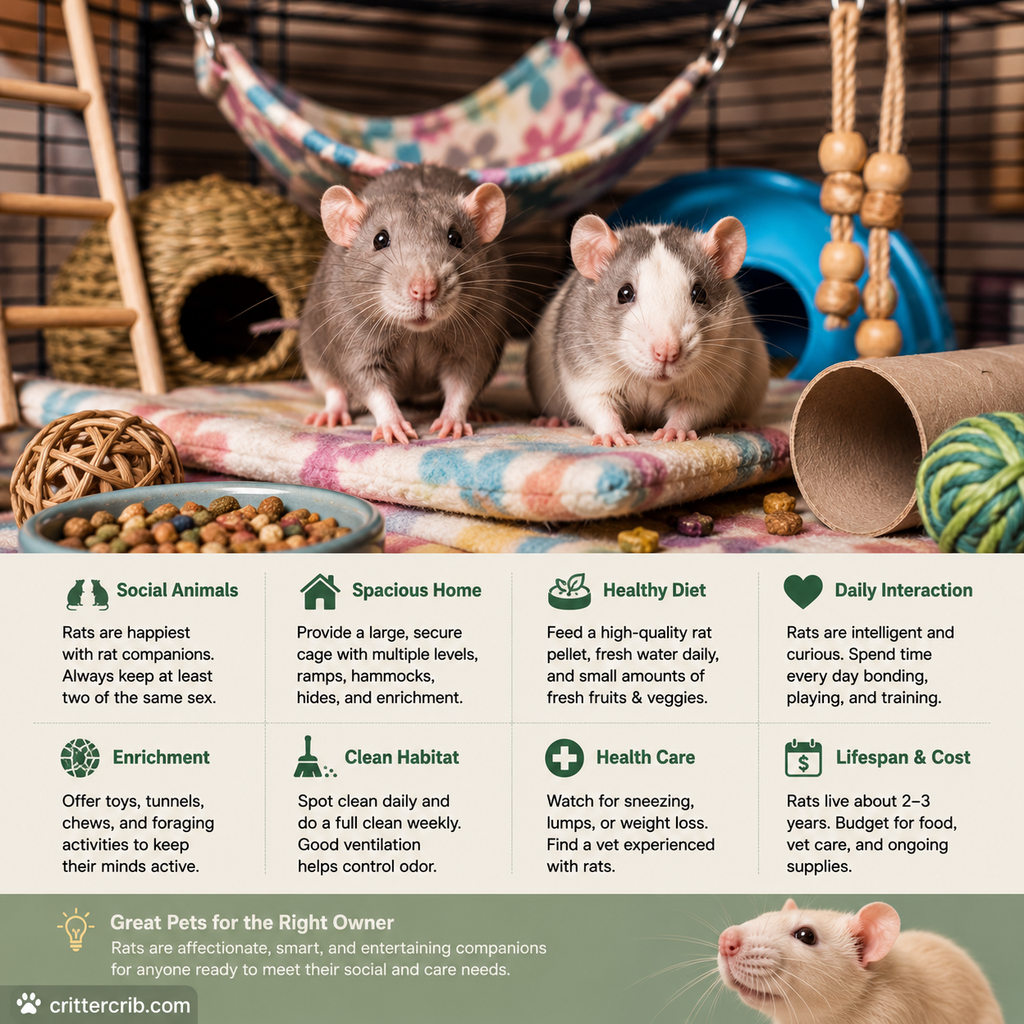
Even a large enclosure doesn’t replace opportunities to exercise and explore outside it.
Rats benefit from regular supervised time in a secure, rat-proofed area.
This gives them opportunities to:
- Run
- Climb
- Explore
- Interact with you
- Investigate new objects
- Forage
- Play with companions
A dedicated playpen or rat-proofed room can make this much easier.
How to Rat-Proof a Room
Rats are curious, intelligent, flexible, and equipped with teeth designed to chew.
That’s an impressive combination when you’re trying to protect your house.
Before playtime, secure:
- Electrical cords
- Small gaps
- Houseplants
- Medications
- Cleaning products
- Small swallowable objects
- Foam and rubber items
- Reclining furniture
- Open doors
- Heating or cooling vents
- Anything fragile
- Anything you don’t want chewed
Get down to floor level and inspect the room.
Rats frequently notice openings that people overlook.
Rats Need Things to Chew
Chewing is normal rodent behavior.
Provide appropriate materials so your rats have acceptable outlets for it.
Options can include:
- Safe wooden chews
- Plain cardboard
- Cardboard boxes
- Tubes
- Other rat-safe chew materials
Cardboard is particularly useful because it’s inexpensive and can serve multiple purposes.
A box can be a hide, climbing structure, nesting area, chew toy, or all four before breakfast.
Foraging Is Excellent Enrichment
Food doesn’t always have to arrive in a bowl.
Encouraging rats to search for part of their diet can provide mental and physical stimulation.
Try:
- Scatter feeding
- Hiding food in cardboard
- Using appropriate foraging toys
- Wrapping small portions in safe paper
- Placing food at different cage levels
Start with easy challenges.
Once your rats understand the game, you can gradually make activities more complicated.
Watching a rat solve a food puzzle is also a good reminder that you’re dealing with a remarkably intelligent animal.
Rotate Enrichment
Rats can become familiar with their environment quickly.
Rotating some enrichment helps maintain novelty.
You might occasionally change:
- Cardboard boxes
- Tunnels
- Climbing layouts
- Foraging activities
- Chew materials
- Safe toys
Don’t completely rebuild the enclosure every day.
Familiar sleeping areas and scents provide security.
Aim for a combination of familiarity and novelty.
Rats Need Human Interaction Too
Having other rats doesn’t mean your pets don’t need you.
Regular positive interaction helps rats become comfortable with handling and makes health checks easier.
Spend time:
- Talking to them
- Offering appropriate treats
- Allowing them to climb onto you
- Training simple behaviors
- Supervising free-roam time
- Gently handling them
- Observing their individual personalities
Let shy rats progress at their own pace.
Chasing and grabbing usually slows down the trust-building process.
Do Rats Like Being Held?
Many rats become comfortable being held, although individual preferences vary.
Young rats may have very little interest in sitting still.
They have places to go.
As rats mature, some become noticeably calmer and more interested in cuddling.
When handling a rat, support its body securely.
Never pick up a rat by the end of its tail.
Are Rats Good Pets for Children?
Rats can be excellent family pets when adults remain responsible for their care.
Their intelligence and interactive personalities can make them especially interesting for older children who want to participate in training and enrichment.
However, children need supervision.
Adults should remain responsible for:
- Daily feeding
- Fresh water
- Cleaning
- Health monitoring
- Veterinary care
- Safe handling
- Ensuring the rats receive daily attention
A rat shouldn’t become neglected because a child’s interest changes.
Are Pet Rats Clean?
Rats are often much cleaner than their reputation suggests.
They groom themselves frequently and may groom their companions.
The cage is usually the source of unpleasant odors—not the rats themselves.
Regular spot cleaning, litter maintenance, bedding changes, and washing fabric accessories can keep odor under control.
Overcleaning can create its own problems, though.
Constantly stripping away every familiar scent isn’t necessary.
Maintain cleanliness without trying to sterilize the entire environment every day.
Do Pet Rats Smell?
Rats do have a natural scent.
Males may also scent mark more noticeably than females.
A strong ammonia or urine smell usually means the enclosure needs attention.
Odor control depends on:
- Appropriate cage size
- Good ventilation
- Absorbent bedding
- Litter training
- Regular spot cleaning
- Washing hammocks
- Cleaning heavily soiled surfaces
Avoid trying to solve odor problems with strong fragrances.
Clean the source instead.
How Often Should You Clean a Rat Cage?
There isn’t one perfect schedule for every setup.
The number of rats, cage size, bedding type, litter habits, and enclosure design all affect cleaning frequency.
Daily or Frequently
Check for:
- Wet bedding
- Dirty litter boxes
- Spoiled fresh food
- Heavily soiled surfaces
- Dirty water
- Damaged enrichment
Periodically
You’ll also need to:
- Replace bedding
- Wash hammocks
- Clean platforms
- Wash food and water containers
- Wipe cage bars when necessary
- Clean litter trays thoroughly
If the enclosure develops a strong odor well before cleaning day, adjust the routine.
Rats Can Be Prone to Health Problems
This is one of the most important disadvantages prospective owners should understand.
Pet rats can develop health issues, including respiratory disease and tumors.
Individual risks vary, but veterinary expenses can become significant during a rat’s lifetime.
Pay attention to:
- Sneezing that persists or worsens
- Noisy breathing
- Difficulty breathing
- Discharge around the nose or eyes
- Lumps
- Weight loss
- Reduced appetite
- Poor coat condition
- Changes in activity
- Difficulty moving
Don’t assume a significant behavioral or physical change will resolve on its own.
Find a Rat-Experienced Veterinarian Before You Need One
Not every veterinary clinic regularly treats rats.
Before bringing rats home, find a veterinarian experienced with small mammals or exotic pets.
Ask whether the clinic routinely sees rats.
It’s much easier to research veterinary options when everyone is healthy than when you’re dealing with an emergency.
Keep the clinic’s phone number and emergency information readily available.
Regular Weight Checks Are Useful
Rats can lose weight before an illness becomes visually obvious.
Using a digital scale to monitor each rat regularly can help you establish a normal baseline.
Keep a simple record.
If one rat begins consistently losing weight, particularly alongside changes in appetite, breathing, activity, or behavior, contact your veterinarian.
Weight is only one health indicator, but it’s a useful one.
How Long Do Pet Rats Live?
One of the hardest parts of rat ownership is their relatively short lifespan.
Pet rats commonly live around two to three years, although individual lifespans vary.
For people who form strong bonds with their animals, this can be emotionally difficult.
It also means a group may change frequently over time.
If you start with similarly aged rats, you may eventually need to think about introductions so a surviving rat isn’t left without appropriate companionship.
Their short lifespan doesn’t make the relationship less meaningful.
It does make planning important.
How Much Do Pet Rats Cost?
The rats themselves may be relatively inexpensive.
Proper care is where most of the cost comes from.
Initial expenses can include:
- A spacious enclosure
- Carrier
- Bedding
- Hammocks
- Hides
- Food and water equipment
- Litter trays
- Climbing accessories
- Enrichment
Ongoing expenses include:
- Food
- Bedding
- Litter
- Replacement hammocks
- Enrichment
- Veterinary care
Medical expenses can exceed the original cost of the rats many times over.
An emergency veterinary fund is a smart part of rat ownership.
Advantages of Keeping Rats as Pets
Rats have a lot going for them.
Some of their biggest advantages include:
- Highly intelligent
- Social and interactive
- Can form strong relationships with people
- Often enjoy handling
- Trainable
- Relatively quiet
- No outdoor walks required
- Fascinating social behavior
- Lots of inexpensive enrichment options
- Distinct individual personalities
For someone who wants a small animal with a high level of interaction, rats are difficult to beat.
Disadvantages of Keeping Rats as Pets
They’re not the right choice for everyone.
Potential disadvantages include:
- Short lifespan
- Need for compatible rat companions
- Daily interaction requirements
- Regular cage cleaning
- Need for substantial enclosure space
- Veterinary costs
- Potential respiratory problems
- Potential tumors and other illnesses
- Chewing behavior
- Need for supervised out-of-cage exercise
- Finding an experienced veterinarian can be difficult in some areas
Think about these points before adopting rather than discovering them afterward.
Rats vs. Hamsters for Beginners
Rats and hamsters are both rodents, but keeping them can be very different.
Rats are highly social and generally need compatible rat companions.
Hamsters are typically housed individually depending on species and circumstances.
Rats also tend to be especially interactive with people and often enjoy climbing onto their owners during playtime.
Their larger enclosure requirements and need for social companionship can make the setup more involved.
If you want an intelligent, highly interactive small pet and have room for a large enclosure, rats may be particularly appealing.
If you’re choosing between species, research the actual care requirements rather than deciding based solely on size or appearance.
Rats vs. Guinea Pigs for Beginners
Rats and guinea pigs are both social animals, but their daily care looks quite different.
Guinea pigs require constant access to grass hay and need dietary vitamin C.
Rats are omnivores and use vertical space much more extensively.
Rats are also exceptional climbers and tend to interact with their environment using their paws in ways that make puzzle-based enrichment particularly useful.
Guinea pigs generally require more uninterrupted horizontal floor space, while rat habitats often take advantage of height.
Both can make rewarding pets.
Neither is maintenance-free.
What Should You Buy Before Getting Rats?
Prepare the habitat before bringing your rats home.
Your basic checklist should include:
- A spacious, secure cage
- Appropriate bedding
- Multiple hammocks and hides
- Food
- Water bottles or bowls
- Litter boxes if you’re litter training
- Safe litter
- Chew materials
- Climbing accessories
- Tunnels
- Foraging activities
- A secure carrier
- Cleaning supplies
- A rat-proofed exercise area
You should also identify a veterinarian who treats rats.
Don’t assume a small “starter cage” contains everything you’ll need.
Should You Adopt Rats?
Adoption can be an excellent option.
Animal shelters and small-animal rescues sometimes have compatible rats looking for homes.
A rescue may also be able to provide useful information about:
- Personality
- Age
- Sex
- Social compatibility
- Previous handling
- Medical history
- Current diet
An established pair or group can be particularly appealing for beginners because the rats already know each other.
Questions to Ask Before Getting Pet Rats
Before making the commitment, ask yourself:
- Do I have enough space for a large enclosure?
- Am I prepared to keep at least two compatible rats?
- Can I provide daily interaction and enrichment?
- Do I have a safe area for out-of-cage exercise?
- Am I willing to clean the enclosure regularly?
- Can I afford veterinary care?
- Is there a rat-experienced veterinarian nearby?
- Am I comfortable with a lifespan that may only be a few years?
- Can I protect electrical cords and belongings from chewing?
- Who will care for the rats when I travel?
If those requirements fit your lifestyle, rats may be an excellent choice.
Frequently Asked Questions About Rats as Pets
Are Rats Easy Pets?
Rats have relatively straightforward basic care, but they aren’t low-maintenance pets.
They need compatible companions, daily food and water, a clean environment, enrichment, exercise, social interaction, and veterinary care.
Are Pet Rats Friendly?
Well-socialized pet rats can be extremely friendly.
Many become comfortable climbing onto familiar people, taking treats, learning simple behaviors, and relaxing during handling.
Personality varies between individuals.
Do Pet Rats Bite?
Any animal with teeth can bite, but well-socialized pet rats aren’t typically looking for opportunities to bite people.
Fear, pain, stress, or inappropriate handling can increase defensive behavior.
Give nervous rats time to build trust.
Can You Keep Just One Rat?
Rats are highly social animals and generally shouldn’t live alone without a specific reason.
A compatible pair or group provides social interaction that human attention can’t replace.
Are Rats Good Apartment Pets?
Rats can work well in apartments because they don’t require outdoor walks and aren’t usually extremely noisy.
You’ll still need enough space for a substantial enclosure and a secure exercise area.
Check your lease or housing rules before bringing them home.
Are Pet Rats Noisy at Night?
Rats can be active during evening and nighttime hours.
You may hear climbing, chewing, drinking, wrestling, or cage accessories moving.
They aren’t generally loud animals, but a rat cage in a bedroom isn’t completely silent.
Do Rats Need Baths?
Healthy rats groom themselves frequently and generally don’t need routine bathing.
Keeping the environment clean is more important.
If your rat becomes unusually dirty or stops grooming, consider whether there may be an underlying health issue and contact your veterinarian when appropriate.
Do Rats Recognize Their Owners?
Rats can become familiar with individual people through scent, sound, routine, and repeated positive interactions.
Many clearly behave differently around familiar caregivers than unfamiliar people.
Can Rats Learn Their Names?
Rats can learn to associate particular sounds, including their names, with attention or rewards.
Using positive reinforcement can make name recognition part of simple training.
So, Are Rats Good Pets?
For the right person, rats can be exceptional pets.
They’re intelligent enough to keep surprising you, social enough to form meaningful relationships, and curious enough to turn everyday objects into entertainment.
But they’re not tiny, maintenance-free substitutes for larger pets.
They need other rats, plenty of cage space, regular out-of-cage activity, mental stimulation, proper nutrition, cleaning, handling, and veterinary care.
The short lifespan is also something every prospective owner should seriously consider. Two or three years can pass remarkably quickly when you’ve become attached to an animal with a distinctive personality.
If you’re comfortable with those responsibilities and want small pets that actively interact with you, rats deserve serious consideration.
Give them a good environment, appropriate companionship, and enough opportunities to use their intelligence, and you’ll quickly understand why rat owners tend to become so enthusiastic about them.