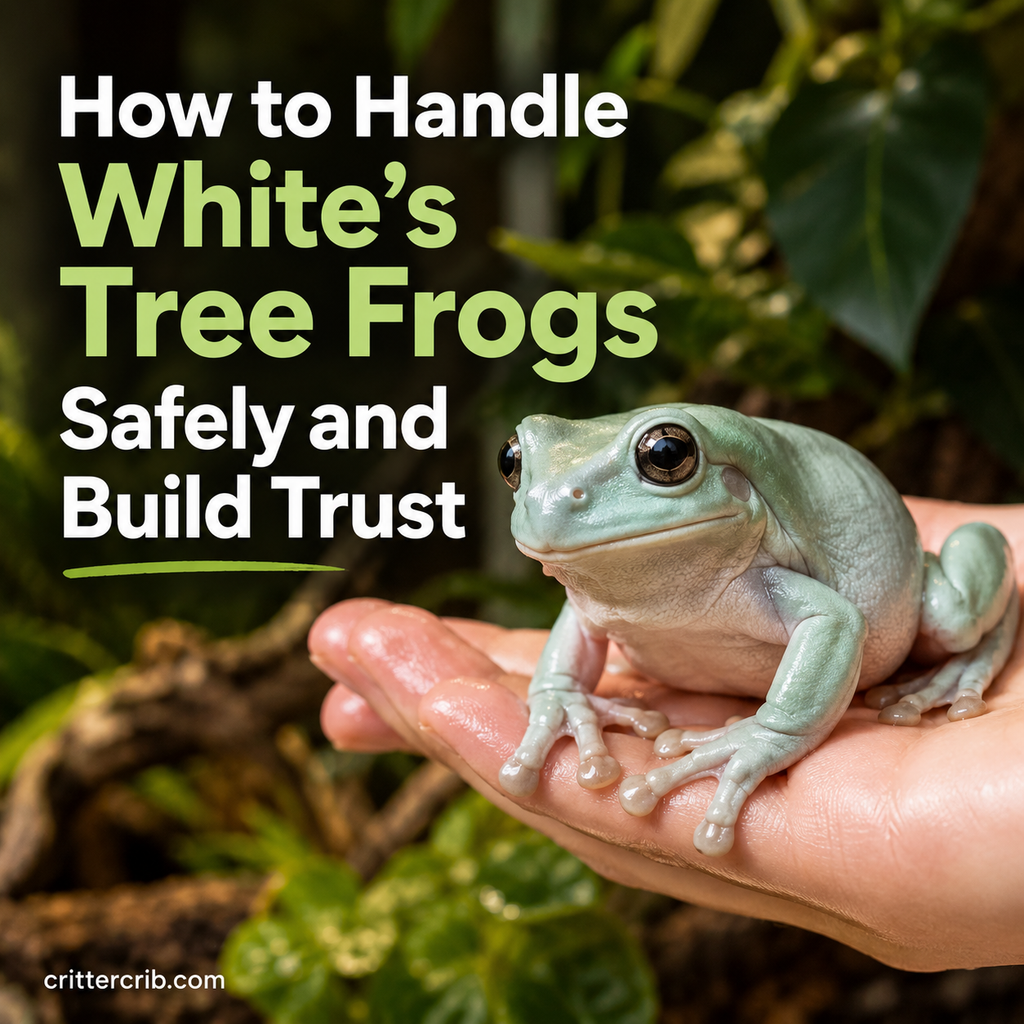
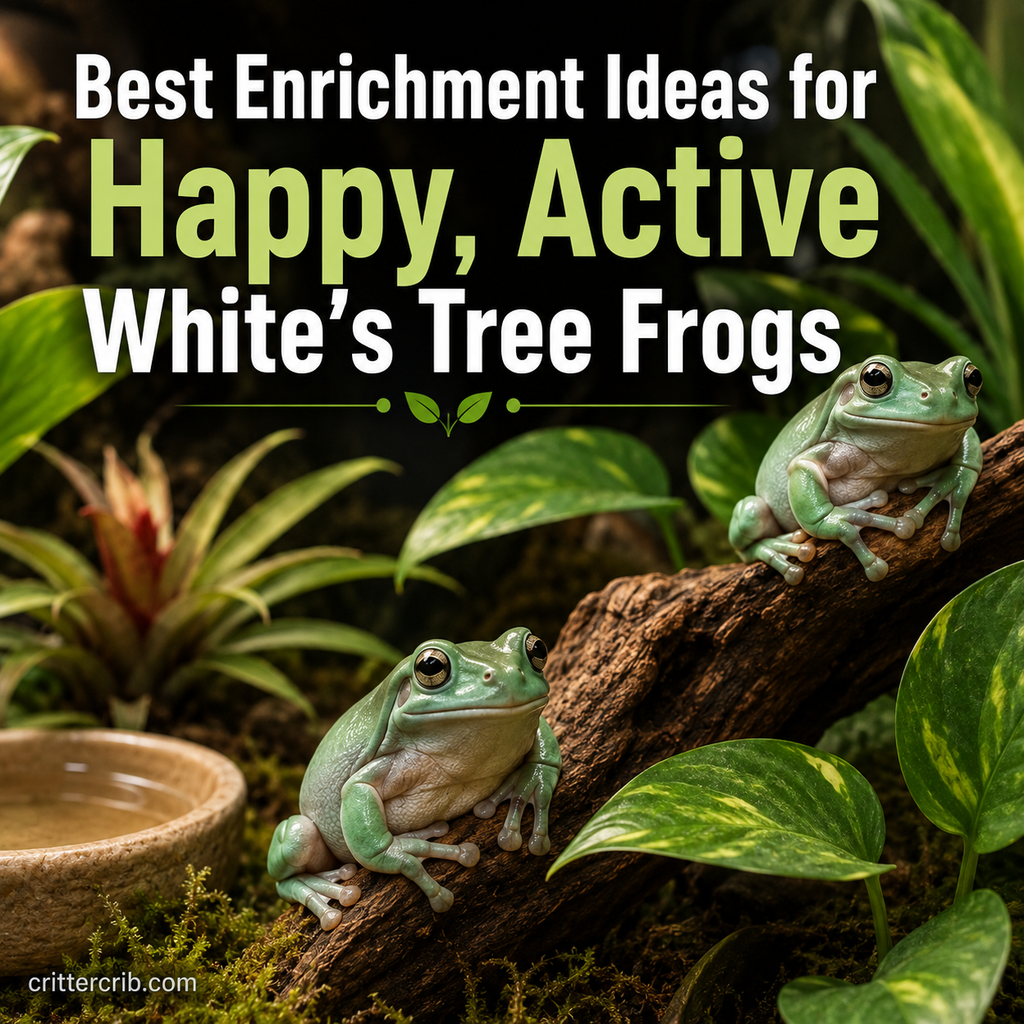
White’s tree frogs aren’t exactly known for running laps around their enclosure. During the day, you may find your frog tucked behind a leaf, wedged into a favorite hiding spot, or sitting in essentially the same position for hours.
That’s perfectly normal.
Also known as Australian green tree frogs or dumpy tree frogs, White’s tree frogs are primarily nocturnal. Much of their interesting behavior happens after the lights go out, when they climb, explore, hunt, soak, and investigate their surroundings.
A good enclosure should give them opportunities to do those things naturally.
Enrichment for White’s tree frogs isn’t about teaching tricks or constantly introducing new toys. It’s about creating a safe, interesting habitat that encourages natural behaviors without causing unnecessary stress.
From climbing branches and leafy hiding places to varied feeding techniques, there are plenty of simple ways to make your frog’s environment more engaging.
What Is Enrichment for White’s Tree Frogs?
Enrichment is anything that safely encourages an animal to interact with its environment and perform natural behaviors.
For White’s tree frogs, those behaviors include:
- Climbing
- Perching
- Hunting
- Exploring
- Hiding
- Soaking
- Choosing between different resting locations
- Moving between different heights and microhabitats
The enclosure itself should provide most of this enrichment.
You don’t need a collection of brightly colored pet toys. In fact, many products designed for mammals or other pets have little value to a frog.
A branch positioned at the right height can provide more meaningful enrichment than an expensive “interactive” toy.
The goal is to think like a frog rather than a human.
Why Is Enrichment Important?
Captive animals don’t experience the same environmental variety they would encounter in nature.
A wild tree frog has vegetation, branches, changing weather, insects, hiding places, different surfaces, and numerous routes through its environment.
A captive frog might spend its entire life inside one enclosure.
That doesn’t mean captivity is inherently boring, but it does mean the keeper controls nearly everything the frog can experience.
Thoughtful enrichment can encourage:
- Natural movement
- Climbing and exploration
- Hunting behavior
- Environmental choice
- Use of different areas of the enclosure
- Appropriate nighttime activity
Enrichment can also make the enclosure much more interesting for you to observe.
When frogs have multiple climbing routes, feeding opportunities, and resting spots, you get to see a wider range of natural behavior.
1. Create Plenty of Climbing Opportunities
If there’s one enrichment feature White’s tree frogs should have, it’s vertical structure.
These are arboreal frogs. They’re built for climbing and have large adhesive toe pads that help them grip branches, leaves, and other surfaces.
A tall enclosure with nothing to climb wastes much of the available space.
Useful climbing structures include:
- Cork bark
- Natural branches
- Driftwood
- Vines
- Bamboo positioned securely
- Amphibian-safe artificial vines
- Sturdy live plants
Try to create routes rather than isolated perches.
A frog should ideally be able to move from the lower portion of the enclosure toward the top using overlapping branches, plants, and vines.
Use Different Branch Thicknesses
Every perch doesn’t need to look identical.
Providing branches with different diameters and orientations gives your frog more options.
Include a mixture of:
- Horizontal resting branches
- Diagonal climbing routes
- Thick stable perches
- Smaller connecting branches
Make sure everything is securely anchored.
A branch that shifts or falls when a frog lands on it isn’t enrichment—it’s a hazard.
2. Provide Elevated Perches
White’s tree frogs often enjoy resting above ground level.
Give them several elevated locations where they can comfortably sit.
Good perches might include:
- Horizontal branches
- Cork ledges
- Broad plant leaves
- Secure vines
- Elevated hides
- Frog-safe magnetic ledges designed for terrariums
Place perches at different heights.
This lets the frog choose where it wants to spend time rather than being restricted to one favorite branch.
It also allows the animal to take advantage of subtle differences in temperature, humidity, light, and airflow within the enclosure.
3. Add Plenty of Leafy Cover
A heavily decorated enclosure isn’t just prettier.
Plants create hiding places, visual barriers, climbing surfaces, and resting spots.
White’s tree frogs often use broad leaves as natural perches.
Suitable enclosure plants may include species such as:
- Pothos
- Philodendron
- Bromeliads
- Some sturdy ferns
- Other non-toxic tropical plants appropriate for terrariums
Artificial plants can work too, especially if you’re not interested in maintaining a fully planted setup.
Whatever you use, inspect it carefully.
Avoid artificial plants with sharp plastic edges, exposed wire, loose pieces, glitter, or coatings that may deteriorate in humid conditions.
Don’t Make the Enclosure Too Open
An enclosure can technically contain branches while still feeling exposed.
Add foliage around some of the climbing structures so your frog can move through covered areas.
The goal isn’t to pack every inch with leaves. Leave open areas for movement while providing enough cover for the frog to retreat when it wants privacy.
4. Offer Multiple Hiding Places
A hiding frog isn’t necessarily an unhappy frog.
Hiding is normal amphibian behavior.
Providing several secure areas gives your White’s tree frog control over where it rests.
Hides can include:
- Cork bark tubes
- Cork flats
- Dense foliage
- Hollow logs
- Elevated hides
- Broad leaves
- Commercial amphibian hides
Consider providing hiding opportunities at different heights rather than placing every hide on the enclosure floor.
White’s tree frogs are arboreal, so an elevated hiding spot may be particularly appealing.
5. Use Live Plants as Natural Enrichment
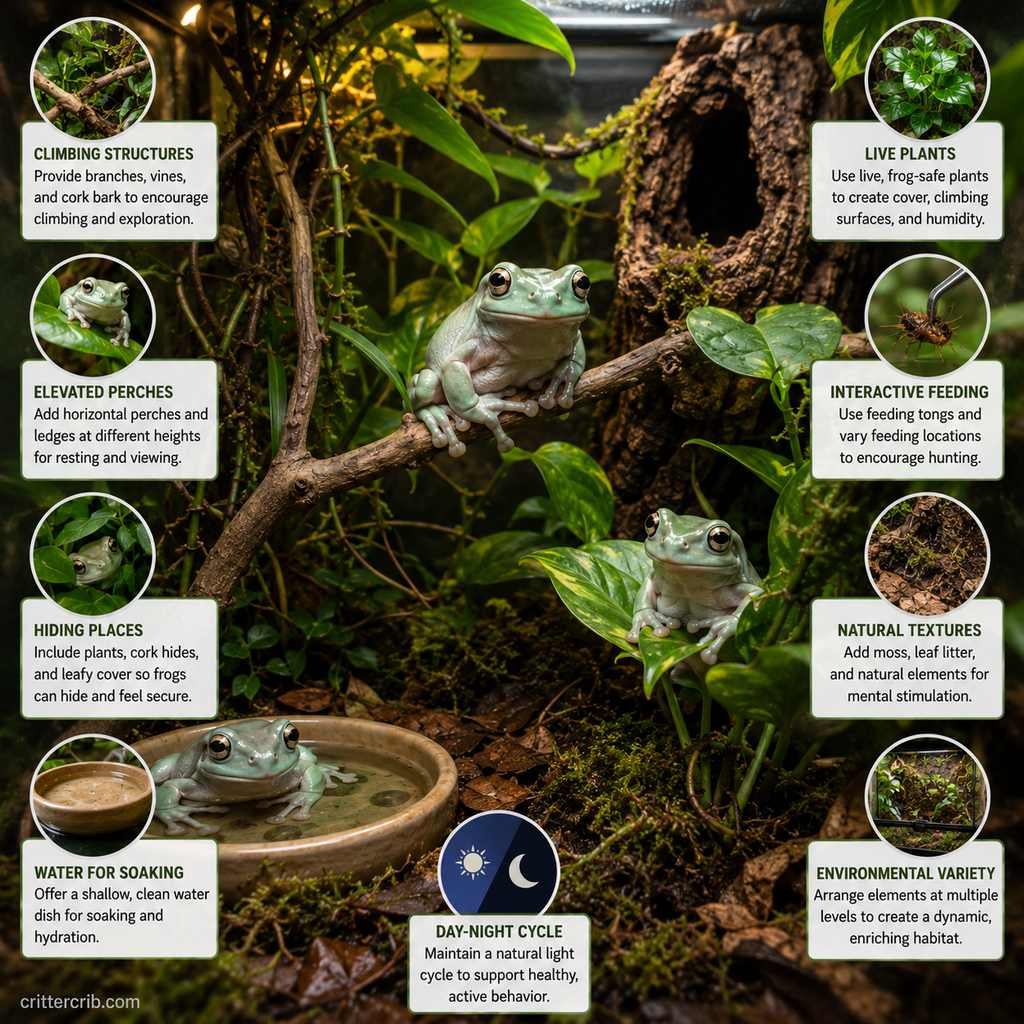
Live plants can transform a basic enclosure into a much more complex environment.
They provide:
- Climbing surfaces
- Resting leaves
- Visual barriers
- Shaded areas
- Changes in texture
- Natural cover
Plants also grow and change over time, which creates subtle environmental variation without requiring you to constantly rearrange the enclosure.
Choose sturdy plants capable of supporting a fairly heavy frog.
White’s tree frogs aren’t tiny, delicate animals. A plant that works beautifully for a small dart frog may collapse under the weight of an adult White’s tree frog.
Make sure any plants introduced into the enclosure are free from pesticides, fertilizers, and other potentially harmful residues.
6. Make Feeding More Interesting
Feeding is one of the easiest opportunities for behavioral enrichment.
White’s tree frogs are insect-eating predators. Instead of simply placing food in exactly the same spot every time, you can occasionally encourage the frog to hunt.
Appropriate feeders may include:
- Crickets
- Dubia roaches
- Black soldier fly larvae
- Silkworms
- Hornworms
- Other appropriately sized feeder insects
Variety can provide both nutritional and behavioral benefits when feeders are selected carefully.
Allow Safe Hunting Opportunities
Occasionally allowing an appropriate feeder insect to move where your frog can hunt it encourages stalking and striking behavior.
However, don’t simply dump large numbers of insects into the enclosure and walk away.
Uneaten feeders can hide, create mess, or potentially bother the frog.
Crickets in particular shouldn’t be left indefinitely with an amphibian.
Monitor feeding and remove uneaten prey when necessary.
7. Rotate Feeder Insects
Food variety can itself be enrichment.
Different prey species:
- Move differently
- Smell different
- Have different textures
- Encourage slightly different hunting responses
A cricket hopping across a branch creates a different experience from a worm moving slowly in a feeding dish.
This doesn’t mean you need a different feeder every night.
Instead, establish a nutritionally appropriate staple diet and periodically rotate other suitable feeders into the schedule.
Remember that nutritional balance comes first. Enrichment shouldn’t result in feeding excessive amounts of fatty treats just because your frog gets excited about them.
8. Try Different Feeding Locations
If your frog is healthy and actively feeding, occasionally changing where food appears can encourage exploration.
For example, you might use feeding tongs near different perches rather than always presenting food in the exact same corner.
You can also use an escape-resistant feeding dish in different accessible locations.
Keep changes reasonable.
The goal is to create mild novelty, not make your frog struggle to find dinner.
Young frogs, newly acquired frogs, or animals with health problems may benefit from a more predictable feeding routine.
9. Create Different Levels Within the Enclosure
Vertical space becomes much more useful when it contains distinct zones.
Imagine the enclosure as several floors rather than one tall empty box.
You might have:
Lower level
Substrate, leaf litter, plants, and the water dish.
Middle level
Branches, foliage, cork bark, and climbing routes.
Upper level
Elevated perches, dense leaves, and secure resting areas.
This arrangement encourages your frog to use more of the enclosure.
It also creates environmental choices.
Your frog might spend one night perched near the top and another tucked into leaves halfway down.
10. Provide a Proper Soaking Area
White’s tree frogs should have access to clean, amphibian-safe water.
A suitable water dish isn’t exactly a toy, but soaking is a natural behavior and an important part of the frog’s environment.
The dish should be:
- Large enough for the frog to comfortably sit in
- Shallow enough for safe access
- Easy to enter and exit
- Stable
- Easy to clean
Replace the water regularly and whenever it becomes contaminated.
Because amphibians absorb substances through their skin, water quality matters.
If your tap water contains chlorine or chloramine, it needs to be appropriately treated before being used for your frog.
11. Introduce Natural Textures
A naturalistic enclosure gives frogs more surfaces to interact with.
Instead of filling the habitat with one smooth material, consider incorporating safe textures such as:
- Cork bark
- Smooth branches
- Leaf litter
- Live foliage
- Moisture-retaining substrate
- Moss used appropriately
- Natural wood
Texture variation makes climbing and exploration more interesting.
Just make sure natural materials are prepared appropriately and haven’t been exposed to pesticides or other contaminants.
Avoid sharp rocks, splintering wood, or anything abrasive enough to damage delicate amphibian skin.
12. Make Small Habitat Changes Occasionally
You don’t need to completely redesign the enclosure every week.
In fact, constantly changing everything may create stress rather than enrichment.
Instead, make occasional small adjustments.
You might:
- Change the angle of a vine
- Add a new branch
- Replace a plant
- Introduce fresh leaf litter
- Move one perch
- Add a new cork hide
This creates some novelty while keeping most of the frog’s familiar environment intact.
Watch how your frog responds.
If an animal becomes unusually stressed after environmental changes, scale back and give it time to settle.
13. Create Visual Barriers
Not every enrichment idea needs to encourage more activity.
Giving an animal the ability to avoid stimulation is equally important.
Dense foliage, cork bark, and strategically placed decorations can break up sightlines inside the enclosure.
This allows a frog to choose whether it wants to sit somewhere exposed or retreat into cover.
Visual barriers become particularly important if the enclosure is located in an active room where people frequently walk past.
Providing choice is one of the most useful principles in animal enrichment.
14. Maintain a Natural Day-Night Cycle
White’s tree frogs are primarily nocturnal.
That means some of their best “enrichment” happens when you aren’t actively doing anything.
Provide a consistent day-night cycle so the frog can maintain normal activity patterns.
During daylight hours, it may rest.
After dark, you may notice it:
- Changing perches
- Exploring branches
- Moving through plants
- Visiting the water dish
- Hunting
- Calling
Don’t assume your frog is inactive simply because you mostly observe it during the day.
Try quietly checking the enclosure after the lights have been off for a while. You may discover your apparently lazy frog has a much busier nighttime schedule.
15. Give Your Frog Enough Space
No amount of decoration can fully compensate for an enclosure that’s too cramped.
White’s tree frogs benefit from vertically oriented housing that provides enough room for climbing.
For multiple frogs, enclosure size becomes even more important.
The habitat needs enough usable space for each animal to:
- Find comfortable resting spots
- Access food
- Reach the water dish
- Move vertically
- Retreat from other frogs
- Choose between exposed and covered areas
More space is most useful when it’s furnished effectively.
A large empty enclosure isn’t automatically enriching. Use branches, foliage, and perches to turn that volume into usable frog habitat.
Can White’s Tree Frogs Be Kept Together?
White’s tree frogs can sometimes be housed in compatible groups when the enclosure is appropriately sized and the animals are similar in size.
However, group housing shouldn’t be viewed as enrichment in the same way companionship might be for a social mammal.
Frogs don’t need a “friend” simply because humans enjoy company.
If keeping multiple White’s tree frogs, make sure there are enough resources to reduce competition.
Provide multiple:
- Perches
- Hiding areas
- Climbing routes
- Resting locations
- Feeding opportunities
Monitor feeding carefully so one frog isn’t consistently getting most of the food.
Avoid housing significantly different-sized frogs together because a sufficiently small frog may potentially be mistaken for prey.
Things You Shouldn’t Use for Frog Enrichment
It’s easy to go too far when trying to make an enclosure entertaining.
White’s tree frogs don’t need hamster toys, exercise wheels, balls, mirrors, or complicated puzzle feeders.
Avoid enrichment items that introduce unnecessary risks.
These include:
- Objects with sharp edges
- Small pieces that could be swallowed
- Painted objects with unknown coatings
- Metal that may rust
- Decorations containing exposed wire
- Adhesives that aren’t safe for humid terrariums
- Objects treated with pesticides or chemicals
- Rough materials that could damage skin
- Deep water features the frog can’t easily exit
When you’re considering a new object, ask a simple question:
Does this help the frog perform a natural behavior?
If the answer is no, it probably doesn’t need to be in the enclosure.
Avoid Excessive Handling as Enrichment
Taking your White’s tree frog out of its enclosure isn’t a good enrichment activity.
Unlike dogs, parrots, or rats, frogs don’t need regular physical interaction with their owners.
Amphibian skin is highly permeable and sensitive. Oils, soap residue, lotions, cleaning products, and other substances on human hands can potentially cause irritation or harm.
Handling can also create stress.
Keep handling to a minimum and reserve it for situations where moving the frog is actually necessary.
You can provide a much richer life by improving the enclosure than by regularly taking the frog out of it.
How to Tell if Your White’s Tree Frog Is Using Its Enrichment
You don’t need your frog to interact dramatically with every new feature.
Look for normal behaviors such as:
- Using different perches
- Climbing after dark
- Moving through foliage
- Hunting actively
- Soaking
- Switching resting locations
- Hiding when desired
- Exploring new branches or plants
You may also discover that your frog completely ignores the expensive new hide and continues sleeping behind the same leaf every day.
That’s okay.
Enrichment is about providing choices. The frog doesn’t have to use every choice equally.
Why Isn’t My White’s Tree Frog Active?
First, consider when you’re watching it.
A White’s tree frog sleeping or sitting quietly throughout the afternoon is behaving normally. These frogs tend to become much more active at night.
Persistent lethargy combined with other changes deserves more attention.
Watch for symptoms such as:
- Loss of appetite
- Weight loss
- Unusual skin changes
- Weakness
- Difficulty climbing
- Abnormal posture
- Persistent soaking
- Difficulty shedding
- Unusual breathing
Also check basic enclosure conditions, including temperature and humidity.
A frog that’s behaving unusually isn’t necessarily “bored.” Illness or inappropriate husbandry shouldn’t be treated by simply adding more enrichment.
If concerning symptoms persist, consult a veterinarian experienced with amphibians or exotic animals.
A Simple White’s Tree Frog Enrichment Setup
You don’t need an elaborate bioactive enclosure to provide meaningful enrichment.
A good basic setup could include:
- A vertically oriented enclosure with adequate space.
- Several securely anchored natural branches.
- Horizontal and diagonal climbing routes.
- Dense live or artificial foliage.
- At least one elevated hiding area.
- Multiple comfortable perches.
- A shallow dish of clean, amphibian-safe water.
- Appropriate substrate.
- A natural day-night cycle.
- A varied, nutritionally balanced feeder insect diet.
From there, you can occasionally introduce small changes such as a new branch, different feeder insect, or additional plant.
The enclosure itself does most of the work.
Frequently Asked Questions About White’s Tree Frog Enrichment
Do White’s tree frogs need toys?
Not in the traditional sense.
White’s tree frogs benefit more from environmental enrichment such as branches, plants, hides, climbing structures, varied perches, and opportunities to hunt.
A well-designed enclosure is essentially their playground.
Do White’s tree frogs get bored?
It’s difficult to measure boredom in frogs the same way we might recognize it in humans or highly social mammals.
Rather than trying to determine whether a frog feels “bored,” focus on providing opportunities to perform natural behaviors.
A varied enclosure with climbing routes, hiding places, foliage, appropriate feeding opportunities, and environmental choices gives the frog more control over how it spends its time.
What do White’s tree frogs like to climb on?
White’s tree frogs can use branches, cork bark, vines, sturdy plants, broad leaves, and other secure terrarium structures.
Provide several surfaces at different angles and heights.
Should I rearrange my frog’s enclosure?
Occasional small changes can provide novelty, but there’s no need to constantly rearrange the entire habitat.
Maintaining familiar hiding and resting areas can help your frog feel secure.
If you make changes, introduce them gradually and observe the frog’s response.
Can I let my White’s tree frog explore outside its enclosure?
Routine free-roaming outside the enclosure isn’t recommended as enrichment.
Outside the controlled habitat, frogs can encounter unsafe surfaces, household chemicals, pets, inappropriate temperatures, contaminants, and opportunities to escape.
Improving the enclosure is a safer way to encourage exploration.
Is live feeding good enrichment?
Appropriate live feeder insects can encourage natural hunting behavior.
However, feeding should be supervised, and uneaten insects shouldn’t be allowed to remain in the enclosure indefinitely.
Nutrition and safety should always take priority over enrichment.
Do White’s tree frogs need companionship?
White’s tree frogs don’t require companionship in the way social mammals do.
Compatible frogs can sometimes be kept together under appropriate conditions, but another frog shouldn’t be added solely because you think a single frog is lonely.
A properly designed enclosure can provide plenty of meaningful stimulation for an individually housed frog.
Final Thoughts
The best enrichment for a White’s tree frog doesn’t come from a toy aisle.
It comes from building an environment that allows the frog to behave like a frog.
Give it branches to climb, sturdy leaves to sit on, covered areas to retreat into, clean water for soaking, different heights to explore, and appropriate live prey to hunt. Occasionally changing a branch, plant, or feeding location can add novelty without turning the enclosure upside down.
Just as importantly, respect the frog’s natural schedule. A White’s tree frog that spends most of the afternoon looking like it has absolutely nowhere to be may become surprisingly active once the room gets dark.
You don’t need to force activity or constantly entertain your frog.
Provide a safe, complex environment with plenty of choices, then let the frog decide how to use it. That’s what good enrichment is really about.