
White’s tree frogs are known for being fairly hardy amphibians, but that doesn’t mean temperature and humidity can be left to chance.
Their enclosure should be warm enough to support normal activity and digestion while still giving the frogs cooler places to retreat. Humidity is a little different. Rather than keeping the terrarium constantly wet, the goal is usually a moderate environment that experiences natural fluctuations throughout the day.
Getting that balance right isn’t difficult once you understand what you’re trying to create.
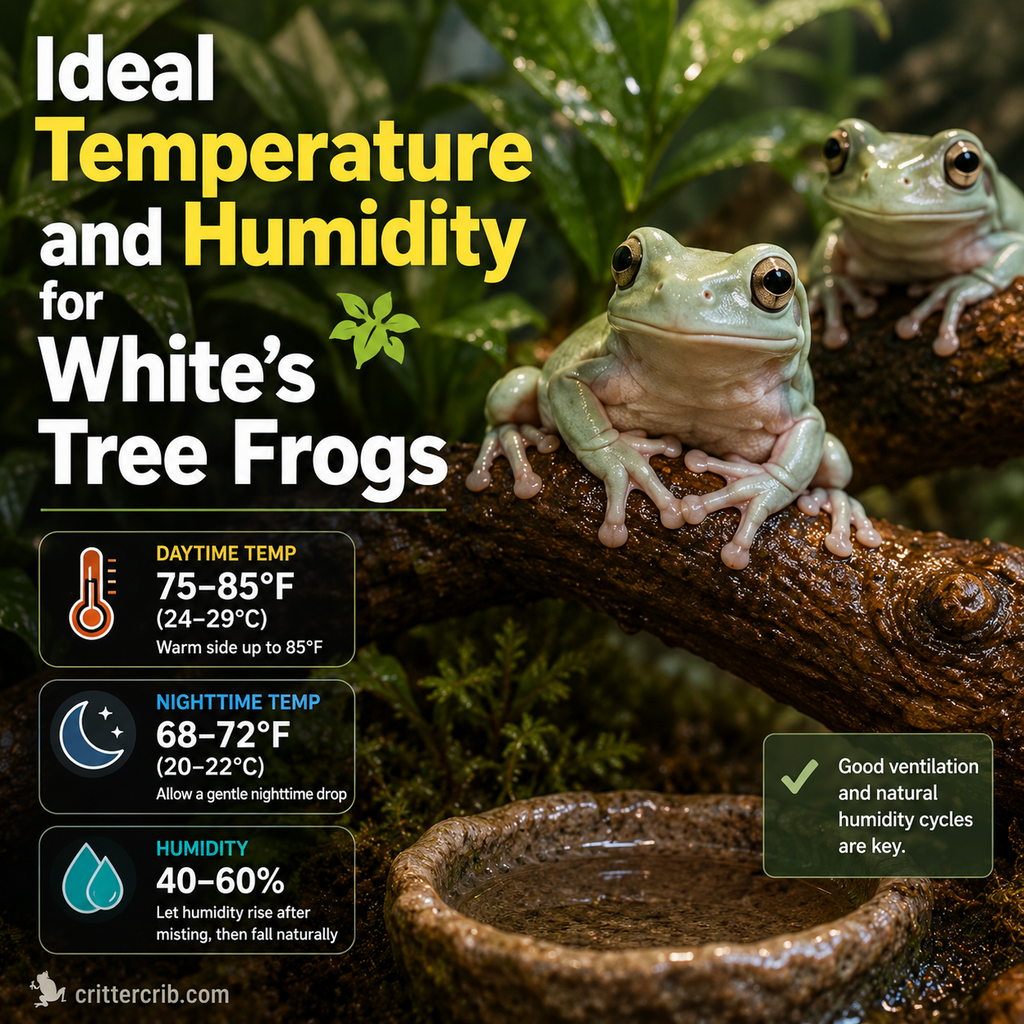
For most White’s tree frog enclosures, aim for a daytime temperature gradient of roughly 75–85°F (24–29°C), with the warmest area toward the upper portion of the habitat. Nighttime temperatures can drop into the upper 60s to low 70s°F (around 20–23°C).
Humidity can generally fluctuate around 40–60%, with temporary increases after misting. Good ventilation and opportunities for the enclosure to dry somewhat between misting sessions are important.
These are general husbandry ranges rather than numbers that need to remain perfectly fixed every minute of the day.
Here’s how to create and maintain those conditions safely.
White’s Tree Frog Temperature and Humidity at a Glance
A useful starting point for a White’s tree frog enclosure is:
- Daytime ambient temperature: approximately 75–80°F
- Warm upper area: approximately 80–85°F
- Cooler areas: mid-70s°F
- Nighttime temperature: upper 60s to low 70s°F
- General humidity: approximately 40–60%
- Temporary humidity after misting: may rise above the normal range
- Ventilation: important
- Substrate: slightly moist where appropriate, not constantly saturated
- Water: clean and dechlorinated
- Monitoring: digital thermometers and hygrometers
The important word here is “gradient.”
Your frog shouldn’t experience exactly the same conditions everywhere in the enclosure.
Why Temperature Matters for White’s Tree Frogs
White’s tree frogs are ectothermic.
They depend on their environment to regulate body temperature rather than generating enough internal heat to maintain a constant temperature like mammals do.
Temperature influences:
- Activity
- Digestion
- Appetite
- Metabolism
- Hydration
- Normal behavior
That’s why simply keeping the entire enclosure at room temperature isn’t always ideal.
Instead, provide a range of temperatures so the frog can choose where it wants to spend its time.
Ideal Daytime Temperature for White’s Tree Frogs
During the day, a general ambient range of approximately 75–80°F (24–27°C) works well for much of the enclosure.
The upper portion can be warmer, reaching approximately 80–85°F (27–29°C) in a controlled warm area.
The lower portions should remain cooler.
This creates a vertical temperature gradient.
Since White’s tree frogs are arboreal, they can move between branches and resting areas to regulate their temperature.
A frog may spend part of the day tucked into a cooler hide and later move toward a warmer perch.
That’s exactly what you want the enclosure to allow.
Do White’s Tree Frogs Need a Basking Area?
White’s tree frogs can benefit from access to a warmer upper area, but it doesn’t need to resemble an intense desert reptile basking spot.
A gently warmed zone is more appropriate.
You might create a warm area around 80–85°F while keeping the rest of the enclosure cooler.
The frog then has a choice.
Avoid turning the entire terrarium into one uniformly hot environment.
Ideal Nighttime Temperature
Temperatures can naturally decrease at night.
A nighttime range around the upper 60s to low 70s°F (approximately 20–23°C) is generally suitable for healthy adult White’s tree frogs.
A modest nighttime drop helps create a natural day-night cycle.
In many homes, this happens automatically when daytime heating equipment switches off.
If your room remains reasonably warm overnight, supplemental nighttime heating may not be necessary.
How Cold Is Too Cold for a White’s Tree Frog?
A brief temperature change isn’t necessarily an emergency, but prolonged cold conditions can interfere with normal activity and digestion.
If the enclosure is regularly dropping into the low 60s°F or below, review your heating strategy.
Pay particular attention during winter.
A tank that maintained perfect temperatures in July may become considerably colder in January.
Monitor the enclosure year-round rather than assuming conditions remain unchanged.
How Hot Is Too Hot for a White’s Tree Frog?
Excessive heat can be dangerous.
Temperatures consistently approaching or exceeding the upper 80s°F throughout the enclosure don’t give the frog enough opportunity to cool down.
The problem becomes more serious if there isn’t a cooler retreat.
High temperatures can also accelerate dehydration.
If the enclosure becomes too warm:
- Turn down or switch off supplemental heating if safe to do so.
- Verify the temperature with another reliable thermometer.
- Make sure the frog has access to cooler areas.
- Check the room temperature.
- Move the enclosure away from direct sunlight if necessary.
Never place a frog enclosure where direct sunlight can turn the glass terrarium into a greenhouse.
Creating a Temperature Gradient
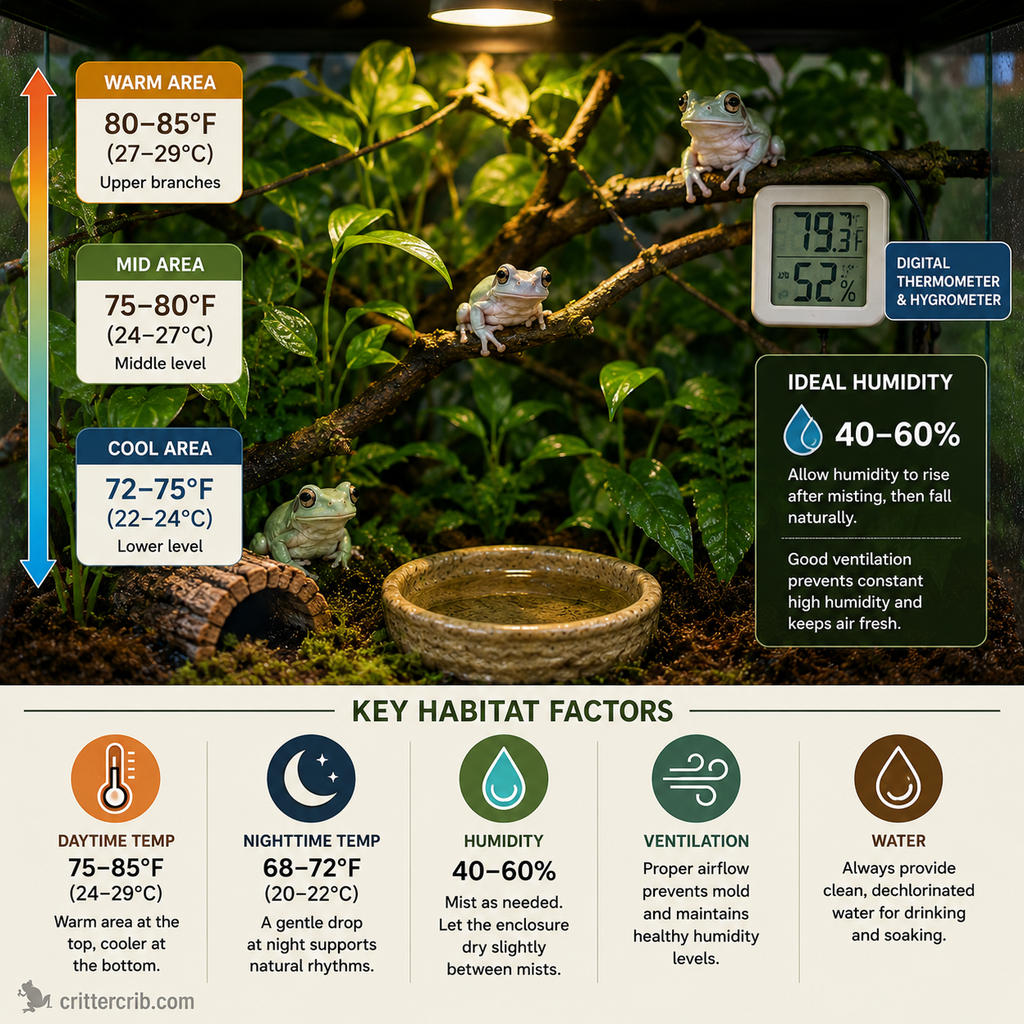
One of the easiest ways to create a useful temperature gradient is to heat one portion of the enclosure rather than the entire habitat.
Because White’s tree frogs climb, a vertical gradient works particularly well.
The habitat might have:
Upper Level
Approximately 80–85°F near the controlled warm area.
Include sturdy branches or perches so the frog can use this zone comfortably.
Middle Level
Approximately 75–80°F.
This becomes a moderate transition zone.
Lower Level
Usually somewhat cooler than the upper portions.
Include cover and shaded resting areas.
These aren’t rigid boundaries.
The goal is simply to provide meaningful choices.
Best Heating Options for White’s Tree Frogs
Whether supplemental heat is necessary depends on your room temperature.
Some homes naturally remain within an appropriate range during much of the year.
Others need additional heat.
Common options include controlled overhead heat sources designed for terrariums.
Low-wattage heat sources can work well when appropriately positioned and regulated.
Whatever method you choose, temperature should be measured at frog level rather than estimated from the wattage printed on the package.
Always Use a Thermostat With Heat Sources
If you’re using a heat source capable of raising enclosure temperatures significantly, connect it to an appropriate thermostat.
A thermostat regulates the heat source according to temperature.
This reduces the risk of dangerous overheating.
Don’t confuse a thermostat with a thermometer.
A thermometer tells you the temperature.
A thermostat helps control it.
Ideally, you’ll use both.
Do White’s Tree Frogs Need Heat at Night?
Not necessarily.
If nighttime room temperatures remain within an appropriate range, additional heating may not be needed.
Allowing a natural temperature drop is generally fine.
If the enclosure becomes excessively cold overnight, a non-light-emitting heat source controlled by a thermostat may be appropriate.
Avoid bright nighttime bulbs.
White’s tree frogs benefit from a normal light-dark cycle.
How to Measure Enclosure Temperature
One thermometer isn’t always enough.
If the enclosure has a warm upper zone and cooler lower zone, measure both.
Digital thermometers with probes are useful because you can position the sensors exactly where you need them.
Consider monitoring:
- Upper warm area
- Middle of enclosure
- Lower cool area
An infrared temperature gun can also be useful for checking surface temperatures on branches and other objects.
It doesn’t replace monitoring ambient air temperature, but it’s a helpful additional tool.
Ideal Humidity for White’s Tree Frogs
Humidity is where White’s tree frog care often gets oversimplified.
They’re frogs, so beginners sometimes assume their enclosure should remain extremely humid and wet at all times.
That’s not necessary.
White’s tree frogs come from environments where moisture levels fluctuate, and captive enclosures benefit from a similar cycle.
A general humidity range of around 40–60% works as a useful starting point for routine conditions.
Humidity may rise temporarily after misting and then gradually decrease as the enclosure dries.
That fluctuation is normal.
Humidity Doesn’t Need to Stay at One Exact Number
Don’t panic because your hygrometer moves from 50% to 65% after misting and later returns toward 45%.
That’s a humidity cycle.
In many cases, it’s preferable to maintaining an enclosure that’s permanently saturated.
Think in terms of trends rather than obsessing over a single number.
You’re trying to prevent two extremes:
- Chronically dry conditions
- Chronically wet, stagnant conditions
Why Constantly High Humidity Can Be a Problem
High humidity isn’t automatically better just because White’s tree frogs are amphibians.
An enclosure that remains constantly wet can encourage:
- Mold
- Bacterial growth
- Stagnant air
- Waterlogged substrate
- Persistent condensation
- Poor overall sanitation
The combination of high humidity and poor ventilation is particularly problematic.
Fresh airflow matters.
Why Very Low Humidity Can Also Be a Problem
At the other extreme, excessively dry conditions can contribute to dehydration.
You may notice the enclosure drying extremely quickly during:
- Winter heating
- Hot summer weather
- Air conditioning
- Low household humidity
If humidity repeatedly falls below the desired range, you may need to adjust misting, substrate moisture, ventilation balance, or other parts of the setup.
Don’t solve dryness by soaking everything continuously.
Small adjustments are usually better.
How Often Should You Mist a White’s Tree Frog Enclosure?
There isn’t one misting schedule that works for every home.
Some enclosures may need light misting daily.
Others may maintain appropriate humidity with less frequent misting.
The correct schedule depends on:
- Room humidity
- Temperature
- Ventilation
- Enclosure size
- Substrate
- Number of plants
- Season
- Heating equipment
Use your hygrometer and the condition of the habitat as guides.
Misting should help create a temporary increase in humidity without leaving the terrarium permanently soaked.
What Water Should You Use for Misting?
Use water that’s safe for amphibians.
Tap water containing chlorine or chloramine should generally be treated with an appropriate water conditioner before use.
Avoid spraying untreated chlorinated water directly into the habitat.
If you’re uncertain about your water source, check your local water report or test it.
Ventilation Is Just as Important as Humidity
Humidity and ventilation need to work together.
A well-designed White’s tree frog habitat allows fresh air exchange while still retaining enough moisture to prevent excessive drying.
Good ventilation helps:
- Reduce stagnant air
- Allow surfaces to dry
- Control mold
- Prevent constant condensation
- Support healthier habitat conditions
A terrarium covered almost completely to trap humidity may solve one number on your hygrometer while creating several other problems.
Signs the Enclosure May Be Too Humid
Possible signs include:
- Constant condensation
- Substrate that never dries at all
- Standing water in the substrate
- Persistent mold
- Musty smell
- Water droplets covering surfaces all day
- Poor airflow
Some temporary condensation after misting isn’t necessarily a problem.
Persistent saturation is different.
Signs the Enclosure May Be Too Dry
Possible clues include:
- Substrate drying extremely quickly
- Humidity remaining consistently low
- Plants wilting despite appropriate watering
- Frog repeatedly soaking for unusually long periods
- Signs consistent with dehydration
Behavior alone shouldn’t be used to diagnose a humidity problem.
Always check actual environmental measurements.
If your frog shows concerning physical or behavioral changes that don’t improve after correcting husbandry, contact a veterinarian experienced with amphibians or exotic animals.
Choosing a Hygrometer
A digital hygrometer is usually more useful than guessing based on condensation.
Place the sensor where it measures the environment the frogs actually use.
Avoid positioning it:
- Directly beneath a mister
- Inside the water dish
- Against constantly wet substrate
- Immediately beside a heat source
Those locations can produce readings that don’t accurately represent the enclosure.
In a tall habitat, you may even want measurements at more than one level.
Temperature and Humidity Work Together
These two environmental factors can’t really be managed independently.
Warmer air and increased ventilation can cause the enclosure to dry faster.
Misting may temporarily lower surface temperatures while increasing humidity.
Heating equipment may decrease relative humidity.
Seasonal room conditions affect both.
That’s why adjusting one part of the environment sometimes requires changing another.
For example, adding a stronger heat source may mean you’ll need to monitor moisture more carefully.
Substrate and Humidity
Substrate plays an important role in moisture management.
A suitable substrate can retain some moisture without becoming swampy.
Depending on the enclosure design, appropriate options may include amphibian-safe soil mixtures and other substrates intended for humid terrariums.
Leaf litter can help cover the surface and create additional microclimates.
Avoid leaving the entire substrate saturated.
If squeezing a handful produces a stream of water, conditions may be too wet.
Live Plants and Humidity
Live plants can make humidity easier to manage.
They hold moisture around leaves and substrate while creating shaded microclimates.
Plants also make the enclosure feel more natural.
Choose species that tolerate:
- Moderate humidity
- Warm temperatures
- Frog activity
- Your chosen lighting
White’s tree frogs are chunky animals.
Delicate plants may quickly discover this.
Sturdy plants with strong leaves and branches are generally more practical.
Provide Clean Water Even With Proper Humidity
Humidity doesn’t replace drinking water.
White’s tree frogs should have access to a clean, appropriately sized water dish containing amphibian-safe water.
The dish should be easy for the frog to enter and exit.
Change the water regularly, especially if the frog soils it.
White’s tree frogs have a remarkable ability to turn a freshly cleaned water dish into something requiring another cleaning.
That’s simply part of keeping them.
Temperature and Humidity During Shedding
White’s tree frogs periodically shed their skin.
You may notice the frog rubbing its body, stretching, or appearing to pull skin toward its mouth.
It often eats the shed skin.
Appropriate hydration and environmental conditions support normal shedding.
You don’t need to dramatically increase humidity every time shedding occurs unless the enclosure is genuinely too dry.
Maintain good husbandry rather than trying to force a special shedding environment.
Temperature and Humidity for Juvenile White’s Tree Frogs
Young frogs can be more vulnerable to environmental mistakes because of their smaller body size.
Monitor juveniles carefully.
Provide:
- Appropriate warmth
- Reliable humidity
- Clean water
- Good ventilation
- Plenty of cover
Avoid extreme temperature or moisture fluctuations.
As always, conditions should be adjusted to the age, size, health, and exact species you’re keeping.
Seasonal Temperature Changes
Your terrarium doesn’t exist in isolation.
The room around it changes throughout the year.
Summer
Watch for:
- Overheating
- Direct sunlight
- Warm nighttime temperatures
- Faster water contamination
Air conditioning may help stabilize room temperature.
Winter
Watch for:
- Low nighttime temperatures
- Dry household air
- Faster enclosure drying
- Increased dependence on supplemental heating
Indoor heating systems can dramatically reduce humidity.
Spring and Fall
Conditions may change quickly from one day to the next.
Continue checking your equipment even when the weather feels comfortable.
What If the Humidity Is Too High?
If humidity remains consistently excessive:
- Increase ventilation.
- Reduce misting frequency.
- Check for waterlogged substrate.
- Remove standing water outside the water dish.
- Verify your hygrometer’s accuracy.
- Evaluate whether plants or drainage are trapping too much moisture.
Make changes gradually.
What If the Humidity Is Too Low?
If the enclosure dries too quickly:
- Verify the hygrometer.
- Lightly increase misting if needed.
- Check substrate moisture.
- Add suitable live plants.
- Review ventilation.
- Check whether heating equipment is drying the habitat excessively.
Don’t completely seal the enclosure simply to raise humidity.
Fresh airflow still matters.
Common Temperature and Humidity Mistakes
Keeping the Entire Tank the Same Temperature
Frogs benefit from having warmer and cooler areas.
Create a gradient.
Using Heat Without a Thermostat
Uncontrolled heat sources can cause dangerous temperature spikes.
Guessing the Temperature
Use a thermometer.
Your hand isn’t a reliable temperature sensor.
Keeping Humidity Extremely High All Day
White’s tree frogs don’t need a permanently saturated environment.
Allow some drying between misting sessions.
Misting on a Fixed Schedule Without Checking Humidity
The same misting schedule may produce very different results in January and July.
Monitor conditions and adjust.
Using Untreated Tap Water
Use amphibian-safe water for misting and the water dish.
Blocking Too Much Ventilation
Don’t sacrifice airflow simply to make the hygrometer display a higher number.
Placing the Tank in Direct Sunlight
Sunlight through glass can cause rapid overheating.
Simple Daily Temperature and Humidity Routine
You don’t need to spend all day watching environmental gauges.
A basic routine works well.
Morning
- Check upper and lower temperatures.
- Check humidity.
- Inspect the water dish.
- Look at substrate moisture.
- Mist lightly if conditions require it.
Afternoon
If you’re still adjusting a new setup, check the warmest area during the hottest part of the day.
This helps identify overheating.
Evening
- Check temperature before nighttime heating changes.
- Refresh water if necessary.
- Mist if your enclosure’s routine calls for it.
- Observe the frogs as they become active.
Once you understand how your enclosure behaves, maintenance becomes much easier.
Frequently Asked Questions
What Temperature Should a White’s Tree Frog Tank Be?
Aim for a daytime gradient with much of the enclosure around 75–80°F and a warmer upper area around 80–85°F.
Provide cooler areas so the frog can thermoregulate.
What Temperature Should the Tank Be at Night?
Nighttime temperatures can generally drop into the upper 60s to low 70s°F.
Avoid prolonged exposure to extreme cold.
What Humidity Do White’s Tree Frogs Need?
A general range around 40–60% works well as a starting point, with temporary increases after misting.
Allow the enclosure to experience a natural humidity cycle rather than keeping it constantly wet.
Is 80% Humidity Too High for White’s Tree Frogs?
A temporary spike after misting isn’t necessarily concerning.
Maintaining approximately 80% humidity continuously, particularly with poor ventilation and saturated surfaces, isn’t generally necessary.
Focus on moderate humidity with good airflow and periodic drying.
Should I Mist My White’s Tree Frog Every Day?
Possibly, but don’t mist purely because the calendar says so.
Use actual humidity readings, substrate moisture, ventilation, and seasonal conditions to determine how often misting is necessary.
Do White’s Tree Frogs Need a Heat Lamp?
That depends on your room temperature and enclosure.
If additional warmth is needed, an appropriate controlled overhead heat source can create a useful warm zone.
Any significant heat source should be regulated appropriately and monitored with accurate thermometers.
Do White’s Tree Frogs Need Heat at Night?
Not if your nighttime temperatures remain within an appropriate range.
If the habitat becomes too cold, controlled supplemental heating that doesn’t produce disruptive visible light may be necessary.
Should a White’s Tree Frog Tank Be Wet?
It should contain appropriate moisture, but it shouldn’t resemble a swamp.
The substrate can retain some moisture while surfaces are allowed to dry between misting cycles.
Why Is My White’s Tree Frog Always in the Water Dish?
Occasional soaking can be normal.
If your frog suddenly spends much more time soaking than usual, check temperature, humidity, water quality, substrate conditions, and general health.
Persistent behavioral changes deserve closer attention.
Finding the Right Balance
Ideal White’s tree frog temperature and humidity aren’t about hitting one perfect number and keeping it there forever.
The enclosure should provide choices.
During the day, create a warm upper area around 80–85°F while allowing cooler portions of the habitat to remain in the mid-to-upper 70s. At night, temperatures can naturally decrease into the upper 60s or low 70s.
Humidity should fluctuate too.
A general range around 40–60% provides a useful starting point, with temporary increases after misting followed by gradual drying.
Combine those conditions with clean water, appropriate substrate, good ventilation, sturdy climbing areas, shaded retreats, and reliable monitoring equipment.
Then watch how the habitat behaves.
Once you’ve experienced a few warm days, cool nights, misting cycles, and seasonal changes, you’ll begin to understand exactly how quickly your particular enclosure heats up and dries out.
That’s more useful than chasing a supposedly perfect number.
A stable, well-monitored habitat with sensible temperature and humidity gradients gives your White’s tree frog something far more valuable: the ability to choose the conditions it needs throughout the day.