
Aquatic snails don’t usually get the same attention as colorful fish or freshwater shrimp. Sometimes they aren’t even intentionally added to an aquarium. A tiny snail appears on a plant one day, and suddenly you’re wondering whether you’ve gained a new pet.
But intentionally kept aquatic snails can be surprisingly interesting animals.
They explore the aquarium at their own pace, climb plants and decorations, graze on surfaces, and display more personality than many first-time keepers expect. They’re also relatively quiet pets that don’t require a huge amount of space.
That doesn’t mean they’re maintenance-free.
Aquatic snails still need appropriate water conditions, food, minerals, filtration, and regular aquarium care. Some species reproduce rapidly, while others may lay eggs above the waterline or require specific conditions to breed.
So, are aquatic snails good pets?
For the right person, absolutely. Here’s what you should know before bringing one home.
Are Aquatic Snails Good Pets for Beginners?
Many freshwater aquatic snails can be good beginner pets when kept in a properly established aquarium.
They’re quiet, fascinating to watch, and generally don’t require the complicated social arrangements that some fish do.
Snails can also work well for someone who enjoys observing natural behaviors rather than physically interacting with a pet.
A well-kept aquatic snail may spend its day:
- Grazing across aquarium glass
- Exploring rocks and driftwood
- Moving through live plants
- Searching the substrate for food
- Resting in sheltered areas
- Investigating algae and biofilm
They’re not pets you hold or train in the traditional sense, but that doesn’t make them boring.
Once you start paying attention, a snail slowly making its way around an aquarium can be oddly entertaining.
The Pros of Keeping Aquatic Snails
Aquatic snails have several qualities that make them appealing to beginners.
They’re Quiet
This one is obvious, but it’s worth mentioning.
There are no barking complaints, squeaky wheels, or early-morning demands for breakfast.
Aquatic snails are about as quiet as pets get.
They Don’t Need a Huge Aquarium
Many commonly kept freshwater snail species can live in relatively modest aquariums.
That doesn’t mean they belong in tiny, unfiltered containers. More water volume generally provides greater environmental stability, and the appropriate tank size depends on the species and number of animals you’re keeping.
Still, compared with many fish, snails don’t necessarily require an enormous setup.
They’re Interesting to Observe
Snails become much more interesting once you stop thinking of them as aquarium decorations.
Watch closely and you may see one stretching surprisingly far from its shell, using its tentacles to investigate its surroundings, climbing upside down beneath a leaf, or carefully maneuvering around a piece of wood.
Some species are especially active and visible.
They Can Graze on Algae and Biofilm
Many aquatic snails spend considerable time grazing on algae, biofilm, and organic material growing on aquarium surfaces.
This can make them useful members of an aquarium ecosystem.
But don’t buy a snail solely as a cleaning tool.
It still produces waste and requires appropriate nutrition. A snail can contribute to aquarium cleanup, but it doesn’t replace maintenance.
Many Are Peaceful
Most popular freshwater aquarium snails aren’t interested in attacking fish, shrimp, or other peaceful aquarium inhabitants.
That can make them suitable for many community setups.
The bigger concern is usually the opposite: whether the fish will bother the snail.
The Cons of Keeping Aquatic Snails
Snails aren’t difficult pets in many situations, but there are a few drawbacks beginners should understand.
Some Species Can Reproduce Very Quickly
This is probably the most famous aquarium snail problem.
Certain small snails can reproduce rapidly when conditions provide abundant food.
You may start with a few and eventually discover snails on the glass, substrate, filter, plants, and decorations.
A population boom is often associated with an abundance of available food.
Overfeeding fish can therefore contribute to rapidly increasing snail numbers.
They Still Produce Waste
Snails eat.
What goes in eventually comes back out.
Adding snails increases the aquarium’s biological load, so they shouldn’t be treated as animals that magically remove waste from the system.
Filtration, water changes, and sensible stocking still matter.
Some Can Damage Certain Plants
Many popular aquarium snails generally prefer algae, biofilm, leftover food, or deteriorating plant material rather than healthy plants.
However, behavior varies by species, food availability, and circumstances.
Research the exact snail you’re considering if maintaining pristine live plants is important to you.
Escaping Can Be a Problem
Some aquatic snails are surprisingly adventurous.
They may climb above the waterline or find openings around aquarium equipment.
A secure lid can be important, particularly for species known to explore above the water.
Their Shells Need the Right Conditions
A snail’s shell isn’t simply a permanent house that takes care of itself.
Shell condition can be influenced by water chemistry and nutrition.
Water that is too acidic or lacks appropriate mineral availability may contribute to shell deterioration in some freshwater snails.
Popular Types of Freshwater Aquarium Snails
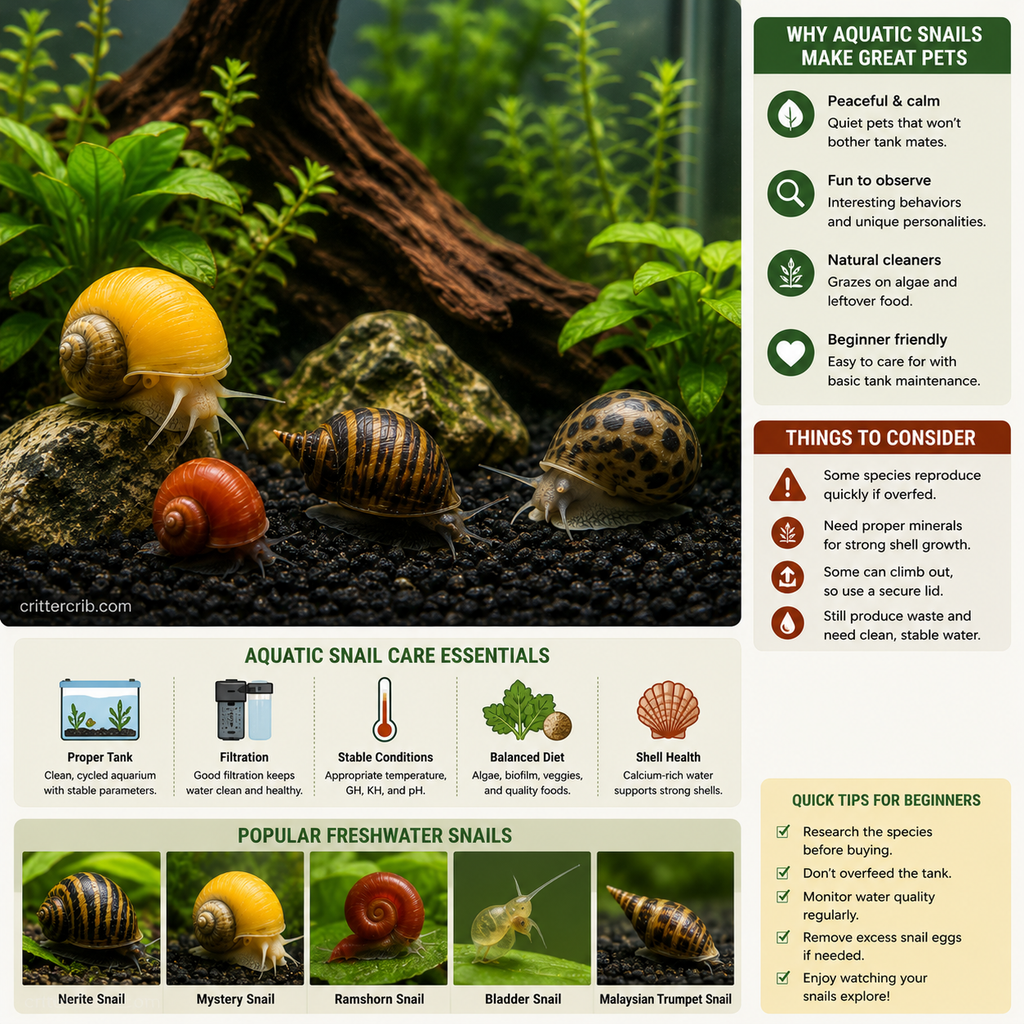
Not all aquatic snails behave the same way.
Choosing the right species is one of the most important decisions you’ll make.
Nerite Snails
Nerite snails are extremely popular in freshwater aquariums.
They’re especially well known for grazing on algae and come in several attractive patterns and shell shapes.
One major advantage for freshwater keepers is that although nerites may lay eggs, their larvae generally require brackish or marine conditions to successfully develop, depending on the species.
That means they aren’t likely to suddenly establish a huge reproducing population in an ordinary freshwater aquarium.
The downside?
Those small pale eggs can be deposited on hard surfaces and may be difficult to remove.
Nerites can also climb above the waterline, so a secure aquarium lid is a good idea.
Mystery Snails
Mystery snails are another popular choice.
They’re much larger and more visually noticeable than many small hitchhiker snails and are available in several shell and body colors.
Mystery snails can be surprisingly entertaining.
They may climb the glass, explore plants, extend a breathing siphon toward the surface, and occasionally let go of a surface and drift downward.
They also require appropriate food rather than being expected to survive entirely on whatever happens to grow in the aquarium.
Mystery snails lay egg clutches above the waterline, making reproduction relatively easy for an observant keeper to manage.
Ramshorn Snails
Ramshorn snails get their name from their distinctive coiled shells.
They’re commonly found in planted aquariums and may arrive unintentionally on plants.
They can be useful grazers and are interesting animals in their own right.
However, they can reproduce quickly when plenty of food is available.
If you intentionally keep ramshorn snails, careful feeding can help keep the population more manageable.
Bladder Snails
Bladder snails are another common aquarium hitchhiker.
They’re small, adaptable, and frequently enter aquariums on live plants.
Some aquarists consider them pests. Others deliberately keep them.
They can consume algae, biofilm, leftover food, and decaying organic material, but their ability to reproduce quickly means food availability needs to be managed.
Malaysian Trumpet Snails
Malaysian trumpet snails spend significant time in or around the substrate.
Their burrowing behavior can make them less visible during parts of the day.
Like several other small aquarium snails, their population can increase considerably when excess food is available.
Before intentionally introducing them, make sure you’re comfortable with the possibility of establishing a long-term snail population.
What Kind of Tank Do Aquatic Snails Need?
The exact setup depends on the species, but most freshwater snails benefit from the same basic things any aquarium animal needs: clean, stable water and an appropriately maintained habitat.
A good setup typically includes:
- A properly cycled aquarium
- Appropriate filtration
- Suitable temperature
- Species-appropriate water chemistry
- Aquarium-safe substrate and decorations
- Food and natural grazing surfaces
- A secure lid when needed
- Regular water testing and maintenance
Don’t assume a snail can simply live in an unfiltered bowl because it moves slowly.
Slow-moving doesn’t mean low-maintenance biology.
Cycle the Aquarium Before Adding Snails
Snails can be affected by ammonia and nitrite just like other aquarium animals.
A newly filled aquarium doesn’t instantly have the biological filtration required to process waste.
Cycling allows beneficial microorganisms to establish themselves and convert toxic waste products through the aquarium’s nitrogen cycle.
Before intentionally adding snails, make sure the aquarium is properly cycled and stable.
Testing is important because water can look perfectly clear while still containing harmful levels of ammonia or nitrite.
Pay Attention to Water Hardness and pH
Water chemistry is especially relevant when you’re keeping an animal with a shell.
Snails need minerals such as calcium to build and maintain their shells.
Very soft or acidic water can create problems for some freshwater snail species, particularly over long periods.
Possible signs of shell problems include:
- Pitting
- Cracks
- Erosion
- Thin-looking new growth
- Whitening or deterioration
Research the preferred GH, KH, and pH range of the snail species you intend to keep.
Don’t constantly add chemicals to chase a precise number. Stable, species-appropriate water conditions are generally more useful than repeatedly changing the aquarium’s chemistry.
What Do Aquatic Snails Eat?
One of the biggest beginner mistakes is assuming a snail will simply eat algae forever.
Natural grazing can be an important part of a snail’s diet, but it may not provide everything the animal needs.
Depending on the species, suitable foods can include:
- Algae and biofilm
- Appropriate sinking foods
- Snail or invertebrate foods
- Certain algae wafers
- Suitable vegetables
- Decaying plant matter
- Other species-appropriate aquarium foods
A varied diet can help provide better nutrition than relying entirely on whatever happens to grow on the glass.
Don’t Overfeed
There’s a balance.
You want your snails to receive enough food without leaving large amounts of uneaten material decomposing in the aquarium.
Overfeeding can reduce water quality and encourage rapid population growth in reproducing snail species.
Start conservatively and observe how quickly food disappears.
Do Aquatic Snails Need Calcium?
Calcium and other minerals play an important role in shell development.
However, you shouldn’t automatically dump calcium products into every snail aquarium.
First understand your existing water chemistry.
If your water already contains appropriate mineral levels, supplementation may be unnecessary.
If you’re keeping snails in soft water or noticing shell problems, investigate GH, KH, pH, diet, and species-specific requirements before deciding what needs to change.
The goal is an appropriate mineral balance, not simply “more calcium.”
Do Aquatic Snails Need a Filter?
In most aquarium setups, yes, filtration is strongly recommended.
A filter helps maintain biological filtration, water movement, and overall water quality.
The type of filter depends on the aquarium.
Sponge filters can work particularly well in smaller peaceful setups because they provide gentle filtration and additional surfaces for biofilm.
Whatever filter you choose, make sure the water movement isn’t creating inappropriate conditions for the animals you’re keeping.
Do Aquatic Snails Need a Heater?
Not every snail aquarium needs a heater.
The answer depends on the snail species and your room temperature.
If your home naturally stays within an appropriate range throughout the year, additional heating may not be necessary.
If temperatures fall outside the species’ preferred range or fluctuate significantly, a heater may help maintain stability.
Research your specific snail rather than assuming every freshwater snail requires the same temperature.
Can Aquatic Snails Live With Fish?
Many freshwater snails can live successfully with peaceful fish.
However, compatibility needs to be considered from both directions.
Some fish may nip at a snail’s exposed body, harass its tentacles, or attempt to eat smaller snails.
Other species are known specifically for eating snails.
Before combining animals, consider:
- Fish temperament
- Adult fish size
- Snail size
- Temperature compatibility
- Water chemistry requirements
- Feeding competition
Don’t rely solely on whether a fish is marketed as a “community fish.”
Research the actual species involved.
Can Aquatic Snails Live With Shrimp?
Freshwater shrimp and peaceful snails are commonly kept together.
They can occupy many of the same planted aquarium environments and often graze alongside each other.
You’ll still need to make sure their water parameters overlap.
This is particularly important if you’re keeping more sensitive shrimp varieties with specific GH, KH, pH, or temperature requirements.
Compatibility isn’t only about whether two animals attack each other. Their environmental needs also have to match.
Do Aquatic Snails Need Friends?
Most commonly kept freshwater snails don’t need a social group in the way schooling fish do.
Keeping one snail by itself isn’t generally considered the same welfare concern as keeping a social fish alone.
That makes snails appealing for someone who wants a small number of aquarium animals without needing to maintain a large group.
However, keeping multiple snails can lead to reproduction in species capable of breeding under your aquarium conditions.
Know what you’re buying before adding several.
How Long Do Aquatic Snails Live?
Lifespan varies considerably by species and environmental conditions.
Rather than choosing a snail based on a single lifespan estimate, research the particular species you’re considering.
Temperature, nutrition, water quality, shell health, genetics, and other factors can all influence longevity.
An aquatic snail shouldn’t be treated as a disposable pet simply because it’s inexpensive at a pet store.
Even a small invertebrate deserves an appropriate habitat for its entire life.
Can You Handle an Aquatic Snail?
Aquatic snails aren’t pets that need regular handling.
If you need to move one, be gentle.
Never forcefully pull a snail from a surface when it’s firmly attached. Doing so can injure the animal.
Instead, allow it to release naturally or gently encourage movement when necessary.
Keep unnecessary time out of water to a minimum and follow species-appropriate handling practices.
For everyday interaction, observation is best.
How Do You Know if an Aquatic Snail Is Healthy?
A healthy snail will generally move around the aquarium, attach normally to surfaces, respond to its surroundings, and maintain a reasonably healthy-looking shell.
Things worth watching include:
- Regular movement and grazing
- Normal attachment to surfaces
- Healthy shell growth
- Normal body appearance
- Typical feeding behavior
Snails do rest, sometimes for surprisingly long periods.
An inactive snail isn’t automatically dead or sick.
Signs That May Indicate a Problem
Investigate further if you notice:
- Persistent unusual inactivity
- Inability to attach normally
- Severe shell deterioration
- Repeated falling without recovering
- Unusual body appearance
- Lack of response over an extended period
If several aquarium animals begin behaving abnormally at the same time, check the water conditions immediately.
How Do You Know if an Aquatic Snail Is Dead?
This can be surprisingly difficult for beginners because living snails may remain motionless for extended periods.
Don’t assume a snail is dead simply because it hasn’t moved for several hours.
A dead snail may eventually hang loosely from its shell, fail to respond to gentle stimulation, and develop a very strong unpleasant odor.
If you’re unsure, inspect it carefully.
Dead snails should be removed because decomposition can negatively affect aquarium water quality, particularly in a small tank.
Will Aquatic Snails Take Over Your Aquarium?
Some can.
Whether this happens depends heavily on the species.
Nerite snails won’t typically establish a reproducing population in an ordinary freshwater aquarium, while bladder, ramshorn, and Malaysian trumpet snail populations can grow significantly.
Food availability plays a major role.
If there’s constantly excess fish food available, reproducing snails have abundant resources.
Instead of immediately blaming the snails, consider whether their increasing numbers are revealing an overfeeding problem.
How to Prevent Too Many Snails
Population control starts with prevention.
You can reduce the chance of an unwanted population explosion by:
- Researching the snail species before introducing it.
- Avoiding excessive feeding.
- Removing uneaten food.
- Maintaining the aquarium regularly.
- Inspecting new plants for hitchhiking snails and egg masses when appropriate.
- Monitoring the population before it becomes overwhelming.
Avoid introducing an animal solely to eat unwanted snails unless you genuinely want that animal and can provide appropriate lifelong care.
A living creature shouldn’t become a temporary pest-control product.
Common Beginner Mistakes With Aquatic Snails
Aquatic snails are often forgiving, but several mistakes can cause avoidable problems.
Treating Snails as Cleaning Equipment
Snails can graze on algae and organic material, but they still require care and contribute waste to the aquarium.
Adding Them to an Uncycled Tank
They’re still aquatic animals affected by poor water quality.
Cycle first.
Assuming All Snails Have the Same Requirements
A mystery snail isn’t a nerite snail, and neither necessarily has the same requirements as every other freshwater species.
Research what you’re actually keeping.
Ignoring Shell Health
Damaged or deteriorating shells can be a clue that nutrition or water chemistry needs attention.
Using Medications Without Checking Invertebrate Safety
Some aquarium medications and treatments may be harmful to snails and other invertebrates.
Always check whether a product is appropriate before using it in a snail aquarium.
Copper-containing treatments deserve particular caution because copper can be toxic to aquatic invertebrates at sufficient concentrations.
Overfeeding
Excess food can harm water quality while fueling population growth in species that reproduce readily.
More food isn’t automatically better care.
Who Should Consider an Aquatic Snail?
Aquatic snails can be excellent pets if you:
- Enjoy observing aquarium animals
- Want a quiet pet
- Like planted aquariums
- Have limited space
- Are interested in freshwater ecosystems
- Don’t need a pet you can physically handle
- Are willing to maintain water quality
- Want an unusual aquarium inhabitant
They can also be a great addition for someone who already keeps freshwater fish or shrimp, provided the species are compatible.
Who Might Not Enjoy Keeping Aquatic Snails?
A snail probably isn’t the best choice if you want a pet that regularly interacts with you.
They’re primarily observation pets.
They also may not appeal to someone who doesn’t want to test aquarium water, maintain filtration, perform water changes, or deal with potential reproduction.
And if the idea of seeing dozens of tiny snails on your aquarium glass sounds horrifying, avoid species known for reproducing rapidly.
A nerite or another carefully selected species may be a better option.
Frequently Asked Questions About Aquatic Snails
Are Aquatic Snails Easy Pets?
Many freshwater snails are relatively straightforward to care for once they’re living in a properly cycled, stable aquarium.
They’re still dependent on good water quality, appropriate nutrition, and suitable water chemistry.
Are Aquarium Snails Dirty?
Snails produce waste like every other animal.
Although they may eat algae, leftover food, and organic material, that doesn’t make waste disappear from the aquarium ecosystem.
Regular maintenance is still necessary.
Can I Keep Just One Aquatic Snail?
Many commonly kept aquarium snails can be kept individually because they don’t require social groups like schooling fish.
Research the specific species before purchasing.
Do Aquarium Snails Clean the Tank?
They can help graze algae and consume certain organic materials, but they don’t replace aquarium maintenance.
Think of algae grazing as a natural behavior with a useful side effect, not a cleaning service.
Will Aquarium Snails Eat My Plants?
It depends on the species.
Many commonly kept snails prefer algae, biofilm, leftover food, and deteriorating plant matter, but some snails may consume living plants.
Research the species before adding it to a planted aquarium.
Do Aquatic Snails Recognize Their Owners?
You shouldn’t expect owner recognition comparable to a dog or cat.
Snails respond to environmental stimuli, food, water conditions, and their surroundings, but they’re better appreciated for their natural behaviors than for forming an obvious social relationship with a person.
Can Aquatic Snails Escape?
Some can and do climb above the waterline.
Using a secure aquarium lid and covering inappropriate openings can reduce the chance of finding your snail somewhere outside the tank.
So, Are Aquatic Snails Good Pets?
For many people, yes.
Aquatic snails are quiet, unusual, fascinating animals that can fit beautifully into a freshwater aquarium. Watching one methodically explore a planted tank can be far more interesting than you might expect.
They’re also a good reminder that “easy pet” doesn’t mean “no-care pet.”
Snails need a properly cycled aquarium, suitable water chemistry, appropriate nutrition, filtration, and regular maintenance just like other aquatic animals.
Choose the right species, understand its reproductive habits, and build the aquarium around its needs rather than treating it as a disposable algae cleaner.
Do that, and a tiny snail may end up becoming one of your favorite aquarium inhabitants.