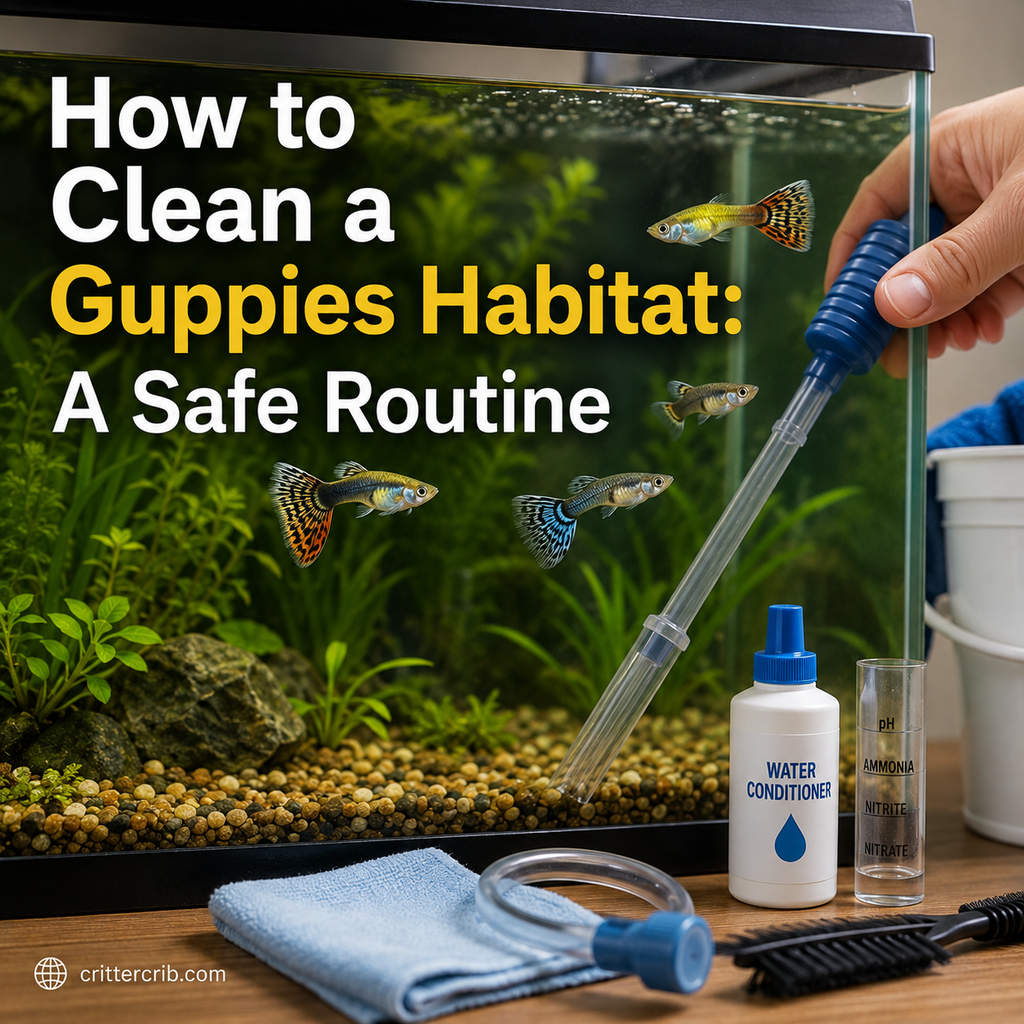
Guppies may be small, but their aquarium still needs regular cleaning to stay healthy. Leftover food, fish waste, decaying plant material, and other debris gradually build up, even when the water looks perfectly clear.
The trick is not to make the tank spotless.
A healthy aquarium contains beneficial bacteria that help process fish waste. If you drain everything, scrub every surface, and replace all the filter media at once, you can disrupt the biological balance that keeps the aquarium safe.
Instead, cleaning a guppy habitat should be a routine of partial water changes, light substrate cleaning, water testing, and occasional filter maintenance.
Here’s how to clean a guppy tank safely without unnecessarily disturbing your fish or the aquarium’s beneficial bacteria.
How Often Should You Clean a Guppy Tank?
For many established guppy aquariums, performing a partial water change about once a week is a practical starting point.
The exact schedule depends on the aquarium.
Factors that affect cleaning frequency include:
- Tank size
- Number of guppies
- Filtration
- Feeding habits
- Live plants
- Water test results
- Amount of accumulated debris
A lightly stocked, planted aquarium may behave differently from a heavily stocked guppy tank receiving several feedings each day.
Instead of relying entirely on the calendar, use water testing and observation to fine-tune your routine.
If nitrate accumulates quickly or the substrate becomes covered with debris between cleanings, you may need larger or more frequent partial water changes.
What You’ll Need to Clean a Guppy Tank
Having everything nearby before you begin makes aquarium maintenance much easier.
Useful supplies include:
- Aquarium gravel vacuum or siphon
- Clean aquarium bucket
- Water conditioner
- Aquarium water test kit
- Algae scraper or aquarium-safe cleaning pad
- Thermometer
- Clean towels
- Small aquarium brush if needed
Ideally, buckets and cleaning tools used inside the aquarium should be reserved for aquarium maintenance.
Never clean aquarium equipment with household detergents, soaps, or cleaning sprays.
Even small amounts of residue can be dangerous to fish.
Should You Remove Guppies While Cleaning the Tank?
Usually, no.
For routine partial water changes, guppies can remain inside the aquarium.
Removing fish every week can create unnecessary stress. Catching them with a net, placing them in another container, and then returning them to the aquarium is generally more disruptive than carefully cleaning around them.
Move slowly while siphoning.
Guppies are curious and may investigate the gravel vacuum, so always watch where the siphon is positioned.
There are situations where fish may need to be temporarily moved, such as replacing an aquarium or performing major repairs. But ordinary weekly maintenance generally isn’t one of them.
How to Clean a Guppy Tank Step by Step
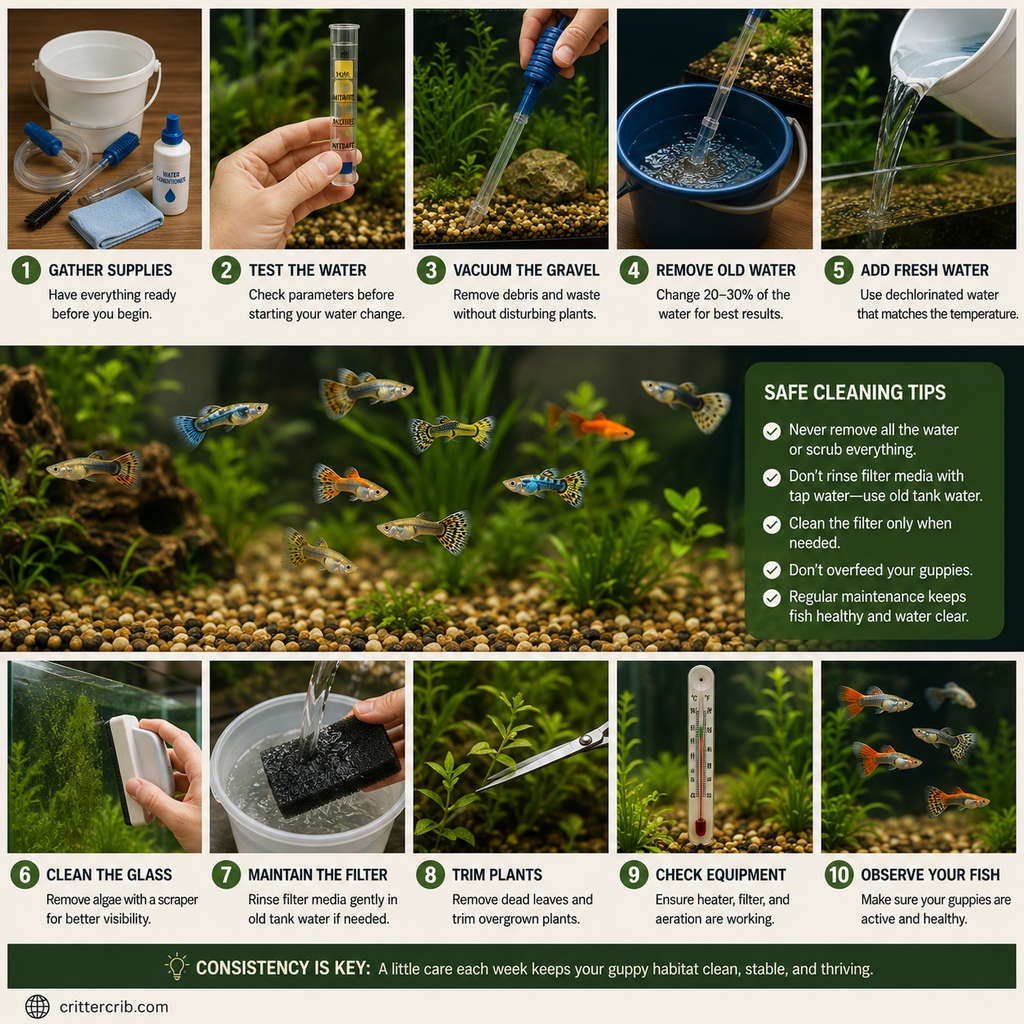
A routine cleaning doesn’t require taking the entire aquarium apart.
The goal is to remove accumulated waste and replace some of the water while preserving the tank’s established biological filtration.
1. Gather Your Aquarium Supplies
Prepare your siphon, bucket, water conditioner, algae scraper, and other supplies before touching the aquarium.
Having everything ready prevents you from leaving the tank unattended midway through maintenance.
Make sure any bucket that will hold aquarium water hasn’t previously contained soap, household cleaners, paint, or other chemicals.
2. Check the Fish Before Cleaning
Take a minute to observe your guppies before you begin.
Look for:
- Normal swimming
- Normal appetite
- Unusual hiding
- Clamped fins
- Rapid breathing
- Spots or discoloration
- Damaged fins
- Unusual lethargy
This gives you a baseline before disturbing the aquarium.
It can also help you notice problems that might otherwise be overlooked during a busy cleaning routine.
3. Test the Aquarium Water
Testing before a water change shows you what’s happening in the aquarium before fresh water dilutes anything.
Important parameters include:
- Ammonia
- Nitrite
- Nitrate
- pH
In a mature, properly cycled aquarium, ammonia and nitrite should remain at safe, effectively zero levels.
Nitrate gradually accumulates and is one reason regular partial water changes are useful.
If ammonia or nitrite is detectable, don’t simply treat the situation as routine cleaning. Investigate the aquarium’s biological filtration, stocking, feeding, and recent changes.
4. Turn Off Electrical Equipment When Necessary
Before lowering the water level, switch off equipment that shouldn’t operate partially exposed.
Depending on your setup, this may include:
- Heater
- Filter
- Powerhead
- Other submerged equipment
Aquarium heaters can potentially be damaged if they’re left operating while exposed to air.
Follow the manufacturer’s instructions for your specific equipment.
Don’t forget to turn everything back on once the aquarium has been refilled.
5. Clean Algae From the Glass
If algae has accumulated on the aquarium glass, remove it before siphoning.
Use an aquarium-safe algae scraper or pad.
Cleaning algae first allows loose pieces to fall into the water, where some can be removed during the water change.
You don’t need to scrub every surface until the aquarium looks sterile.
A small amount of algae isn’t automatically harmful, and established surfaces inside the aquarium support microorganisms that are part of the tank ecosystem.
Focus on keeping the viewing areas clean and preventing excessive algae growth.
6. Vacuum the Gravel
Place the gravel vacuum into the aquarium and start the siphon according to the manufacturer’s directions.
Push the larger vacuum tube gently into sections of substrate.
You’ll often see debris rise through the tube while heavier gravel falls back down.
Work through the tank gradually.
You don’t necessarily need to deep-clean every inch of substrate during every water change, particularly in planted aquariums.
Pay extra attention to areas where debris collects, including:
- Beneath feeding areas
- Around decorations
- Behind plants
- Near tank corners
- Areas with weaker water circulation
Move carefully around plant roots.
7. Remove Part of the Aquarium Water
Routine aquarium maintenance should normally involve a partial water change rather than completely draining the tank.
The appropriate amount depends on your aquarium’s conditions, but approximately 20% to 30% per week can be a reasonable starting point for many established guppy tanks.
Some aquariums may benefit from larger or more frequent changes.
Water testing should guide your routine.
If nitrate rises quickly because the tank is heavily stocked, simply changing a small percentage each week may not be enough.
Likewise, avoid assuming that changing more water is always better. Stability matters, especially when the replacement water differs significantly in temperature or chemistry.
How to Prepare New Water for Guppies
Replacement water needs to be safe before it enters the aquarium.
If you’re using treated tap water, use an appropriate aquarium water conditioner according to its instructions to address chlorine or chloramine.
These disinfectants make municipal drinking water safer for people but can harm aquarium fish and beneficial microorganisms.
Match the Temperature
Try to keep the replacement water reasonably close to the aquarium’s temperature.
Guppies are tropical fish, and suddenly adding a large volume of much colder or hotter water can create unnecessary stress.
Use a thermometer rather than relying entirely on how the water feels to your hand.
Use Water Conditioner Correctly
Follow the dosage instructions on your water conditioner.
More isn’t automatically better.
If you’re unsure whether your local water contains chlorine or chloramine, check with your water provider or use a conditioner designed for the disinfectant used in your water supply.
Consider Your Source Water
Tap water chemistry varies considerably by location.
Parameters such as pH, hardness, and alkalinity can influence your aquarium.
Testing your source water occasionally can help you understand what you’re adding during water changes.
How to Refill a Guppy Aquarium Safely
Add replacement water gradually.
Pouring a bucket rapidly into the aquarium can:
- Disturb the substrate
- Uproot plants
- Frighten fish
- Scatter debris
- Move decorations
You can pour the water onto a clean plate, shallow container, or another aquarium-safe surface to soften the flow.
Once the aquarium is filled to its normal level, check that decorations and plants are still secure.
Don’t Forget to Restart the Equipment
After refilling the aquarium, turn the filter and other equipment back on.
If you switched off the heater, make sure it is properly submerged before restarting it according to the manufacturer’s instructions.
Then check that:
- The filter is flowing normally
- The heater is operating properly
- The water level is correct
- Nothing is leaking
- Fish are swimming normally
It’s surprisingly easy to finish a water change and forget that a filter is still unplugged.
Making this final equipment check part of your routine can prevent problems.
How to Clean a Guppy Tank Filter
Filters shouldn’t necessarily be cleaned every time you perform a water change.
They should be maintained when needed.
The important thing to remember is that aquarium filter media isn’t just collecting dirt. Much of your aquarium’s biological filtration may live on and inside that media.
Aggressively sterilizing it can remove beneficial bacteria.
Cleaning Mechanical Filter Media
If a sponge or other reusable mechanical media is clogged with debris, gently rinse or squeeze it in water removed from the aquarium during a water change.
This can remove excess waste without exposing the media to untreated tap water.
The goal isn’t to make the sponge look brand new.
You simply want water to flow through it properly again.
Should You Rinse Filter Media Under the Faucet?
It’s generally safer to avoid rinsing established biological filter media under untreated chlorinated tap water.
Instead, use old aquarium water when gently cleaning reusable media.
This helps preserve the bacterial community living in the filter.
Should You Replace All Filter Media?
Avoid replacing all established filter media at the same time unless there’s a specific reason to do so.
Many disposable filter cartridges are marketed with replacement schedules, but removing established biological media can also remove a large portion of the bacteria supporting the nitrogen cycle.
Reusable sponge and biological media can often be maintained rather than routinely discarded.
If media truly needs replacing, replacing portions gradually can help preserve biological filtration.
Should You Clean Aquarium Decorations?
Decorations don’t need to be scrubbed every week.
If algae or debris becomes excessive, remove individual decorations and clean them using aquarium-safe methods.
You can:
- Gently scrub them with an aquarium-only brush.
- Rinse them using removed aquarium water when appropriate.
- Return them to the tank.
Never use household soap or detergent.
Also avoid cleaning every decoration, the filter, and the substrate aggressively on the same day unless there’s a specific need.
Established surfaces throughout the aquarium contribute to its biological ecosystem.
How to Clean Live Plants in a Guppy Tank
Live plants usually don’t need much cleaning.
During your regular maintenance routine:
- Remove dead leaves
- Trim damaged growth
- Gently shake debris from plants
- Siphon loose waste nearby
- Remove excessive algae when practical
Don’t scrub healthy leaves aggressively.
Some algae growth is normal in planted aquariums.
The goal is to keep plants healthy, not perfectly spotless.
How to Clean Artificial Aquarium Plants
Artificial plants can collect algae and debris over time.
During a water change, gently wipe or brush them if necessary.
Soft artificial plants are generally preferable in guppy aquariums because rough or sharp plastic edges can potentially damage fins.
Inspect artificial plants while cleaning and replace any that have become damaged or developed sharp edges.
How Often Should You Vacuum Guppy Tank Gravel?
Light gravel vacuuming can be incorporated into regular water changes.
You don’t necessarily need to deep-clean the entire substrate every week.
Instead, rotate areas.
For example:
- Week 1: Clean the left side.
- Week 2: Clean the right side.
- Week 3: Focus around decorations.
- Week 4: Clean areas where waste accumulates most heavily.
This can be particularly useful in planted aquariums where you want to avoid repeatedly disturbing roots.
Bare-bottom guppy tanks are different. Waste is easier to see and can often be siphoned directly from the bottom.
How Often Should You Change Guppy Tank Water?
Weekly partial water changes are a useful starting routine for many aquariums.
However, there’s no universal percentage that works for every guppy tank.
A lightly stocked 30-gallon planted aquarium and an overcrowded 10-gallon breeding setup can accumulate waste at very different rates.
Use nitrate and general water quality to determine whether your schedule is adequate.
You may need to adjust:
- How much water you replace
- How often you replace it
- How much you feed
- How many fish you’re keeping
- Your filtration
Remember that guppies reproduce easily.
A tank that was appropriately stocked a few months ago can become crowded as fry mature.
Can You Change Too Much Aquarium Water?
Large water changes aren’t automatically dangerous when performed correctly, particularly when the replacement water closely matches the aquarium’s temperature and chemistry.
The bigger concern is sudden instability.
Problems can occur when replacement water differs dramatically in:
- Temperature
- pH
- Hardness
- Other water chemistry
Completely draining and refilling an aquarium simply because it’s “cleaning day” is unnecessary for routine maintenance.
Regular partial water changes are usually more practical and less disruptive.
Why Does My Guppy Tank Get Dirty So Fast?
If the aquarium looks dirty again shortly after cleaning, something else may need attention.
Overfeeding
Excess food eventually becomes waste.
Feed only an appropriate amount and remove significant uneaten food rather than allowing it to decay.
Too Many Fish
Guppies reproduce quickly.
What begins as a small group can turn into a crowded aquarium surprisingly fast.
More fish means more waste.
Inadequate Filtration
A filter that is too small, clogged, or poorly maintained may struggle to capture debris and support the aquarium’s biological load.
Too Much Light
Excessive aquarium lighting can encourage algae growth.
Keeping lights on from morning until late at night isn’t necessary.
A timer makes maintaining a consistent lighting schedule much easier.
Poor Water Circulation
Debris often collects in areas with little water movement.
Adjusting filter flow or aquarium layout may help prevent excessive waste from settling in certain areas.
Common Guppy Tank Cleaning Mistakes
Some cleaning habits seem helpful but can actually make aquarium maintenance harder.
Avoid these common mistakes:
- Completely draining the aquarium every week
- Removing guppies for routine cleaning
- Washing aquarium equipment with soap
- Replacing all filter media at once
- Aggressively scrubbing every aquarium surface
- Forgetting water conditioner
- Adding replacement water that’s drastically different in temperature
- Overcleaning biological filter media
- Forgetting to restart the filter or heater
- Cleaning only when the water looks dirty
Clear water doesn’t guarantee good water quality.
Testing tells you much more than appearance alone.
A Simple Weekly Guppy Tank Cleaning Routine
Once you become familiar with aquarium maintenance, the process becomes straightforward.
A typical routine might look like this:
- Observe the guppies for unusual behavior or physical changes.
- Test important water parameters.
- Gather your maintenance equipment.
- Switch off equipment that can’t safely operate during a water change.
- Scrape excessive algae from the glass.
- Vacuum debris from part of the substrate.
- Remove approximately 20% to 30% of the water, adjusting based on your tank’s needs.
- Prepare conditioned replacement water at a similar temperature.
- Slowly refill the aquarium.
- Restart and check all equipment.
- Observe your guppies for a few minutes afterward.
Filter cleaning can be added when flow decreases or the media becomes excessively clogged.
You don’t need to dismantle the aquarium every weekend.
Consistency is far more useful than aggressive cleaning.
Frequently Asked Questions About Cleaning a Guppy Tank
Do Guppies Need a Completely Clean Tank?
No.
An aquarium isn’t meant to be sterile.
Healthy tanks contain beneficial bacteria and other microorganisms. Your goal is to control waste and maintain safe water conditions rather than eliminate every trace of biological activity.
Can I Use Tap Water in a Guppy Tank?
Tap water can often be used, but it generally needs to be treated appropriately before being added to an aquarium.
Use a suitable aquarium water conditioner to address chlorine or chloramine, and make sure the temperature is appropriate.
Because tap water chemistry varies, it’s also helpful to understand your local water parameters.
Can I Use Soap to Clean a Fish Tank?
No.
Avoid soap, detergent, household glass cleaner, and similar products on surfaces or equipment that will contact aquarium water.
Use aquarium-safe cleaning methods instead.
Should I Take Everything Out When Cleaning the Tank?
No.
Routine maintenance doesn’t require removing all plants, decorations, gravel, fish, and equipment.
Doing so can create unnecessary stress and disturb the aquarium’s biological stability.
Why Is My Aquarium Cloudy After a Water Change?
Temporary cloudiness can occur if substrate debris was disturbed during cleaning.
Persistent cloudiness may have other causes, including bacterial blooms, excess nutrients, overfeeding, or filtration issues.
If cloudiness continues, test the water and investigate the cause rather than repeatedly performing complete cleanings.
How Often Should I Clean the Filter?
Clean the filter when debris begins restricting flow or the media becomes excessively dirty.
The schedule varies depending on the filter, aquarium size, stocking level, and feeding.
Filter maintenance doesn’t need to happen on exactly the same day every week.
How Often Should I Clean the Aquarium Glass?
Clean the glass whenever algae begins interfering with your view or becomes excessive.
If you’re scraping heavy algae every few days, investigate lighting duration, nutrient levels, feeding, and aquarium maintenance rather than simply cleaning more often.
Final Thoughts
Cleaning a guppy habitat isn’t about making the aquarium look brand new every week.
It’s about maintaining a stable environment.
For many established tanks, a good routine starts with weekly partial water changes, light gravel vacuuming, water testing, algae removal as needed, and periodic filter maintenance.
Leave your guppies in the aquarium during ordinary cleaning, treat replacement tap water with an appropriate conditioner, and avoid using soap or household cleaners anywhere near the tank.
Most importantly, protect the beneficial bacteria that keep your aquarium’s nitrogen cycle functioning.
Once you stop thinking of aquarium cleaning as a complete teardown and start treating it as regular maintenance, caring for a guppy tank becomes much simpler.
A little work each week is usually far better than waiting for the aquarium to become visibly dirty and trying to clean everything at once.