Aquatic snails have a reputation for eating whatever they find in the aquarium. Watch one slowly work its way across the glass and it certainly looks that way. Snails spend hours grazing on algae, biofilm, leftover food, and other material growing on surfaces.
But that doesn’t mean every aquarium snail can survive on leftovers alone.
What aquatic snails eat depends partly on the species. Mystery snails, nerite snails, ramshorn snails, Malaysian trumpet snails, and other freshwater snails don’t all feed in exactly the same way. The amount of natural food available in the aquarium matters too.
A mature planted tank covered with biofilm may provide plenty to graze on, while a spotless new aquarium can leave a snail with surprisingly little to eat.
The best approach is to understand what your particular snails naturally consume and supplement their diet when necessary.
What Do Aquatic Snails Eat?
Most commonly kept freshwater aquarium snails are opportunistic feeders that consume a combination of algae, biofilm, decaying plant material, leftover fish food, and other organic matter.
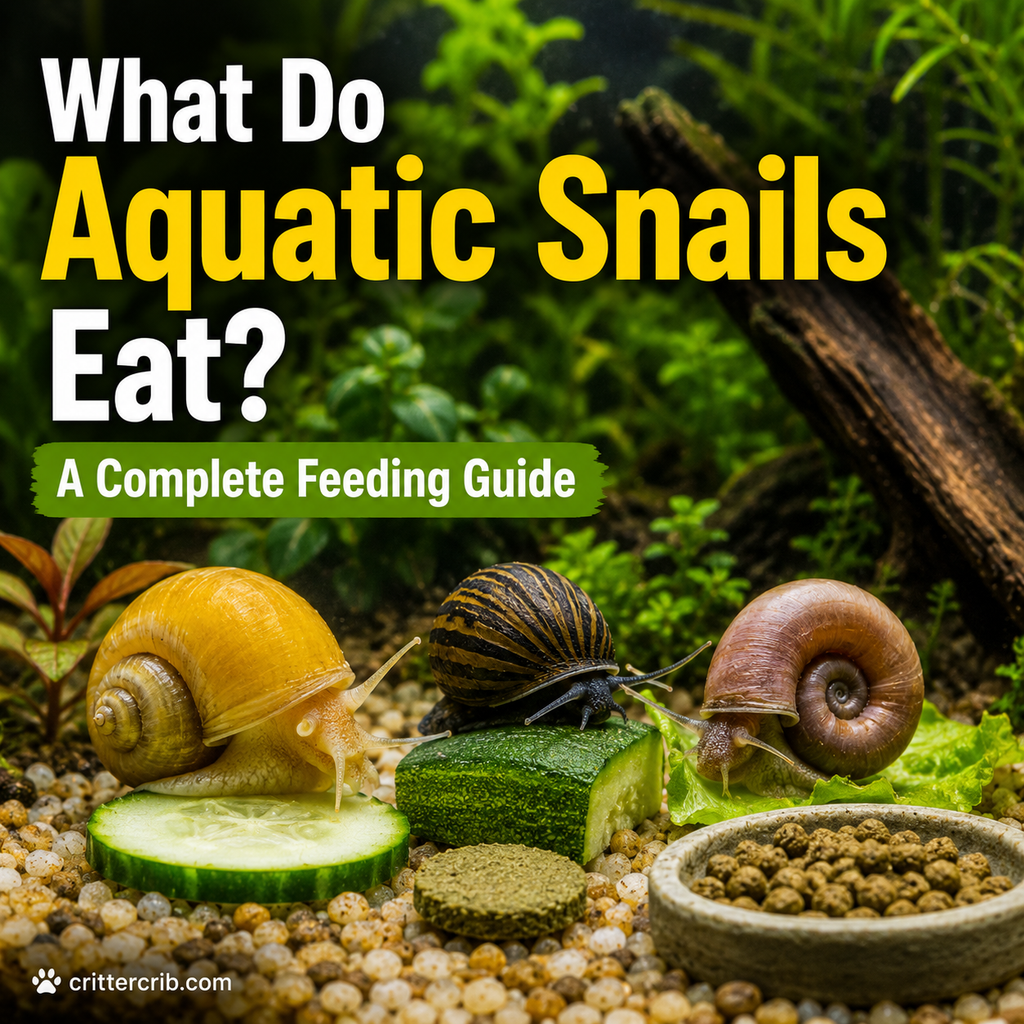
Depending on the species, aquatic snails may eat:
- Algae
- Biofilm
- Decaying plant matter
- Dead leaves
- Leftover fish food
- Sinking pellets
- Algae wafers
- Blanched or softened vegetables
- Specialized snail foods
- Small amounts of animal-based foods
- Other organic material
The exact balance varies.
Nerite snails, for example, are particularly well known as algae grazers. Mystery snails are more willing to eat a varied diet that includes prepared foods and vegetables.
Before choosing a feeding routine, identify the species you’re keeping.
Do Aquarium Snails Eat Algae?
Yes, many aquatic snails eat algae.
It’s one of the main reasons people add snails to freshwater aquariums.
Snails may graze on algae growing on:
- Aquarium glass
- Rocks
- Driftwood
- Decorations
- Plant leaves
- Filter equipment
However, don’t expect a snail to eliminate every type of algae.
Different algae have different textures and growth patterns, and some are much more appealing to snails than others.
A snail also isn’t a replacement for proper aquarium maintenance. If algae is growing excessively because of too much light, excess nutrients, or another imbalance, adding more snails doesn’t address the underlying cause.
Do Aquatic Snails Eat Biofilm?
Biofilm is an important natural food source for many aquatic snails.
It’s the thin layer of microorganisms and organic material that develops on submerged surfaces.
You may barely notice it, but your snails certainly do.
Biofilm develops on:
- Driftwood
- Rocks
- Plant leaves
- Aquarium glass
- Decorations
- Filter surfaces
This is one reason established aquariums can be excellent environments for grazing animals.
A brand-new aquarium that’s been scrubbed spotless may contain far less natural food than a mature tank.
Do Aquarium Snails Eat Leftover Fish Food?
Many do.
Snails often find flakes, pellets, wafers, and other food that reaches the bottom of the aquarium.
This scavenging behavior can be useful, but it creates a common misconception: snails don’t make uneaten fish food disappear from the ecosystem.
They simply turn some of it into snail waste.
If large amounts of food are repeatedly reaching the bottom, the better solution is usually to feed the aquarium less rather than adding animals to consume the leftovers.
Snails contribute to the tank’s biological load just like fish and shrimp do.
What Should You Feed Aquarium Snails?
If natural algae and biofilm aren’t enough, you can supplement your snails with appropriate prepared foods and fresh foods.
Good options depend on the species but may include:
- Algae wafers
- Sinking pellets
- Snail-specific foods
- Shrimp foods
- Blanched vegetables
- Calcium-containing foods appropriate for aquatic snails
- Occasional protein-containing foods
Variety can help provide a broader nutritional profile than relying on one food exclusively.
Just remember that snails eat slowly. A large piece of food can sit in the aquarium long after they’ve lost interest in it.
Vegetables Aquatic Snails Can Eat
Many common freshwater snails will readily graze on vegetables.
Popular choices include:
- Zucchini
- Cucumber
- Green beans
- Spinach
- Kale
- Carrot
- Broccoli
Not every snail will show equal enthusiasm for every vegetable.
Zucchini is particularly popular with many aquarium keepers because it’s easy to prepare and gives snails a broad surface to graze.
How to Prepare Vegetables for Aquarium Snails
Raw vegetables can be too firm for some snails.
Blanching or briefly cooking them can soften the food.
A simple method is:
- Wash the vegetable thoroughly.
- Cut off a small piece.
- Blanch or briefly boil it until slightly softened.
- Allow it to cool completely.
- Place a small portion in the aquarium.
- Remove significant leftovers before they begin deteriorating.
Avoid vegetables prepared with salt, butter, oil, seasoning, sauces, or other ingredients intended for people.
Plain is best.
Can Aquatic Snails Eat Cucumber?
Yes. Many freshwater aquarium snails will eat cucumber.
Cucumber is easy to prepare and can be useful as an occasional supplemental food.
However, cucumber contains a lot of water and isn’t necessarily the most nutritionally dense vegetable available.
For a more varied diet, rotate it with foods such as zucchini, green beans, leafy greens, and appropriate prepared snail foods.
Remove uneaten cucumber before it becomes mushy and begins fouling the water.
Can Aquatic Snails Eat Zucchini?
Zucchini is one of the most commonly offered vegetables for aquarium snails.
A lightly blanched slice becomes soft enough for many snails to graze easily.
Because even a thin slice can be a lot of food for one or two snails, start with a small portion.
If several snails quickly consume it, you can adjust future servings.
If most of the zucchini is still sitting there many hours later, offer less next time.
Can Aquarium Snails Eat Spinach?
Many aquatic snails will eat spinach.
Blanching the leaves makes them softer and easier to graze.
Leafy greens can contribute variety to the diet, but they shouldn’t automatically become the only supplemental food you provide.
Rotate foods rather than relying heavily on one ingredient.
And as always, remove uneaten portions before they begin breaking down.
Do Aquatic Snails Eat Live Plants?
This depends heavily on the snail species and the condition of the plants.
Many commonly kept aquarium snails prefer algae, biofilm, prepared foods, and dying or decaying plant material over healthy living plants.
That’s why you may see a snail covering a damaged leaf without necessarily being responsible for the damage.
The leaf may already have been deteriorating.
Snails That May Eat Plants
Some aquatic snail species are much more likely to consume healthy vegetation than others.
Large apple snails, for example, can be enthusiastic plant eaters depending on the species.
This is another reason correct identification matters.
Don’t assume every round-shelled aquarium snail is a harmless algae eater.
Do Snails Eat Dead Plants?
Yes. Many freshwater snails readily consume dying or decaying plant material.
This can make them useful members of a planted aquarium’s cleanup crew.
Old leaves naturally deteriorate, and snails may graze on the softer damaged tissue.
Again, that doesn’t mean you should rely on snails to perform all aquarium cleanup.
Dead plant material that accumulates faster than the aquarium inhabitants can consume it should still be removed during maintenance.
Do Aquatic Snails Need Calcium?
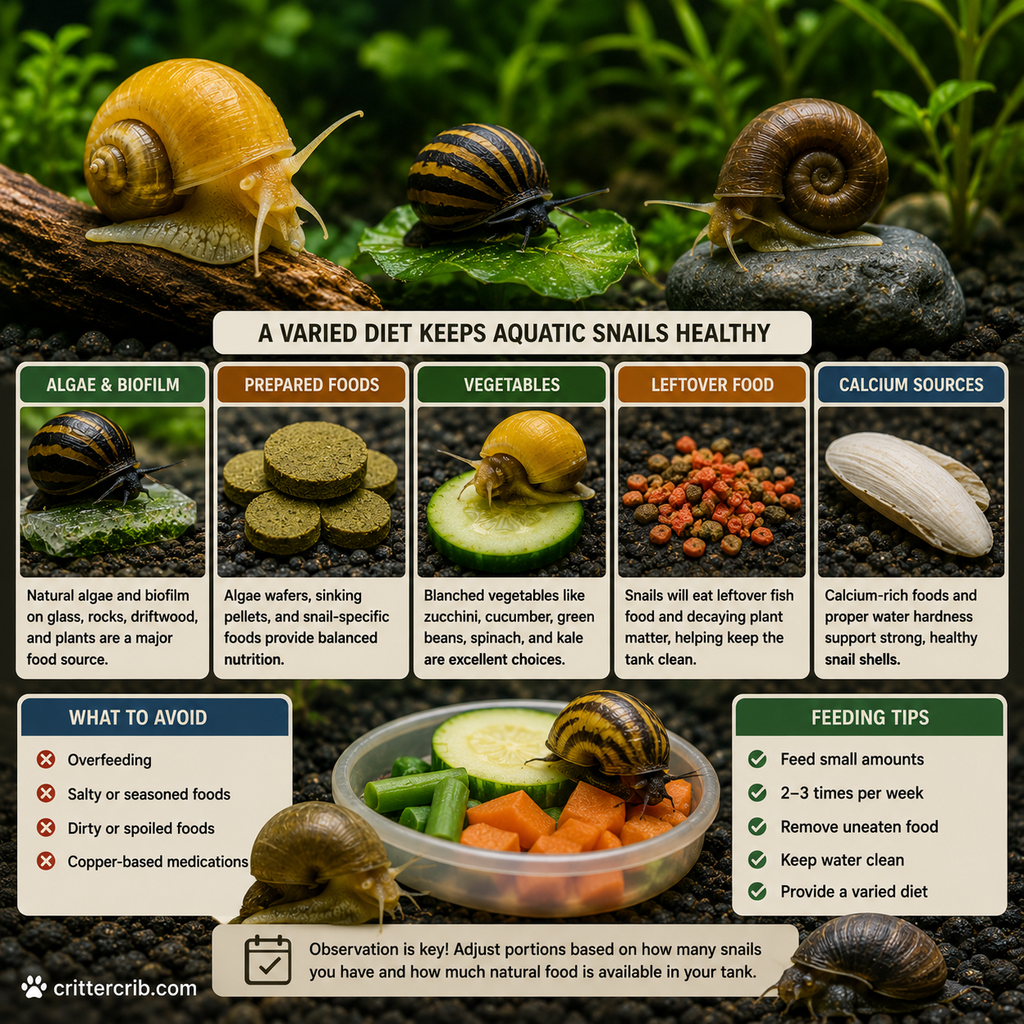
Calcium and other minerals play important roles in maintaining a snail’s shell.
A healthy shell should grow normally without excessive erosion, cracking, or deterioration.
However, shell health isn’t determined by food alone.
Water chemistry matters too.
Important factors can include:
- General hardness (GH)
- Carbonate hardness (KH)
- pH
- Dietary mineral availability
Very soft or acidic water can be challenging for some snail species because acidic conditions may contribute to shell erosion.
Should You Add Calcium to a Snail Tank?
Don’t automatically add calcium products simply because you own snails.
Test your water first.
If your water already contains appropriate mineral levels for the species, additional supplementation may be unnecessary.
When supplementation is appropriate, options may include calcium-containing prepared foods or aquarium-safe mineral sources designed for invertebrates.
The goal is to provide suitable conditions—not continuously add minerals without knowing what’s already in the water.
What Do Mystery Snails Eat?
Mystery snails are enthusiastic and relatively versatile feeders.
They may consume:
- Algae
- Biofilm
- Decaying plant material
- Algae wafers
- Sinking foods
- Blanched vegetables
- Leftover fish food
- Specialized snail foods
Because mystery snails are relatively large compared with many common aquarium snails, they can require more supplemental feeding than you might expect.
A spotless aquarium with little algae may not provide enough natural food for one.
Mystery snails also need appropriate minerals and water conditions to maintain healthy shell growth.
What Do Nerite Snails Eat?
Nerite snails are especially valued for their algae-grazing ability.
They spend a great deal of time moving across hard surfaces in search of algae and biofilm.
This makes them useful in established aquariums with natural growth.
It can also create a problem.
A very clean tank may not contain enough algae for a nerite snail.
Some nerites accept supplemental foods such as algae wafers or vegetables, while others may show relatively little interest in them.
For that reason, consider the aquarium’s natural food availability before adding multiple nerite snails.
What Do Ramshorn Snails Eat?
Ramshorn snails are opportunistic feeders.
They commonly eat:
- Algae
- Biofilm
- Decaying plants
- Leftover fish food
- Vegetables
- Prepared aquarium foods
They’re also prolific breeders when conditions are favorable.
A sudden explosion in the ramshorn population can sometimes indicate that the aquarium contains an abundant food supply, often because fish are being overfed.
Reducing excess food can help limit population growth.
What Do Malaysian Trumpet Snails Eat?
Malaysian trumpet snails spend a considerable amount of time moving through and across the substrate.
They consume materials such as:
- Algae
- Biofilm
- Leftover food
- Decaying organic material
Their burrowing behavior can make them less visible during parts of the day.
Like ramshorn snails, their population can increase dramatically when large amounts of food are available.
If hundreds suddenly seem to appear, take a look at how much food is entering the aquarium.
What Do Bladder Snails Eat?
Bladder snails frequently arrive in aquariums as hitchhikers on live plants.
They feed on:
- Algae
- Biofilm
- Decaying plant matter
- Leftover food
- Other organic material
They’re often labeled “pest snails” because they reproduce readily.
But the snails themselves aren’t necessarily the underlying problem.
Large populations are often supported by an abundant food supply.
Controlling overfeeding and removing excess organic waste can help keep their numbers manageable.
How Often Should You Feed Aquatic Snails?
There isn’t one feeding schedule that works for every snail aquarium.
How often you need to supplement depends on:
- Snail species
- Number of snails
- Aquarium size
- Amount of algae
- Biofilm availability
- Other animals in the tank
- Amount of leftover fish food
- Type of supplemental food
In a mature community aquarium, snails may spend much of the day grazing and need relatively little additional food.
In a clean snail-only tank, supplemental feeding may be much more important.
Start conservatively and observe.
How Much Should You Feed Aquarium Snails?
Snails are slow eaters, which makes portion size tricky.
A piece of zucchini that looks small compared with the aquarium may be enormous compared with the snail eating it.
Start with a small amount.
Then observe:
- How many snails find the food
- How quickly they begin eating
- How much remains after several hours
- Whether leftovers repeatedly accumulate
- Whether water quality is affected
If food regularly remains untouched, reduce the portion.
Overfeeding snails can be just as problematic as overfeeding fish.
When Should You Remove Uneaten Snail Food?
Fresh vegetables and prepared foods shouldn’t remain in the aquarium indefinitely.
As food decomposes, it can contribute to declining water quality.
A practical approach is to remove significant leftovers once it’s clear the snails are no longer actively eating them or the food is beginning to deteriorate.
Exactly how quickly that happens depends on the food.
A firm vegetable may hold together longer than a soft prepared food.
Pay attention to its condition rather than relying solely on an exact number of hours.
Can You Overfeed Aquatic Snails?
Yes.
You may not see a snail become obviously overfed in the same way you might notice an overweight mammal, but excess food can create serious aquarium problems.
Too much food can contribute to:
- Ammonia
- Rising nitrate
- Cloudy water
- Bacterial growth
- Pest snail population explosions
- Excess organic waste
- Algae problems
Feed the aquarium, not your perception of how hungry the snails look.
Snails naturally spend large amounts of time grazing even when they’re receiving adequate nutrition.
Do Snails Eat Fish Waste?
This is a persistent aquarium myth.
Snails may investigate waste and consume microorganisms or edible material associated with it, but you shouldn’t think of them as animals that make fish poop disappear.
Snails produce waste themselves.
Adding more snails doesn’t eliminate the need for:
- Water changes
- Filtration
- Substrate maintenance
- Sensible stocking
- Appropriate feeding
A cleanup crew can help process certain organic materials, but it doesn’t replace aquarium maintenance.
Do You Need to Feed Snails in a Community Tank?
Sometimes.
A community aquarium may already provide plenty of food through:
- Natural algae
- Biofilm
- Leftover fish food
- Decaying plant matter
- Foods intentionally offered to bottom-dwelling animals
But don’t simply assume your snails are getting enough.
Observe them and consider the species.
A mystery snail in a spotless tank may benefit from intentional supplemental feeding even if the fish are fed regularly.
You can also place sinking food near the snail after the fish have eaten so it has a better chance of getting some.
What Foods Should Aquatic Snails Avoid?
Avoid feeding aquarium snails foods that could harm them or degrade water quality.
Generally avoid:
- Salty foods
- Seasoned human food
- Fried food
- Sugary food
- Processed snacks
- Foods containing sauces
- Moldy or spoiled food
- Large amounts of meat
- Foods contaminated with pesticides or cleaning products
Vegetables should be thoroughly washed before preparation.
If you’re unsure whether a food is safe for your particular snail species, stick with established aquarium foods instead of experimenting.
Feeding Snails While You’re Away
If you’re leaving for a short period, don’t dump a large amount of food into the aquarium before you go.
Extra food can decompose and cause water-quality problems while nobody is there to notice.
In a mature aquarium, many snails can continue grazing on naturally occurring algae and biofilm for some time.
For longer trips, your plan depends on the snail species, aquarium setup, and other animals in the tank.
If someone will be feeding your aquarium, pre-portion the food.
This helps prevent the classic fish-sitter problem of several days’ worth of food being added at once.
How to Tell If Your Aquatic Snail Is Eating
Sometimes it’s difficult to tell how much a snail is actually consuming.
Look for behaviors such as:
- Regularly grazing across surfaces
- Moving toward supplemental food
- Spending time on algae-covered areas
- Eating softened vegetables
- Normal activity for the species
You may also notice tiny grazing trails where algae has been removed from aquarium glass.
Shell condition can provide information about long-term health, although shell damage doesn’t automatically mean the snail is starving.
Water chemistry and previous living conditions can also affect shell appearance.
Why Isn’t My Aquatic Snail Eating?
A snail that ignores one piece of food isn’t necessarily sick.
It may simply prefer the algae or biofilm already available.
However, prolonged inactivity or loss of appetite deserves attention.
Possible causes include:
- Poor water quality
- Inappropriate temperature
- Unsuitable pH or hardness
- Sudden changes in water parameters
- Illness or injury
- Stress after being introduced
- An inappropriate food
- Natural periods of inactivity
Test the aquarium water if your snail’s behavior changes noticeably.
How Do You Know If an Aquatic Snail Is Dead?
Snails can remain motionless for surprisingly long periods, so don’t immediately assume an inactive snail has died.
A dead snail may eventually produce a strong, unpleasant odor and may hang loosely from its shell.
If you’re unsure, carefully inspect it rather than immediately discarding it.
Never pull forcefully on the snail’s body.
A Simple Feeding Routine for Aquarium Snails
Snail feeding doesn’t need to be complicated.
A practical routine might look like this:
Step 1: Let Them Graze
Allow your snails to naturally consume algae and biofilm throughout the aquarium.
Step 2: Assess Available Food
Consider how clean the aquarium is and whether your snail species relies heavily on algae.
Step 3: Supplement When Needed
Offer small portions of algae wafers, sinking foods, snail food, or appropriate vegetables.
Step 4: Provide Variety
Rotate suitable foods instead of relying on cucumber or one type of wafer indefinitely.
Step 5: Remove Leftovers
Take out uneaten food before it decomposes significantly.
Step 6: Monitor Shell Health
Maintain appropriate water chemistry and mineral availability for your particular snail species.
Step 7: Watch Water Quality
Test ammonia, nitrite, nitrate, and other relevant parameters regularly.
Feeding should support the aquarium ecosystem, not overwhelm it.
Frequently Asked Questions About Feeding Aquatic Snails
What is the best food for aquatic snails?
There isn’t one best food for every species. Many freshwater snails benefit from a combination of natural algae and biofilm along with appropriate supplemental foods such as algae wafers, sinking foods, vegetables, and snail-specific diets.
Do aquatic snails need to be fed every day?
Not necessarily. Snails in mature aquariums may obtain substantial nutrition by grazing. Supplemental feeding frequency should depend on the species, number of snails, natural food availability, and other foods entering the aquarium.
Can aquatic snails eat lettuce?
Many freshwater snails will graze on softened leafy vegetables, including some types of lettuce. More nutrient-dense greens and a varied diet may be preferable to relying heavily on lettuce.
Can aquatic snails eat carrots?
Many aquarium snails will eat softened carrot. Because carrots are firm, blanching or cooking a small plain piece can make it easier to graze.
Can aquarium snails eat algae wafers?
Yes. Many common freshwater snails readily consume algae wafers. They’re particularly convenient when the aquarium doesn’t produce enough natural algae.
Can aquatic snails eat fish flakes?
Many snails will eat flakes that reach the bottom. Fish flakes can contribute to the diet, but don’t deliberately overfeed the fish simply to provide leftovers for snails.
Do aquarium snails need calcium?
Snails require minerals for healthy shell growth, but whether you need to supplement calcium depends on the species, diet, and existing water chemistry. Test your water rather than adding supplements automatically.
Will snails eat all the algae in my aquarium?
Probably not. Snails may consume substantial amounts of certain algae, but they don’t eat every type. Persistent algae problems should be addressed by examining lighting, nutrients, feeding, maintenance, and overall aquarium balance.
Do aquatic snails eat dead fish?
Some opportunistic aquarium snails may scavenge a dead fish or other animal. If you discover a dead tank inhabitant, remove it rather than relying on snails to consume it, since decomposition can quickly affect water quality.
Final Thoughts
So, what do aquatic snails eat?
For many common freshwater aquarium snails, the answer includes algae, biofilm, decaying plant material, leftover aquarium food, prepared sinking foods, and appropriate vegetables.
But the best diet depends on the snail.
A nerite grazing continuously on algae-covered driftwood has different feeding circumstances than a large mystery snail living in a spotless aquarium. That’s why identifying your species and observing the available natural food are so important.
Supplement when necessary, provide variety, maintain appropriate minerals and water chemistry, and remove excess food before it decomposes.
Most importantly, don’t think of aquatic snails as tiny garbage disposals.
They’re living aquarium inhabitants with nutritional and environmental needs of their own. Give them appropriate food and stable water conditions, and they’ll do far more than help with algae—they’ll become an interesting part of the aquarium in their own right.