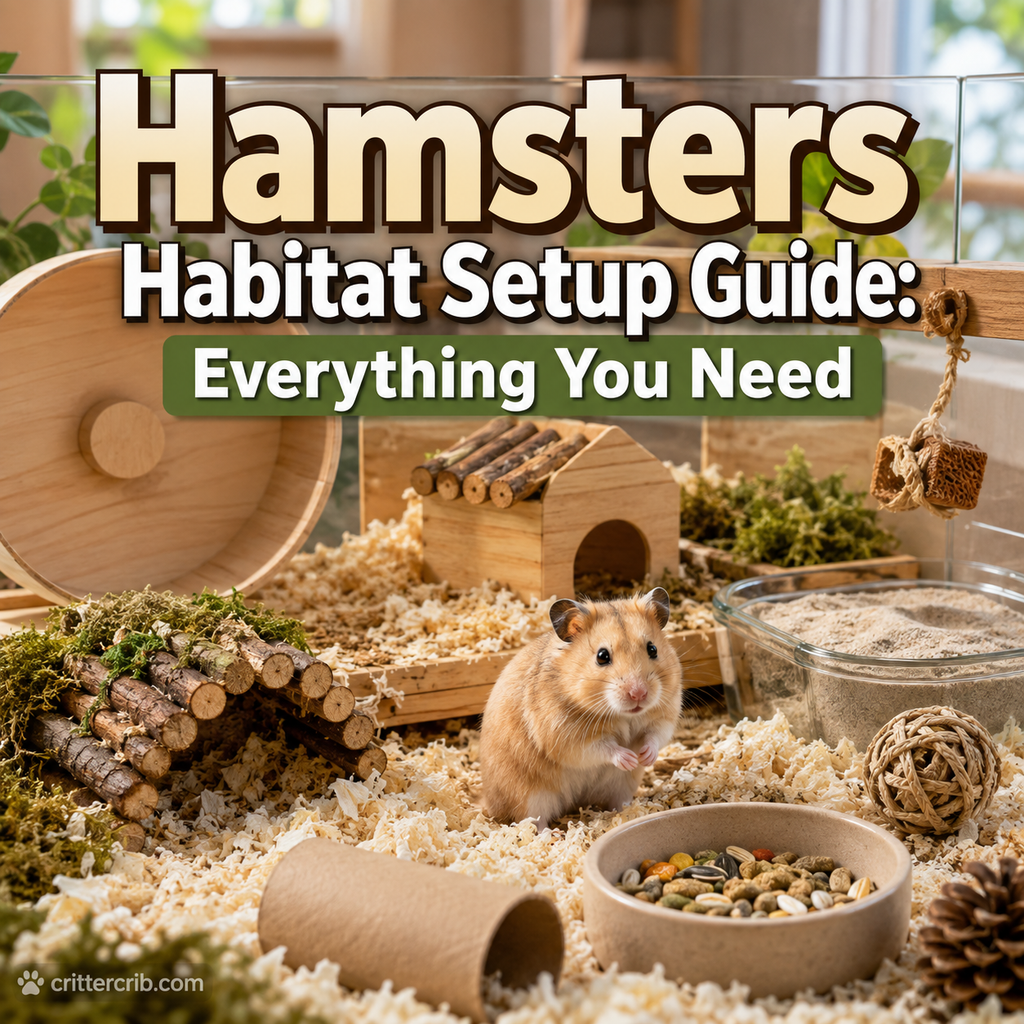
Bringing home a hamster is exciting, but the tiny cages and handful of accessories commonly marketed for hamsters can give new owners the wrong idea about what these animals actually need.
Hamsters may be small, but they’re active animals with natural instincts to dig, burrow, forage, explore, and travel surprisingly long distances during their waking hours. A good hamster habitat gives them enough room to express those behaviors rather than simply providing a place to eat and sleep.
Fortunately, setting up a hamster habitat doesn’t have to be complicated. Once you understand the basics—space, bedding, a proper wheel, hiding places, enrichment, food, and water—you can create a comfortable home that works well for both you and your hamster.
This guide covers everything you need to set up a hamster habitat from the ground up.
Start With the Right Hamster Enclosure
The enclosure is the foundation of the entire habitat, so it’s worth choosing carefully.
One of the most common mistakes new hamster owners make is buying a cage that’s too small. Hamsters need enough uninterrupted floor space for burrowing, running, nesting, and exploring.
Many modern hamster keepers use large glass tanks, appropriately sized bin-style enclosures, or spacious cages designed specifically around natural hamster behavior.
How Much Space Does a Hamster Need?
Recommendations vary somewhat between animal welfare organizations and countries, but bigger is generally better when it comes to hamster housing.
Rather than focusing only on the dimensions printed on the package, look at the amount of usable, continuous floor space the enclosure provides. Tall cages with several tiny platforms aren’t necessarily better than a large enclosure with plenty of horizontal space.
A roomy habitat also gives you space for:
- Deep bedding
- A properly sized exercise wheel
- Multiple hides
- Sand bathing
- Foraging areas
- Tunnels and cork logs
- Chew toys
- Other forms of enrichment
If you’re deciding between two appropriate enclosure sizes and have room for the larger one, the extra space is usually worthwhile.
Tanks, Bin Cages, and Wire Cages
There isn’t just one type of enclosure that works for hamsters.
Glass tanks and tank-style habitats are popular because they allow for deep bedding without it spilling onto the floor. They’re also easy to observe through and can be arranged into natural-looking habitats.
Large plastic bin enclosures can provide plenty of space at a relatively low cost when they’re properly modified with secure ventilation.
Wire cages can work too, provided they are sufficiently large and have safe bar spacing for the hamster species. The bottom should be solid rather than wire mesh, since wire flooring can be uncomfortable and potentially injure a hamster’s feet.
Whatever enclosure you choose, make sure it is secure. Hamsters are talented escape artists and can squeeze through surprisingly small openings.
Choose Safe, Deep Bedding
Bedding does much more than make the enclosure comfortable. It gives your hamster somewhere to dig and build tunnels.
Burrowing is an important natural behavior for hamsters. In the wild, they create underground tunnel systems containing sleeping chambers, food storage areas, and other spaces.
Providing a deep bedding area allows your hamster to recreate some of that behavior at home.
How Deep Should Hamster Bedding Be?
Whenever your enclosure allows it, provide a generously deep section of bedding rather than spreading a thin layer across the bottom.
Several inches is better than a shallow covering, while deeper areas can give your hamster enough material to create more stable tunnels.
You don’t necessarily need identical bedding depth throughout the enclosure. One section can be especially deep for burrowing while another holds heavier accessories such as the wheel or sand bath.
Good Bedding Options
Common hamster bedding materials include:
- Unscented paper-based bedding
- Aspen shavings
- Suitable combinations of paper bedding and safe wood bedding
Soft hay can sometimes be mixed into sections of bedding to add structure and texture, although it shouldn’t replace absorbent bedding.
Avoid heavily scented bedding and products designed to mask odors with perfume. A hamster’s sense of smell is much stronger than ours, and strong fragrances aren’t necessary for keeping a properly maintained enclosure clean.
Give Your Hamster a Proper Exercise Wheel
A wheel is one of the most important pieces of equipment in a hamster habitat.
Hamsters are naturally active, particularly at night, and a wheel gives them an opportunity to run even when they’re living in an enclosure.
The important part is choosing the right wheel.
Choosing the Correct Wheel Size
Your hamster should be able to run comfortably without having to arch its back sharply.
Larger hamster species generally require larger wheels than dwarf species. Instead of choosing a wheel solely because the packaging says “hamster,” watch your hamster’s running posture.
If its back curves significantly while running, the wheel is probably too small.
Choose a wheel with a solid running surface rather than an open wire or mesh surface. Solid surfaces give the hamster’s feet consistent support.
The wheel should also spin smoothly and remain stable when your hamster runs at full speed.
Provide Several Hiding Places
Hamsters are prey animals, so having places to disappear can help them feel secure.
One hide isn’t necessarily enough.
Providing several sheltered areas lets your hamster choose where it wants to sleep, store food, or simply get away from activity outside the enclosure.
Useful hiding places include:
- Wooden hamster houses
- Multi-chamber hides
- Cork tunnels
- Cardboard boxes
- Ceramic hides
- Underground hides
- Appropriately sized tunnels
A multi-chamber hide can be particularly useful because it resembles the separate chambers hamsters naturally create within their burrows.
You don’t have to buy everything from a pet store, either. Plain cardboard boxes and tubes can make inexpensive enrichment as long as they’re clean, safe, and free from potentially harmful coatings or materials.
Add a Sand Bath
Many hamsters enjoy using a sand bath, and it can serve several purposes within the habitat.
Hamsters shouldn’t normally be bathed in water. Instead, suitable sand allows them to roll and groom themselves naturally.
A sand bath may also become a favorite digging spot. Some hamsters even choose one section as a toilet, which can make spot cleaning easier.
Choosing Hamster-Safe Sand
Use a product suitable for hamsters rather than grabbing any bag of sand you happen to find.
Avoid extremely dusty materials and products containing fragrances, dyes, or unnecessary additives.
The container should be large enough for your hamster to enter, turn around, dig, and roll comfortably.
A sturdy glass, ceramic, or similar container can work well because it is difficult for a hamster to chew.
Include Chew Toys
Hamsters’ teeth continuously grow, making appropriate chewing opportunities an important part of their environment.
Provide several safe textures rather than relying on one chew toy.
Options can include:
- Hamster-safe wooden chews
- Appropriate untreated branches
- Cardboard tubes
- Plain cardboard
- Natural chew toys designed for small animals
Individual hamsters have preferences. One hamster may immediately destroy a wooden chew while another completely ignores it and prefers cardboard.
Experimenting with different safe materials can help you discover what your hamster actually uses.
Create Tunnels and Different Textures
A hamster habitat becomes much more interesting when it isn’t just a flat enclosure filled with bedding.
Think of the enclosure as a miniature landscape.
You can create different areas using tunnels, substrates, platforms, hides, and natural materials.
For example, you might have a deep burrowing section on one side, a sand area on another, and cork tunnels running between several hides.
Different safe textures can encourage exploration.
Depending on the setup, these might include:
- Cork
- Sand
- Paper bedding
- Aspen bedding
- Cardboard
- Safe wooden surfaces
Accessories don’t need to be rearranged constantly. Hamsters rely heavily on scent and can become familiar with the layout of their territory.
Make Food Part of the Enrichment
A food bowl is convenient, but it isn’t the only way to feed a hamster.
Hamsters naturally spend time searching for and collecting food. You can encourage this behavior by scattering some of their food throughout the enclosure.
This is often called scatter feeding.
Instead of walking over to the same bowl every night, your hamster has to sniff, explore, dig, and forage.
You can hide small portions of food:
- Around tunnels
- Near hides
- Beneath a thin layer of bedding
- Inside safe cardboard enrichment toys
- Around different sections of the enclosure
A balanced hamster diet should still be the foundation. Enrichment doesn’t replace proper nutrition—it simply makes obtaining some of that food more interesting.
Fresh foods may also be offered when appropriate for your hamster, but introduce unfamiliar foods gradually and remove uneaten fresh food before it spoils.
Provide Fresh Water at All Times
Your hamster should always have access to clean drinking water.
Both water bottles and appropriately sized water bowls can be used, although each has advantages.
Bottles are difficult to contaminate with bedding, but the drinking mechanism should be checked regularly to make sure it hasn’t become blocked.
Bowls allow a natural drinking position but can become filled with bedding or tipped over if they’re too light.
If you use a bowl, choose a small, heavy container and place it on a stable surface.
Replace the water regularly and clean the bottle or bowl as needed.
Put Heavy Items on Stable Surfaces
Once you start using deep bedding, another safety consideration becomes important.
Heavy objects shouldn’t simply sit on top of loose bedding.
If your hamster tunnels underneath them, an unstable object could shift or collapse into the burrow.
Items such as:
- Exercise wheels
- Large ceramic hides
- Sand baths
- Heavy wooden houses
- Platforms
should be positioned securely.
Platforms or other stable supports can be useful for keeping heavier accessories above the bedding while still allowing your hamster to burrow underneath surrounding areas.
Don’t Forget Nesting Material
Hamsters naturally create sleeping nests inside their burrows and hiding places.
Provide safe nesting material your hamster can collect and arrange itself.
Soft, unscented paper-based materials are generally a simple option. Some hamsters will carry pieces around the enclosure before disappearing into their chosen sleeping area.
Avoid fluffy cotton-like nesting products that can separate into long fibers. Materials that wrap tightly around small limbs or are difficult to digest aren’t worth the risk.
One of the fun parts of keeping a hamster is watching it design its own sleeping area. Give it suitable materials and let it do the decorating.
Add Enrichment Without Overcrowding
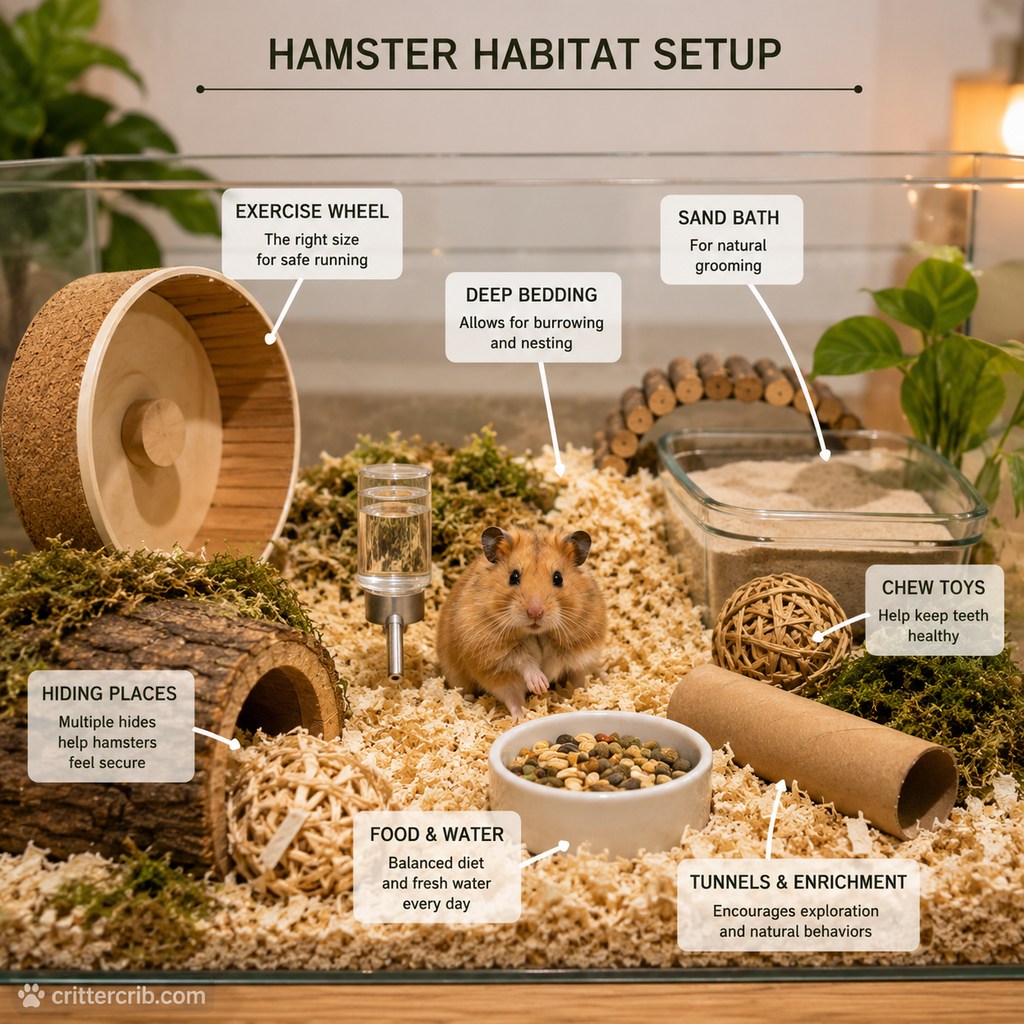
A good hamster habitat should be interesting, but that doesn’t mean filling every available inch with accessories.
Your hamster still needs room to move.
Try creating different functional zones instead.
For example:
- A deep bedding and burrowing area
- A wheel and activity area
- A sand bath
- A multi-chamber sleeping area
- A foraging area
- Tunnels connecting different parts of the enclosure
You can occasionally introduce a new cardboard tunnel, chew item, or foraging activity without completely redesigning the enclosure.
The goal is to provide choices.
Where Should You Put the Hamster Habitat?
Even a perfectly designed enclosure can be uncomfortable if it’s placed in the wrong part of your home.
Choose a location with a relatively stable temperature and good ventilation.
Avoid placing the habitat:
- In direct sunlight
- Directly beside a heater
- Next to an air-conditioning vent
- In a drafty location
- Near loud televisions or speakers
- Somewhere that is frequently bumped or disturbed
Hamsters are generally most active during the evening and nighttime hours, so think carefully before placing the enclosure next to your bed.
That silent-looking exercise wheel at 3 p.m. can become considerably less silent at 3 a.m.
Keep the Habitat Secure From Other Pets
Dogs and cats may be fascinated by a hamster enclosure.
Your hamster probably won’t share their enthusiasm.
Even if another pet can’t physically reach the hamster, repeatedly staring at, pawing at, or jumping onto the enclosure can create an intimidating environment.
Place the habitat somewhere secure where other animals can’t knock it over or access the lid.
Never rely on supervision alone. A secure enclosure and secure location provide protection even when you aren’t in the room.
How to Clean a Hamster Habitat
A hamster enclosure doesn’t necessarily need to be completely emptied every few days.
In fact, constantly removing everything can eliminate familiar scents and disrupt established burrows.
Spot cleaning is usually an important part of regular maintenance.
Remove:
- Soiled bedding
- Wet areas
- Spoiled fresh food
- Excessive waste
- Dirty sand when necessary
How frequently larger cleanings are needed depends on the enclosure size, bedding depth, hamster habits, and where the hamster urinates.
When a more extensive cleaning is necessary, avoid treating the habitat like it needs to be sterilized from top to bottom unless there’s a specific health reason to do so.
Maintaining some familiar, clean bedding can help preserve your hamster’s scent within its territory.
Setting Up the Habitat Before Your Hamster Arrives
It’s much easier to build the habitat before bringing your hamster home.
That way, your new pet can move directly into a complete environment rather than waiting while you continue adding necessities.
A basic setup process looks like this:
- Choose and secure the enclosure.
- Add a deep layer of appropriate bedding.
- Install the exercise wheel on a stable surface.
- Add a main sleeping hide and several additional hiding places.
- Set up the sand bath.
- Add tunnels and safe chew materials.
- Provide nesting material.
- Add food and fresh water.
- Check that heavy objects are stable.
- Make sure the enclosure closes securely.
Before introducing your hamster, inspect the habitat from its perspective. Look for sharp edges, narrow openings where it could become trapped, unstable objects, or possible escape routes.
Let Your Hamster Settle In
Once your hamster arrives, it can be tempting to start handling it immediately.
Give it some time.
Moving into a completely unfamiliar environment introduces new smells, sounds, people, and surroundings all at once. Your hamster may spend its first few days hiding or exploring primarily when the room is quiet.
That’s normal.
Allow it to investigate its habitat and establish a nest before pushing interaction.
You can gradually introduce yourself by spending time near the enclosure and allowing the hamster to become familiar with your voice and scent.
When you begin hand-taming, move at the hamster’s pace rather than trying to force contact.
Common Hamster Habitat Setup Mistakes
Even well-meaning owners can make mistakes when setting up their first enclosure.
Some of the most common include:
- Choosing an enclosure with very little floor space
- Using only a shallow layer of bedding
- Buying a wheel that’s too small
- Using a wire or mesh running wheel
- Providing only one hiding place
- Using strongly scented bedding
- Using dusty bathing materials
- Providing unsafe fluffy nesting material
- Putting heavy accessories directly over unstable burrows
- Keeping the enclosure in direct sunlight
- Allowing cats or dogs unrestricted access to the enclosure
- Completely replacing all bedding too frequently
- Providing too little enrichment
Most of these problems are easy to correct once you recognize them.
What Do You Really Need for a Hamster?
Pet stores contain an enormous number of hamster products, but you don’t need to buy every accessory on the shelf.
Focus on the essentials first.
Your hamster habitat should include:
- A spacious, secure enclosure
- Plenty of safe bedding
- A correctly sized solid-surface wheel
- Multiple hiding places
- Safe nesting material
- A suitable sand bath
- Chewable materials
- Tunnels and enrichment
- Balanced hamster food
- Fresh drinking water
- Stable surfaces for heavy accessories
Once those basics are covered, you can gradually add enrichment based on your hamster’s behavior.
Frequently Asked Questions About Hamster Habitats
Do Hamsters Need a Big Cage?
Hamsters benefit from generous, uninterrupted floor space because they need room to explore, forage, exercise, and burrow. When choosing between suitable habitats, providing additional usable space generally gives you more flexibility for deep bedding and enrichment.
Do Hamsters Need Deep Bedding?
Yes. Hamsters are natural burrowers, and deep bedding allows them to dig tunnels and create nesting chambers. A thin layer of bedding may absorb waste, but it doesn’t provide the same opportunity for natural burrowing behavior.
Does a Hamster Need a Wheel?
A suitable exercise wheel is an important part of a hamster habitat. It provides an outlet for running and physical activity. Make sure the wheel is large enough for your hamster to run without noticeably arching its back.
Can Hamsters Live Together?
Housing depends on the hamster species and individual circumstances, but keeping hamsters separately is the safest default for pet owners. Syrian hamsters are solitary and should be housed alone. Even species sometimes described as more tolerant of other hamsters can fight, sometimes with little warning.
If you’re unsure, providing each hamster with its own complete habitat avoids the risks associated with incompatible pairings.
Can I Use a Fish Tank for a Hamster?
A sufficiently large glass tank can make an effective hamster enclosure when it provides adequate floor space and ventilation. A secure ventilated lid is important because hamsters can climb accessories and escape through an open top.
How Often Should Hamster Bedding Be Changed?
There isn’t one schedule that works for every habitat. Spot clean soiled areas regularly and replace bedding when necessary rather than automatically stripping the entire enclosure on a rigid schedule.
Larger habitats with deeper bedding can often stay cleaner longer than very small enclosures.
Where Should a Hamster Sleep?
Your hamster will decide.
Provide deep bedding, nesting material, and several hiding options. Many hamsters create a sleeping chamber beneath the bedding or inside a sheltered hide and then modify it over time.
Building a Habitat Around Your Hamster’s Natural Behavior
A good hamster habitat isn’t defined by how many colorful accessories fit inside it. What matters is whether the environment allows your hamster to behave like a hamster.
Give it room to run.
Give it bedding deep enough to dig.
Provide dark places to hide, materials to chew, food to search for, and different areas to explore.
You may also notice the enclosure changing once your hamster moves in. Bedding gets pushed around. Tunnels appear. Food disappears into hidden caches. Nesting material gets carried from one side of the habitat to another.
That’s part of the experience.
Instead of trying to keep everything arranged exactly the way you designed it, give your hamster a safe environment and some freedom to make it its own.
A thoughtfully designed habitat doesn’t have to be elaborate. Start with enough space and the essentials, pay attention to how your hamster uses them, and adjust the setup as you learn what your individual pet prefers.