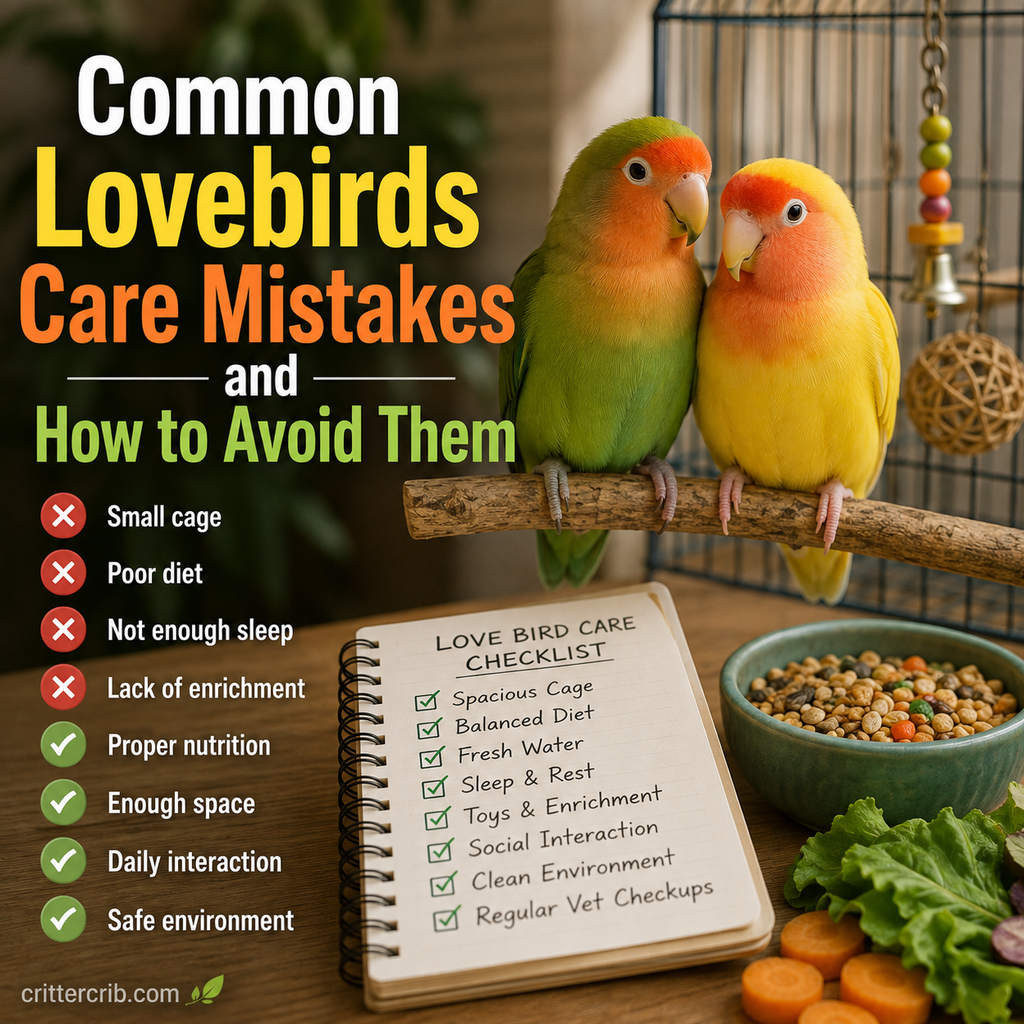
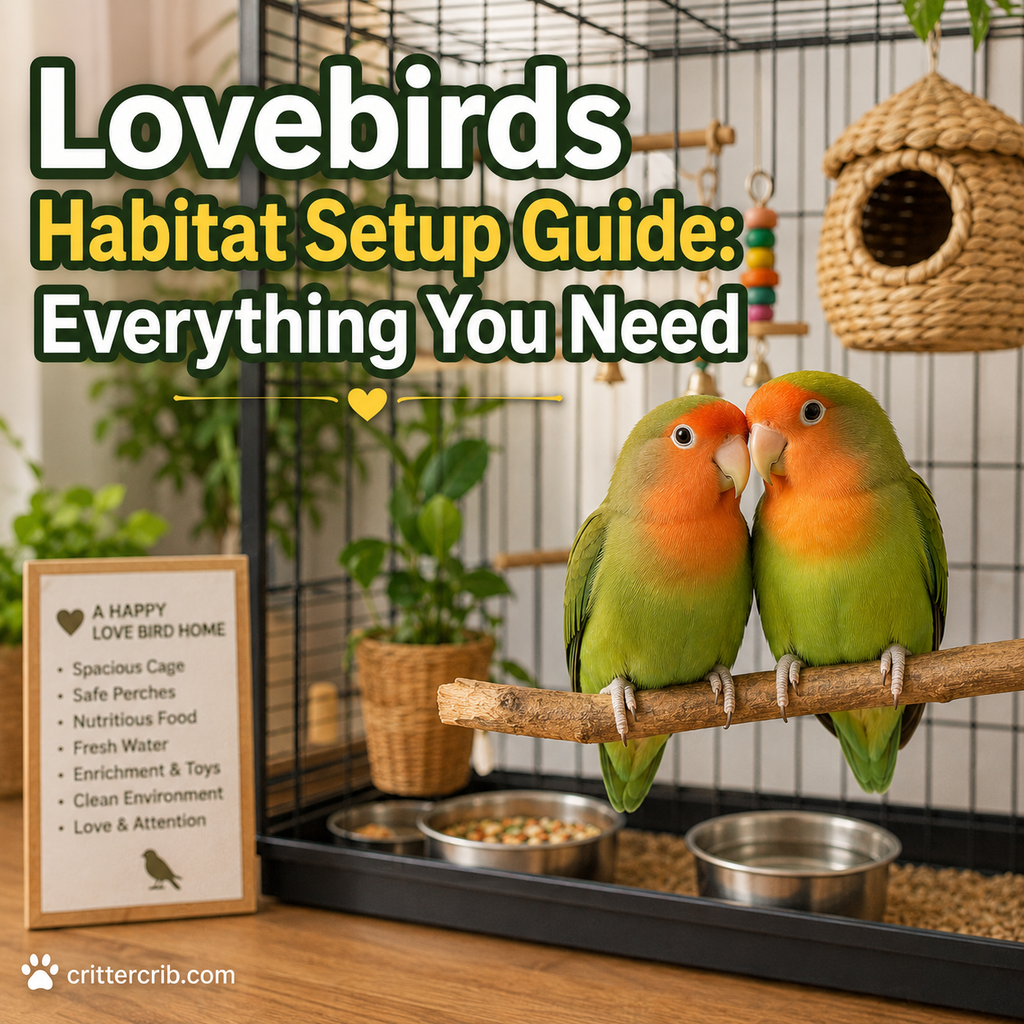
Lovebirds may be small parrots, but they need more than a small cage with a couple of perches and a food bowl.
They’re active, curious birds that climb, chew, explore, play, and interact throughout the day. A good lovebird habitat needs to provide enough space for all of those behaviors while also giving your bird somewhere safe to eat, rest, and sleep.
Fortunately, setting up a lovebird cage doesn’t have to be complicated.
Start with a spacious, secure cage, add several well-chosen perches and toys, place food and water where they’ll stay relatively clean, and choose a comfortable location in your home. From there, you can adjust the setup as you learn what your particular lovebird enjoys.
This guide covers everything you need to create a safe, comfortable, and engaging habitat for a pet lovebird.
Choosing the Right Cage for a Lovebird
The cage is the foundation of your lovebird’s habitat, so this is one area where it’s worth choosing carefully.
Lovebirds are energetic birds. They need room to stretch their wings, move between perches, climb, and play without constantly bumping into toys or cage bars.
Avoid choosing a cage simply because the packaging says it’s suitable for lovebirds.
Some cages marketed for small birds are surprisingly cramped.
When possible, choose the largest appropriately designed cage that comfortably fits your available space and budget.
What Size Cage Does a Lovebird Need?
For a single lovebird, aim for a cage that’s at least approximately 18 inches wide by 18 inches deep by 24 inches tall, although larger is strongly preferred.
Something closer to 24 inches wide by 18 inches deep by 24 inches tall or larger gives an active lovebird much more usable room.
For two lovebirds, provide considerably more space.
Remember that these measurements should be treated as a starting point rather than a target you shouldn’t exceed.
Bigger is generally better as long as:
- Bar spacing is safe
- The cage is constructed from bird-safe materials
- The design doesn’t create dangerous gaps
- You can clean and maintain it properly
Horizontal space is especially valuable because birds move and fly from side to side.
A very tall, narrow cage may look large based on total dimensions but provide less useful flight space.
What Bar Spacing Is Safe for Lovebirds?
Bar spacing is extremely important.
Lovebirds are small enough that excessively wide gaps can allow them to push their heads between the bars and potentially become trapped.
For most lovebird cages, approximately 1/2-inch bar spacing is appropriate.
Always inspect the entire cage for unusually large gaps around doors, corners, feeding ports, or removable trays.
A cage can have safe spacing across the main bars while still containing dangerous openings elsewhere.
Horizontal Bars Are Helpful
Lovebirds are enthusiastic climbers.
Cages with at least some horizontal bars give them more opportunities to climb around the sides of the cage using their feet and beak.
You’ll probably see your lovebird climbing upside down, hanging from the bars, and finding routes through the cage that you never intended.
That’s normal parrot behavior.
Choose Bird-Safe Cage Materials
A bird cage needs to withstand chewing.
Avoid cages with peeling paint, rust, sharp edges, exposed wire ends, or questionable metal coatings.
High-quality powder-coated cages and appropriate stainless steel cages are commonly used for parrots.
Be cautious with old or secondhand cages if you don’t know what materials or coatings were used.
Lovebirds explore with their beaks, so anything on the cage surface may eventually end up in their mouths.
Where Should You Put a Lovebird Cage?
Choosing the right cage location can make a noticeable difference in how secure and comfortable your lovebird feels.
Lovebirds are social birds and often enjoy being somewhere they can observe normal household activity.
A living room, family room, or home office can work well.
However, the busiest possible location isn’t necessarily the best one.
Your bird also needs periods of quiet and uninterrupted sleep.
A Good Cage Location Should Be:
- Away from direct drafts
- Away from heating and cooling vents
- Protected from intense direct sunlight
- Away from cooking fumes
- Away from smoke and aerosols
- Somewhere with regular household interaction
- Secure from dogs, cats, and other pets
- Quiet enough for proper nighttime sleep
Positioning part of the cage near a wall can help some birds feel more secure than placing the cage completely exposed in the center of a room.
Don’t Keep a Lovebird Cage in the Kitchen
The kitchen is generally a poor location for a bird cage.
Cooking produces smoke, steam, grease, and fumes.
More importantly, birds have highly sensitive respiratory systems. Fumes from overheated nonstick cookware and certain heated appliances can be extremely dangerous to them.
The kitchen also contains obvious physical hazards such as:
- Hot stovetops
- Boiling water
- Open containers
- Sharp utensils
- Hot food
- Cleaning chemicals
Keep your lovebird’s primary habitat away from cooking areas.
How High Should a Lovebird Cage Be?
The cage doesn’t need to touch the ceiling, but it shouldn’t normally sit directly on the floor either.
A sturdy cage stand that positions much of the living area somewhere around your chest or eye level can work well.
Birds often feel more secure when they’re elevated.
Make sure the cage and stand are stable enough that they can’t easily tip over.
What Perches Do Lovebirds Need?
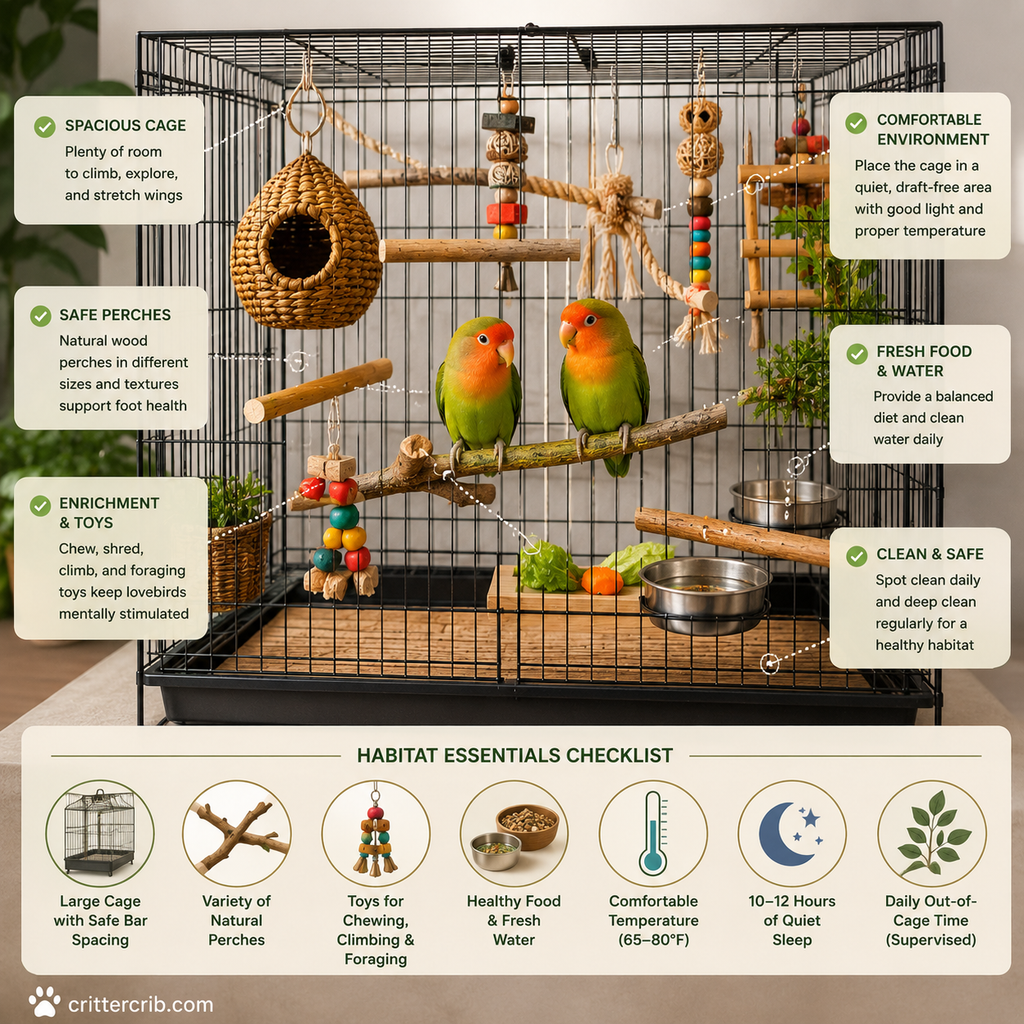
Perches aren’t just places to sit.
Your lovebird spends a large portion of its life standing on its feet, so perch variety matters.
Provide several perches with different:
- Diameters
- Shapes
- Textures
- Positions
Natural bird-safe branches are particularly useful because their irregular shapes allow your bird’s feet to rest in different positions.
Avoid Using Only Dowel Perches
Smooth wooden dowels are commonly included with bird cages.
One dowel isn’t necessarily a problem, but don’t make identical dowels the only perches available.
Standing on exactly the same diameter and texture throughout the day doesn’t provide much variation for the feet.
Natural perches are generally a better foundation for the cage.
Where Should Perches Go?
Perch placement requires a little strategy.
Your lovebird should be able to move comfortably around the cage without the perches blocking every flight path.
Place perches at different heights, but don’t stack them directly over food and water dishes.
Otherwise, you’ll quickly discover why.
Droppings fall downward.
Also avoid positioning a perch so close to the cage bars that your lovebird’s tail constantly rubs against them.
Leave open areas where your bird can stretch and move.
What Should Go on the Bottom of a Lovebird Cage?
Keep the cage bottom simple.
Plain paper or another bird-safe disposable cage liner makes it easy to clean the cage and monitor droppings.
Being able to see changes in droppings can sometimes help you notice health problems.
Avoid materials that make it difficult to monitor the cage bottom or that your bird could ingest in unsafe quantities.
Change the liner frequently enough to keep the cage clean and dry.
Food and Water Bowl Placement
Food and water should be easy for your lovebird to reach but positioned to minimize contamination.
Avoid placing bowls directly underneath favorite perches.
Otherwise, food and water can quickly become contaminated with droppings.
Stainless steel bowls are popular because they’re durable and relatively easy to clean.
Regardless of the material, dishes should be washed regularly.
Fresh drinking water should always be available.
What Should You Feed a Lovebird?
Habitat setup and nutrition go together.
A beautiful cage isn’t much use if the diet is poor.
An appropriate lovebird diet generally includes a quality formulated food along with suitable fresh vegetables and other bird-safe foods.
Seeds can be part of the diet, but feeding nothing except a seed mix can result in nutritional imbalances.
Suitable fresh foods may include options such as:
- Leafy greens
- Broccoli
- Bell peppers
- Carrots
- Peas
- Other bird-safe vegetables
Fruit can be offered appropriately but is generally better treated as a smaller portion of the diet than vegetables.
If your lovebird currently eats mostly seeds, don’t suddenly remove its familiar food and assume it will automatically eat pellets or vegetables.
Diet transitions should happen carefully, ideally with guidance from an avian veterinarian.
Lovebirds Need Toys
Lovebirds are intelligent parrots.
Without enough stimulation, a cage can become extremely boring.
Provide several types of bird-safe toys rather than filling the cage with identical bells or plastic accessories.
Good options can include:
- Chewing toys
- Shredding toys
- Foraging toys
- Climbing toys
- Swings
- Bird-safe ropes
- Foot toys
- Puzzle-style activities
Lovebirds often enjoy destroying things.
That’s not necessarily bad behavior.
Giving them appropriate materials to chew and shred provides an outlet for natural parrot behavior.
Don’t Overcrowd the Cage With Toys
There’s a point where enrichment becomes clutter.
Your lovebird still needs space to move.
Instead of placing every toy you own inside the cage at once, keep a reasonable selection available and rotate toys periodically.
This gives your bird something different to investigate without sacrificing movement space.
Whenever you introduce a new toy, observe your lovebird.
Some birds investigate new objects immediately. Others treat a harmless wooden toy like a terrifying monster for three days.
Give cautious birds time to adjust.
Inspect Toys Regularly
Parrot toys don’t last forever.
Lovebirds chew, pull, untie, shred, and dismantle things.
Inspect toys frequently for:
- Loose threads
- Frayed rope
- Sharp pieces
- Broken plastic
- Exposed wires
- Loose bells or hardware
- Gaps where feet or heads could become trapped
Remove damaged toys when they become unsafe.
Do Lovebirds Need a Nest?
Pet lovebirds don’t automatically need a nest box.
In fact, providing nest boxes, huts, enclosed tents, coconut shells, or other dark cavities can encourage nesting and hormonal behavior in some birds.
Unless you’re intentionally breeding birds under appropriate conditions and understand the health and reproductive considerations involved, there’s usually no reason to provide a nest box.
Your lovebird can sleep comfortably on an appropriate perch.
Be particularly cautious with fabric huts because chewing can create loose fibers that may present entanglement or ingestion risks.
How Much Sleep Do Lovebirds Need?
Lovebirds need plenty of uninterrupted sleep.
Aim for approximately 10 to 12 hours of quiet, darkness, and rest each night.
A consistent sleep schedule can help support normal behavior.
If the cage is in a room where televisions, lights, and conversations continue late into the night, consider whether your bird is actually getting enough uninterrupted rest.
Some owners use a separate sleeping area when the main household room remains active late at night.
Should You Cover a Lovebird Cage at Night?
A cage cover isn’t mandatory for every lovebird.
Some birds settle more easily when their cage is covered, while others sleep perfectly well without one.
If you use a cover:
- Choose a breathable material
- Maintain good ventilation
- Keep the bird away from loose threads
- Don’t use the cover to compensate for an excessively cold room
A cover should create a calmer sleeping environment, not seal the cage.
Ideal Temperature for Lovebirds
Healthy pet lovebirds generally do well at normal comfortable household temperatures.
A range of roughly 65°F to 80°F (18°C to 27°C) is suitable for many healthy birds, with temperatures around 70°F to 75°F (21°C to 24°C) being comfortable in many homes.
Stability is important.
Avoid sudden temperature swings and direct drafts.
Young, elderly, sick, or recovering birds may have different needs, so consult an avian veterinarian when appropriate.
Humidity and Air Quality
Moderate household humidity is generally suitable for lovebirds.
Around 40% to 60% relative humidity is a reasonable indoor target.
Very dry air can become uncomfortable, while excessive humidity can encourage mold and mildew.
Air quality is equally important.
Keep your lovebird away from:
- Cigarette smoke
- Vaping aerosols
- Scented candles
- Aerosol sprays
- Strong cleaning fumes
- Essential oil diffusers
- Paint fumes
- Cooking smoke
- Overheated nonstick cookware
A room can be the perfect temperature and still be unsafe because of contaminated air.
Do Lovebirds Need Natural Light?
A normal day-and-night cycle is important.
Place the cage somewhere that experiences natural changes in daytime light without exposing the bird to intense direct sunlight for long periods.
Sunlight through a window can quickly heat a cage.
Always make sure your lovebird has access to shade.
Keep in mind that ordinary window glass filters portions of natural sunlight, so simply putting a cage beside a window isn’t necessarily equivalent to safe outdoor sun exposure.
If you’re concerned about lighting requirements, discuss appropriate options with an avian veterinarian.
How Much Out-of-Cage Time Does a Lovebird Need?
Even a large cage shouldn’t be your lovebird’s entire world.
Lovebirds benefit from regular opportunities to exercise, explore, interact, and fly in a safe environment.
Before opening the cage, bird-proof the room.
Check for:
- Open doors
- Open windows
- Ceiling fans
- Hot surfaces
- Open toilets
- Deep containers of water
- Toxic plants
- Electrical cords
- Other pets
- Small gaps where the bird could become trapped
Turn ceiling fans off before your bird leaves the cage.
Ideally, provide supervised out-of-cage time regularly rather than treating it as an occasional event.
Consider a Play Stand
A play stand can give your lovebird an interesting destination outside the cage.
A simple setup might include:
- Natural perches
- Climbing opportunities
- Toys
- Foraging activities
- Food treats
- Chewable materials
Having a designated play area can also make supervised out-of-cage time easier to manage.
Setting Up a Habitat for Two Lovebirds
Two lovebirds need more than simply two food bowls in a cage designed for one bird.
Provide additional space and enough resources to reduce competition.
Consider offering:
- Multiple food dishes
- Multiple water access points
- Several comfortable perches
- More than one desirable resting location
- Multiple toys
- Plenty of room to move away from each other
Even bonded birds occasionally want space.
Monitor interactions carefully when introducing unfamiliar birds.
Never assume that two birds will automatically get along because they’re the same species.
How Often Should You Clean a Lovebird Cage?
Cleaning is part of habitat maintenance.
Daily tasks typically include:
- Refreshing drinking water
- Cleaning obviously dirty dishes
- Removing spoiled fresh food
- Checking the cage liner
- Cleaning obvious messes
Regularly replace cage liners and wash food and water dishes thoroughly.
The cage itself will also need deeper cleaning depending on how quickly it becomes dirty.
During a Deeper Cleaning
Clean:
- Cage bars
- Cage tray
- Grates if used
- Perches
- Toys as appropriate
- Food and water dishes
- Areas surrounding the cage
Use bird-safe cleaning methods and rinse thoroughly when necessary.
Never expose your lovebird to strong chemical fumes.
Set Up the Cage Before Bringing Your Lovebird Home
Don’t wait until your new bird arrives to assemble everything.
Prepare the habitat beforehand.
A basic setup should include:
- A spacious, secure cage
- Several appropriate perches
- Food dishes
- Fresh water
- Familiar food
- A few safe toys
- A clean cage liner
- A comfortable cage location
Keep the initial arrangement relatively simple.
A new lovebird is already adjusting to unfamiliar surroundings. You can gradually add or rotate enrichment once the bird becomes comfortable.
Lovebird Habitat Setup Checklist
Before bringing your bird home, run through this list.
Cage
- Spacious enough for movement and wing stretching
- Appropriate bar spacing
- Secure doors and feeding ports
- Bird-safe materials
- No sharp edges or dangerous gaps
Inside the Cage
- Natural perches of varied diameters
- Clean food dishes
- Fresh water
- Bird-safe toys
- Chewing and shredding opportunities
- Open movement space
- Clean cage liner
Cage Location
- Away from drafts
- Away from HVAC vents
- Away from the kitchen
- Protected from excessive sunlight
- Free from smoke and fumes
- Secure from other pets
- Social but not constantly chaotic
Daily Environment
- Appropriate temperature
- Moderate humidity
- Clean air
- Regular sleep schedule
- Opportunities for exercise
- Social interaction
- Enrichment
Common Lovebird Habitat Setup Mistakes
Even well-meaning owners can make mistakes when setting up their first cage.
Some of the most common include:
- Buying a cage that’s too small
- Choosing unsafe bar spacing
- Using only smooth dowel perches
- Overcrowding the cage with toys
- Putting food beneath perches
- Keeping the cage in the kitchen
- Positioning the cage directly under an air vent
- Providing unsafe fabric huts
- Leaving damaged toys in the cage
- Giving the bird too little sleep
- Providing no opportunity for exercise
- Using scented products around the bird
- Assuming a cage labeled “lovebird cage” is automatically appropriate
Most of these are easy to correct once you know what to look for.
Frequently Asked Questions About Lovebird Habitats
What Size Cage Is Best for a Lovebird?
For one lovebird, approximately 18 by 18 by 24 inches should be considered a starting minimum, with a larger cage preferred whenever possible.
Horizontal space is particularly valuable.
What Bar Spacing Should a Lovebird Cage Have?
Around 1/2 inch is generally appropriate for lovebirds.
Check the entire cage for larger gaps around doors, feeding ports, and corners.
Do Lovebirds Need a Nest to Sleep In?
No. A healthy pet lovebird can sleep on a comfortable perch.
Providing enclosed nesting areas can encourage hormonal and nesting behavior and generally isn’t necessary for a non-breeding pet.
How Many Perches Should a Lovebird Have?
There’s no perfect number.
Provide several perches with different shapes, diameters, and textures while maintaining enough open space for your bird to move comfortably.
Quality and placement matter more than filling the cage with perches.
Do Lovebirds Need Toys?
Yes.
Lovebirds are intelligent, active parrots that benefit from chewing, shredding, climbing, foraging, and other forms of enrichment.
Rotate toys periodically and inspect them for damage.
Should Lovebirds Be Kept Near a Window?
Being near a window can provide visual stimulation and natural daylight, but avoid drafts and excessive direct sunlight.
Make sure part of the cage always remains shaded.
Can Lovebirds Stay in Their Cage All Day?
A cage provides a secure home base, but lovebirds benefit from regular opportunities for supervised exercise and exploration outside the cage in a bird-safe room.
A larger cage is still important even when your bird gets daily out-of-cage time.
What Room Is Best for a Lovebird?
A social room such as a living room or home office can work well if the cage is protected from drafts, fumes, excessive noise, direct sunlight, and other pets.
Avoid kitchens because of cooking hazards and potentially dangerous fumes.
Final Thoughts
A good lovebird habitat is about more than buying a cage and filling it with accessories.
Think about how your bird will actually use the space.
Can it move freely? Can it climb and chew? Does it have different places to perch? Are food and water protected from obvious contamination? Is there enough room to play without the cage becoming cluttered?
Then look beyond the cage itself.
Your lovebird also needs clean air, comfortable temperatures, consistent sleep, social interaction, enrichment, exercise, and protection from common household hazards.
Start with a spacious cage with safe bar spacing. Add natural perches, appropriate food and water dishes, a selection of bird-safe toys, and plenty of open movement space. Place the cage somewhere your lovebird can participate in household life without being exposed to constant noise, drafts, cooking fumes, or other dangers.
You can refine the habitat as you get to know your bird.
Some lovebirds love swings. Others spend hours shredding wood and paper. Some immediately investigate every new toy, while others need several days before they’ll approach it.
The best habitat isn’t necessarily the one with the most accessories.
It’s the one that gives your lovebird enough space, security, stimulation, and choice to behave like a healthy, active little parrot.