Turtles are sometimes sold as inexpensive pets. You might see a small turtle with a relatively low price tag and assume you’re looking at an easy, budget-friendly animal.
The turtle may be inexpensive.
The setup usually isn’t.
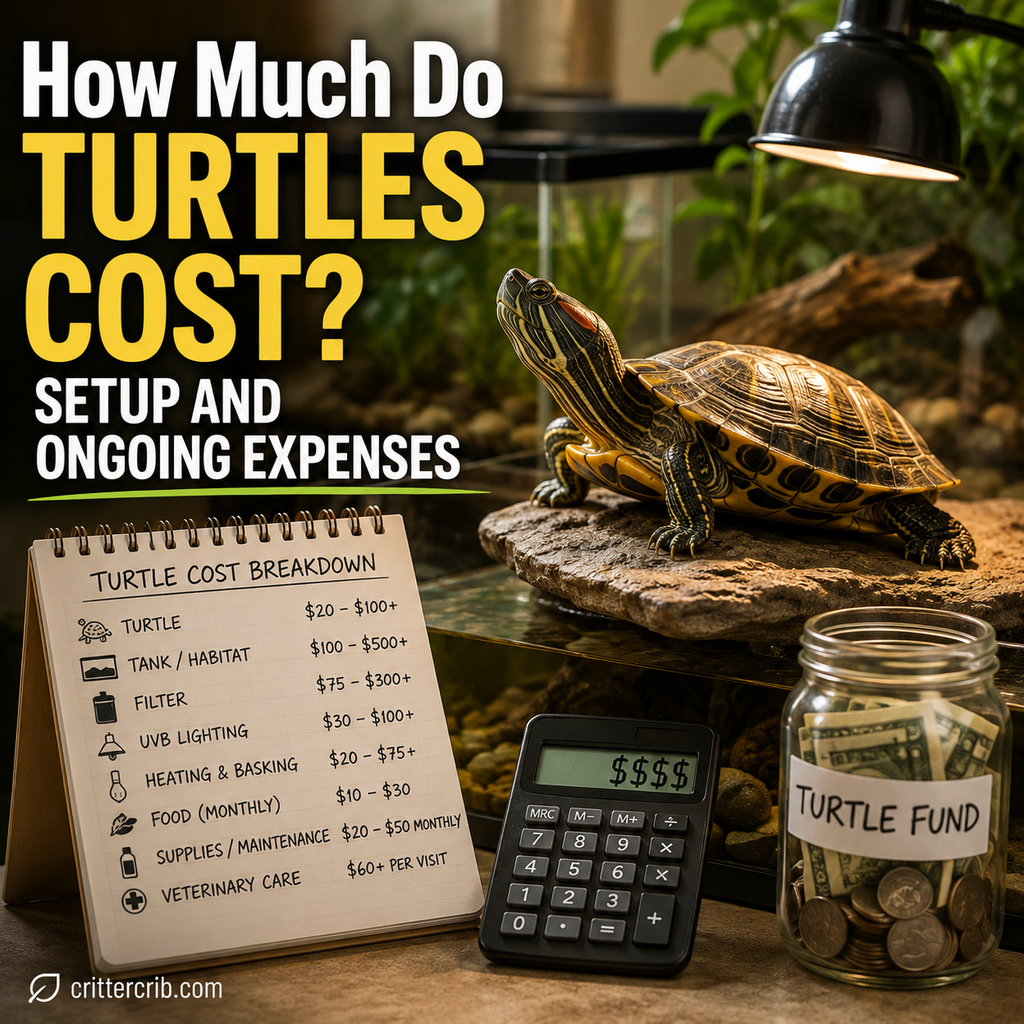
So, how much do turtles cost?
Depending on the species and where you get one, the turtle itself might cost around $20 to $100 or more. Certain species, morphs, captive-bred animals, or less common turtles can cost considerably more. Adoption fees may sometimes be lower.
For an aquatic turtle, however, the enclosure, filtration, heating, UVB lighting, basking equipment, substrate or décor, food, water maintenance supplies, and other necessities can easily bring the initial investment to several hundred dollars.
A reasonable first-year budget for many pet turtles may fall somewhere around $500 to $1,500 or more, depending heavily on the species and setup.
And because turtles can live for decades, the ongoing costs matter just as much as the initial price.
Here’s what to budget for before bringing one home.
How Much Does a Pet Turtle Cost?
The purchase price of a pet turtle varies considerably.
A relatively common captive-bred turtle might cost approximately $20 to $100 or more, while certain species, color morphs, ages, or animals from specialized breeders can cost hundreds of dollars.
Some unusual turtles may cost considerably more.
Several factors influence price:
- Species
- Age
- Size
- Coloration or morph
- Captive-bred versus other legal sources
- Breeder
- Availability
- Geographic location
- Local laws
The important thing to remember is that purchase price tells you very little about the actual cost of ownership.
A $40 turtle can still require a $500+ habitat.
The Type of Turtle Makes a Big Difference
“Turtle” covers a huge variety of animals.
A red-eared slider and a small terrestrial species don’t have identical housing requirements.
Even among aquatic and semi-aquatic turtles, adult size can dramatically affect enclosure costs.
Before calculating your budget, identify the exact species you’re considering.
You need to know its:
- Adult size
- Aquatic or terrestrial lifestyle
- Temperature requirements
- UVB requirements
- Diet
- Water depth requirements
- Filtration needs
- Lifespan
- Habitat requirements
Buying equipment before knowing the species can lead to expensive replacements later.
Why Is the Turtle Often the Cheapest Part?
A turtle doesn’t come with everything it needs to live.
For aquatic species, you’re essentially building and maintaining a small controlled ecosystem.
That may require:
- Large aquarium or stock tank
- Powerful filtration
- Water heater when appropriate
- Basking platform
- Basking heat
- UVB lighting
- Thermometers
- Water-treatment supplies
- Décor
- Food
- Cleaning equipment
A small juvenile turtle may initially make this setup look excessive.
Then it grows.
Planning for adult size from the beginning can save money over the long term.
How Much Does a Turtle Setup Cost?
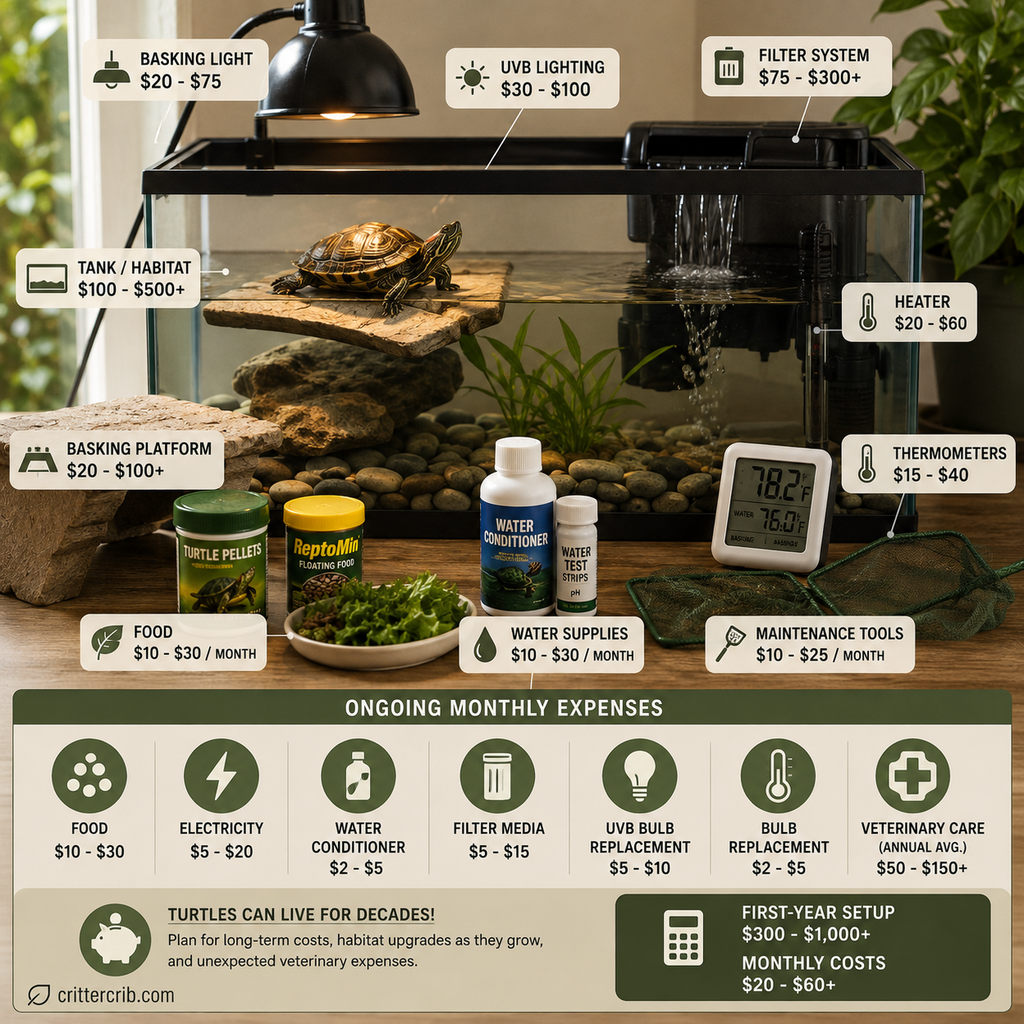
For many aquatic turtles, an initial setup might cost approximately $300 to $1,000 or more.
Large, premium, custom, or highly naturalistic setups can cost substantially more.
A basic startup budget might include:
- Turtle: $20–$100+
- Enclosure: $100–$500+
- Filter: $75–$300+
- UVB lighting: $30–$100+
- Basking heat setup: $20–$75+
- Water heater if needed: $20–$60+
- Thermometers: $15–$40
- Basking platform: $20–$100+
- Décor and substrate: $25–$150+
- Food: $10–$30
- Water maintenance supplies: $20–$50
These are broad estimates.
Species requirements, enclosure size, equipment quality, and local prices can move the total significantly in either direction.
How Much Does a Turtle Tank Cost?
The enclosure can be one of the largest initial expenses.
Small starter aquariums may seem economical, but many popular pet turtles eventually need much more space.
Depending on size and type, a suitable enclosure could cost anywhere from around $100 to $500 or considerably more.
Options may include:
- Glass aquariums
- Large stock tanks
- Purpose-built turtle habitats
- Custom enclosures
- Indoor ponds
Used aquariums can sometimes reduce costs, but inspect them carefully for damage and leaks.
Don’t Budget Around the Turtle’s Current Size
A juvenile turtle may fit comfortably into a relatively small habitat.
That doesn’t mean it will stay that way.
Research adult size before purchasing an enclosure.
Buying one appropriately sized habitat can be cheaper than repeatedly upgrading through several tanks.
Filtration Is a Major Expense
Aquatic turtles are messy.
Very messy.
They produce considerably more waste than many aquarium fish, which means filtration is one area where buying inadequate equipment can quickly become frustrating.
A good filter may cost approximately $75 to $300 or more.
Large canister filters and other high-capacity systems tend to cost more upfront but can make water maintenance much easier.
You’ll also have ongoing expenses for:
- Filter media
- Replacement parts
- Cleaning supplies
- Electricity
Why Cheap Filtration Can Cost More
An undersized filter may lead to:
- Poor water quality
- More frequent cleaning
- Cloudy or dirty water
- Additional equipment purchases
- An eventual filter upgrade
Spending more on appropriate filtration from the beginning can sometimes save money later.
UVB Lighting Costs
Many commonly kept turtles require appropriate UVB exposure.
UVB helps support vitamin D3 production and calcium metabolism.
A basic UVB setup might cost approximately $30 to $100 or more depending on the fixture and bulb.
The expense doesn’t end with the initial purchase.
UVB bulbs need periodic replacement according to manufacturer recommendations because useful UVB output can decline even when the bulb still produces visible light.
That makes UVB lighting an ongoing cost.
Basking Light and Heat Costs
Many aquatic turtles need access to a dry basking area where they can leave the water and warm themselves.
This typically requires an appropriate heat source.
A basking lamp and fixture might cost roughly $20 to $75 or more.
You’ll also need to account for replacement bulbs and electricity.
The basking temperature should be measured rather than guessed.
Your hand isn’t a reliable thermometer.
Water Heater Costs
Some turtle species may require heated water depending on their age, species, and ambient room temperature.
An aquarium heater might cost approximately $20 to $60 or more.
Larger volumes of water may require more powerful equipment.
Any heater used around a turtle should be appropriate for the enclosure and protected when necessary from damage by the animal.
Turtles are stronger than they look.
How Much Does a Basking Platform Cost?
A basking platform gives an aquatic turtle a dry area where it can rest and warm itself.
Commercial platforms may cost around $20 to $100 or more depending on size and design.
Large turtles can quickly outgrow small floating docks.
For bigger setups, owners sometimes use:
- Above-tank basking areas
- Large commercial platforms
- Custom-built platforms
- Secure naturalistic structures
Whatever you choose needs to support the turtle’s weight safely and allow easy access.
Substrate and Décor Costs
Aquatic turtle enclosures don’t necessarily need elaborate decoration.
However, safe environmental complexity can improve the habitat.
Depending on your setup, you might spend $25 to $150 or more on:
- Large rocks
- Driftwood
- Hides
- Artificial plants
- Substrate
- Background materials
- Platforms
Be careful with small gravel.
Some turtles may swallow small stones, potentially creating a health risk.
Anything placed in the enclosure should be too large to ingest or otherwise known to be safe for the species.
How Much Does Turtle Food Cost?
Food is usually one of the more manageable recurring expenses.
Depending on the turtle’s size, species, diet, and number of animals, you might spend approximately $10 to $30 per month feeding one turtle.
A balanced diet may include species-appropriate combinations of:
- Quality commercial turtle pellets
- Leafy greens
- Vegetables
- Aquatic plants
- Appropriate animal protein
- Insects
- Other suitable whole foods
Diet changes with species and age.
Some turtles become more herbivorous as they mature, while others have different nutritional patterns.
Don’t assume every turtle should eat the same diet.
Do Turtles Need Supplements?
Supplementation needs depend on species, diet, UVB exposure, age, and health.
Calcium is particularly important for shell and skeletal health.
Some keepers use appropriate calcium sources or supplements as part of a balanced husbandry plan.
However, more isn’t always better.
If you’re unsure about supplementation, discuss your turtle’s diet and UVB setup with a veterinarian experienced with reptiles.
Water Treatment and Maintenance Costs
Aquatic turtle ownership means maintaining water quality.
Depending on your water supply and setup, you may need products or equipment for:
- Water conditioning
- Testing water quality
- Cleaning
- Filter maintenance
- Siphoning
- Algae control through husbandry
These costs may only amount to a few dollars per month when averaged over time, but they add up across years.
A water-testing kit may also be a worthwhile initial expense.
Clear water isn’t automatically clean water.
Electricity Costs
Turtle habitats may run multiple electrical devices every day.
These can include:
- Filter
- UVB light
- Basking lamp
- Water heater
- Additional lighting
The exact electricity cost depends on equipment wattage, daily operating time, local utility rates, and enclosure size.
For one turtle, the monthly increase may be modest, but it’s still part of the true cost of ownership.
Larger habitats and powerful heaters generally consume more energy.
Monthly Cost of Owning a Turtle
Once the complete habitat is established, you might spend approximately $20 to $60 or more per month on routine care for one turtle.
Possible monthly expenses include:
- Food: $10–$30
- Electricity: variable
- Filter media: averaged over time
- Water conditioner: a few dollars
- Cleaning supplies: variable
- Replacement equipment: averaged over time
- Supplements: variable
This doesn’t include veterinary emergencies.
Large turtles, multiple turtles, expensive diets, or elaborate habitats can push monthly costs higher.
Annual Cost of Owning a Turtle
Routine annual expenses after the initial setup might fall around $250 to $700 or more.
An annual budget can include:
- Food
- Electricity
- Replacement UVB bulbs
- Basking bulbs
- Filter media
- Water-treatment products
- Cleaning supplies
- Replacement equipment
- Routine veterinary care
A year involving a broken filter or veterinary emergency can cost considerably more.
How Much Does a Turtle Vet Visit Cost?
Veterinary care is one of the most unpredictable expenses.
Not every veterinarian treats reptiles.
Depending on your location and clinic, a basic reptile examination might cost approximately $60 to $150 or more.
Additional costs may include:
- Fecal testing
- Bloodwork
- Imaging
- Medication
- Shell treatment
- Surgery
- Emergency appointments
A complicated medical problem can cost several hundred dollars or more.
The turtle’s purchase price doesn’t determine the cost of treatment.
A $30 turtle can still require a $500 veterinary procedure.
Build a Turtle Emergency Fund
Veterinary care is easier to manage when you’ve planned for it.
Consider keeping several hundred dollars available specifically for unexpected pet expenses.
You can build the fund gradually.
For example:
- Set aside $10 to $25 each month.
- Keep the money separate from routine spending.
- Continue contributing while your turtle is healthy.
- Use it only for veterinary care or essential equipment failures.
- Replenish it after an emergency.
A failed filter can also become urgent, so an emergency fund isn’t useful only for medical problems.
First-Year Cost of Owning a Turtle
The first year is usually the most expensive because you’re purchasing the enclosure and equipment.
For many pet turtles, a reasonable first-year budget might be approximately $500 to $1,500 or more.
A hypothetical aquatic turtle setup might look like:
- Turtle: $50
- Large enclosure: $250
- Filter: $175
- UVB fixture and bulb: $60
- Basking heat setup: $40
- Heater: $35
- Thermometers: $25
- Basking platform: $50
- Décor: $50
- Food: $180 per year
- Water supplies and filter media: $100 per year
- Electricity: variable
That puts the total well above the turtle’s original purchase price.
A premium enclosure can easily push the first-year total higher.
Budget Turtle Setup vs. Premium Setup
There’s plenty of room between a safe, practical turtle habitat and an elaborate display enclosure.
Budget Setup
A budget-conscious setup might use:
- Large stock tank instead of premium glass aquarium
- Simple basking platform
- Essential lighting
- High-quality but practical filtration
- Minimal safe décor
- Reusable maintenance equipment
You might be able to establish an appropriate habitat for several hundred dollars depending on the species.
The goal should be eliminating unnecessary cosmetic expenses, not essential husbandry.
Premium Setup
A high-end turtle habitat could include:
- Large display aquarium
- Custom cabinet
- Premium canister filtration
- Above-tank basking enclosure
- Naturalistic hardscape
- Live plants
- Automated equipment
- Advanced lighting
- Custom plumbing
Such a setup can easily cost $1,000 to several thousand dollars.
The turtle doesn’t need luxury branding.
It needs appropriate conditions.
Hidden Costs of Turtle Ownership
Some expenses aren’t obvious when you’re standing in front of a tiny turtle at the pet store.
Tank Upgrades
One of the biggest hidden costs is growth.
A juvenile turtle may need a dramatically larger habitat as an adult.
Planning for adult size can reduce repeated purchases.
Filter Replacement
Filters don’t last forever.
Pumps can fail, seals can leak, and components eventually wear out.
Replacement Bulbs
UVB and basking bulbs are ongoing expenses.
Keep replacement schedules in your long-term budget.
Water Usage
Large aquatic habitats require regular partial water changes.
That means additional water consumption.
Furniture and Floor Protection
Large aquariums are extremely heavy.
A substantial turtle habitat may require a proper stand and careful placement.
Water spills are also part of maintaining an aquatic animal.
Vacation Care
Someone needs to check the turtle and its equipment while you’re away.
A friend may help for free, but professional pet care adds another potential expense.
How Long Will You Be Paying for Turtle Care?
Potentially decades.
Many turtles are remarkably long-lived animals.
Depending on the species, a turtle may live for several decades with appropriate care.
That completely changes the way ownership cost should be viewed.
Suppose routine care averages $400 per year.
Over 20 years, that’s:
$400 × 20 = $8,000
And that’s after the initial habitat purchase.
It also doesn’t include major veterinary expenses or large equipment upgrades.
A relatively inexpensive turtle can therefore represent thousands of dollars in lifetime care.
Can You Save Money on Turtle Care?
Absolutely.
There are plenty of ways to reduce costs without compromising welfare.
Buy for Adult Size
Constantly replacing tanks is expensive.
When practical, choose equipment with the turtle’s eventual size in mind.
Consider Stock Tanks
A large stock tank can sometimes provide more usable space per dollar than a display aquarium.
It may not look as decorative, but turtles don’t care about the view from your living room.
Invest in Appropriate Filtration
A good filter may cost more initially but can save time and reduce the frustration of inadequate water quality.
Compare Food Prices
Quality turtle food purchased in sensible quantities can reduce the cost per serving.
Don’t buy so much that it expires before you use it.
Maintain Equipment
Regular filter cleaning and equipment maintenance can extend the useful life of your setup.
Avoid Unnecessary Accessories
Pet stores sell plenty of things that look attractive but aren’t essential.
Spend your budget on equipment that directly contributes to health, safety, and appropriate behavior.
Where Should You Buy a Turtle?
Turtles may be available from:
- Reputable breeders
- Reptile specialty stores
- Reptile expos
- Rescues
- Adoption organizations
Research the source before purchasing.
Ask about:
- Species
- Age
- Diet
- Health history
- Captive breeding
- Current husbandry
Avoid impulse purchases.
You should have the complete enclosure established before bringing the turtle home.
Consider Adopting a Turtle
Turtles are frequently surrendered because people underestimate their adult size, lifespan, or care requirements.
A reptile rescue may have animals needing homes.
Adoption can sometimes cost less than purchasing from a breeder, although the biggest advantage is giving an existing animal an appropriate home.
Occasionally, surrendered turtles come with equipment.
Don’t assume that equipment is automatically suitable.
Evaluate everything against current species-specific husbandry requirements.
Check Your Local Laws Before Buying
Turtle ownership and sales can be regulated.
In the United States, federal rules restrict certain sales and distribution of turtles with shell lengths under four inches, with limited exceptions.
State and local laws can impose additional restrictions on species, possession, collection, or transport.
Never collect a wild turtle simply because you want a free pet.
Wild populations can be harmed by collection, and taking native wildlife may be illegal.
Choose legally obtained animals from responsible sources.
Are Turtles Cheap Pets?
The purchase price can be cheap.
Ownership isn’t necessarily cheap.
Turtles require specialized equipment that dogs and cats don’t need, including UVB lighting, basking heat, and—in aquatic species—substantial filtration.
They’re also long-lived.
A $30 turtle that lives for decades can ultimately cost far more than its purchase price suggests.
Are Turtles Good Pets for Beginners?
Some turtles can be suitable for dedicated beginners who research their needs beforehand.
However, they aren’t necessarily easy pets.
Aquatic turtles require regular attention to:
- Water quality
- Filtration
- Temperature
- UVB
- Basking
- Diet
- Cleaning
- Adult enclosure size
They’re better suited to someone who finds maintaining the habitat interesting rather than someone looking for an extremely low-maintenance pet.
Frequently Asked Questions About Turtle Costs
How Much Is a Pet Turtle?
Many common pet turtles may cost approximately $20 to $100 or more, although species, age, morph, breeder, availability, and location can significantly affect price.
Specialized or unusual turtles can cost hundreds of dollars or more.
How Much Does a Turtle Setup Cost?
A complete aquatic turtle setup may cost approximately $300 to $1,000 or more.
Large enclosures, premium filtration, custom basking areas, and elaborate habitats can increase the cost substantially.
How Much Does a Turtle Cost Per Month?
Routine monthly expenses for one turtle might average approximately $20 to $60 or more after the habitat has been established.
Veterinary expenses aren’t included in that estimate.
How Much Does a Turtle Cost Per Year?
Routine annual expenses might total approximately $250 to $700 or more, depending on food, electricity, filter maintenance, replacement bulbs, supplies, and veterinary care.
How Much Does a Turtle Cost in the First Year?
For many turtles, approximately $500 to $1,500 or more is a reasonable first-year range once the animal, habitat, equipment, food, and routine supplies are included.
What Is the Most Expensive Part of Owning a Turtle?
For aquatic turtles, the enclosure and filtration system are often among the biggest initial expenses.
Over the animal’s lifetime, veterinary care, equipment replacement, and years of routine maintenance can become much larger costs.
Is It Expensive to Feed a Turtle?
Food is usually relatively affordable compared with the habitat.
Many owners might spend around $10 to $30 per month, although costs depend on species, size, diet, and local prices.
Do Turtles Need a Heat Lamp and UVB?
Many commonly kept turtles require both an appropriate basking heat source and UVB lighting.
Exact requirements vary by species, so research the particular turtle you’re keeping rather than relying on a generic setup.
Final Thoughts
So, how much do turtles cost?
The animal itself may only cost around $20 to $100 for many commonly kept species, but that’s a small part of the real expense.
For aquatic turtles especially, the habitat is where the budget grows.
A sufficiently large enclosure, powerful filtration, UVB lighting, basking heat, water heating when necessary, thermometers, a basking platform, food, and water-maintenance equipment can push startup costs into the hundreds of dollars.
A realistic first-year budget for many pet turtles may be around $500 to $1,500 or more, followed by approximately $250 to $700 or more in routine annual expenses.
The biggest factor, though, is time.
Many turtles can live for decades.
That inexpensive animal in the pet store could still need food, clean water, replacement UVB bulbs, filtration, heating, and veterinary care many years from now.
If you’re prepared for that commitment, a turtle can be a fascinating long-term pet.
Just make sure you’re budgeting for the turtle’s entire habitat and lifetime—not the number written on its price tag.