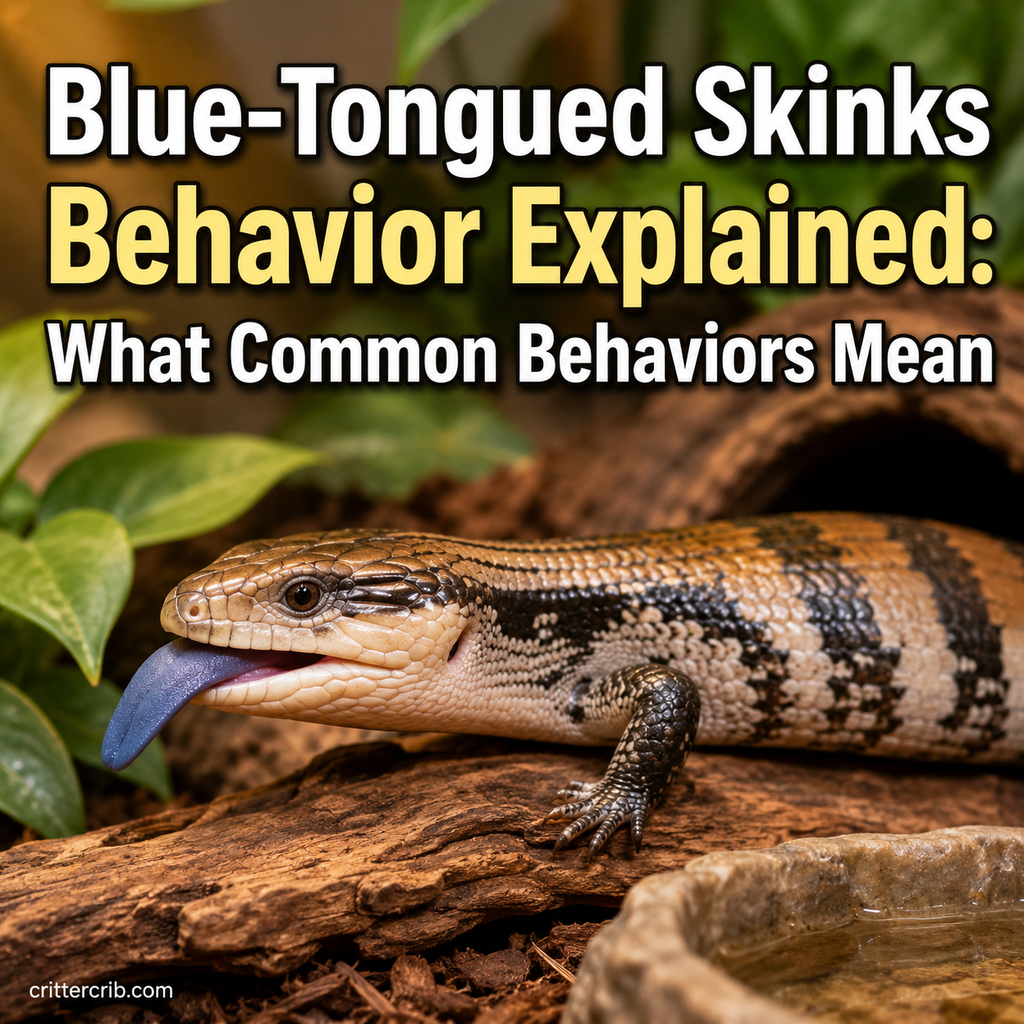
Blue-tongued skinks can be surprisingly expressive reptiles. They may not bark, chirp for attention, or wag their tails like more familiar pets, but they communicate quite a bit through posture, movement, breathing, appetite, and that unmistakable blue tongue.
For a new owner, some perfectly normal behaviors can look concerning. A skink that spends most of the day hiding might seem unhappy. Hissing can sound aggressive. Burrowing for hours may make you wonder whether something is wrong with the enclosure.
In many cases, these behaviors are simply part of being a blue-tongued skink.
Learning what your skink’s behavior means makes it easier to recognize when your pet is comfortable, stressed, defensive, curious, or potentially unwell. It also helps you understand your individual skink’s personality and normal routine.
This guide explains common blue-tongued skink behaviors, why they happen, and when a change in behavior deserves closer attention.
Understanding Normal Blue-Tongued Skink Behavior
Blue-tongued skinks are terrestrial lizards that spend much of their time exploring at ground level, hiding beneath cover, and digging through loose material.
They are generally solitary animals. Unlike social mammals, they don’t need another skink for companionship, and housing blue-tongued skinks together can lead to stress, competition, or injury.
Individual personalities vary considerably. One skink may confidently walk toward the enclosure door whenever you enter the room, while another prefers to watch from beneath a hide.
Age, species or subspecies, previous handling, enclosure conditions, season, and individual temperament can all influence behavior.
Rather than expecting your skink to behave a certain way every day, learn its usual patterns. Changes from that baseline often tell you more than any single behavior.
Why Do Blue-Tongued Skinks Stick Out Their Tongues?
Tongue flicking is one of the most common behaviors you’ll see.
Blue-tongued skinks use their tongues to gather chemical information from their surroundings. Particles collected by the tongue are transferred to the Jacobson’s organ, also called the vomeronasal organ, located in the roof of the mouth.
In simple terms, your skink is investigating its environment.
You may notice frequent tongue flicking when your skink:
- Explores a new enclosure
- Encounters an unfamiliar object
- Smells food
- Investigates your hand
- Moves through recently changed substrate
- Enters a new room during supervised handling
Frequent tongue flicking while calmly walking around is usually a sign of curiosity and environmental investigation.
Why Is a Blue-Tongued Skink’s Tongue Blue?
The bright blue tongue also serves another purpose: defense.
When threatened, a blue-tongued skink may open its mouth widely and expose its vivid tongue. Combined with hissing and flattening the body, the display can make the skink appear larger and more intimidating.
The dramatic coloration may surprise or discourage a potential predator long enough for the skink to escape.
So while casual tongue flicking is usually exploratory, a wide-open mouth with the tongue prominently displayed can mean something very different.
Why Do Blue-Tongued Skinks Hiss?
Hissing usually means your skink wants more space.
A frightened or defensive skink may inflate or flatten its body, open its mouth, display its tongue, and hiss. Some individuals hiss frequently without attempting to bite.
Common triggers include:
- Being picked up unexpectedly
- Reaching into a hide
- Approaching from above
- Moving the skink into an unfamiliar enclosure
- Handling a newly acquired skink
- Sudden movements
- Being disturbed while resting
Hissing shouldn’t automatically be interpreted as aggression.
Your skink may simply be communicating, “I’m uncomfortable with what’s happening.”
What Should You Do When Your Skink Hisses?
Avoid punishing or deliberately provoking defensive behavior.
Instead, move slowly and give the animal an opportunity to calm down. If you’re working on handling, gradually build trust through short, predictable interactions.
Try approaching from the side rather than suddenly grabbing the skink from above. A hand coming down from overhead can resemble the approach of a predator.
Over time, many skinks become much more comfortable with routine interaction.
Why Does My Blue-Tongued Skink Hide So Much?
Hiding is normal.
Blue-tongued skinks naturally seek protected spaces where they can rest without feeling exposed. A skink spending several hours inside a hide isn’t necessarily bored, frightened, or unhappy.
You should provide multiple secure hiding areas, ideally including options on different parts of the enclosure.
Your skink may hide more frequently when:
- It has recently moved into a new enclosure
- The room is unusually busy
- It is preparing to shed
- Temperatures are changing
- It has recently eaten
- It is stressed
- Seasonal activity levels are decreasing
Some skinks are simply more secretive than others.
When Can Excessive Hiding Be Concerning?
Pay more attention when hiding occurs alongside other changes.
For example, a normally active skink that suddenly stays hidden constantly and stops eating may warrant an enclosure check and closer observation.
Review basic husbandry, particularly:
- Basking temperature
- Cooler-side temperature
- Humidity
- Lighting schedule
- Access to fresh water
- Substrate condition
- Recent environmental changes
Persistent lethargy or unusual behavior, particularly when accompanied by weight loss, breathing changes, weakness, or other physical symptoms, should be discussed with a veterinarian experienced with reptiles.
Why Do Blue-Tongued Skinks Burrow?
Burrowing is another completely natural behavior.
Given suitable substrate, many blue-tongued skinks enthusiastically dig beneath the surface. Some disappear almost entirely, leaving only a nose or section of their back visible.
Burrowing can help a skink:
- Feel protected
- Rest
- Regulate temperature
- Find a preferred humidity level
- Prepare for shedding
- Avoid environmental disturbances
This is why an enclosure shouldn’t consist of only a hard floor with a couple of decorative hides.
Providing an appropriate layer of safe substrate gives your skink another way to interact naturally with its environment.
Why Is My Skink Suddenly Burrowing More?
A temporary increase in digging isn’t automatically a problem.
However, repeated attempts to escape the heat by burying itself can indicate that enclosure temperatures deserve checking. Seasonal changes may also affect activity and burrowing patterns.
Consider the entire situation rather than interpreting digging by itself.
Why Is My Blue-Tongued Skink Scratching at the Glass?
Repeated scratching, climbing, or pacing along enclosure walls is often called “glass surfing.”
Occasional attempts to investigate the glass aren’t unusual. Persistent glass surfing, however, can have several possible causes.
These include:
- Exploring the boundaries of the enclosure
- Wanting access to an area outside the enclosure
- Insufficient environmental enrichment
- An enclosure that is too small
- Incorrect temperatures
- Seasonal or reproductive behavior
- Seeing reflections
- Stress caused by nearby activity
A skink that has learned enclosure-opening routines may also approach or scratch the glass when it sees you because it associates your presence with food or being allowed out.
How to Respond to Glass Surfing
Start by reviewing the enclosure rather than assuming your skink simply “wants out.”
Check temperatures with reliable equipment and make sure the skink has enough usable floor space, hides, substrate, and environmental variety.
You can also provide safe enrichment by periodically changing enclosure furnishings, adding appropriate objects to investigate, or allowing supervised exploration in a secure area.
Persistent frantic pacing should not simply be ignored, especially if it represents a major change in your skink’s normal behavior.
Why Does My Blue-Tongued Skink Flatten Its Body?
Blue-tongued skinks sometimes flatten themselves until they look noticeably wider.
Context matters.
Flattening While Basking
A relaxed skink may spread its body while basking. Increasing the body’s exposed surface area can help it absorb heat.
If your skink is comfortably positioned beneath its basking area with relaxed limbs and normal breathing, flattening can simply be part of thermoregulation.
Defensive Flattening
A frightened skink may also flatten or inflate its body to appear larger.
Defensive flattening is more likely to occur alongside:
- Hissing
- Open-mouth displays
- Rapid breathing
- A raised or tense posture
- Attempts to retreat
- Sudden movements toward a perceived threat
Look at the entire posture rather than the flattened body alone.
Why Does My Blue-Tongued Skink Open Its Mouth?
An open mouth can mean several different things.
During a defensive display, the skink may open its mouth to show its blue tongue and warn a perceived threat.
An occasional brief gape while basking can also occur.
Repeated open-mouth breathing, however, is different from a defensive display and should receive attention.
Watch for symptoms such as:
- Frequent open-mouth breathing
- Wheezing or clicking
- Mucus or bubbles around the nose or mouth
- Labored breathing
- Unusual lethargy
- Reduced appetite
Respiratory symptoms should be evaluated by a reptile-experienced veterinarian.
Why Does My Blue-Tongued Skink Puff Up?
A skink may puff up its body when frightened or defensive.
Making itself appear larger is another way of discouraging potential predators. Puffing may occur together with hissing, flattening, and tongue displays.
This behavior is particularly common when a skink isn’t accustomed to handling or is surprised.
Give the animal space and avoid turning the interaction into a confrontation.
Why Does My Blue-Tongued Skink Wag or Twitch Its Tail?
Tail movements can occur in several contexts.
A tense skink may move or twitch its tail when alert, defensive, or overstimulated. Tail movements can also appear during interactions associated with courtship or territorial behavior.
Because tail movement isn’t associated with one universal message, observe what else your skink is doing.
Ask yourself:
- Is the body tense or relaxed?
- Is the skink hissing?
- Is another skink nearby?
- Has something recently changed?
- Is the animal attempting to escape?
- Is the behavior happening around feeding?
The surrounding context usually provides the best clue.
Why Does My Blue-Tongued Skink Suddenly Freeze?
Freezing can be a defensive response.
When something unfamiliar enters the environment, a skink may stop moving and assess whether it represents danger.
You might notice this when:
- Walking suddenly past the enclosure
- Introducing a new object
- Reaching toward the skink
- Moving the enclosure
- Allowing the skink to explore somewhere unfamiliar
If the perceived threat disappears, the skink will often resume normal activity.
Repeated freezing in a busy environment may indicate that the animal feels exposed. Providing adequate hides and visual cover can help.
Why Does My Skink Close Its Eyes When I Pet It?
This behavior is easy to anthropomorphize.
A blue-tongued skink closing its eyes during handling doesn’t necessarily mean it is enjoying being petted in the same way a dog might.
Depending on the circumstances, closing the eyes can occur when the skink is resting, tolerating contact, or attempting to disengage from something it finds uncomfortable.
Look at the rest of its body language.
A calm skink generally appears loose and relaxed. A stressed animal may become rigid, breathe more heavily, repeatedly attempt to escape, or display defensive behaviors.
Allowing the skink to move away rather than forcing prolonged contact can make handling more positive.
Why Does My Blue-Tongued Skink Try to Bite?
Blue-tongued skinks can bite, although many captive individuals become quite tolerant of handling.
Biting is usually associated with defense, fear, food, or mistaken identity rather than a skink deciding to be “mean.”
A bite may occur because:
- The skink feels cornered
- Handling was forced
- A hand smells like food
- The animal was startled
- Previous warning signals were ignored
- Food was presented too close to fingers
Wash your hands after handling food and consider using feeding utensils when appropriate.
More importantly, learn the warning signs that tend to come before a defensive bite.
Hissing, body inflation, backing away, and open-mouth displays are opportunities to change your approach before the situation escalates.
Why Does My Blue-Tongued Skink Follow Me?
Some skinks become highly aware of the people who care for them.
Your skink may approach the enclosure door, follow your movement through the glass, or emerge when you enter the room.
That doesn’t necessarily mean the skink experiences attachment exactly like a dog or cat.
There may be a simpler explanation: you’ve become associated with interesting things.
You may represent:
- Food
- Handling
- Enrichment
- An open enclosure door
- Activity worth investigating
Whatever the motivation, voluntarily approaching rather than retreating generally suggests the skink is comfortable enough to investigate your presence.
Can Blue-Tongued Skinks Recognize Their Owners?
Blue-tongued skinks can become accustomed to familiar routines, smells, handling patterns, and people.
An animal that once hid whenever someone entered the room may eventually walk toward a familiar keeper.
It’s reasonable to say that captive reptiles can learn associations and distinguish familiar circumstances. It’s more difficult to assign human emotional concepts to those interactions.
Instead of worrying about whether your skink “loves” you, focus on observable signs of trust.
A comfortable skink may:
- Remain relaxed when you approach
- Explore your hands without immediately becoming defensive
- Accept routine handling
- Eat normally in your presence
- Investigate you through tongue flicking
- Approach voluntarily
Those are meaningful signs that your animal has become comfortable with its environment and routine.
Why Is My Blue-Tongued Skink Suddenly More Active?
Activity naturally changes.
A skink may become particularly active when searching for food, investigating enclosure changes, or responding to seasonal and reproductive cues.
If your skink suddenly begins pacing or exploring constantly, check whether anything has changed.
Consider:
- Enclosure temperatures
- Lighting duration
- Feeding schedule
- Room temperature
- Recent enclosure changes
- Seasonal timing
- Signs of reproductive behavior
Increased activity isn’t inherently bad. What matters is whether the behavior appears purposeful and relaxed or frantic and persistent.
Why Is My Blue-Tongued Skink Suddenly Less Active?
Reduced activity can also have several explanations.
Blue-tongued skinks may become quieter after eating, during shedding, or in response to seasonal changes.
They may also slow down when enclosure temperatures are inadequate.
A significant decrease in activity deserves more attention when accompanied by:
- Loss of appetite
- Weight loss
- Weakness
- Difficulty walking
- Abnormal breathing
- Swelling
- Persistent eye closure
- Changes in stool
- Other unusual physical symptoms
Don’t assume prolonged lethargy is simply laziness.
Do Blue-Tongued Skinks Brumate?
Blue-tongued skinks can experience seasonal reductions in activity associated with cooler periods. Depending on the species, geographic origin, captive conditions, and individual animal, this can include reduced appetite, increased hiding, and much lower activity.
This is often described as brumation.
However, a skink becoming lethargic or refusing food should not automatically be assumed to be brumating.
Incorrect enclosure temperatures and illness can produce similar behavioral changes.
Owners should understand the specific husbandry requirements of their type of blue-tongued skink and consult a reptile veterinarian when unexplained behavioral changes are significant or persistent.
How Does Behavior Change Before Shedding?
A skink preparing to shed may behave differently for a short period.
You may notice:
- More hiding
- Increased burrowing
- Reduced activity
- Temporary appetite changes
- Duller coloration
- Changes in skin appearance
- Irritability when handled
Once the shed is complete, normal behavior generally returns.
Maintaining appropriate humidity and providing suitable surfaces can help support the natural shedding process.
Why Is My Skink Digging in Its Water Bowl?
Some blue-tongued skinks develop surprisingly messy relationships with their water bowls.
A skink may walk through the bowl, dig around it, soak in it, or push substrate into the water.
Occasional soaking or climbing into the bowl isn’t necessarily concerning.
Repeated soaking, however, deserves some investigation. Check enclosure temperature and humidity and examine the skink for possible skin irritation, shedding problems, or external parasites.
Keep the water clean, especially if your skink regularly tracks substrate into it.
Why Does My Blue-Tongued Skink Rearrange Its Enclosure?
You carefully arrange the enclosure.
Your skink disagrees.
Blue-tongued skinks can push lightweight decorations, dig beneath objects, bury plants, move substrate, and generally remodel their surroundings.
This is often simply part of normal exploration and burrowing behavior.
Make sure enclosure furnishings are stable. Heavy rocks, hides, or decorations should never be positioned where digging underneath them could cause them to collapse onto the animal.
A slightly messy enclosure is often the result of an active skink doing exactly what skinks do.
What Does a Relaxed Blue-Tongued Skink Look Like?
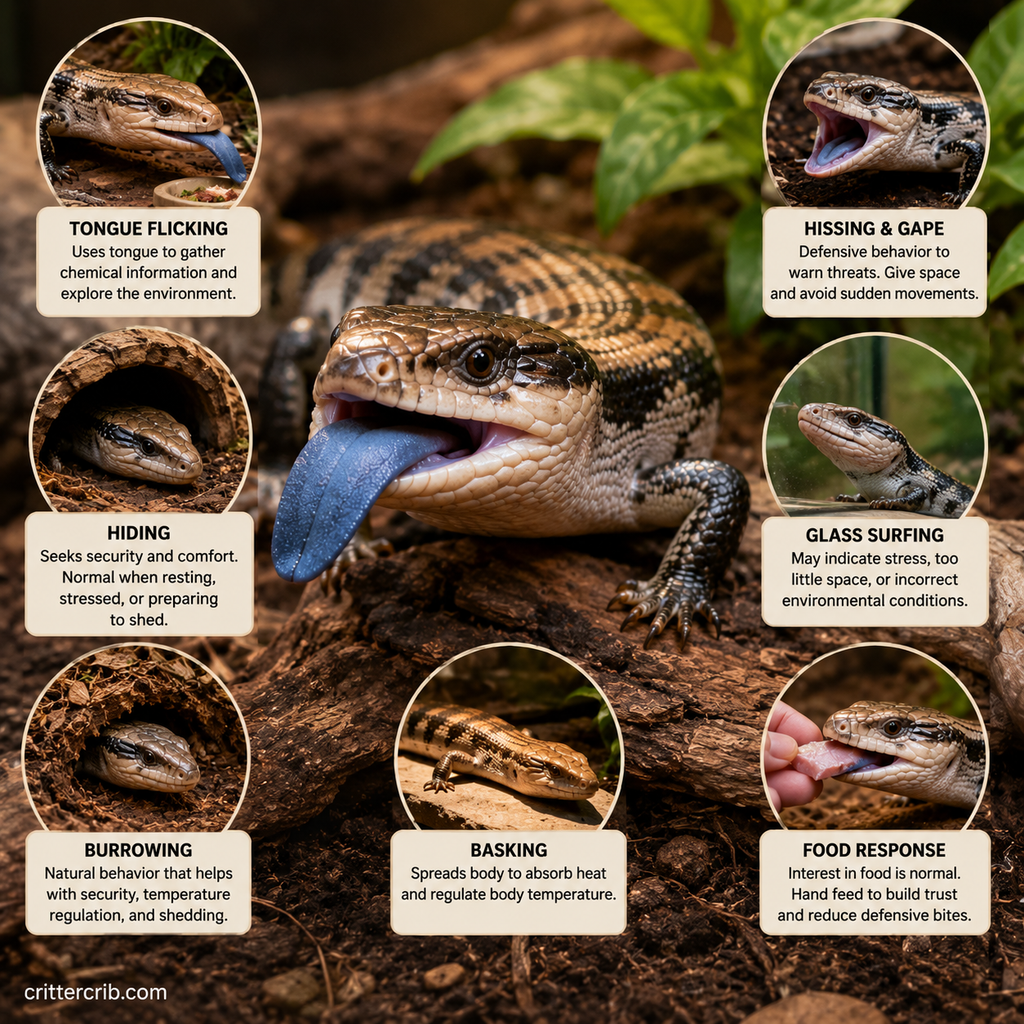
There isn’t one universal relaxed posture, but a comfortable skink often displays a combination of calm behaviors.
You may see:
- Slow, deliberate exploration
- Regular tongue flicking
- Normal basking
- Comfortable use of hides
- Burrowing
- A loose rather than rigid body posture
- Consistent appetite
- Normal interaction with its environment
A healthy routine usually includes a mixture of activity and rest.
Your skink doesn’t need to be constantly exploring to be content.
What Does a Stressed Blue-Tongued Skink Look Like?
Stress can show up differently between individuals.
Possible signs include:
- Frequent defensive hissing
- Persistent escape attempts
- Frantic glass surfing
- Repeated hiding after previously being active
- Defensive biting
- Body inflation
- Open-mouth defensive displays
- Reduced appetite
- Increased sensitivity to handling
One isolated behavior doesn’t prove your skink is chronically stressed.
Look for patterns.
A newly acquired skink, for example, may hide and hiss frequently during its first days in a new environment. That behavior may gradually decrease as it becomes familiar with its surroundings.
Persistent stress behaviors are a reason to evaluate husbandry and handling practices.
How to Build Trust With a Blue-Tongued Skink
Trust develops through predictable, non-threatening interactions.
Don’t rush the process, particularly with a newly acquired or poorly socialized animal.
1. Allow an Adjustment Period
Give a new skink time to learn that its enclosure is safe.
Immediately attempting long handling sessions can make an already stressful transition harder.
2. Spend Time Near the Enclosure
Simply being present can help your skink become familiar with normal household movement.
3. Move Slowly
Avoid sudden grabbing movements, particularly from above.
4. Let the Skink Investigate You
Place your hand nearby and allow tongue flicking and voluntary investigation when practical.
5. Keep Early Handling Sessions Short
Brief, calm interactions are often more productive than forcing a frightened animal through a long session.
6. Support the Entire Body
When lifting your skink, support its body and legs rather than allowing it to dangle.
7. Pay Attention to Warning Signals
If the skink becomes increasingly defensive, continuing to push the interaction can make future handling more difficult.
Consistency usually matters more than speed.
Behavioral Changes Can Point to Husbandry Problems
Behavior is one of the most useful tools you have for evaluating your skink’s environment.
A sudden behavioral change can sometimes be the first clue that something isn’t right.
For example:
- Constantly avoiding the basking area could indicate excessive heat.
- Remaining on the warm side may indicate that other areas are too cool.
- Persistent escape behavior may warrant checking enclosure conditions and available space.
- Increased hiding can occur when the animal feels exposed.
- Difficulty shedding may indicate that humidity or other husbandry factors need adjustment.
Whenever behavior changes unexpectedly, check environmental conditions with reliable measuring equipment rather than relying on how the enclosure feels to you.
When Should You Be Concerned About Your Skink’s Behavior?
Behavior becomes more concerning when it changes dramatically without an obvious explanation or appears alongside physical symptoms.
Contact a veterinarian experienced with reptiles if you’re concerned about symptoms such as:
- Severe or persistent lethargy
- Unexplained weight loss
- Persistent refusal of food outside expected seasonal changes
- Labored or open-mouth breathing
- Wheezing or respiratory discharge
- Weakness or difficulty moving
- Tremors
- Significant swelling
- Persistent abnormal stool
- Injuries
- Sudden neurological-looking behavior
Reptiles can sometimes conceal signs of illness, so significant changes shouldn’t be dismissed simply because the animal isn’t obviously in distress.
Frequently Asked Questions About Blue-Tongued Skink Behavior
Are blue-tongued skinks friendly?
Many blue-tongued skinks become calm and tolerant of regular handling, but temperament varies between individuals. They are better described as potentially docile and manageable than inherently “friendly” in the mammalian sense.
Why does my blue-tongued skink hiss at me?
Hissing is usually defensive communication. Your skink may feel startled, threatened, cornered, or uncomfortable with handling. Give it space and use gradual, predictable interactions to build trust.
Is it normal for a blue-tongued skink to hide all day?
Occasional long periods of hiding can be completely normal. Concern increases when excessive hiding represents a sudden behavioral change or occurs alongside appetite loss, weight loss, weakness, or other symptoms.
Why does my blue-tongued skink stare at me?
Your skink may simply be watching movement outside its enclosure. It can also learn that your presence predicts feeding, handling, or another interesting event.
Do blue-tongued skinks like being handled?
Some individuals tolerate or appear comfortable with handling more than others. Allowing your skink to become accustomed to you gradually is preferable to forcing interaction.
Why does my blue-tongued skink lick me?
What looks like licking is usually tongue flicking. Your skink is gathering chemical information about you and its surroundings.
Why does my blue-tongued skink keep trying to escape?
Occasional exploration of enclosure boundaries is normal. Persistent escape attempts can be associated with enclosure conditions, insufficient space or enrichment, reflections, seasonal behavior, or other stressors. Review the entire setup if the behavior becomes excessive.
Do blue-tongued skinks get bored?
We can’t measure reptile boredom exactly the way we describe it in humans, but blue-tongued skinks benefit from opportunities to perform natural behaviors. Appropriate substrate, hides, environmental variety, exploration, and safe enrichment can make the enclosure more stimulating.
Final Thoughts
Understanding blue-tongued skink behavior becomes much easier once you stop looking at individual actions in isolation.
A hiss isn’t necessarily aggression. Burrowing doesn’t mean your skink dislikes you. Tongue flicking usually isn’t licking. And a skink spending hours inside a hide isn’t automatically unhappy.
Pay attention to context and patterns.
Learn when your skink normally eats, basks, hides, explores, and sleeps. Notice how it reacts to handling and how its behavior changes during shedding or seasonal transitions.
Once you understand that baseline, unusual behavior becomes much easier to spot.
Your blue-tongued skink may never communicate as obviously as a dog or cat, but it is constantly giving you information. Learning to read those subtle signals is one of the most useful skills you can develop as a keeper.