Bringing home a ball python is much easier when the enclosure is completely set up before the snake arrives.
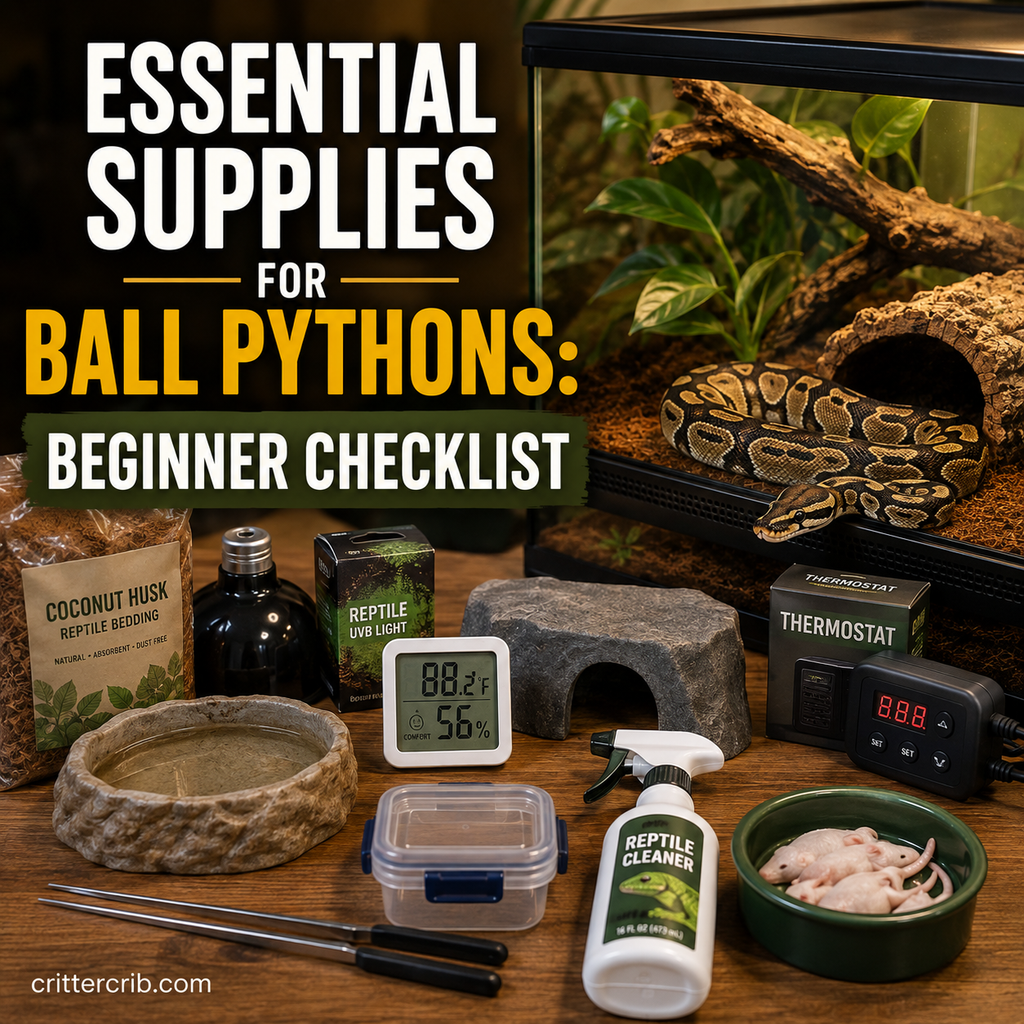
The good news is that ball pythons don’t need an endless collection of accessories. They do, however, need a few essentials that work together properly: a secure enclosure, controlled heat, suitable humidity, hiding places, substrate, water, and reliable equipment for monitoring conditions.
Getting those basics right matters far more than filling the habitat with decorative reptile products.
If you’re preparing for your first ball python, use this checklist to figure out what you actually need, what can wait, and which supplies deserve extra attention.
Ball Python Supplies Checklist
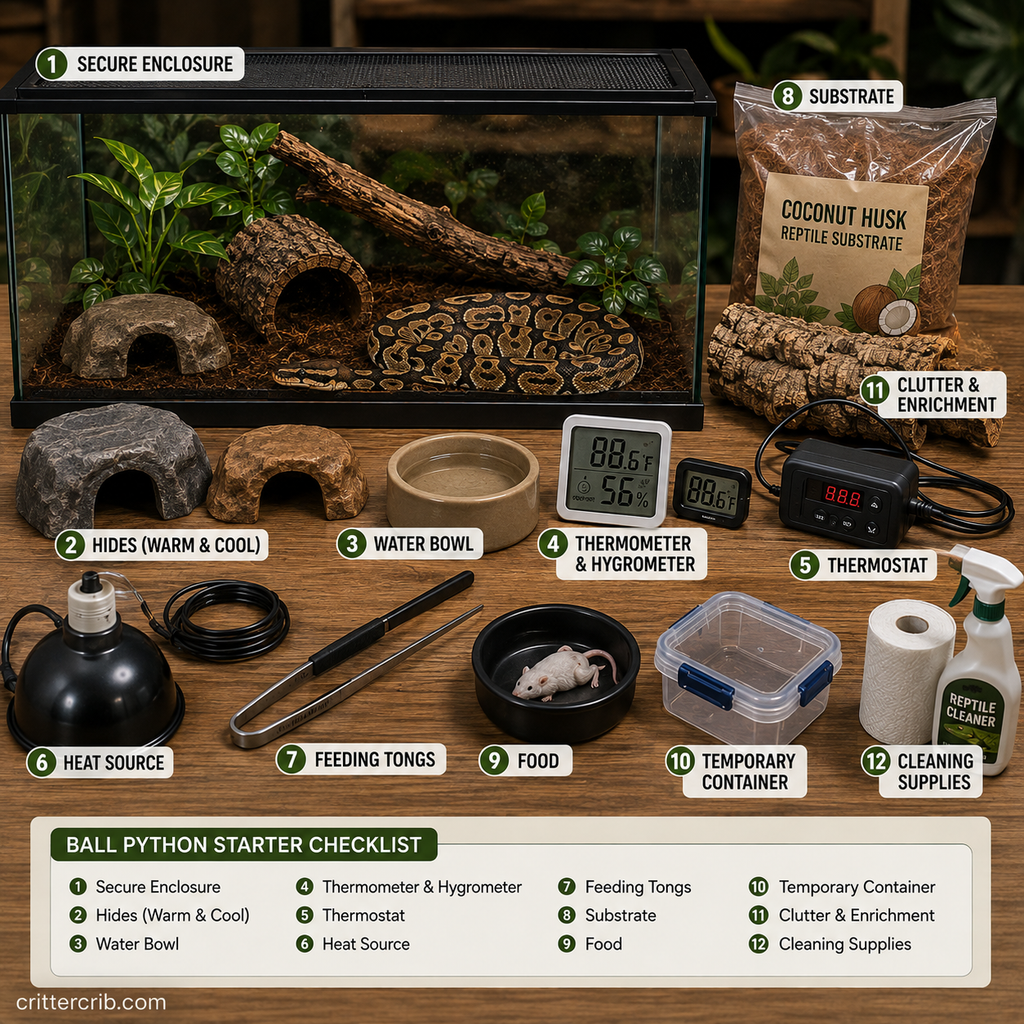
Here’s a quick overview of the essentials you’ll need:
- Appropriately sized, secure enclosure
- Suitable heat source
- Thermostat for controlling heat
- Digital thermometers
- Digital hygrometer
- At least two secure hides
- Appropriate substrate
- Large, stable water bowl
- Lighting as appropriate for your setup
- Clutter and enclosure enrichment
- Feeding tongs
- Food
- Cleaning supplies
- Secure temporary container
- Optional digital kitchen scale
Some of these items are inexpensive. Others, particularly the enclosure and heating equipment, are worth planning for before buying the snake.
Let’s look at each one in more detail.
1. A Secure Ball Python Enclosure
The enclosure is the foundation of your setup.
Ball pythons are strong snakes and surprisingly capable escape artists. Whatever habitat you choose needs to close securely while still providing appropriate ventilation.
For an adult ball python, an enclosure around 4 feet long by 2 feet wide by 2 feet tall is a commonly used target and provides substantially more usable space than smaller traditional setups.
Larger individuals may benefit from additional space.
Young ball pythons can also use larger enclosures when they’re properly furnished with plenty of hides and cover. A big, completely empty habitat can make a snake feel exposed, but the solution is to provide security—not necessarily to keep the animal in a tiny container.
Common Enclosure Types
Ball python enclosures may be made from:
- PVC
- Glass
- Wood designed and sealed for reptile use
- Other reptile-safe materials
PVC enclosures are popular because they can retain heat and humidity effectively.
Glass terrariums can work, but depending on your climate and setup, they may require more attention to humidity and heat retention.
Whatever you choose, prioritize the actual dimensions and functionality rather than relying only on gallon ratings.
2. A Reliable Heat Source
Ball pythons are ectothermic, so they depend on their environment to regulate body temperature.
Your enclosure needs a warmer area and a cooler area rather than one uniform temperature throughout.
Depending on the enclosure, heating options can include appropriately installed overhead heat sources or other reptile heating equipment.
The exact equipment needed depends on factors such as:
- Enclosure material
- Enclosure dimensions
- Room temperature
- Ventilation
- Distance from the heat source
- Whether the heating equipment is mounted internally or externally
The goal isn’t to make the entire enclosure hot.
Your ball python should be able to move between warmer and cooler areas as needed.
3. A Thermostat
If you’re going to spend money on one piece of equipment that beginners sometimes overlook, make it a proper thermostat.
A thermostat regulates the heat source to prevent it from continuously running at full power.
This is different from a thermometer.
A thermometer tells you the temperature.
A thermostat helps control it.
Heating equipment that requires regulation should be connected to an appropriate thermostat. The thermostat probe also needs to be positioned correctly according to the type of heat source and setup you’re using.
Don’t rely on simply choosing a certain wattage and assuming the temperature will be safe.
Room conditions change, and enclosure temperatures can change with them.
4. Digital Thermometers
Even when your heat source is controlled by a thermostat, you still need to monitor the actual temperatures inside the habitat.
Digital thermometers with probes are useful because they can monitor specific areas.
Ideally, you should be able to evaluate both:
- The warm side
- The cool side
This tells you whether you’re maintaining a useful temperature gradient.
Avoid relying exclusively on inexpensive stick-on analog gauges. They can give you a general indication, but digital equipment usually provides much more useful information for managing a reptile enclosure.
5. An Infrared Temperature Gun
An infrared temperature gun isn’t absolutely essential, but it’s one of the most useful additions to a reptile keeper’s toolkit.
It allows you to quickly check surface temperatures in different parts of the enclosure.
For example, you can check:
- The surface beneath a heat source
- The top of a hide
- Branches
- Substrate surfaces
- Different areas of the warm and cool sides
Remember that an infrared thermometer measures surface temperature, not air temperature.
That’s why it works best alongside digital thermometers rather than replacing them.
6. A Digital Hygrometer
Ball pythons need appropriate humidity, so you’ll need a way to measure it.
Guessing based on whether the substrate “looks damp” isn’t very reliable.
A digital hygrometer gives you actual information about enclosure humidity and makes it easier to spot problems before they become significant.
Humidity is affected by:
- Substrate
- Ventilation
- Water bowl placement
- Room humidity
- Heating
- Enclosure material
- Misting or adding water when appropriate
A hygrometer lets you adjust those factors based on measurements rather than guesswork.
7. At Least Two Proper Hides
Ball pythons spend a lot of time hiding.
That’s normal.
At minimum, provide:
- A hide on the warm side
- A hide on the cooler side
Ideally, the hides should be similar enough that your snake doesn’t strongly prefer one simply because it feels more secure.
If the best hide is only available on the warm side, for example, the snake may remain there even when it would otherwise choose a cooler temperature.
What Makes a Good Ball Python Hide?
A good hide should:
- Feel snug
- Have an appropriately sized entrance
- Provide darkness and security
- Be stable
- Be easy to inspect or clean
A hide that’s dramatically oversized and open may not provide the sense of security you’re trying to create.
Many ball pythons prefer being able to touch the sides of a hide when curled inside.
8. Appropriate Substrate
Substrate covers the enclosure floor and can play an important role in humidity management.
Common options used in ball python habitats include moisture-retaining reptile substrates and suitable natural materials.
The best choice depends partly on your enclosure and local environment.
A substrate should be:
- Safe for the snake
- Easy to maintain
- Appropriate for your humidity needs
- Free from harmful chemicals
- Able to support the type of enclosure you’re creating
Avoid strongly aromatic woods and materials that aren’t appropriate for reptile housing.
What About Paper Towels?
Paper towels can be useful temporarily.
They’re especially practical for:
- Quarantine
- Monitoring a new snake
- Monitoring abnormal waste
- Certain medical situations
They’re easy to replace and make it simple to inspect feces and urates.
For permanent housing, many keepers prefer a substrate that offers better humidity management and a more natural environment.
9. A Large, Stable Water Bowl
Your ball python should always have access to fresh drinking water.
Choose a bowl that’s difficult to tip over.
Ball pythons are strong enough to move lightweight enclosure accessories, and a constantly overturned water dish can quickly soak the substrate.
The bowl should be:
- Stable
- Easy to clean
- Large enough for convenient access
- Made from a reptile-safe material
Some ball pythons may occasionally soak.
Clean the bowl whenever it becomes dirty and replace the water regularly.
10. Appropriate Lighting
Ball pythons need a consistent day-night cycle.
If the room doesn’t naturally provide an appropriate light cycle, enclosure lighting can establish one.
Lighting should turn off at night rather than illuminating the enclosure 24 hours a day.
Does a Ball Python Need UVB?
You’ll encounter different recommendations regarding UVB for ball pythons.
Ball pythons can benefit from appropriately provided UVB and opportunities to choose whether they’re exposed to it.
If you use UVB, the setup needs to account for:
- Fixture type
- Bulb output
- Distance from the snake
- Mesh or other barriers
- Enclosure height
- Available shaded areas
Don’t simply buy the strongest UVB bulb available.
Reptile lighting needs to be matched to the enclosure and species.
11. Clutter and Visual Cover
A ball python enclosure shouldn’t look like an empty box containing two hides and a water bowl.
Add cover between major areas of the habitat.
Useful options include:
- Artificial plants
- Live reptile-safe plants
- Cork bark
- Branches
- Additional hides
- Leaf litter
- Other safe enclosure structures
Clutter helps your snake move around without feeling completely exposed.
This becomes particularly important in larger enclosures.
A well-furnished habitat allows the snake to choose between hiding completely and exploring under partial cover.
12. Climbing and Enrichment Items
Ball pythons are often treated as though they never climb.
Given the opportunity, many will.
You can provide sturdy, appropriately sized climbing structures such as:
- Thick branches
- Cork bark
- Platforms
- Secure ledges
Everything needs to support the snake’s weight.
Avoid precariously balanced rocks or branches that could fall.
Enrichment doesn’t need to turn the habitat into an obstacle course. The goal is simply to provide choices and opportunities for natural movement.
13. Ball Python Food
Have an appropriate food source arranged before bringing your snake home.
Ball pythons typically eat appropriately sized rodents.
Frozen-thawed prey is commonly used in captivity because it avoids some of the risks associated with offering live rodents.
The prey size and feeding schedule depend on factors including:
- Snake’s age
- Snake’s weight
- Body condition
- Prey size
- Growth stage
Avoid choosing prey simply because the packaging labels it for a particular age of snake.
Individual ball pythons grow at different rates.
14. Feeding Tongs
A pair of long feeding tongs or hemostats makes feeding easier.
They allow you to offer prey without putting your fingers immediately next to it.
Choose a pair long enough to provide comfortable distance between your hand and the snake.
Use them only for appropriate feeding and husbandry tasks, and keep them clean.
15. A Digital Kitchen Scale
A digital kitchen scale is inexpensive and extremely useful.
Tracking your ball python’s weight can help you:
- Monitor growth
- Select appropriate prey
- Identify unexpected weight changes
- Evaluate feeding patterns
- Keep better health records
Use a secure container on top of the scale, zero the scale, and then place the snake inside.
Recording weight periodically is more informative than trying to judge growth visually.
You don’t need to weigh a healthy adult constantly, but having a baseline is useful.
16. Cleaning Supplies
Keep a small set of supplies specifically for reptile care.
Useful items include:
- Paper towels
- Reptile-appropriate disinfectant
- Cleaning cloths
- Small scrub brush
- Waste scoop
- Spare substrate
- Spare water bowl if desired
Don’t use the same brush you use for household cleaning.
Cleaning equipment dedicated to the enclosure reduces the chance of accidentally introducing inappropriate cleaning products.
Always follow disinfectant instructions for dilution, contact time, rinsing, and drying.
Never mix cleaning chemicals.
17. A Secure Temporary Container
Sooner or later, you’ll need somewhere safe to put your ball python temporarily.
This might happen while:
- Deep cleaning the enclosure
- Rearranging the habitat
- Transporting the snake
- Inspecting equipment
- Performing maintenance
A secure plastic container with appropriate ventilation can work well for temporary use.
Make sure the lid closes securely.
Never underestimate a ball python’s ability to push against a loose lid.
18. A Reptile-Safe Transport Container
For longer transportation, such as a veterinary visit, you’ll want an appropriate secure container.
The exact arrangement depends on weather and travel conditions.
The important priorities are:
- Security
- Appropriate temperature
- Ventilation
- Minimal unnecessary stress
Don’t carry a loose ball python into a veterinary clinic.
Even a normally calm snake can react unpredictably in an unfamiliar environment.
Optional Ball Python Supplies Worth Considering
Once the essentials are covered, a few additional items can make care easier.
Timer
Timers are useful for maintaining consistent lighting schedules.
Rather than manually switching lights on and off every day, you can automate the cycle.
Spare Thermometer or Hygrometer
Monitoring equipment can eventually fail.
Having a backup makes it easier to verify suspicious readings.
Extra Hide
A third hide can provide another option, especially in a larger enclosure.
Humid Hide
A localized humid hide may be useful in some situations, particularly around shedding.
It shouldn’t be used as a substitute for maintaining appropriate overall enclosure conditions.
Reptile Care Log
You can keep notes on your phone, in a spreadsheet, or in a notebook.
Useful information to record includes:
- Feeding dates
- Prey size
- Weight
- Shedding
- Refused meals
- Bowel movements
- Unusual behavior
- Enclosure changes
You may never need most of these records, but they’re extremely helpful when you’re trying to identify a pattern.
Supplies You Don’t Necessarily Need
Reptile stores contain plenty of products that look essential but aren’t.
You don’t need to buy every item marketed for snakes.
Decorative Reptile Products With No Function
Decorations aren’t bad, but prioritize items that provide cover, climbing opportunities, hiding places, or another useful function.
Extremely Small Starter Enclosures
A tiny enclosure that needs to be replaced shortly can end up costing more in the long run.
If possible, consider buying a suitable long-term enclosure and furnishing it appropriately from the beginning.
Heat Rocks
Heated rocks aren’t necessary for creating a proper temperature gradient.
A safely installed, thermostatically controlled heat source is a much better approach.
Nighttime Colored Lights
Ball pythons don’t need bright red, blue, or purple lights shining into the enclosure all night.
Maintain a normal dark period.
Common Beginner Ball Python Setup Mistakes
Buying the right supplies doesn’t guarantee that they’ll be used correctly.
Watch out for these common problems.
Using Heat Without a Thermostat
Heating equipment can become dangerously hot.
Control appropriate heat sources with a thermostat and verify conditions independently.
Using Only One Thermometer
One temperature doesn’t describe the entire habitat.
Monitor both warmer and cooler areas.
Providing Only One Hide
Your snake shouldn’t have to choose between security and thermoregulation.
Provide secure hiding opportunities across the temperature gradient.
Buying an Enclosure and Leaving It Empty
A spacious enclosure needs cover.
Add hides, plants, branches, cork, and other safe structures so the snake can move around without being completely exposed.
Guessing Humidity
Use a digital hygrometer.
Your eyes can’t accurately measure relative humidity.
Buying Everything the Pet Store Recommends
Starter kits can contain useful items, but don’t assume every included product is necessary or appropriate.
Evaluate the enclosure, heating, monitoring equipment, substrate, lighting, and hides individually.
What Should You Buy Before Bringing Your Ball Python Home?
Ideally, everything.
At minimum, have the complete habitat operating before the snake arrives.
That includes:
- Enclosure
- Substrate
- Hides
- Water bowl
- Heat source
- Thermostat
- Thermometers
- Hygrometer
- Lighting if used
- Cover and enrichment
Set the enclosure up and run it before bringing the animal home.
This gives you time to discover problems.
Maybe the warm side isn’t reaching the intended temperature. Maybe humidity drops too quickly. Perhaps the thermostat needs adjustment or the enclosure isn’t retaining heat as expected.
Those problems are much easier to solve before there’s a snake inside.
Ball Python Beginner Shopping Checklist
Before bringing your ball python home, make sure you can check off the following.
Essential Habitat Supplies
- Secure, appropriately sized enclosure
- Suitable substrate
- Warm-side hide
- Cool-side hide
- Stable water bowl
- Clutter and visual cover
- Secure climbing or enrichment structures
Heating and Monitoring
- Appropriate heat source
- Compatible thermostat
- Digital warm-side thermometer
- Digital cool-side thermometer
- Digital hygrometer
- Infrared temperature gun, recommended
Feeding
- Appropriate frozen-thawed prey
- Long feeding tongs
- Digital kitchen scale, recommended
Lighting
- Daytime lighting if needed
- Appropriate UVB setup if provided
- Timer, recommended
Cleaning and Maintenance
- Paper towels
- Reptile-appropriate cleaning product
- Dedicated cleaning brush or cloth
- Waste scoop
- Spare substrate
Handling and Transportation
- Secure temporary holding container
- Safe transportation setup for veterinary visits
Frequently Asked Questions About Ball Python Supplies
What Do I Absolutely Need for a Ball Python?
At minimum, your ball python needs a secure enclosure with appropriate heat, a thermostat, temperature and humidity monitoring, suitable substrate, secure hides, fresh water, appropriate food, and enough cover to feel secure.
Do Ball Pythons Need Two Hides?
Providing at least two secure hides is recommended—one toward the warm side and another toward the cooler side.
This allows the snake to thermoregulate without giving up security.
Do Ball Pythons Need a Heat Lamp?
They need an appropriate heat source, but the specific equipment depends on the enclosure and setup.
Whatever heating method you choose needs to create suitable conditions safely and should be properly controlled.
Do Ball Pythons Need a Heat Mat?
A heat mat isn’t automatically required simply because you’re keeping a ball python.
Heating should be selected based on the enclosure design and the conditions you need to create rather than following a one-size-fits-all equipment list.
Do Ball Pythons Need UVB?
Appropriately provided UVB can be beneficial and can be incorporated into a well-designed ball python habitat. The bulb, fixture, distance, enclosure height, and shaded areas all need to be considered when setting it up.
What Size Enclosure Should I Buy for an Adult Ball Python?
An enclosure around 4 feet long by 2 feet wide by 2 feet tall is a commonly used target for an adult and provides room for temperature zones, hides, cover, and enrichment.
Individual snakes vary in size, so larger animals may benefit from additional space.
Should I Set Up the Enclosure Before Buying the Snake?
Yes.
Ideally, run the complete enclosure beforehand so you can verify temperatures, humidity, heating controls, and equipment operation.
It’s much easier to troubleshoot an empty enclosure than one containing a newly arrived snake.
Final Thoughts
A ball python doesn’t need a mountain of equipment, but the supplies you choose need to work together.
Start with a secure, appropriately sized enclosure. Add controlled heating, accurate temperature and humidity monitoring, multiple snug hides, suitable substrate, fresh water, and enough clutter to give the snake plenty of security.
Then add the practical tools that make long-term care easier: feeding tongs, a digital scale, cleaning supplies, a temporary container, and reliable backup equipment where possible.
Most importantly, don’t wait until the day your ball python comes home to put everything together.
Set up the habitat in advance and let it run. Check temperatures at different times of day. Watch the humidity. Make sure the thermostat is controlling the heat correctly and that the enclosure remains secure.
When your new ball python finally arrives, you can focus on helping it settle in rather than trying to troubleshoot the habitat around it.