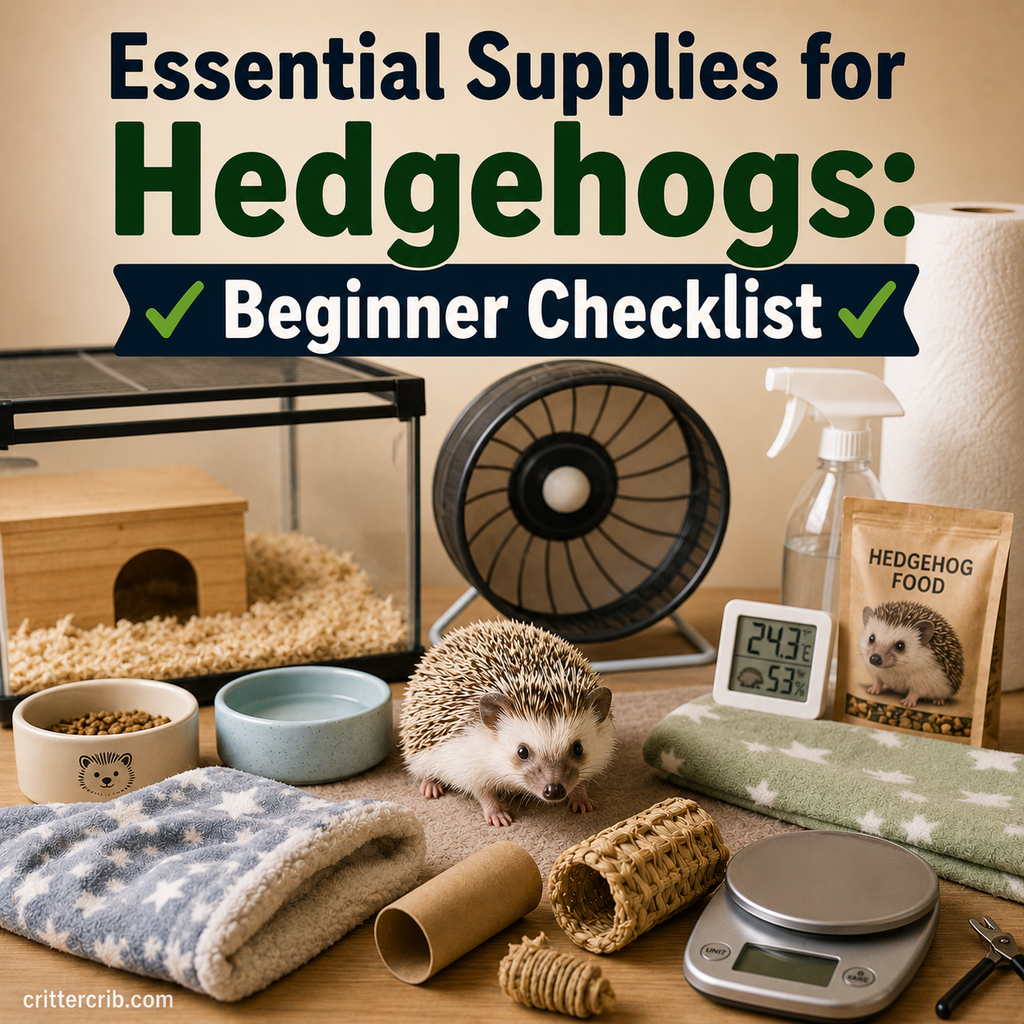
Getting a hedgehog means buying more than a cage, food bowl, and bag of bedding.
Hedgehogs have some fairly specific needs, especially when it comes to temperature, exercise, hiding places, and habitat setup. A product labeled for “small animals” isn’t automatically appropriate for a hedgehog, either. Some accessories are too small, difficult to clean, or simply don’t match the way hedgehogs behave.
The easiest approach is to get the essentials ready before your new pet comes home.
This beginner hedgehog supplies checklist covers what you’ll need for housing, feeding, temperature control, exercise, enrichment, cleaning, transportation, and basic health monitoring. We’ll also look at a few things you can probably leave on the pet-store shelf.
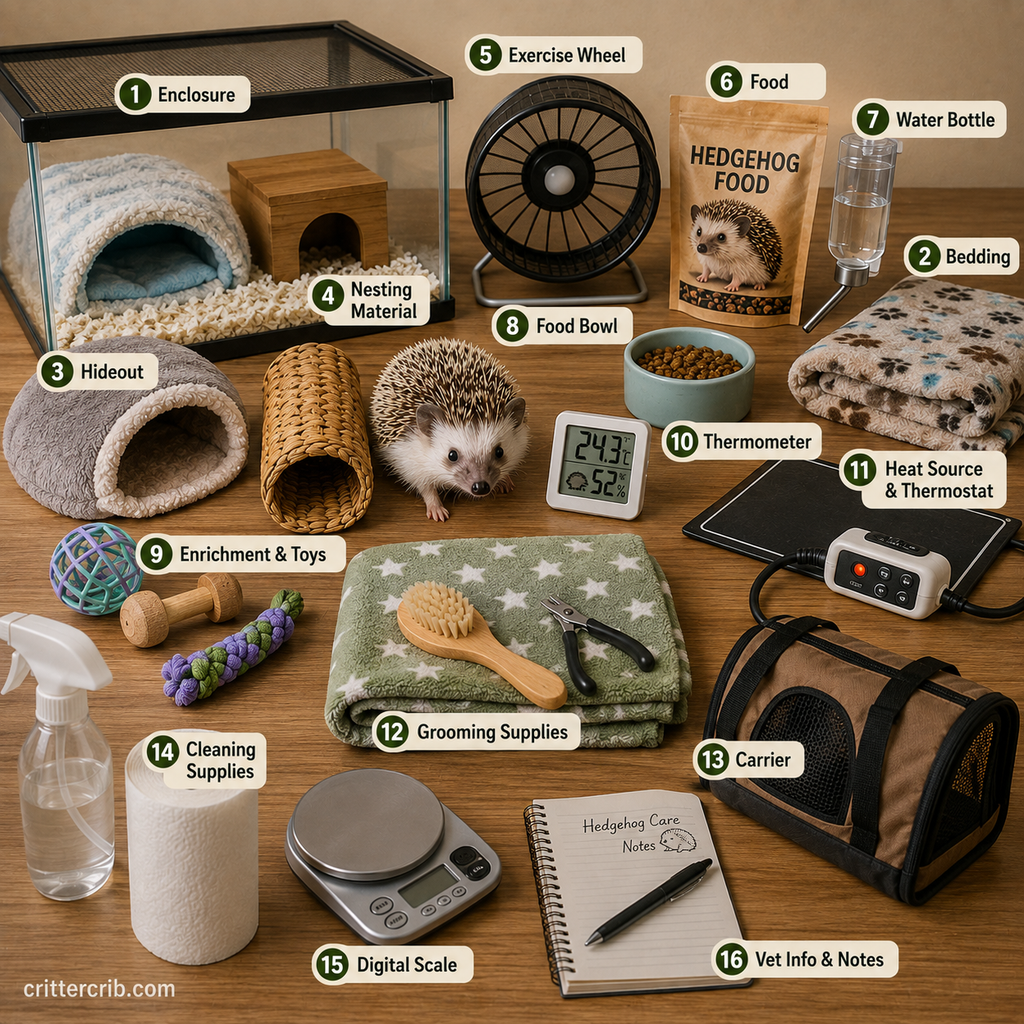
Hedgehog Supplies Checklist at a Glance
Here’s a quick overview of the essentials:
- Spacious, secure enclosure
- Appropriate bedding or liners
- Hideout or sleeping area
- Safe nesting material
- Large solid-surface exercise wheel
- Appropriate hedgehog food
- Food bowl
- Fresh water setup
- Reliable thermometer
- Safe heat source if needed
- Thermostat for heating equipment
- Enrichment items
- Cleaning supplies
- Secure pet carrier
- Small digital scale
- Basic grooming supplies
- Veterinarian contact information
You may eventually add more toys and accessories, but these items create a much better starting point than buying a cart full of random small-animal products.
1. A Spacious Hedgehog Enclosure
Your hedgehog’s habitat is one of the most important purchases you’ll make.
Hedgehogs may spend much of the day sleeping, but they can become surprisingly active after dark. They need room to walk, forage, use their wheel, investigate objects, and move between sleeping, eating, and bathroom areas.
Choose an enclosure that provides generous usable floor space.
Useful features include:
- Secure walls or doors
- Good ventilation
- Solid flooring
- Easy access for cleaning
- Enough room for a large wheel
- Space for a hide and enrichment
- No dangerous gaps
Floor space is more useful to a hedgehog than an extremely tall enclosure designed primarily for climbing animals.
Avoid Wire Flooring
Hedgehogs need a solid walking surface.
Wire floors can create problems for small feet and aren’t necessary for keeping the enclosure clean.
If a cage includes a wire bottom, provide an appropriate solid surface rather than expecting your hedgehog to walk directly on the wire.
2. Safe Bedding or Cage Liners
The bottom of the enclosure needs a comfortable, absorbent surface.
Depending on your setup, you might use:
- Appropriate paper-based bedding
- Suitable loose substrate
- Washable fleece liners
- Another hedgehog-appropriate flooring system
Whatever you choose should be low in dust and easy to keep dry.
Avoid heavily scented bedding.
Strong fragrances don’t make an enclosure healthier, and hedgehogs don’t need their habitat to smell like artificial flowers.
Keep Spare Bedding Ready
Don’t wait until cleaning day to discover you’ve run out.
If you use disposable bedding, keep an extra supply on hand.
If you use washable liners, having at least one spare set makes cleaning much easier. You can rebuild the habitat immediately while the dirty liners are being washed.
3. A Comfortable Hideout
Hedgehogs need somewhere enclosed to sleep during the day.
A hide gives your hedgehog a dark, secure resting place and allows it to retreat when it doesn’t want interaction.
Good options may include:
- Appropriate small-animal hides
- Fabric sleeping sacks
- Fleece pouches
- Safe enclosed shelters
Make sure the hide is large enough for your hedgehog to enter, turn around, and rest comfortably.
Inspect it regularly for damage.
Give Your Hedgehog Privacy
Hedgehogs are often active at night and sleep for long periods during daylight hours.
Place the hide somewhere your hedgehog can rest without being constantly disturbed.
You don’t need to wake your hedgehog every few hours to check whether it’s still cute.
It is.
Let it sleep.
4. Safe Nesting Material
Many hedgehogs enjoy arranging their sleeping area.
You can provide safe nesting material such as appropriate strips or pieces of fleece, depending on your habitat setup.
Avoid fluffy, stringy materials that could wrap around feet or legs.
Inspect fabric regularly for:
- Loose threads
- Holes
- Fraying
- Heavy soiling
Replace anything that becomes unsafe.
5. A Large Solid-Surface Exercise Wheel
A proper wheel is one of the most important pieces of hedgehog equipment.
Hedgehogs can travel surprising distances during their active periods and many will spend a significant amount of time running.
The wheel needs to be large enough for comfortable movement.
Look for:
- Large diameter
- Solid running surface
- Stable construction
- Easy cleaning
- No mesh
- No widely spaced bars
A small hamster wheel isn’t suitable.
Why a Solid Wheel Matters
Feet and toes can potentially become caught in wire or mesh running surfaces.
A continuous solid surface provides safer footing.
You’ll also appreciate a wheel that’s easy to wash because hedgehogs aren’t known for pausing their exercise routine when they need to use the bathroom.
The wheel may become one of the dirtiest objects in the habitat.
6. Appropriate Hedgehog Food
You’ll need a nutritionally appropriate staple diet before your hedgehog comes home.
Diet recommendations can vary depending on the individual animal, age, health, and veterinary advice.
Some hedgehogs are fed an appropriate commercial hedgehog diet, while certain high-quality cat foods may also be used as part of feeding plans under knowledgeable guidance.
Rather than choosing food based solely on the picture on the bag, pay attention to nutritional suitability.
Find Out What Your Hedgehog Currently Eats
If you’re adopting from a breeder, rescue, or previous owner, ask what food the hedgehog is already eating.
A sudden diet change can cause digestive upset.
If you plan to change foods, transition gradually when appropriate.
7. A Stable Food Bowl
A simple food dish is all you need.
Ceramic bowls are popular because they’re:
- Heavy
- Stable
- Easy to clean
- Difficult to tip
Choose something shallow enough for comfortable access.
You don’t need an enormous dish.
The bowl should hold an appropriate portion without taking over half the enclosure.
8. A Reliable Water Setup
Fresh water should always be available.
Some owners use bowls, while others use water bottles.
A heavy water bowl can provide a natural drinking position and is easy to inspect, but it needs to be stable enough that the hedgehog can’t constantly tip it.
Whatever system you choose, check it daily.
Water should be:
- Fresh
- Clean
- Easy to reach
- Free from bedding and waste
If using a bottle, verify that water actually flows.
A full bottle with a blocked drinking mechanism isn’t useful.
9. A Digital Thermometer
This small purchase is extremely important.
Hedgehogs require an appropriate environmental temperature and can be sensitive to conditions that become too cold.
Don’t rely on how the room feels to you.
Use a reliable thermometer near the enclosure.
A digital thermometer makes it easy to monitor the actual temperature throughout the day and night.
Why Temperature Matters So Much
Pet hedgehogs aren’t equipped to go through normal hibernation safely in a household environment.
If they become too cold, they may attempt to enter a hibernation-like state, which can be dangerous.
Temperature control therefore isn’t simply about comfort.
It’s part of basic hedgehog care.
10. A Safe Heat Source
Depending on your home’s climate and temperature stability, you may need supplemental heating.
The goal is to maintain an appropriate, stable environment rather than creating a single extremely hot spot.
Common heating setups may use equipment designed to warm the habitat safely without producing disruptive light throughout the night.
The exact setup depends on your enclosure and room.
Don’t Guess With Heating Equipment
Improperly installed heat sources can create burns, overheating, or fire hazards.
Heating equipment should be appropriately sized and positioned for the enclosure.
Never place a hot device where your hedgehog can directly contact it.
11. A Thermostat
If you’re using a powered heat source, a thermostat is one of the most important pieces of equipment.
A thermostat regulates the heating system based on temperature.
This helps prevent the enclosure from becoming excessively hot.
Don’t confuse a thermostat with a thermometer.
A thermometer tells you the temperature.
A thermostat controls heating equipment.
For many setups, you’ll want both.
12. Backup Temperature Planning
Think about what happens if:
- The heater fails
- The power goes out
- The room suddenly gets colder
- You travel
- The weather changes overnight
Keep a backup thermometer available and have a plan for maintaining a safe environment during an outage or equipment failure.
Don’t wait for a winter power outage to start figuring this out.
13. Hedgehog-Safe Enrichment
A wheel provides exercise, but it shouldn’t be the only interesting object in the habitat.
Hedgehogs benefit from opportunities to explore.
Simple enrichment may include:
- Tunnels
- Safe balls
- Small boxes
- Digging opportunities
- Foraging activities
- Fleece strips
- Safe toys
- Occasional changes to the enclosure
You don’t need to overcrowd the habitat.
Leave enough open floor space for comfortable movement.
14. Tunnels
Tunnels work particularly well for hedgehogs because they provide both exploration and cover.
Choose tunnels wide enough that your hedgehog can’t become stuck.
Good tunnels should be:
- Smooth
- Appropriately sized
- Easy to inspect
- Free from sharp edges
Avoid extremely narrow tubes intended for much smaller animals.
If your hedgehog has to squeeze through it, choose something larger.
15. A Dig Box
Some hedgehogs enjoy digging and rooting through loose materials.
A supervised dig box can provide another form of enrichment.
Use only materials known to be safe for hedgehogs, and make sure the container is easy to enter and exit.
You can occasionally hide appropriate food or treats inside to encourage foraging.
16. Safe Toys
Hedgehogs don’t need dozens of complicated toys.
Simple objects can be surprisingly interesting.
Depending on your hedgehog’s personality, you might try:
- Lightweight balls
- Small plush-free toys designed for pets
- Tubes
- Boxes
- Foraging toys
- Digging activities
Observe how your hedgehog interacts with each object.
Remove anything that’s being damaged or chewed in a potentially unsafe way.
17. A Secure Pet Carrier
Every hedgehog owner should have a carrier before it’s needed.
You’ll use it for:
- Veterinary appointments
- Moving
- Travel
- Emergencies
- Evacuations
Choose a carrier that is secure, ventilated, and easy to clean.
It should have enough room for your hedgehog to sit comfortably without being so large that the animal slides around during transportation.
Depending on weather conditions, you may also need to consider how you’ll maintain an appropriate temperature during travel.
18. Cleaning Supplies
A small dedicated cleaning kit makes habitat maintenance easier.
Useful supplies include:
- Small dustpan and brush
- Paper towels
- Reusable cleaning cloths
- Scrub brush
- Warm water
- Pet-appropriate cleaner
- Spare bedding
- Trash bags
The wheel may need particularly frequent cleaning.
Hedgehogs commonly urinate or defecate while running, so don’t be surprised if a spotless wheel doesn’t remain spotless for very long.
19. A Small Digital Scale
A digital scale that measures small weight changes can be useful for monitoring your hedgehog.
Weight changes may provide an early clue that something isn’t right.
Weigh your hedgehog periodically and record the result.
You’re looking for trends rather than obsessing over tiny fluctuations.
Unexpected weight loss or gain should be considered alongside:
- Appetite
- Activity
- Stool
- Behavior
- Other symptoms
Contact your veterinarian if you’re concerned.
20. Nail-Care Supplies
Hedgehog nails need regular attention.
You’ll want a suitable small pair of nail clippers.
Some owners use small animal clippers, while others find human nail clippers easier to control.
The important thing is being able to see what you’re doing.
You’ll also want:
- Good lighting
- Towel
- Styptic powder or another veterinarian-recommended product for accidental minor nail bleeding
If you’re uncomfortable trimming nails, ask your veterinarian to demonstrate the technique.
21. Bathing Supplies
Hedgehogs don’t need constant full baths.
Frequent bathing can dry the skin.
However, occasional cleaning may be necessary.
Useful supplies include:
- Shallow basin or sink setup
- Soft toothbrush
- Towels
- Veterinarian-approved or hedgehog-appropriate bathing product if needed
Don’t Forget Foot Baths
Hedgehog feet can become dirty from running on a soiled wheel.
A shallow foot bath may be all that’s needed rather than a full bath.
Never leave a hedgehog unattended around water.
22. Soft Towels
Keep a few towels specifically for your hedgehog.
They’re useful for:
- Bathing
- Nail trimming
- Handling
- Carrier setup
- Cleaning emergencies
Choose towels without loose loops or threads that could catch small nails.
Inspect them regularly.
23. A Hedgehog-Proofed Exercise Area
A wheel is excellent exercise, but supervised exploration outside the enclosure can provide additional activity and enrichment.
Prepare the area before bringing your hedgehog out.
Remove access to:
- Electrical cords
- Cleaning products
- Medications
- Small objects
- Houseplants
- Other pets
- Deep gaps beneath furniture
- Stairs
- Open doors
Hedgehogs can squeeze into surprisingly inconvenient spaces.
Block those spaces before your pet discovers them.
24. An Exotic-Pet Veterinarian
This isn’t a product, but it absolutely belongs on the beginner checklist.
Find a veterinarian who treats hedgehogs before you bring one home.
Not every dog-and-cat practice is comfortable treating exotic small mammals.
Save:
- Clinic name
- Phone number
- Address
- Business hours
- Emergency instructions
Also find out where you would go after hours.
You’ll be glad you did this ahead of time if your hedgehog ever becomes sick.
25. A Basic Hedgehog Health Kit
You don’t need to build a miniature veterinary hospital at home.
A simple monitoring kit is enough.
Useful items include:
- Digital scale
- Nail clippers
- Thermometer
- Towels
- Carrier
- Veterinary contact information
Avoid stocking medications or supplements “just in case” unless your veterinarian recommends them.
Many products that are safe for humans or other animals may not be appropriate for a hedgehog.
What Supplies Don’t Hedgehogs Need?
Pet stores sell plenty of products that aren’t necessary—or aren’t appropriate—for hedgehogs.
Small Hamster Wheels
A hedgehog needs a much larger running surface than a hamster.
Choose an appropriately sized solid wheel.
Wire or Mesh Wheels
These can create unnecessary risks for feet and nails.
Use a solid running surface.
Exercise Balls
Enclosed exercise balls aren’t necessary for hedgehog exercise.
A secure, supervised play area gives the animal more control over movement and exploration.
Fluffy Nesting Material
Avoid stringy or cotton-like nesting products that could wrap around feet or legs.
Use safer bedding and nesting materials.
Heavily Scented Bedding
Fragrance doesn’t improve habitat cleanliness.
Choose low-dust, appropriate bedding instead.
Random Vitamin Supplements
Don’t automatically add vitamins, mineral blocks, or supplements because they’re marketed for small pets.
A balanced diet should be the foundation.
Use supplements only when there’s a specific reason and knowledgeable guidance.
Tiny Tubes
Tunnels designed for dwarf hamsters or similarly tiny pets may be too narrow.
Always consider the actual diameter rather than trusting a “small animal” label.
How to Set Up a Hedgehog Habitat
Once you have the supplies, assemble everything before your hedgehog arrives.
A simple setup process looks like this:
- Choose a stable indoor location.
- Set up the enclosure.
- Add appropriate bedding or liners.
- Position the hideout.
- Install the exercise wheel.
- Add food and fresh water.
- Place the thermometer.
- Install and test heating equipment if required.
- Connect the heat source to an appropriate thermostat.
- Add tunnels and a few enrichment items.
- Check for gaps and hazards.
- Monitor the temperature before your hedgehog moves in.
Don’t wait until arrival day to discover the heating system can’t maintain a stable temperature.
Test everything beforehand.
Where Should You Put a Hedgehog Cage?
Choose a room with a relatively stable environment.
Avoid locations directly beside:
- Windows with strong sunlight
- Air-conditioning vents
- Heating vents
- Exterior doors
- Drafty windows
- Loud speakers
The enclosure should be somewhere you can check regularly without constantly disrupting your hedgehog’s daytime sleep.
How Much Do Hedgehog Supplies Cost?
Startup costs vary depending on your enclosure, heating needs, and accessories.
The major initial purchases may include:
- Enclosure
- Exercise wheel
- Heating equipment
- Thermostat
- Thermometer
- Hide
- Carrier
- Food and water equipment
Then you’ll have ongoing expenses such as:
- Food
- Bedding
- Cleaning supplies
- Replacement toys
- Heating electricity
- Veterinary care
Veterinary expenses are especially important to plan for.
Exotic-animal appointments and emergency care can cost significantly more than a bag of food or bedding.
What Should You Buy First?
If you’re building the setup gradually, prioritize items that directly affect health and basic care.
Start with:
- Suitable enclosure
- Temperature monitoring
- Heating equipment if required
- Thermostat
- Appropriate bedding
- Hideout
- Exercise wheel
- Food
- Water setup
- Carrier
Once those essentials are covered, add additional enrichment and convenience items.
A simple habitat that meets your hedgehog’s needs is much better than an elaborate setup missing reliable temperature control.
Complete Beginner Hedgehog Checklist
Before bringing your hedgehog home, run through this final list.
Housing
- Spacious enclosure
- Solid flooring
- Appropriate bedding or liners
- Spare bedding or liners
- Hideout
- Safe nesting material
Temperature
- Digital thermometer
- Safe heat source if necessary
- Thermostat
- Backup temperature plan
Food and Water
- Appropriate staple diet
- Stable food bowl
- Reliable water setup
Exercise and Enrichment
- Large solid exercise wheel
- Tunnels
- Safe toys
- Dig box if desired
- Hedgehog-proofed play area
Grooming
- Nail clippers
- Towels
- Soft toothbrush
- Bathing supplies as needed
Cleaning
- Small brush and dustpan
- Cleaning cloths
- Pet-appropriate cleaner
- Spare bedding
- Wheel-cleaning supplies
Health and Transportation
- Digital scale
- Secure carrier
- Exotic-pet veterinarian
- Emergency veterinary information
If you can check off the essential items before arrival day, you’ll have a much easier time helping your new hedgehog settle in.
Frequently Asked Questions About Hedgehog Supplies
What do I need before getting a hedgehog?
At minimum, prepare a spacious enclosure, appropriate bedding, a hide, large solid exercise wheel, suitable food, fresh water, temperature monitoring, heating equipment if needed, and a secure carrier.
You should also identify a veterinarian who treats hedgehogs.
Do hedgehogs need a heat lamp?
Whether supplemental heating is necessary depends on the room temperature and habitat setup.
If heating equipment is used, it needs to maintain an appropriate stable temperature safely and should be controlled properly.
A veterinarian or experienced exotic-animal professional can help you determine the right setup for your situation.
Do hedgehogs need a thermostat?
If you’re using an active heat source, appropriate temperature control is important.
A thermostat can regulate compatible heating equipment and help prevent dangerous temperature swings.
You should still use a separate thermometer to monitor actual enclosure conditions.
What size wheel does a hedgehog need?
Choose a large wheel designed to allow an adult hedgehog to run comfortably without an excessively curved posture.
The running surface should be solid and easy to clean.
Avoid tiny hamster wheels and wire or mesh surfaces.
Do hedgehogs need bedding?
Yes, the enclosure needs an appropriate floor covering.
Depending on your setup, this may be a safe loose bedding or a suitable washable liner system.
Whichever you choose should remain dry, comfortable, and low in dust.
Do hedgehogs need toys?
Hedgehogs benefit from enrichment, although toys don’t have to be complicated.
Tunnels, digging opportunities, foraging activities, boxes, and other safe objects can encourage exploration.
Do hedgehogs need baths?
Hedgehogs may occasionally need bathing, but frequent full baths can dry the skin.
Sometimes a simple foot bath is enough, particularly after a messy night on the exercise wheel.
Can hedgehogs drink from a bowl?
A stable, shallow water bowl can be used as long as your hedgehog can access it easily and doesn’t repeatedly tip or contaminate it.
Fresh drinking water should always be available.
What is the most important hedgehog supply?
It’s difficult to choose one because housing, food, water, exercise, and temperature all matter.
However, new owners should pay particular attention to temperature monitoring and control.
A hedgehog habitat can have an excellent wheel, beautiful hide, and plenty of toys and still be inappropriate if the environment becomes too cold.
Final Thoughts: Start With the Hedgehog Essentials
Shopping for a new hedgehog can get complicated quickly.
There are cages, wheels, tunnels, treats, beds, toys, supplements, bedding choices, and shelves full of products labeled for small animals.
You don’t need all of them.
Focus first on the supplies that support your hedgehog’s basic needs.
Provide a spacious habitat with solid flooring, a comfortable place to sleep, an appropriately sized exercise wheel, suitable food, fresh water, and reliable temperature monitoring. Add safe enrichment, keep the enclosure clean, and have a secure carrier and veterinarian ready before you need them.
Then see what your individual hedgehog actually enjoys.
One may spend half the night running.
Another may be obsessed with tunnels.
And another may decide the cardboard box you almost threw away is considerably more interesting than the toy you bought.
That’s okay.
The best hedgehog setup isn’t the one with the most accessories.
It’s the one that’s safe, comfortable, easy to maintain, and built around what a hedgehog actually needs.