
Land snails aren’t exactly known for dramatic behavior. They move slowly, spend plenty of time hiding, and can seemingly disappear into their shells for hours.
But once you start keeping snails, you’ll notice there’s actually quite a lot going on.
One night your snail may spend hours exploring every inch of the enclosure. The next day it’s buried beneath the substrate. You might find it hanging upside down from the lid, sitting motionless on the wall, eating something unexpected, or interacting closely with another snail.
Most of these behaviors are perfectly normal.
Learning what common land snail behaviors mean can help you understand when your snail is simply being a snail—and when its behavior might be telling you to check the enclosure more closely.
Understanding Normal Land Snail Behavior
Land snails experience the world very differently from mammals, birds, or even many reptiles.
They’re primarily guided by things such as:
- Moisture
- Temperature
- Light
- Food
- Chemical cues
- Touch
- Reproduction
- Safety
Many land snails are most active during the evening, at night, or after conditions become damp.
During the day, it’s completely normal to see very little activity.
Behavior also varies by species. “Land snail” describes a huge number of terrestrial gastropods living in different environments around the world.
That’s important to remember throughout this guide.
A behavior that’s typical for one species may be less common in another, and appropriate temperature, humidity, diet, and substrate can vary considerably.
Why Is My Land Snail Not Moving?
A motionless snail isn’t automatically a sick snail.
Land snails spend plenty of time resting.
You may find yours attached to:
- Enclosure walls
- The lid
- Cork bark
- Plants
- Branches
- The substrate
- The side of a hide
Sometimes it may remain in the same spot for many hours.
Snails don’t need to be constantly roaming around their enclosure to be healthy.
Before becoming concerned, look at the bigger picture.
Has the snail been active recently? Is it eating? Are enclosure conditions appropriate? Does it become active after dark or following misting?
If so, daytime inactivity may simply be part of its normal routine.
Why Is My Snail More Active at Night?
Nighttime activity is common among many terrestrial snails.
Darkness often brings cooler temperatures and higher humidity, reducing the risk of losing moisture while moving around.
In captivity, you may notice a snail that seems almost inactive all day suddenly begin:
- Exploring
- Climbing
- Eating
- Investigating other snails
- Moving around the enclosure
Try checking the habitat an hour or two after the room becomes dark.
You may discover your “inactive” snail has a surprisingly busy nightlife.
Why Is My Land Snail Climbing the Walls?
Wall climbing is extremely common.
A snail can use its muscular foot and mucus to travel across vertical surfaces and even move upside down.
Climbing doesn’t automatically mean your snail is trying to escape.
It may simply be exploring.
Snails may climb to:
- Explore their surroundings
- Find food
- Rest
- Reach a preferred microclimate
- Interact with another snail
- Find a suitable place to sleep
Occasional climbing is normal.
Persistent behavior becomes more interesting when the snail seems to avoid the substrate completely.
In that case, it’s worth checking whether something about the substrate is unsuitable.
Why Does My Snail Sleep on the Enclosure Lid?
If you’ve carefully created a beautiful naturalistic habitat only to find your snail sleeping upside down on the lid, you’re not alone.
Snails don’t always choose the locations we expect.
The lid may offer:
- A comfortable moisture level
- A secure attachment point
- Less disturbance
- A preferred temperature
- A convenient resting location
Sleeping on the lid isn’t necessarily a problem.
Just be careful when opening the enclosure.
Always check for snails attached to the lid before removing it. Pulling or dropping a snail accidentally could damage its shell.
Why Is My Land Snail Burrowing?
Burrowing is another common land snail behavior.
Depending on species and circumstances, a snail may burrow to:
- Rest
- Regulate moisture
- Escape unfavorable conditions
- Lay eggs
- Prepare for a period of inactivity
- Hide
Some species naturally spend more time beneath the surface than others.
A burrowing snail doesn’t automatically need to be dug up.
In most cases, allow it to emerge on its own.
Is the Substrate Deep Enough?
Regular burrowing is one reason land snails need appropriate substrate depth.
The snail should have enough material to bury itself comfortably.
If you’re keeping an egg-laying species, females may also need sufficient depth to deposit eggs.
The exact depth and substrate composition should be chosen according to the species you’re keeping.
Why Is My Snail Hiding in Its Shell?
Retracting into the shell is one of a land snail’s primary forms of protection.
A snail may retreat because:
- It’s resting
- Conditions are becoming dry
- It has been disturbed
- Something touched it
- It’s stressed
- Temperature is unfavorable
- It’s conserving moisture
Briefly retreating when touched or disturbed is completely normal.
A snail remaining deeply withdrawn for an unusually long time deserves a closer look at environmental conditions.
Check temperature, moisture, food availability, substrate, and the general condition of the enclosure.
Why Is My Snail Sealed Inside Its Shell?
Sometimes a snail doesn’t simply retract. It creates a temporary seal over the shell opening.
This can happen when environmental conditions become unfavorable, particularly when they’re too dry.
Many land snails can form an epiphragm, a mucus-based membrane that helps reduce moisture loss.
This behavior may occur during aestivation or other periods of dormancy.
Don’t immediately peel the seal away.
Instead, investigate why the snail has entered this state.
Check:
- Humidity
- Substrate moisture
- Temperature
- Ventilation
- Species-specific environmental requirements
Correcting inappropriate conditions is more useful than forcibly waking the snail.
What Is Aestivation in Land Snails?
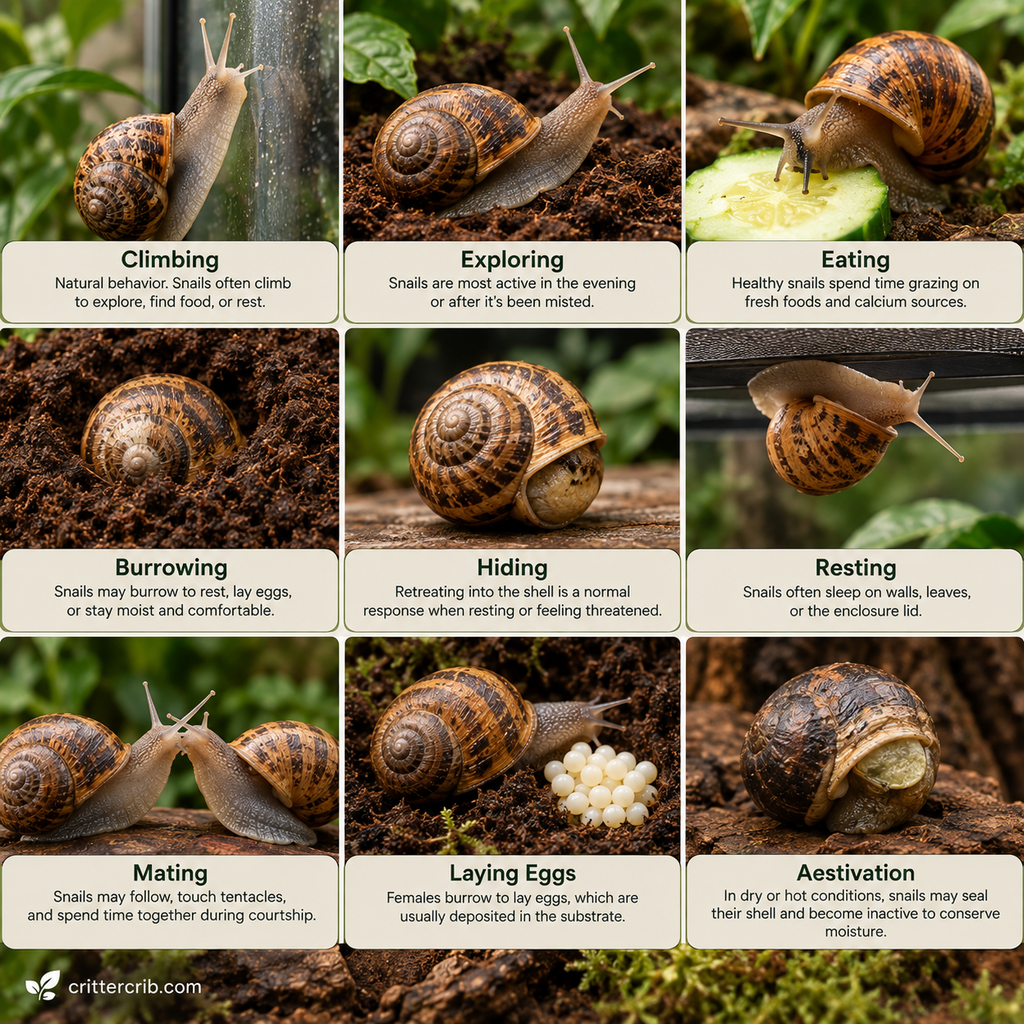
Aestivation is a period of reduced activity that helps some snails survive hot or dry conditions.
The snail may:
- Withdraw deeply into its shell
- Become inactive
- Attach itself to a surface
- Form an epiphragm
- Remain inactive for an extended period
In the wild, this can be an important survival strategy.
In captivity, unexpected aestivation may indicate that the enclosure is too hot, too dry, or otherwise outside the snail’s preferred conditions.
Some species have natural seasonal cycles, so context matters.
Why Does My Snail Become Active After Misting?
If your snail suddenly starts moving shortly after you mist the enclosure, there’s a straightforward explanation.
Moist conditions favor snail activity.
Snails lose moisture while moving across surfaces, so higher humidity and available water make exploration less risky.
You may see increased:
- Feeding
- Climbing
- Exploration
- Social interaction
This doesn’t mean the enclosure should be constantly soaked.
The correct moisture level depends on species, and waterlogged substrate can create its own problems.
Misting should help maintain suitable conditions rather than turn the habitat into a swamp.
Why Is My Snail Eating So Much?
Land snails can spend surprisingly long periods feeding.
Most commonly kept terrestrial snails consume a range of plant material, although exact dietary needs vary by species.
A healthy snail may graze steadily on food for quite some time.
Appetite can also change with:
- Age
- Growth
- Temperature
- Reproductive activity
- Food type
- Recent inactivity
Instead of worrying about how long the snail spends eating, focus on providing an appropriate, varied diet and continuous access to a suitable calcium source.
Why Has My Land Snail Stopped Eating?
A temporary reduction in appetite isn’t automatically an emergency.
A snail may eat less because:
- It’s resting
- Temperature has changed
- Conditions are too dry
- It’s preparing to lay eggs
- It’s entering a dormant state
- Food isn’t appealing
- It’s stressed
Persistent refusal to eat combined with weakness, unusual retraction, shell problems, or other changes deserves more attention.
Start by checking husbandry.
Environmental problems often affect several behaviors at once.
Why Is My Snail Eating Cuttlebone or Calcium?
This is normal and important.
Land snails need calcium to build and maintain their shells.
Many keepers provide a calcium source such as plain cuttlebone continuously so the snail can access it when needed.
You may notice periods when a snail seems particularly interested in calcium.
Growing juveniles and reproductively active snails may have significant calcium demands.
Don’t mix excessive calcium into every food simply to force consumption. Providing a separate appropriate source allows the snail to regulate its intake more naturally.
Why Is My Snail Eating Its Own Shell?
Occasionally you may see a snail appearing to rasp around the edge or surface of its shell.
Some shell grooming can occur.
However, persistent shell rasping or obvious damage deserves attention.
Check whether the snail has access to:
- Appropriate calcium
- Suitable nutrition
- Correct environmental conditions
Also inspect the shell itself for damage.
Don’t assume every instance of the snail touching its shell with its mouth means it’s actively consuming it.
Why Is My Snail Eating Another Snail’s Shell?
Snails may occasionally rasp calcium-containing surfaces, including shells.
If you see repeated shell rasping involving another snail, make sure an appropriate calcium source is readily available.
Also watch the interaction.
What looks like one snail “attacking” another may simply be exploratory or feeding-related behavior.
However, husbandry and species matter. Not all land snails have identical diets or social behavior, and some snail species are predatory.
Know exactly which species you’re keeping.
Why Do Snails Follow Each Other?
Snails leave mucus trails as they travel.
Another snail may move along a similar route while responding to chemical and environmental cues.
Following behavior can also occur during reproductive interactions.
You may see two snails spending considerable time:
- Following one another
- Touching tentacles
- Remaining close together
- Circling
- Crawling over one another
Context is important, especially if both animals are sexually mature.
Why Are My Snails Touching Their Tentacles?
Tentacle contact can be part of normal investigation and reproductive behavior.
A land snail’s upper tentacles generally carry the eyes, while sensory structures help it gather information about its surroundings.
Snails may investigate each other at close range.
You don’t need to separate two compatible snails simply because they’re touching or crawling over one another.
If you’re keeping multiple snails, however, you should understand their reproductive potential.
Are My Land Snails Mating?
Land snail courtship can be surprisingly elaborate.
Depending on species, mating behavior may involve:
- Following
- Tentacle contact
- Circling
- Prolonged physical contact
- Positioning alongside one another
- Extended mating sessions
Many terrestrial snail species are hermaphrodites, meaning an individual has both male and female reproductive organs.
That doesn’t necessarily mean every species reproduces alone. Reproductive biology varies.
If you keep multiple mature snails together, eggs are something you should be prepared to manage.
What Are Love Darts?
Some land snail species use structures commonly called “love darts” during courtship.
Despite the charming name, this isn’t a tiny romantic arrow.
A love dart is a hard, often calcium-based structure used as part of the reproductive process in certain snail groups.
Not all land snails use them.
If your species does, the behavior can look strange if you’ve never encountered it before, but it’s part of normal reproductive biology.
Why Is My Snail Digging Before Laying Eggs?
A snail that’s ready to lay eggs may spend time searching for an appropriate location and burrowing into the substrate.
It may become:
- Restless
- More interested in the substrate
- Less interested in food
- Partially or completely buried
Eventually, eggs may be deposited underground.
This is another reason adequate substrate depth matters.
If you keep sexually mature snails, learn what their eggs look like and check the enclosure appropriately without constantly disturbing the animals.
Why Did I Find Eggs If I Only Have One Snail?
This surprises a lot of new keepers.
There are several possibilities.
Some land snails can retain sperm after previous mating and produce eggs later.
Depending on species, certain snails may also have reproductive strategies that don’t require a recent mating.
That means keeping one snail doesn’t always guarantee you’ll never encounter eggs.
If you don’t intend to raise offspring, research humane and legally appropriate egg-management practices for your particular species and location.
Never release unwanted snails or eggs outdoors.
Why Is My Snail Hanging From Another Snail?
Snails occasionally crawl over each other.
Sometimes that’s simply because another snail happens to be in the way.
Other times, close physical interaction may be associated with courtship or mating.
Brief climbing isn’t necessarily a problem.
However, make sure the enclosure isn’t overcrowded and that all snails have adequate access to food, calcium, hides, and suitable resting areas.
Why Does My Snail Stretch Its Body So Far?
A moving snail can extend its body surprisingly far beyond the shell.
This is normal.
Stretching allows the snail to investigate nearby surfaces before committing to moving its entire body.
You may see it extend across a gap toward:
- A branch
- The enclosure wall
- Food
- Another snail
- A hide
Watching a snail carefully reach for something is one of the more entertaining behaviors you’ll notice once you start paying attention.
Why Are My Snail’s Tentacles Retracting?
Tentacles are sensitive.
A snail may retract them rapidly when they touch an object or encounter a sudden disturbance.
This is a protective reflex.
If you gently approach a snail, you may notice a tentacle retract and then slowly extend again once the animal determines that the immediate disturbance has passed.
Constantly poking the tentacles to make them retract isn’t appropriate handling.
Let the snail investigate at its own pace.
Why Does My Snail Produce So Much Slime?
Mucus is essential to snail movement.
It helps the snail glide across surfaces and can also contribute to protection and moisture management.
Seeing a mucus trail after your snail explores the enclosure is normal.
You may notice more mucus during:
- Active exploration
- Handling
- Reproductive behavior
- Stress or disturbance
An unusually excessive or different-looking secretion alongside abnormal behavior may deserve closer attention.
Why Is My Snail Bubbling or Foaming?
Bubbling or foaming can occur when a land snail is highly stressed or irritated.
This is different from the ordinary mucus trail left during normal movement.
Potential triggers can include:
- Rough handling
- Irritating substances
- Chemical exposure
- Salt exposure
- Other severe disturbances
If this happens, stop handling the snail and investigate what it may have contacted.
Never deliberately expose a pet snail to salt. Salt can cause severe dehydration and tissue damage.
Why Does My Snail Pull Away When I Touch It?
Retreating from touch is a normal defensive response.
A snail doesn’t understand that you’re trying to pet it.
Sudden contact may simply register as a possible threat.
If you need to move your snail, avoid pulling it forcefully from a surface.
Instead, encourage it to crawl onto your hand or another safe object.
A snail attached firmly to glass shouldn’t be yanked away by its shell.
Do Land Snails Like Being Handled?
There’s no good reason to assume a snail enjoys handling in the way a social mammal might.
Handling should generally be kept gentle and limited.
If you need to pick up your snail:
- Wash and thoroughly rinse your hands so they’re free of soap, lotion, salt, and chemical residues.
- Keep your hands damp with suitable water.
- Encourage the snail to crawl onto you.
- Keep it close to a safe surface.
- Return it gently to the enclosure.
Avoid squeezing the shell or dropping the snail.
Observation is usually the safest way to enjoy snail behavior.
Why Does My Snail Keep Trying to Escape?
Snails are excellent climbers and natural explorers.
Finding one near the enclosure lid doesn’t automatically mean something is wrong.
However, persistent attempts to leave the habitat are a good reason to check:
- Temperature
- Humidity
- Substrate condition
- Food
- Ventilation
- Overcrowding
- Irritating materials
Also make sure the lid is secure.
Snails can squeeze through surprisingly small openings.
Ventilation holes should be appropriately sized for the species and age of the snails.
Why Is My Snail Falling From the Wall or Lid?
An occasional loss of grip can happen.
Repeated falling deserves more attention.
Check whether the snail appears weak and whether enclosure surfaces are safe.
Hard rocks and ceramic decorations can turn a minor fall into a shell injury.
Many snail keepers avoid placing hard objects directly beneath areas where snails frequently climb.
Arrange the habitat with falls in mind.
What Does a Healthy Land Snail Usually Do?
There’s no single behavior that proves a snail is healthy.
Instead, look for a collection of normal activities over time.
A healthy snail may regularly:
- Explore
- Climb
- Rest
- Burrow
- Eat
- Use its calcium source
- Extend its tentacles
- Respond to environmental changes
- Become more active after dark
- Retract when disturbed
Your snail doesn’t need to perform all of these behaviors every day.
Patterns are more useful than individual moments.
When Should Land Snail Behavior Concern You?
Some changes deserve closer attention, particularly when several appear together.
Watch for:
- Persistent deep retraction
- Failure to respond normally
- Unusual weakness
- Repeated falling
- Significant shell damage
- Persistent refusal to eat
- Unexpected prolonged dormancy
- Excessive bubbling or foaming
- Unusual odor
- Severe swelling or abnormal body appearance
- Behavior suggesting the enclosure is consistently unsuitable
Start by checking husbandry.
Verify temperature, humidity, ventilation, substrate, diet, calcium, and cleanliness.
If a snail appears seriously injured or unwell, seek advice from a veterinarian or experienced exotic invertebrate professional familiar with terrestrial gastropods when possible.
How to Observe Your Snail’s Behavior
You don’t need to constantly handle your snail to learn its habits.
Observation is much more useful.
Try watching the enclosure:
- Shortly after misting
- In the evening
- After fresh food is added
- After the room becomes dark
You’ll probably see far more activity than you do during the middle of the day.
Keeping simple notes can also help.
Record things such as:
- Feeding
- Long periods of inactivity
- Burrowing
- Egg laying
- Changes in appetite
- Unusual behavior
Over time, you’ll learn what’s normal for your particular snail.
Frequently Asked Questions About Land Snail Behavior
Why Is My Snail Sleeping All Day?
Many land snails are more active at night or during damp conditions.
Daytime resting is often completely normal.
Why Is My Snail Always on the Lid?
The lid may simply be a preferred resting or exploring location.
Check enclosure conditions if the snail consistently avoids the substrate.
Why Is My Snail Buried?
It may be resting, regulating moisture, avoiding unfavorable conditions, or preparing to lay eggs.
Avoid digging it up unnecessarily.
Why Is My Snail Sealed Inside Its Shell?
It may have formed an epiphragm to conserve moisture during unfavorable conditions.
Check humidity, temperature, and species-specific requirements rather than forcibly removing the seal.
Why Does My Snail Come Out After I Mist the Tank?
Moist conditions encourage activity and reduce the risk of dehydration while the snail moves around.
This is normal behavior for many terrestrial snails.
Why Has My Snail Stopped Eating?
Temporary food refusal can happen during rest, environmental changes, reproductive activity, or dormancy.
Persistent appetite loss combined with other unusual signs deserves investigation.
Why Is My Snail Climbing Over Another Snail?
It may simply be exploring, or the interaction could be related to courtship and mating.
Observe the surrounding behavior before drawing conclusions.
Do Snails Recognize Their Owners?
There’s little reason to interpret snail behavior as owner recognition in the same way we would with dogs or other socially complex pets.
Their responses are better understood through sensory cues, food, moisture, touch, and environmental conditions.
Can a Snail Sleep for Several Days?
Some land snails can remain inactive for extended periods, particularly in response to environmental or seasonal conditions.
If the behavior is unusual for your snail, check temperature and moisture levels.
Should I Wake Up an Inactive Snail?
Usually not.
First make sure enclosure conditions are correct. Avoid repeatedly poking, pulling, or forcibly waking a resting or dormant snail.
Final Thoughts on Land Snail Behavior
Land snails may move slowly, but their behavior can tell you quite a lot once you know what you’re looking at.
Climbing walls, sleeping upside down, burrowing, becoming active after misting, retracting when touched, eating calcium, following other snails, and spending the day motionless can all be normal parts of snail life.
The trick is not to overreact to one unusual-looking moment.
Instead, learn the natural behavior of your species and pay attention to patterns. A sudden behavioral change becomes much more meaningful when you already know what your snail normally does.
And remember that many behaviors are closely connected to the environment.
When something seems unusual, check the basics first: moisture, temperature, ventilation, substrate, food, calcium, and enclosure safety.
Give your snail the right conditions and enough time to behave naturally, and you’ll discover that these supposedly simple little animals are much more interesting than they first appear.