

Tiger salamanders don’t get as much attention as colorful tree frogs or unusual-looking axolotls, but they can be fascinating pets in their own right.
They’re large by salamander standards, spend plenty of time burrowing, and can become surprisingly enthusiastic when food appears. Their care is also relatively straightforward once you have the enclosure set up correctly.
So, are tiger salamanders good pets for beginners?
For the right person, yes. Tiger salamanders can be rewarding pets for someone who wants a quiet amphibian to observe rather than an animal to handle frequently. They don’t require an enormous enclosure or complicated lighting, and their feeding routine is manageable.
There are a few catches, though. They need consistently cool, moist conditions, their skin is delicate, and some individuals spend a lot of time underground. They’re also a long-term commitment.
Before bringing one home, here’s what you should know about keeping a tiger salamander as a pet.
What Is a Tiger Salamander?
Tiger salamanders are large, stocky terrestrial salamanders native to North America.
Depending on the species, subspecies, and individual, their markings can vary considerably. Many have dark bodies covered with yellow, olive, or tan spots, blotches, or bars.
Adults can commonly reach around 6–8 inches long, with some individuals growing larger.
Unlike fully aquatic salamanders such as axolotls, adult tiger salamanders spend most of their lives on land. They naturally spend significant amounts of time underground, emerging to feed and during favorable environmental conditions.
That burrowing lifestyle is one of the most important things to understand before keeping one.
Are Tiger Salamanders Good Pets for Beginners?
Tiger salamanders can be good beginner amphibians when the keeper is willing to maintain their habitat properly.
Their basic requirements aren’t especially complicated.
They need:
- A secure enclosure
- Deep, moisture-retaining substrate
- Cool temperatures
- Hiding places
- Clean water
- Appropriate live food
- Regular spot cleaning
- Minimal handling
Once the enclosure is established, daily care is generally manageable.
However, they’re not ideal for someone looking for a pet that’s constantly visible or highly interactive.
Your salamander may disappear into its substrate for long periods.
That’s normal.
If watching an empty-looking patch of soil for part of the day sounds disappointing, a more visible amphibian may suit you better.
Why Tiger Salamanders Can Make Good Pets
Tiger salamanders have several characteristics that make them appealing to amphibian keepers.
They’re Relatively Easy to Feed
Tiger salamanders are enthusiastic carnivores.
Many healthy adults readily accept suitable live prey and quickly learn that movement near the enclosure can mean feeding time.
A varied diet may include appropriately sized:
- Earthworms
- Nightcrawlers
- Crickets
- Dubia roaches
- Other suitable feeder insects and invertebrates
Earthworms and nightcrawlers are particularly useful foods because they can form an important part of a nutritious diet.
Feeder insects should be appropriately gut-loaded, and supplementation may be necessary depending on the overall diet and veterinary or husbandry guidance.
They Don’t Need a Huge Enclosure
Tiger salamanders need enough floor space to move around and enough substrate to burrow, but they don’t require the enormous habitat that some exotic pets do.
For a single adult, an enclosure with roughly 10–20 gallons of usable space can serve as a starting point, with larger floor space preferable when practical.
A longer enclosure is generally more useful than a tall one.
The salamander spends its time on or underneath the ground, so vertical height isn’t the priority.
They’re Quiet
Tiger salamanders aren’t going to disturb your neighbors.
There are no loud calls, barking, or nighttime running wheels.
That can make them suitable for bedrooms, apartments, and home offices, provided the room temperature is appropriate.
They Can Become Familiar With Feeding Routines
A tiger salamander isn’t going to bond with you like a dog.
Still, some individuals become noticeably responsive when their keeper approaches, particularly around feeding time.
You may see your salamander emerge from a burrow or become more alert when the enclosure opens.
That’s probably more about anticipating food than seeking affection, but it can still make them enjoyable animals to care for.
Why Tiger Salamanders Aren’t Right for Everyone
There are also disadvantages.
Understanding them beforehand is much better than discovering them after you’ve purchased the animal.
They Spend a Lot of Time Buried
Tiger salamanders are natural burrowers.
A salamander hiding underground isn’t necessarily stressed or unhappy. It’s behaving like a salamander.
Some individuals are more visible than others, but you shouldn’t expect a pet that’s constantly sitting in the open.
They’re Not Handling Pets
Amphibian skin is delicate and permeable.
Tiger salamanders can absorb substances through their skin, which means oils, lotions, soap residue, sanitizer, and other contaminants on human hands can potentially cause problems.
Handling should therefore be kept to a minimum.
They Need Cool Conditions
Heat is another important consideration.
Tiger salamanders generally prefer cool temperatures and can become stressed when kept too warm.
That may make them more difficult to keep in hot homes or climates without air conditioning.
What Temperature Do Tiger Salamanders Need?
A generally suitable temperature range for many captive tiger salamanders is approximately 60–70°F (16–21°C).
Some variation is normal, and exact requirements can depend on the particular species and animal.
Temperatures consistently climbing into the upper 70s Fahrenheit or beyond can become problematic.
Use a reliable digital thermometer inside the enclosure.
Don’t rely solely on your home’s thermostat because temperatures inside an enclosure can differ from the surrounding room.
Do Tiger Salamanders Need a Heat Lamp?
Usually not.
In many homes, the bigger challenge is preventing the enclosure from becoming too warm.
Intense heat lamps can dry the substrate and create temperatures that are unsuitable for a cool-loving salamander.
If your home remains within an appropriate range, supplemental heating may not be needed at all.
How Humid Should a Tiger Salamander Enclosure Be?
Tiger salamanders need a moist environment, but chasing one exact humidity percentage isn’t always the most useful approach.
Substrate moisture is particularly important.
The substrate should remain consistently damp enough to support burrowing and prevent dehydration without becoming waterlogged.
Think moist soil rather than swamp.
Too little moisture can contribute to dehydration.
Too much moisture combined with poor ventilation can create stagnant conditions and encourage mold or bacterial growth.
The enclosure should balance moisture with adequate airflow.
What Kind of Enclosure Does a Tiger Salamander Need?
Tiger salamanders are terrestrial, so prioritize floor space.
Glass aquariums, appropriately designed terrariums, and secure plastic enclosures can all potentially work when they provide adequate space and ventilation.
The enclosure needs a secure lid.
Salamanders may not look like escape artists, but leaving gaps around lids, cables, or equipment isn’t worth the risk.
Provide Deep Substrate
Substrate is one of the most important parts of the habitat.
Tiger salamanders naturally burrow, so give them enough material to dig into comfortably.
A depth of around 4–6 inches or more can provide useful burrowing opportunities for many adults.
Suitable materials may include:
- Organic topsoil without fertilizers or pesticides
- Coconut fiber
- Appropriate soil-based amphibian mixtures
- Combinations of safe moisture-retaining substrates
Avoid soil containing fertilizers, pesticides, perlite, or other potentially harmful additives.
Avoid Gravel and Unsafe Substrates
Loose gravel can create an ingestion risk, particularly during feeding.
Also avoid substrates that are excessively dusty, sharp, chemically treated, or unable to retain suitable moisture.
The enclosure floor isn’t just decoration.
For a burrowing salamander, it is a major part of the habitat.
Give Your Salamander Places to Hide
Even with deep substrate, provide above-ground hiding options.
Good choices may include:
- Cork bark
- Smooth caves
- Hollow logs designed for terrariums
- Leaf litter
- Pieces of bark
- Amphibian-safe artificial hides
Ideally, provide more than one hiding area.
Your salamander can then choose where it feels most comfortable.
Do Tiger Salamanders Need a Water Dish?
Yes.
Provide a shallow dish of clean, amphibian-safe water.
The dish should be large enough for the salamander to sit in but shallow enough to enter and leave easily.
Tiger salamanders aren’t aquatic adults, so they don’t need a swimming pool.
Change the water regularly and immediately if it becomes contaminated with substrate or waste.
If your tap water contains chlorine or chloramine, treat it appropriately before use.
What Do Tiger Salamanders Eat?
Tiger salamanders are carnivores and generally have excellent appetites.
Their diet should focus on nutritionally appropriate invertebrates.
Good food options may include:
- Earthworms
- Nightcrawlers
- Appropriately sized crickets
- Dubia roaches
- Other suitable feeder invertebrates
Prey should be appropriately sized for the salamander.
A varied diet is generally preferable to relying on one nutritionally limited feeder.
How Often Should You Feed a Tiger Salamander?
Feeding frequency depends on age, body condition, prey size, temperature, and individual metabolism.
Juveniles generally need to eat more frequently than healthy adults.
Many adults can be fed a few times per week rather than every day.
Watch body condition.
A tiger salamander shouldn’t become excessively thin, but overfeeding isn’t healthy either.
Remove uneaten prey rather than leaving insects roaming around the enclosure indefinitely.
Can You Handle a Tiger Salamander?
You can handle a tiger salamander when necessary, but routine handling should be avoided.
If you need to move the animal, clean powder-free gloves moistened with amphibian-safe water are a good option.
Move slowly and support the salamander’s entire body.
Never grab it by:
- The tail
- A leg
- The head
Keep handling brief and close to a safe surface in case the animal suddenly moves.
Afterward, wash your hands thoroughly.
Amphibians can carry microorganisms such as Salmonella even when they appear healthy, so good hygiene protects both you and the salamander.
Do Tiger Salamanders Bite?
Tiger salamanders aren’t generally considered aggressive toward people.
However, they’re enthusiastic feeders.
A hungry salamander may mistake a moving finger for food and lunge at it.
Their bites generally aren’t the primary safety concern with keeping them, but it’s still better to use feeding tongs rather than encouraging the animal to associate your fingers directly with prey.
Wash any accidental bite or scratch thoroughly.
Can Tiger Salamanders Live Together?
For beginners, keeping one tiger salamander is usually simplest.
Housing multiple salamanders together can introduce problems involving:
- Competition for food
- Stress
- Size differences
- Accidental biting during feeding
- Increased waste
- Disease transmission
If multiple animals are housed together, they need considerably more space and careful monitoring.
Animals that differ substantially in size shouldn’t be casually housed together.
A species-only enclosure also avoids the complications associated with mixing salamanders with unrelated amphibians or reptiles.
How Often Do You Clean a Tiger Salamander Enclosure?
Tiger salamander enclosures benefit from regular spot cleaning rather than constant complete teardown.
Routine maintenance includes:
- Removing feces
- Removing uneaten food
- Replacing dirty water
- Cleaning the water dish
- Checking for mold
- Removing spoiled organic material
- Monitoring substrate moisture
- Checking temperature
How often you completely replace substrate depends on the enclosure design, substrate type, animal, and whether you’re using a conventional or bioactive setup.
Avoid unnecessarily disturbing the entire habitat every few days.
A salamander that has created a comfortable burrow doesn’t benefit from having its home constantly dismantled.
How Long Do Tiger Salamanders Live?
Tiger salamanders are a long-term commitment.
With appropriate care, they can live for 10 years or more, and some captive individuals may live considerably longer.
That’s important to consider before buying one.
A salamander purchased today may still be with you many years from now.
Think about future housing, moving, travel, veterinary care, and whether you’re prepared to maintain the enclosure over the long term.
How Much Does It Cost to Keep a Tiger Salamander?
The animal itself is only part of the expense.
Initial costs may include:
- Enclosure
- Secure lid
- Substrate
- Hides
- Water dish
- Thermometer
- Water conditioner
- Feeding tongs
- Decorations
- Food and supplements
Ongoing expenses include feeder animals, substrate replacement, water treatment, and veterinary care when necessary.
Tiger salamanders don’t generally require extremely expensive equipment, but you should still price the complete habitat before purchasing the animal.
If your home is too warm, keeping the enclosure cool may also increase costs.
Do Tiger Salamanders Need Special Veterinary Care?
It’s a good idea to locate a veterinarian experienced with amphibians or exotic pets before an emergency occurs.
Not every veterinary clinic treats salamanders.
Potential signs that deserve attention include:
- Persistent refusal to eat
- Significant weight loss
- Unusual swelling
- Skin sores or discoloration
- Difficulty moving
- Abnormal posture
- Severe lethargy
- Persistent bloating
- Injuries
- Unusual shedding or skin changes
Environmental problems can sometimes contribute to health issues, so check temperature, moisture, cleanliness, and water quality whenever something seems wrong.
Are Tiger Salamanders Legal to Keep?
This is something you should verify before buying one.
Tiger salamanders are native to North America, and regulations regarding the collection, possession, sale, or transportation of native amphibians can vary by species and location.
Some areas may restrict wild collection even if captive ownership is permitted under certain circumstances.
Always check current state, provincial, and local regulations.
If you’re purchasing an animal, a reputable captive breeder is generally preferable to removing a salamander from the wild.
Never release a captive salamander into the wild.
Where Should You Get a Tiger Salamander?
Look for a reputable captive breeder or responsible seller whenever possible.
Ask questions before purchasing.
Find out:
- What species or subspecies is it?
- Was it captive-bred?
- How old is it?
- What is it currently eating?
- How often is it fed?
- What temperature is it currently kept at?
- What substrate is it accustomed to?
- Has it experienced any recent health problems?
Be cautious if a seller can’t identify the salamander or provide basic information about its care.
Knowing the exact animal you’re getting makes it much easier to provide appropriate husbandry.
Common Beginner Mistakes With Tiger Salamanders
Tiger salamanders aren’t especially difficult to care for, but several mistakes can cause unnecessary problems.
Avoid:
- Keeping the enclosure too warm
- Allowing the substrate to dry completely
- Keeping the substrate waterlogged
- Using unsafe soil containing fertilizers or pesticides
- Providing substrate that’s too shallow for burrowing
- Handling the salamander frequently
- Using untreated chlorinated water
- Leaving uneaten insects in the enclosure
- Overfeeding
- Providing no hiding places
- Housing incompatible animals together
- Assuming a buried salamander is sick
- Collecting wild salamanders without checking local laws
Most good tiger salamander care comes down to providing the right environment and then resisting the urge to interfere with it constantly.
Pros and Cons of Tiger Salamanders as Pets
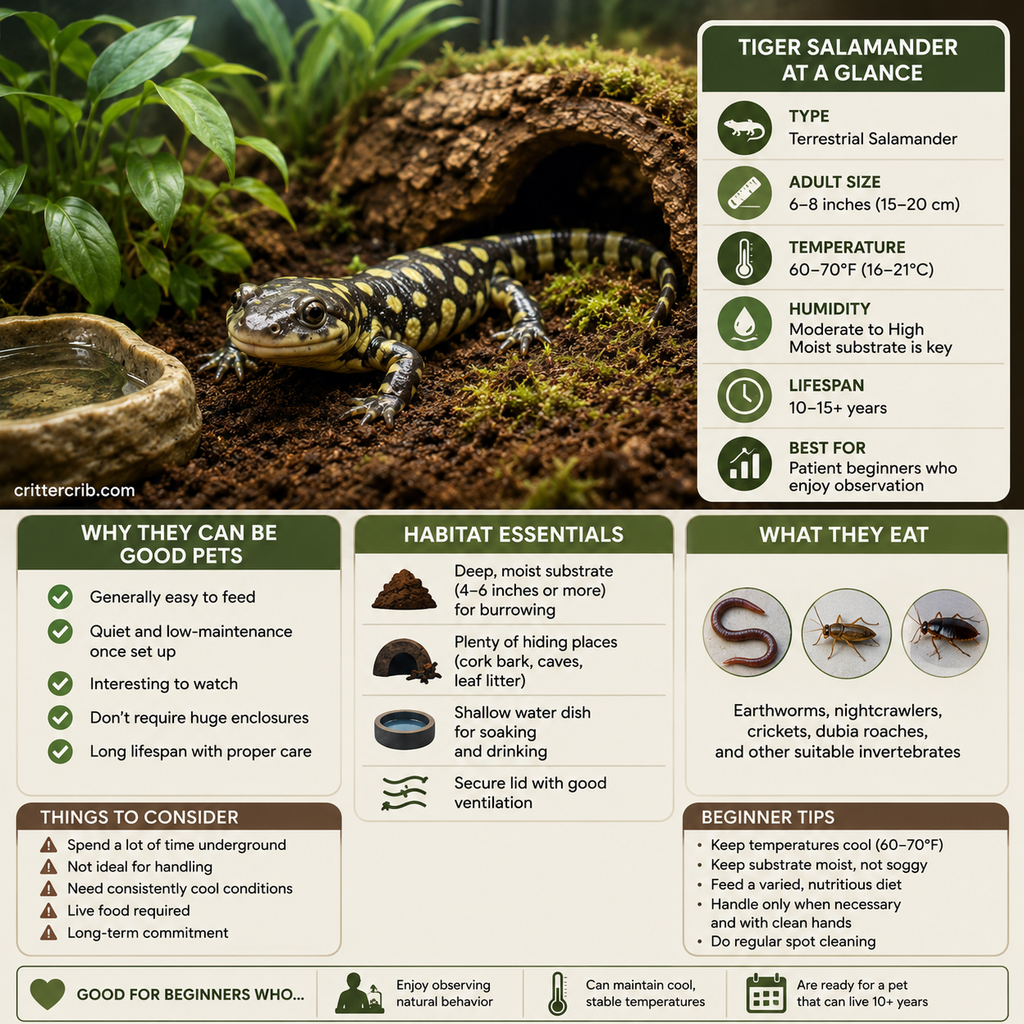
Tiger salamanders can be excellent pets, but they’re best suited to a particular kind of keeper.
Pros
- Relatively straightforward habitat requirements
- Generally enthusiastic eaters
- Quiet
- Don’t require a huge enclosure
- Fascinating natural behavior
- Attractive markings
- No need for daily social interaction
- Long lifespan with proper care
Cons
- Spend significant time underground
- Not suitable for frequent handling
- Need consistently cool conditions
- Require live or appropriate feeder prey
- Exotic veterinary care may be difficult to find
- Can live for well over a decade
- Native wildlife regulations may affect ownership
- Need careful moisture management
Is a Tiger Salamander Right for You?
A tiger salamander may be a good choice if you enjoy observing natural amphibian behavior and don’t mind keeping a pet that sometimes disappears underground.
You should be comfortable maintaining cool temperatures, moist substrate, and a supply of appropriate feeder animals.
Before getting one, ask yourself:
- Can I keep the enclosure cool throughout the year?
- Am I comfortable feeding worms and insects?
- Can I provide several inches of safe burrowing substrate?
- Am I okay with a pet that may hide for long periods?
- Do I understand that handling should be minimal?
- Can I care for the animal for 10 years or potentially much longer?
- Do I have access to an exotic veterinarian?
- Is the species legal to own where I live?
If those requirements fit your lifestyle, a tiger salamander can be a very manageable and interesting amphibian to keep.
Final Thoughts
So, are tiger salamanders good pets?
For many beginner amphibian keepers, they can be.
They’re quiet, generally straightforward to feed, don’t require an enormous enclosure, and can display some surprisingly entertaining behavior around feeding time.
But they’re not miniature lizards or cuddly pets.
A healthy tiger salamander may spend hours—or longer—hidden beneath the substrate. It doesn’t need frequent handling or constant interaction. What it needs is a cool, moist, secure enclosure where it can burrow, hide, eat, and behave naturally.
If you’re looking for an amphibian you can observe and care for without expecting a traditional pet-owner relationship, a tiger salamander can be a rewarding choice.
Set up the habitat correctly, keep temperatures cool, maintain appropriate moisture, provide a nutritious diet, and let the salamander spend plenty of time doing what tiger salamanders do best: disappearing underground until dinner arrives.