
Corydoras catfish—usually called corys or cory cats—are some of the most likable little fish you can add to a freshwater aquarium. They’re peaceful, social, constantly investigating the bottom of the tank, and often look like they’re busy with some very important underwater project.
They’re also commonly described as “cleanup fish.”
That’s only partly true.
Corydoras will search the substrate for edible bits, but they aren’t aquarium vacuum cleaners and shouldn’t be expected to survive on leftovers. They need their own food, suitable water conditions, compatible tank mates, and—most importantly—the company of other Corydoras.
For most commonly kept species, good Corydoras care means keeping a group of at least six of the same species when possible, providing smooth sand or fine rounded substrate, maintaining clean and stable water, and feeding a varied diet of quality sinking foods.
This complete Corydoras care guide covers everything you need to know before bringing these entertaining bottom dwellers home.
What Are Corydoras?
Corydoras are small freshwater catfish native to South America.
There are many species in the genus, ranging from tiny dwarf corys to larger varieties. Several have been popular aquarium fish for decades.
Commonly kept Corydoras include:
- Bronze cory
- Albino cory
- Peppered cory
- Panda cory
- Sterbai cory
- Pygmy cory
- Julii-type corys
Different species vary in adult size, appearance, preferred temperature, and other details, so identifying your fish matters.
The general care principles are similar, but you should still research the specific Corydoras you’re planning to keep.
Are Corydoras Good for Beginners?
Corydoras can be excellent fish for beginners who are willing to provide the right setup.
They’re generally:
- Peaceful
- Social
- Active
- Compatible with many community fish
- Relatively straightforward to feed
- Entertaining to watch
The biggest beginner mistakes usually come from misunderstanding what corys need.
A single Corydoras in a tiny aquarium isn’t an appropriate setup simply because the fish itself is small.
They need a group, sufficient bottom space, suitable substrate, stable water conditions, and dedicated feeding.
Get those fundamentals right and they’re much easier to care for.
How Big Do Corydoras Get?
Adult size depends heavily on species.
Many popular Corydoras reach approximately 2 to 3 inches long, although some remain smaller and others can grow larger.
Pygmy corys are among the smallest commonly available varieties and typically stay around an inch in length.
Bronze, peppered, panda, and Sterbai corys generally grow larger.
Don’t choose aquarium size based on the dimensions of a juvenile fish at the store.
Research its expected adult size first.
How Long Do Corydoras Live?
With good care, many Corydoras can live for around 5 years or longer, and some individuals may live considerably longer under favorable conditions.
Their longevity makes them more of a commitment than they may initially appear.
Water quality, diet, genetics, stress, tank mates, and long-term stability can all influence lifespan.
How Many Corydoras Should Be Kept Together?
Corydoras are social fish.
Keeping just one or two may prevent you from seeing their normal group behavior.
A good target is at least six Corydoras of the same species, assuming your aquarium has enough space.
Larger groups can be even more interesting.
You may see them:
- Foraging together
- Resting near one another
- Following each other around the aquarium
- Exploring as a group
- Becoming more confident in open areas
Different Corydoras species may interact, but keeping several of the same species is generally preferable to creating a collection of unrelated single fish.
Six panda corys, for example, make a more appropriate social group than one panda, one bronze, one peppered, one Sterbai, and two unrelated species.
What Size Tank Do Corydoras Need?
Tank size depends on the species and number of fish.
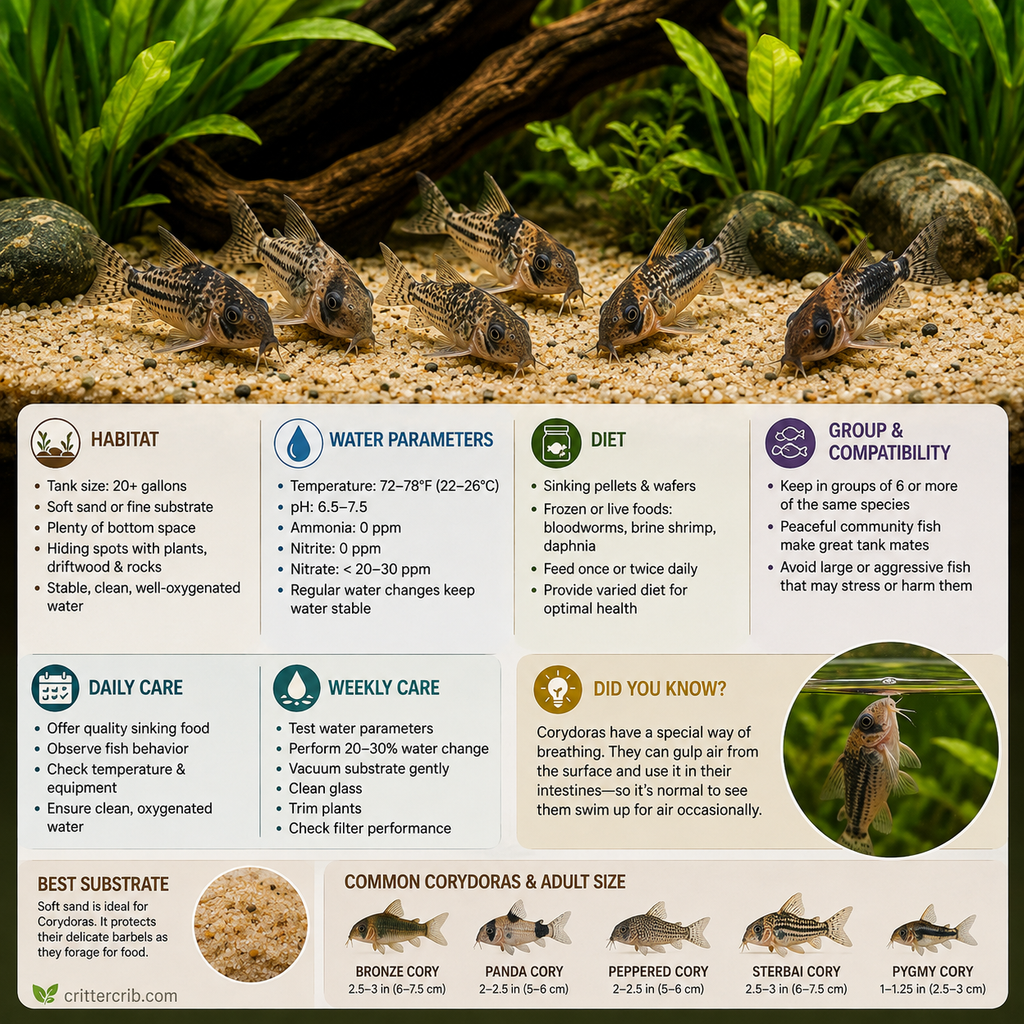
For a typical group of medium-sized Corydoras, a 20-gallon long aquarium is an excellent starting point.
The “long” part is useful because Corydoras spend so much time near the bottom.
A tank with a large horizontal footprint provides more usable foraging and swimming space than a tall, narrow aquarium of similar volume.
Smaller species such as pygmy corys may work in smaller carefully planned aquariums, while larger groups or larger species need more room.
Consider:
- Adult fish size
- Number of Corydoras
- Bottom footprint
- Other tank inhabitants
- Filtration
- Aquascaping
Don’t choose a tank based only on gallons.
Best Substrate for Corydoras
Substrate matters more for Corydoras than it does for many midwater fish.
Corys spend a large part of the day searching along the bottom with their sensitive barbels.
Fine aquarium sand is an excellent option.
You can also use smooth, fine gravel if it doesn’t contain sharp or abrasive pieces.
Avoid rough substrate that could damage delicate barbels or skin.
Does Sand Cause Corydoras Problems?
Aquarium-safe sand is generally well suited to Corydoras.
You’ll often see them push their snouts into it while searching for food and then release tiny clouds of sand through their gills.
It’s one of their most interesting natural behaviors.
Maintain the substrate properly so excessive waste doesn’t accumulate.
Corydoras Tank Setup
If you’re putting together your first tank, our essential Corydoras supplies checklist covers the aquarium, filtration, smooth substrate, water-testing equipment, sinking foods, maintenance supplies, and other basics you’ll want before bringing your fish home.
Consider including:
- Fine sand or smooth substrate
- Live plants
- Driftwood
- Smooth rocks
- Shaded areas
- Open foraging space
Arrange decorations so the fish can move comfortably along the bottom.
Corys often appreciate resting under wood, broad plant leaves, and shaded areas.
At the same time, don’t cover every inch of substrate.
Leave plenty of open space for group foraging.
Do Corydoras Need Live Plants?
Live plants aren’t strictly required, but they’re a great addition.
Plants provide:
- Cover
- Shaded resting areas
- Visual barriers
- Additional surfaces for biological activity
- A more natural-looking environment
Easy freshwater plants can work well in a Corydoras aquarium.
Depending on your lighting and substrate, possibilities include:
- Anubias
- Java fern
- Amazon swords
- Cryptocoryne
- Floating plants
Choose plants compatible with your particular aquarium conditions.
Water Parameters for Corydoras
Exact requirements depend on species.
Many commonly kept Corydoras do well in typical tropical freshwater conditions, but you shouldn’t assume every species prefers exactly the same temperature or water chemistry.
As a general starting point, many species can be maintained around:
- Temperature: approximately 72–78°F (22–26°C)
- pH: roughly 6.5–7.5
- Ammonia: 0 ppm
- Nitrite: 0 ppm
- Nitrate: kept controlled through maintenance
Some species prefer warmer or cooler conditions.
Sterbai corys, for example, are often chosen for warmer community aquariums.
Research the exact species before deciding on a temperature.
Stable conditions are usually more important than constantly adjusting the water to hit one supposedly perfect number.
Corydoras Need a Cycled Aquarium
Corydoras should be added to a properly established aquarium.
The nitrogen cycle allows beneficial bacteria to process toxic waste.
In simplified form:
- Fish waste produces ammonia.
- Beneficial bacteria convert ammonia into nitrite.
- Other bacteria convert nitrite into nitrate.
- Regular water changes help control nitrate accumulation.
In an established aquarium, ammonia and nitrite should generally remain at 0 ppm.
Corydoras spend much of their time near the substrate, where waste can accumulate, making good maintenance particularly important.
Filtration and Water Movement
Corydoras benefit from good filtration and oxygenated water.
Suitable filters may include:
- Sponge filters
- Hang-on-back filters
- Canister filters
- Internal filters
Choose filtration appropriate for the aquarium’s size and stocking level.
You want enough circulation to maintain good water quality without creating an exhausting current across the entire tank.
Moderate water movement is generally fine.
Providing some surface agitation also promotes gas exchange.
Why Do Corydoras Swim to the Surface?
Corydoras occasionally dart to the surface, take a gulp of air, and return to the bottom.
This can be completely normal.
Corydoras are capable of intestinal air breathing, allowing them to use swallowed atmospheric air.
An occasional surface dash isn’t automatically a sign that something is wrong.
However, if every cory is repeatedly rushing to the surface far more than usual, investigate the aquarium.
Check:
- Ammonia
- Nitrite
- Temperature
- Oxygenation
- Filter operation
- Recent changes
A sudden change in behavior is more meaningful than an occasional normal surface visit.
What Do Corydoras Eat?
Corydoras are omnivorous bottom feeders.
They need a balanced diet rather than whatever happens to fall past the other fish.
Good foods can include:
- Quality sinking pellets
- Bottom-feeder tablets
- Appropriate wafers
- Frozen bloodworms
- Brine shrimp
- Daphnia
- Other suitable protein-rich foods
Variety helps provide balanced nutrition.
Rotate between a quality staple food and appropriate supplemental foods rather than relying on one product exclusively.
Corydoras Are Not Algae Eaters
This misconception is worth addressing directly.
Corydoras aren’t primarily algae-eating fish.
If you purchase corys expecting them to scrub algae from the glass, you’ll probably be disappointed.
They may investigate almost everything in the aquarium, but that doesn’t mean algae provides adequate nutrition.
If algae control is your goal, address:
- Lighting duration
- Excess nutrients
- Maintenance
- Plant health
- Feeding
Don’t make a Corydoras responsible for a job it wasn’t designed to do.
Corydoras Are Not Cleanup Crews
Corys will happily find pieces of food that reach the bottom.
That’s useful.
But leftovers shouldn’t be their entire diet.
A Corydoras living beneath well-fed community fish can still be underfed if very little nutritious food reaches the substrate.
Feed them intentionally.
Use sinking foods and observe whether the entire group gets access.
How Often Should You Feed Corydoras?
Most adult Corydoras can be fed once or twice per day in appropriate portions.
The exact amount depends on:
- Number of fish
- Size of fish
- Food type
- Other tank inhabitants
- Natural foods available
Feed enough that the group gets a reasonable meal without leaving large amounts of food decomposing in the substrate.
If food consistently remains long after feeding, reduce the amount.
When Should You Feed Corydoras?
Corydoras may become particularly active around feeding time and during lower-light periods.
If fast community fish consume most food before it reaches the bottom, try:
- Sinking foods
- Feeding in multiple areas
- Feeding corys after other fish receive food
- Offering some food when aquarium lights are dimmer
Watch what happens rather than assuming food eventually reaches them.
Can Corydoras Live With Other Fish?
Yes. Their peaceful temperament makes them popular community fish.
Potential tank mates include many peaceful species with compatible environmental requirements, such as:
- Tetras
- Rasboras
- Guppies
- Platies
- Peaceful gouramis
- Other suitable community fish
Compatibility isn’t just about aggression.
Make sure every species shares compatible:
- Temperature requirements
- Water chemistry
- Aquarium size
- Feeding needs
Avoid large predatory fish capable of swallowing or injuring Corydoras.
Can Corydoras Live With Bettas?
Sometimes.
A peaceful betta may coexist with Corydoras in an appropriately sized aquarium.
The advantage is that the fish occupy somewhat different areas.
But individual bettas vary enormously in temperament.
Some ignore corys completely. Others may chase or harass them.
You’ll also need a tank large enough for a proper Corydoras group, which usually means choosing the aquarium around the corys rather than simply adding them to a small betta tank.
Have a backup plan whenever combining fish with uncertain compatibility.
Can Corydoras Live With Shrimp?
Corydoras can often coexist with adult freshwater shrimp.
Very small baby shrimp may be eaten opportunistically if a cory happens to find them.
Dense plants, moss, and hiding areas can improve shrimplet survival.
If maximizing shrimp reproduction is your main goal, a shrimp-only aquarium is generally safer.
Daily Corydoras Care
Once the aquarium is established, daily care is fairly straightforward.
Feed Appropriately
Provide suitable sinking foods and watch to make sure the entire group eats.
Observe the Fish
Spend a few minutes looking at your corys.
Watch for:
- Normal swimming
- Foraging
- Social behavior
- Breathing
- Fin condition
- Barbel condition
- Unusual spots or wounds
You’ll recognize problems much faster once you know what normal behavior looks like.
Check Equipment
Make sure:
- Filter is running
- Heater is functioning
- Temperature is appropriate
- Air pump is operating if used
This takes less than a minute.
Weekly Corydoras Care
Weekly maintenance helps keep conditions stable.
For a more detailed maintenance routine, our guide to cleaning a Corydoras habitat safely covers water changes, substrate cleaning, filter care, water testing, and maintaining the tank without disrupting its biological stability.
A typical routine may include:
- Test aquarium water.
- Perform an appropriate partial water change.
- Remove accumulated waste from the substrate.
- Clean excessive algae from viewing panels.
- Trim plants when needed.
- Check filter flow.
- Inspect equipment.
- Observe the fish during and after maintenance.
The exact water-change percentage depends on your aquarium’s stocking and test results.
Many community tanks use approximately 20% to 30% weekly as a starting point, but heavily stocked aquariums may need more.
Let water quality guide your routine.
How to Clean Corydoras Substrate
Good substrate maintenance is particularly important because corys spend so much time on the bottom.
With gravel, use an aquarium siphon to remove trapped debris.
With sand, hover the siphon just above the surface so waste is removed without sucking out large quantities of sand.
You don’t need to sterilize the substrate.
The goal is removing excessive organic waste while preserving the aquarium’s biological stability.
Barbel Health in Corydoras
Those whisker-like structures around a Corydoras’ mouth are called barbels.
Corys use them while investigating the substrate for food.
Healthy barbels should appear intact rather than severely eroded.
Problems can be associated with:
- Poor water quality
- Dirty substrate
- Abrasive surfaces
- Injury
- Infection
Smooth substrate helps, but substrate texture isn’t the only factor.
Clean water and good overall aquarium hygiene are just as important.
Signs of a Healthy Corydoras
Healthy corys are usually active and curious. Our guide to signs that your Corydoras are happy and comfortable takes a closer look at normal foraging, appetite, social behavior, resting, breathing, and other behaviors that can help you judge how well your fish are adjusting.
Good signs include:
- Regular foraging
- Normal social interaction
- Healthy appetite
- Intact fins
- Clear eyes
- Healthy barbels
- Smooth swimming
- Occasional normal surface dashes
Corydoras also rest.
Seeing several sitting motionless on the bottom isn’t automatically concerning, especially if they become active again later.
Signs a Corydoras May Be Sick or Stressed
Watch for significant changes such as:
- Refusing food
- Isolation from the group
- Persistent rapid breathing
- Constant surface gasping
- Clamped fins
- White spots
- Red or inflamed areas
- Severe barbel erosion
- Loss of balance
- Unusual swelling
- Sudden lethargy
Test water parameters whenever fish behavior changes unexpectedly.
Water quality is one of the first things worth ruling out.
If illness is suspected, identify the likely problem before adding medication.
Common Corydoras Care Mistakes
Corydoras are relatively forgiving fish, but several mistakes can create unnecessary problems. Our guide to common Corydoras care mistakes and how to avoid them goes deeper into problems involving solitary housing, rough substrate, poor water quality, inadequate feeding, tank size, and other issues new Cory keepers commonly encounter.
Keeping Only One Corydoras
They’re social fish and should generally be kept in groups.
Using Sharp Substrate
Rough substrate can be hard on fish that constantly forage along the bottom.
Expecting Them to Survive on Leftovers
Corys need intentional feeding and balanced nutrition.
Assuming They’re Algae Eaters
They’re not an algae-control solution.
Overstocking the Aquarium
A larger group requires adequate bottom space and filtration.
Ignoring Species Differences
Not every Corydoras has identical temperature or size requirements.
Neglecting Substrate Maintenance
Waste can accumulate where corys spend most of their time.
Adding Them to an Uncycled Tank
Stable biological filtration is fundamental to long-term health.
Do Corydoras Need a Special Light?
No special Corydoras-specific aquarium light is required.
Choose lighting based primarily on your live plants and overall aquarium setup.
Corys often appreciate shaded areas.
You can create these with:
- Floating plants
- Driftwood
- Broad-leaved plants
- Caves
- Areas beneath decorations
Maintain a normal day-and-night cycle rather than leaving aquarium lights on continuously.
Do Corydoras Need Caves?
Caves aren’t strictly necessary, but sheltered areas can help corys feel secure.
A good aquarium includes both cover and open substrate.
Use smooth decorations without:
- Sharp edges
- Tiny trapping holes
- Rough interior surfaces
Driftwood and plants can create excellent natural shelters without requiring artificial caves.
Do Corydoras Need an Air Pump?
Not necessarily.
If your filter provides adequate surface movement and oxygenation, an additional air pump may not be required.
An air stone or sponge filter can still be useful, particularly in warm or heavily stocked aquariums.
Watch the fish and maintain good gas exchange.
Breeding Corydoras
Healthy adult Corydoras sometimes breed in community aquariums.
Spawning behavior may include increased activity and chasing.
Many species deposit adhesive eggs on:
- Aquarium glass
- Plant leaves
- Decorations
- Other surfaces
Adult fish and tank mates may eat eggs or newly hatched fry.
If you want to raise Corydoras intentionally, a dedicated breeding setup gives you more control over eggs, water quality, and fry feeding.
Breeding requirements vary by species, so research your particular cory before attempting it.
How to Introduce New Corydoras
Whenever possible, quarantine new fish before introducing them to your established aquarium.
This provides time to observe them for signs of disease.
When it’s time to move them:
- Dim the aquarium lighting.
- Acclimate the fish appropriately to the new water.
- Avoid adding unnecessary store water to your aquarium.
- Release the fish gently.
- Give them time to settle.
- Observe them closely over the following days.
New corys may hide initially.
A proper group and plenty of cover can help them become comfortable.
Corydoras Care Checklist
Before bringing Corydoras home, make sure you can provide:
- A group of at least six of the same species when possible
- An appropriately sized aquarium
- Adequate horizontal bottom space
- Fine sand or smooth substrate
- Established biological filtration
- Stable species-appropriate temperature
- Ammonia at 0 ppm
- Nitrite at 0 ppm
- Controlled nitrate
- Quality sinking foods
- Plants or sheltered areas
- Open foraging space
- Compatible tank mates
- Regular water changes
- Routine substrate maintenance
If you can check those boxes, you’re already covering most of what these fish need.
Frequently Asked Questions About Corydoras Care
Are Corydoras easy to care for?
Corydoras can be relatively beginner-friendly when kept in a properly cycled aquarium with suitable water conditions, substrate, food, and a group of their own species.
How many Corydoras should I keep together?
A group of at least six of the same species is a good target when aquarium size allows. Larger groups can display even more natural social behavior.
What size tank do Corydoras need?
Tank size varies by species, but a 20-gallon long aquarium is a good starting point for a typical group of many commonly kept medium-sized Corydoras.
What is the best substrate for Corydoras?
Fine aquarium sand is an excellent choice because it allows corys to forage naturally. Smooth fine gravel can also work if it isn’t sharp or abrasive.
Do Corydoras clean the bottom of the tank?
They forage for edible material along the substrate, but they don’t remove fish waste or replace aquarium maintenance. They also require their own food.
Do Corydoras eat algae?
Corydoras aren’t primarily algae eaters and shouldn’t be purchased as an algae-control solution.
What should I feed Corydoras?
Feed quality sinking pellets, bottom-feeder foods, and appropriate supplemental foods such as frozen or live brine shrimp, daphnia, and bloodworms.
Why is my Corydoras swimming to the surface?
Occasional trips to gulp atmospheric air can be normal. Frequent or sudden surface activity throughout the group may indicate a problem with water quality, temperature, or oxygenation and should be investigated.
How long do Corydoras live?
Many Corydoras can live around five years or longer with appropriate care, and some individuals may live considerably longer.
Final Thoughts
Corydoras aren’t complicated fish, but they deserve more than being treated as the aquarium’s cleanup crew.
Give them a proper social group, plenty of bottom space, smooth substrate, stable water, and their own nutritious food.
Then watch them.
That’s when Corydoras really start to make sense.
You’ll see them forage together, suddenly race to the surface for air, pile into the same resting spot despite having an entire aquarium available, and investigate every corner as though something new appeared there five minutes ago.
They’re peaceful enough for many community aquariums but active enough to give the bottom of the tank a personality of its own.
Provide the right environment, and a healthy group of corys can remain one of the most entertaining parts of your aquarium for years.