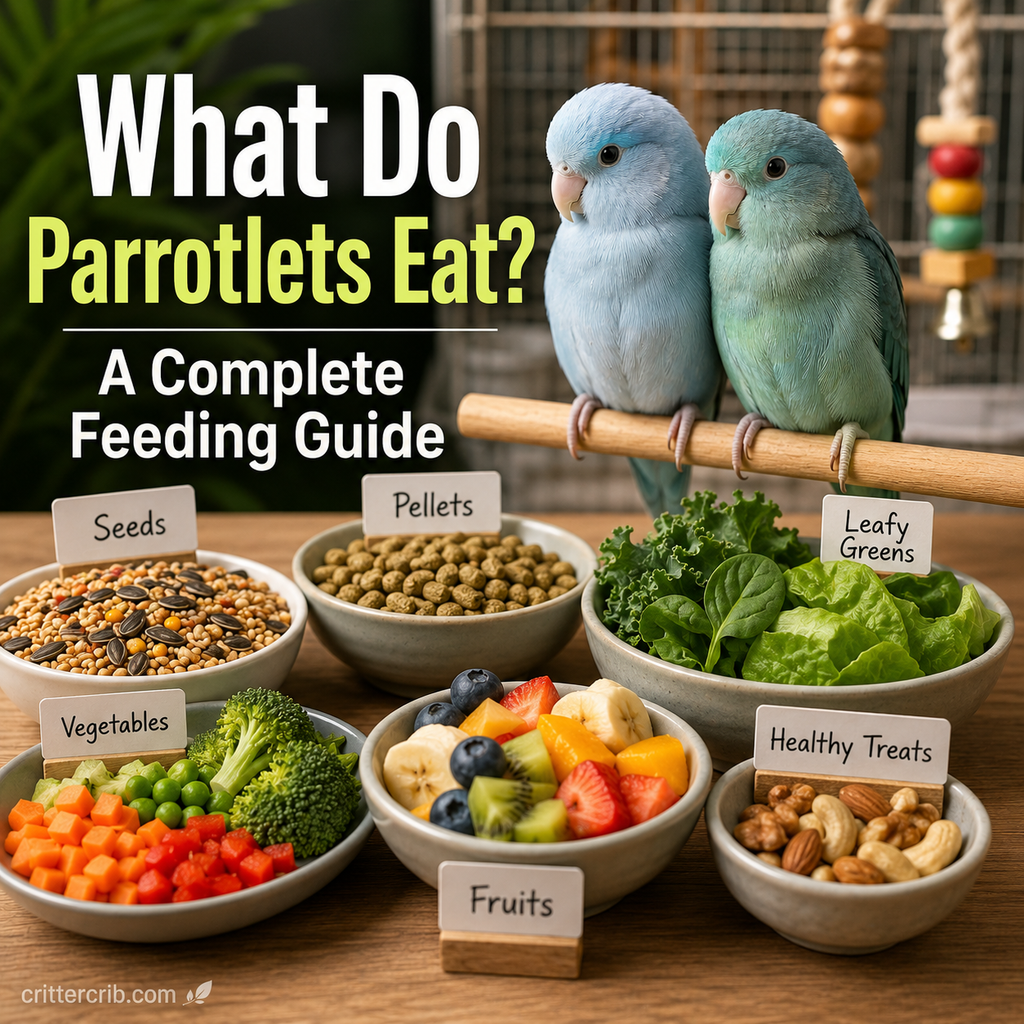
Parrotlets may be tiny, but feeding them properly involves more than filling a bowl with birdseed.
Like other parrots, parrotlets benefit from a varied, nutritionally balanced diet. Seeds can certainly have a place in that diet, but relying entirely on a traditional seed mix can leave nutritional gaps—especially when a bird picks out its favorite seeds and ignores everything else.
A healthy feeding routine generally centers around a quality formulated food, along with appropriate vegetables and leafy greens. Fruit, seeds, and other treats can add variety in more moderate amounts.
The exact diet can vary with your bird’s age, health, activity level, and veterinary recommendations, so an avian veterinarian is the best person to help you fine-tune your individual parrotlet’s nutrition.
For everyday planning, though, there are some useful guidelines.
Here’s what parrotlets can eat, what foods should be limited, what to avoid entirely, and how to build a practical feeding routine.
What Should a Parrotlet Eat Every Day?
A parrotlet’s daily diet should provide balanced nutrition without relying too heavily on high-fat favorites.
For many healthy adult pet parrotlets, a feeding plan may include:
- A quality formulated pellet as a dietary foundation
- Fresh bird-safe vegetables
- Leafy greens
- Small amounts of appropriate fruit
- Seeds in controlled portions
- Occasional healthy treats
- Fresh, clean drinking water
There’s no single percentage breakdown that’s perfect for every bird.
Pellet manufacturers, veterinarians, and avian nutrition resources may give somewhat different recommendations.
Rather than obsessing over an exact percentage, focus on dietary balance and discuss your bird’s individual needs with an avian veterinarian.
Pellets for Parrotlets
A quality formulated pellet can provide a more nutritionally consistent foundation than a bowl of mixed seeds.
Pellets are designed so that each piece contains a similar nutritional profile.
That’s important because birds are selective eaters.
With a seed mix, your parrotlet can potentially eat its favorite ingredients while leaving the rest behind. A bowl that appears varied doesn’t necessarily produce a varied diet.
Choosing Parrotlet Pellets
Look for a reputable formulated food designed for small parrots.
The pellet size should be comfortable for a tiny bird to eat.
When comparing foods, consider:
- Appropriate bird size
- Nutritional formulation
- Manufacturer feeding guidance
- Storage instructions
- Your veterinarian’s recommendations
Don’t choose food based only on packaging or bright colors.
Nutrition matters more than appearance.
How Much Pellet Food Should You Give a Parrotlet?
Parrotlets eat surprisingly small quantities.
The exact amount depends on factors such as:
- Body size
- Activity level
- Age
- Metabolism
- Other foods offered
- Health
- Individual appetite
Follow the manufacturer’s starting recommendations and adjust with guidance from your avian veterinarian.
Monitor what your bird actually consumes rather than endlessly refilling a bowl.
You don’t want to severely restrict food, but you also don’t need to keep an overflowing dish filled with stale leftovers.
Can Parrotlets Eat Vegetables?
Yes. Appropriate vegetables can be an important part of a varied parrotlet diet.
They provide different nutrients, flavors, colors, and textures while also creating opportunities for exploration and foraging.
Good options may include:
- Broccoli
- Carrots
- Bell peppers
- Leafy greens
- Peas
- Green beans
- Squash
- Zucchini
- Sweet potato
- Pumpkin
Introduce unfamiliar foods gradually.
A parrotlet that has eaten seed for years may stare at broccoli as though you’ve placed an alien object in its cage.
That doesn’t mean it will never eat vegetables.
It may simply need repeated exposure.
Best Leafy Greens for Parrotlets
Leafy greens are an easy way to add variety.
Appropriate choices can include:
- Kale
- Romaine lettuce
- Collard greens
- Mustard greens
- Dandelion greens from a safe source
- Bok choy
Rotate what you offer rather than relying on the same green every day.
Wash produce thoroughly before serving it.
Avoid greens exposed to pesticides, roadside contamination, or other substances that may be harmful to your bird.
Can Parrotlets Eat Carrots?
Yes.
Carrots can be offered raw or appropriately cooked without added salt, butter, seasoning, or oil.
Because parrotlets are so small, finely chopping or shredding carrot can make it easier to investigate.
You can experiment with presentation.
One bird may enjoy tiny chopped pieces while another prefers pulling at a larger securely attached piece.
Can Parrotlets Eat Broccoli?
Broccoli is another useful option.
Both the florets and suitable portions of the stalk can provide interesting textures.
Wash it thoroughly and offer an appropriately sized amount.
Broccoli can also double as enrichment because birds may spend time picking apart the florets.
Can Parrotlets Eat Bell Peppers?
Bell peppers can be offered as part of a varied diet.
Different colors provide visual variety, and many parrots enjoy tearing into the flesh.
Wash peppers before serving.
You can chop them into small pieces or experiment with larger manageable sections depending on your bird’s preferences.
Can Parrotlets Eat Sweet Potato?
Properly cooked plain sweet potato can be offered to parrotlets.
Serve it without:
- Butter
- Salt
- Sugar
- Syrup
- Seasoning
Allow cooked foods to cool completely before offering them.
Remove leftovers before they spoil.
Can Parrotlets Eat Fruit?
Yes, but fruit is generally best offered in smaller amounts than vegetables because many fruits contain considerable natural sugar.
Fruit can be a useful source of variety and may work particularly well as a training reward.
Bird-safe options can include:
- Berries
- Banana
- Mango
- Melon
- Papaya
- Pear
- Apple flesh with seeds removed
- Orange in modest amounts
- Kiwi
Keep portions tiny.
Remember, a piece that looks small to you may be a substantial serving for a bird weighing only a few dozen grams.
Can Parrotlets Eat Apples?
The flesh of an apple can be offered in small amounts.
Wash the apple and remove the seeds and core before serving.
Apple seeds should not be intentionally fed to birds because they contain compounds that can release cyanide.
A tiny piece of seed-free apple is plenty for a parrotlet.
Can Parrotlets Eat Bananas?
Yes.
Banana can be offered occasionally in a small portion.
It’s soft, sweet, and easy for a small parrot to eat.
Because fruit shouldn’t dominate the diet, don’t let a bird’s enthusiasm for banana replace more nutritionally useful everyday foods.
Can Parrotlets Eat Berries?
Appropriate berries can make good occasional foods.
Examples include:
- Blueberries
- Strawberries
- Raspberries
- Blackberries
Wash them thoroughly.
Be prepared for a mess.
A parrotlet eating a berry can somehow distribute juice much farther than you’d expect from such a tiny bird.
Can Parrotlets Eat Seeds?
Yes.
Seeds aren’t inherently bad.
The problem is feeding an all-seed diet.
Many seeds are calorie-dense and high in fat, and parrotlets may strongly prefer them over other foods.
Seeds can be useful as:
- Controlled portions of the diet
- Training rewards
- Foraging incentives
- Occasional treats
The amount should reflect the rest of your bird’s diet and individual needs.
Sunflower Seeds and Parrotlets
Many parrots love sunflower seeds.
That enthusiasm is exactly why they’re useful as occasional rewards rather than unlimited everyday food.
If your parrotlet is especially motivated by sunflower seeds, small pieces can be valuable during training.
You get a powerful reward without letting one high-fat favorite dominate the diet.
Can Parrotlets Eat Millet?
Millet can be offered in moderation.
Spray millet is particularly attractive to many small parrots and can be useful during:
- Training
- Trust building
- Foraging
- Introducing a new environment
Because birds may enthusiastically overeat favorite seeds, treat millet as one component of the diet rather than an unlimited staple.
Should Parrotlets Eat Nuts?
Bird-safe unsalted nuts can sometimes be offered in very small quantities.
Examples might include:
- Almond
- Walnut
- Pecan
Nuts are calorie-dense and high in fat.
For a tiny parrotlet, a very small piece can already be a substantial treat.
Never offer salted, seasoned, chocolate-covered, candied, or otherwise flavored nuts.
How Much Fruit and Treat Food Is Too Much?
One of the easiest feeding mistakes is forgetting how small a parrotlet actually is.
A grape, for example, may look like a tiny snack to a person.
Relative to a parrotlet, it’s enormous.
Use small portions and prioritize nutritionally useful foods.
Treats should remain treats.
If your bird fills up on fruit, seeds, and nuts, it may eat less of the balanced foods you actually want it consuming.
How to Introduce Vegetables to a Parrotlet
Don’t give up because your bird ignored kale twice.
Parrots can take time to recognize unfamiliar foods.
Try different approaches.
1. Offer Small Portions
A huge pile of unfamiliar vegetables may be intimidating.
Start small.
2. Experiment With Texture
Try foods:
- Finely chopped
- Shredded
- In small chunks
- In larger pieces suitable for tearing
Your bird may dislike one presentation but enjoy another.
3. Offer Vegetables When Your Bird Is Active
Morning can be a useful time to introduce fresh foods because many birds are ready to eat after waking.
Don’t withhold the bird’s regular food in an attempt to force it to eat vegetables.
4. Use a Separate Dish
A dedicated fresh-food bowl can make cleanup easier and keep moist vegetables from contaminating dry pellets.
5. Keep Trying
Some birds need many exposures before tasting something unfamiliar.
Consistency matters.
Chop vs. Whole Pieces
There isn’t one correct way to serve vegetables.
Finely chopped foods allow you to combine several ingredients into a small mixture.
Larger pieces encourage chewing and manipulation.
You can use both.
For example, offer a small vegetable chop some mornings and securely attach a piece of leafy green to the cage on another day.
Food can be nutrition and enrichment at the same time.
What Is Bird Chop?
“Chop” is a common term for a mixture of finely chopped bird-safe vegetables, greens, and sometimes other appropriate ingredients.
It can make offering variety convenient.
A simple chop might include several vegetables such as:
- Broccoli
- Carrot
- Bell pepper
- Leafy greens
Keep recipes straightforward and use only ingredients you’ve confirmed are safe for your bird.
Because chop contains fresh food, proper refrigeration, freezing, thawing, and disposal are important.
Don’t leave moist food sitting in the cage all day.
Can Parrotlets Eat Cooked Food?
Some plain cooked foods can be included as part of an appropriate diet.
Depending on your veterinarian’s recommendations, examples may include properly prepared:
- Sweet potato
- Squash
- Quinoa
- Brown rice
- Certain legumes
Cook foods thoroughly when required and serve them plain.
Avoid adding:
- Salt
- Butter
- Oil
- Sauces
- Sugar
- Seasoning
Let cooked food cool before it reaches the cage.
What Foods Should Parrotlets Never Eat?
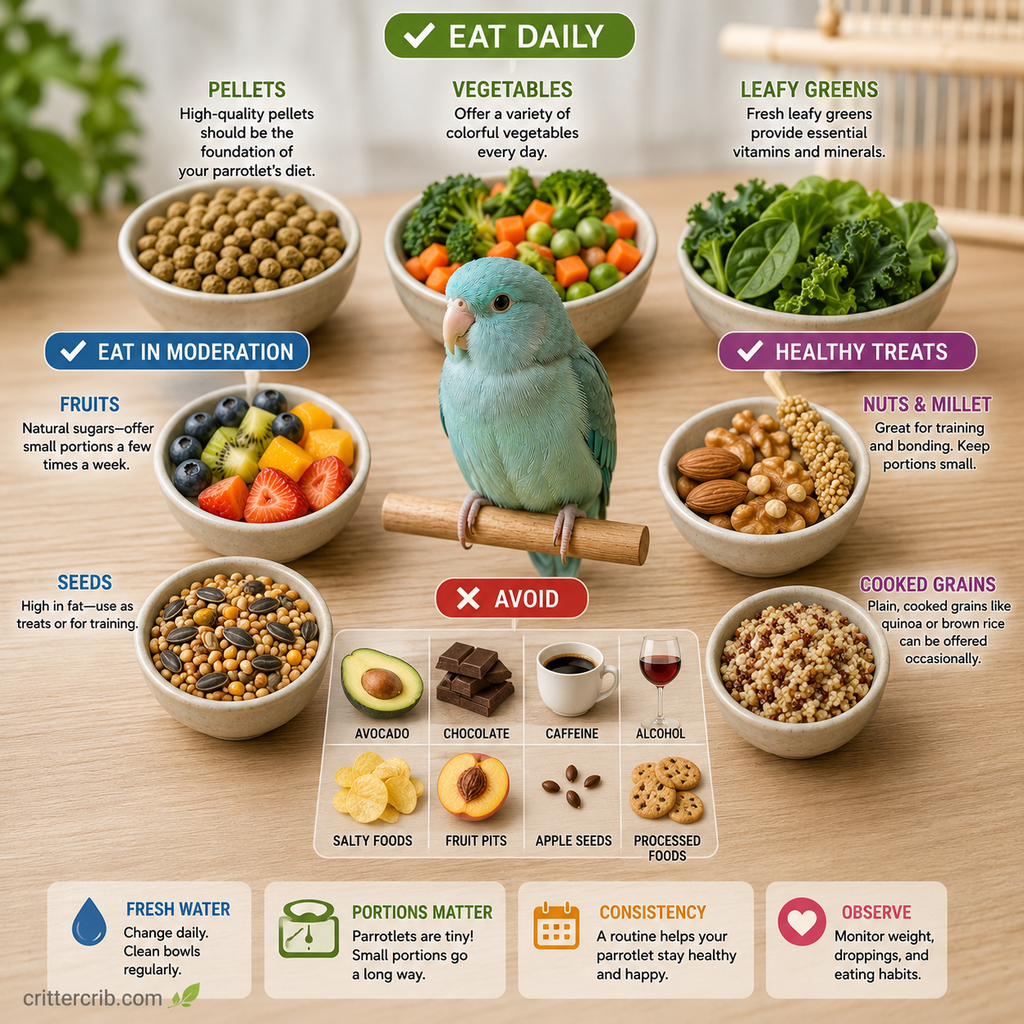
Some foods are inappropriate or potentially dangerous for birds.
Avoid feeding your parrotlet:
- Avocado
- Chocolate
- Alcohol
- Caffeinated drinks
- Apple seeds
- Fruit pits
- Highly salty foods
- Heavily processed foods
- Foods containing unsafe artificial sweeteners
- Moldy or spoiled food
This isn’t necessarily a complete list of every food that could be unsafe.
When you’re uncertain about an ingredient, check before feeding it.
Why Avocado Is Dangerous for Birds
Avocado contains persin, which can be toxic to birds.
Don’t intentionally offer avocado flesh, skin, pit, or foods containing avocado.
Because birds are small, it’s not worth experimenting with potentially unsafe amounts.
Why Chocolate and Caffeine Are Unsafe
Chocolate contains compounds that can be toxic to birds.
Caffeinated drinks such as coffee, energy drinks, and caffeinated tea should also be kept away from parrotlets.
Don’t allow your bird to casually sip from your cup just because it seems interested.
Provide fresh water instead.
Be Careful With Salt
Parrotlets are tiny.
Foods that don’t taste particularly salty to us can contain far more sodium than is appropriate for a small bird.
Avoid routinely sharing foods such as:
- Chips
- Pretzels
- Processed snacks
- Salty crackers
- Heavily seasoned meals
Your bird doesn’t need human snack food.
Avoid Highly Processed Human Food
A parrotlet may desperately want a bite of pizza.
That doesn’t make pizza parrot food.
Processed human foods often contain combinations of:
- Salt
- Fat
- Sugar
- Dairy
- Sauces
- Seasonings
- Preservatives
Keep your bird’s treats simple and bird-appropriate.
Can Parrotlets Eat Eggs?
Some bird owners occasionally offer small amounts of plain cooked egg.
Whether this makes sense for your individual bird depends on the overall diet and veterinary guidance.
If offered, egg should be thoroughly cooked and served plain without salt, butter, oil, or seasoning.
Remove leftovers promptly.
Your parrotlet doesn’t need egg every day to receive adequate protein if it’s already eating an appropriately formulated diet.
Fresh Water Is Part of a Healthy Diet
Nutrition isn’t just food.
Your parrotlet should always have access to fresh, clean drinking water.
Change the water at least daily and whenever it becomes contaminated.
Birds frequently drop:
- Food
- Pellet crumbs
- Seed hulls
- Feathers
- Toy debris
into their water.
Wash the dish rather than simply topping it off.
Should You Add Vitamins to a Parrotlet’s Water?
Don’t automatically add vitamin supplements to drinking water.
Supplements aren’t necessarily harmless, and they can affect water taste or create problems when used unnecessarily.
A bird eating a balanced formulated diet may already receive substantial amounts of added vitamins and minerals.
Use supplements only when appropriate based on veterinary guidance.
Do Parrotlets Need Cuttlebone or Mineral Blocks?
Calcium and mineral requirements depend on the overall diet and individual bird.
Cuttlebones and mineral products are commonly sold for pet birds, but supplementation shouldn’t replace a balanced diet.
Female birds that lay eggs can have particular nutritional concerns.
If you’re worried about calcium intake or egg production, consult an avian veterinarian rather than guessing at supplementation.
How Often Should You Feed a Parrotlet?
Many owners provide access to an appropriate amount of staple food throughout the day while offering fresh foods at particular times.
A simple routine might be:
Morning
- Refresh drinking water
- Check or replace staple food
- Offer fresh vegetables or greens
During the Day
- Monitor what was actually eaten
- Use tiny appropriate treats for training
- Check water for contamination
Later in the Day
- Remove spoiled fresh foods
- Clean dishes as necessary
- Make sure appropriate staple food remains available according to your feeding plan
Consistency makes it easier to notice changes in appetite.
How Long Can Fresh Food Stay in the Cage?
Fresh and moist foods spoil more quickly than dry foods.
Exactly how long they’re safe depends on the food and room temperature.
Rather than leaving vegetables, cooked foods, or chop in the cage all day, remove leftovers after a reasonable feeding period.
Be especially cautious in warm conditions.
When food looks dried out, contaminated, or questionable, throw it away.
Clean Food Bowls Matter
Food residue can build up quickly.
Wash dishes regularly with bird-safe methods and rinse them thoroughly.
Don’t continually pour fresh food over old crumbs.
Check bowls for damage as well.
Stainless steel dishes are popular because they’re durable and relatively easy to clean.
Don’t Judge the Bowl by How Full It Looks
This is especially important when feeding seeds.
Empty seed hulls can remain in the bowl and make it appear full.
A bird may have eaten far more than you realize.
Check the actual contents rather than simply looking at the surface.
How to Transition a Parrotlet From Seeds to Pellets
If your parrotlet currently eats an all-seed diet, don’t simply remove the seeds and replace them with unfamiliar pellets.
A stubborn bird may refuse to eat the new food.
Because small birds have limited energy reserves, inadequate food intake can become dangerous.
A gradual transition is safer.
A Basic Transition Approach
- Establish your bird’s normal weight with an accurate gram scale.
- Introduce the new food while familiar food remains available.
- Experiment with different pellet sizes or presentations.
- Observe whether the bird actually eats the pellets.
- Monitor body weight and droppings.
- Gradually adjust the diet based on progress.
- Contact an avian veterinarian if you’re unsure whether your bird is eating enough.
Never assume the transition worked because pellets disappeared from the bowl.
Your bird may have thrown them onto the floor.
Why Weighing Your Parrotlet Is Useful
Parrotlets are so small that even modest weight changes can matter.
An accurate gram scale gives you information that visual inspection can’t.
Weigh your bird under similar conditions and keep a simple record.
This can be particularly helpful during:
- Diet changes
- Illness
- Recovery
- Changes in appetite
Ask your avian veterinarian what weight range is appropriate for your individual bird rather than relying solely on generic numbers online.
Using Food for Training
Food rewards can make training much easier.
The trick is finding something your parrotlet values and offering tiny portions.
Possible rewards include a small piece of:
- Millet
- Sunflower seed
- Nut
- Favorite fruit
- Another safe preferred food
Break rewards into very small pieces.
The bird cares about receiving the reward more than receiving a giant portion.
This lets you perform multiple training repetitions without feeding excessive treats.
Use Food for Foraging
Feeding can also provide mental stimulation.
Once your bird understands basic foraging, you can hide small amounts of appropriate food in safe, easy-to-access locations.
Foraging encourages your parrotlet to:
- Explore
- Climb
- Manipulate objects
- Search
- Problem-solve
Start easy.
A bird shouldn’t have to solve a complicated puzzle to access its entire daily diet.
Common Parrotlet Feeding Mistakes
Even well-meaning owners can develop feeding habits that aren’t ideal.
Watch for these common mistakes:
- Feeding only seeds
- Offering unlimited high-fat treats
- Providing too much fruit
- Assuming vegetables will be accepted immediately
- Changing diets abruptly
- Not monitoring actual food intake
- Leaving fresh food out too long
- Feeding heavily processed human foods
- Adding unnecessary supplements
- Allowing drinking water to become dirty
- Using food bowls that aren’t cleaned regularly
- Giving human-sized portions to a tiny bird
- Ignoring unexplained appetite or weight changes
Small improvements can make a big difference over the bird’s lifetime.
Signs Your Parrotlet May Not Be Eating Normally
Get to know your bird’s normal appetite.
A meaningful change can be important.
Pay attention if your parrotlet:
- Suddenly stops eating
- Eats dramatically less
- Drops food repeatedly
- Appears unable to manipulate food
- Loses weight
- Becomes unusually sleepy
- Sits fluffed for prolonged periods
- Shows significant changes in droppings
- Vomits
- Becomes weak
Don’t assume appetite loss is simply pickiness.
Birds can hide illness, and a small parrot can deteriorate quickly.
Contact an avian veterinarian if you’re concerned.
Sample Daily Parrotlet Feeding Routine
A simple feeding routine for a healthy adult bird might look like this:
Breakfast
Provide fresh water, an appropriate amount of formulated food, and a small serving of vegetables or leafy greens.
Midday
Check water and food.
Remove anything contaminated and offer a tiny reward during training or a simple foraging activity.
Afternoon
Your bird continues eating its staple diet as appropriate.
You might offer a small piece of fruit occasionally rather than every day.
Evening
Remove remaining fresh or moist foods before they spoil.
Clean dirty dishes and check that your bird has eaten normally.
This is only an example.
Your veterinarian may recommend a different routine based on your bird’s health and diet.
Parrotlet Food Checklist
A balanced feeding plan can include:
Regular Foods
- Quality formulated pellets
- Bird-safe vegetables
- Leafy greens
- Fresh water
Foods to Offer More Moderately
- Fruit
- Seeds
- Millet
- Nuts
- Other treats
Foods to Avoid
- Avocado
- Chocolate
- Alcohol
- Caffeine
- Fruit pits
- Apple seeds
- Very salty foods
- Heavily processed foods
- Moldy or spoiled food
When in doubt, verify before feeding.
Frequently Asked Questions About Feeding Parrotlets
What Is the Best Food for Parrotlets?
A quality formulated food can serve as the nutritional foundation of a parrotlet’s diet, supplemented with appropriate vegetables and other bird-safe foods.
Your avian veterinarian can recommend a feeding plan based on your bird’s individual needs.
Can Parrotlets Live on Seeds?
An all-seed diet is generally not considered nutritionally balanced for pet parrotlets.
Seeds can still be included in controlled amounts.
How Often Should Parrotlets Eat Vegetables?
Appropriate vegetables and leafy greens can be offered regularly as part of a varied diet.
Rotate different bird-safe choices to provide nutritional and environmental variety.
Can Parrotlets Eat Fruit Every Day?
Small amounts of bird-safe fruit can be included, but vegetables are generally a better everyday focus because fruit contains more natural sugar.
Keep portions small.
What Is a Parrotlet’s Favorite Food?
Individual preferences vary.
Many parrotlets strongly prefer seeds, millet, nuts, or fruit, but favorite doesn’t necessarily mean healthiest.
Use highly preferred foods strategically as treats or training rewards.
Can Parrotlets Eat Human Food?
Some plain foods people eat are also safe for parrots, such as certain vegetables and properly prepared grains.
Many processed human foods aren’t appropriate because they contain salt, fat, sugar, sauces, or unsafe ingredients.
Can Parrotlets Eat Rice?
Plain, properly cooked rice can be offered in small amounts as part of an appropriate varied diet.
Don’t add salt, butter, oil, or seasoning.
Can Parrotlets Eat Bread?
A tiny amount of plain bread isn’t necessarily the most dangerous food in the kitchen, but bread offers relatively little nutritional value compared with vegetables and a balanced formulated diet.
It doesn’t need to be a regular part of your parrotlet’s menu.
How Do I Know if My Parrotlet Is Eating Enough?
Monitor actual food consumption, droppings, activity, and body weight.
An accurate gram scale is particularly useful.
If your bird suddenly eats less or loses weight, contact an avian veterinarian.
Final Thoughts
Feeding a parrotlet well isn’t about finding one perfect food.
It’s about balance.
A quality formulated diet can provide a reliable nutritional foundation, while vegetables and leafy greens add variety, texture, and valuable nutrients. Fruit, seeds, millet, nuts, and other treats can still have a place—they simply shouldn’t take over the menu.
Portion size matters too.
A parrotlet is tiny, so a snack that looks insignificant to you may represent a substantial amount of food to your bird.
Introduce new foods patiently. Experiment with different textures and presentations. Keep dishes clean, provide fresh water every day, and remove moist foods before they spoil.
Most importantly, pay attention to what your bird actually eats.
A beautifully balanced bowl doesn’t help if your parrotlet throws the healthy food onto the cage floor and eats nothing but sunflower seeds.
Monitor appetite and weight, especially when making dietary changes, and work with an avian veterinarian when you need to adjust your bird’s nutrition.
A healthy parrotlet diet doesn’t have to be complicated. Keep it balanced, varied, fresh, and appropriate for a very small parrot with a surprisingly strong opinion about what’s for dinner.